How to start a bamboo clothing business from scratch
See article summary
- Startup costs run $7,000 to $25,000, with initial inventory as the largest line item.
- Form an LLC, get a free EIN from the IRS, and register a Seller's Permit.
- Most "bamboo" fabric is rayon; the FTC requires you to label it as "rayon made from bamboo."
- Vet suppliers on certifications, MOQ, sample lead time, communication, and defect rate.
- Use Shopify or Stripe online at 2.9% plus 30 cents; use JIM in person at 1.99%.
Starting a bamboo clothing business lets you turn demand for soft, sustainable apparel into a real brand. Eco-friendly fiber is no longer a niche side note: it shows up in babywear, activewear, underwear, and everyday basics, and shoppers actively search for it. The opportunity is real, but so is the compliance work, because most "bamboo" fabric is actually rayon, and the Federal Trade Commission (FTC) has specific rules about how you can label and market it.
Below you will find startup budget ranges, LLC and licensing steps, supplier vetting, FTC labeling compliance, and payment setup so you can launch a bamboo apparel brand in the U.S. without the common first-year mistakes.
How much does it cost to start a bamboo clothing business?
Startup costs for a small-scale bamboo clothing launch run from $7,000 to $25,000, with inventory as the largest single line item. A first order of 200 to 500 units typically costs $5,000 to $15,000, so plan this number carefully before you commit to a supplier.
Other expenses add up fast. Here is an itemized breakdown for a typical small launch:
| Expense category | Typical range |
|---|---|
| Initial inventory (200 to 500 units) | $5,000 to $15,000 |
| Business formation (LLC, licenses, permits) | $300 to $800 |
| Shopify website build | $1,000 to $5,000 |
| Initial marketing | $1,000 to $3,000 |
| Shipping equipment and supplies | $200 to $400 |
These figures give you a defensible baseline for your business plan and any funding request. Define a specific niche before you spend, because a focused catalog keeps your first inventory order smaller and your margins higher.
Pick a niche and analyze the competition
Narrow your focus to one sub-niche, such as bamboo babywear, plus-size bamboo basics, or patterned bamboo sleepwear. Use Google Trends to compare search volumes for terms like "bamboo baby clothes" versus "bamboo activewear," then browse Etsy and Amazon to spot underserved product categories where demand outpaces supply.
Identify your top 3 to 5 competitors and analyze their online presence with a platform like Ahrefs or Semrush. The trap to avoid is launching a generic product line that competes on price alone. Find a unique angle your competitors miss, such as extended sizing or a specific fabric blend, and build your first collection around it.
Define your legal terms early
Before you order inventory, get clear on a few terms that drive your costs and compliance. Minimum Order Quantity, or MOQ, is the fewest units a supplier will produce per style, and it directly sets your inventory spend. Landed cost is the total expense to get one unit into your inventory, including manufacturing, shipping, and import duties, and it is the number you need for pricing. Keystone pricing means doubling your landed cost for a 100% markup, which targets a 50% gross profit margin.
Here are 3 immediate steps to take:
- Define a target niche based on Google Trends and marketplace research.
- Use a tool like Ahrefs to list three direct competitors and their top products.
- Create a preliminary budget using the itemized breakdown above.
Do you need an LLC for a bamboo clothing brand?
Most new clothing brands choose a Limited Liability Company, or LLC, because it protects your personal assets if the business faces debt or lawsuits and offers pass-through taxation, which simplifies annual tax filings. LLC filing fees vary by state and typically range from about $50 to $500, though some states charge more. You can confirm the exact fee and file the paperwork through your state's Secretary of State website. The U.S. Small Business Administration (SBA) also publishes a state-by-state business registration guide that lists each state's filing requirements.
Operating as a sole proprietor leaves your personal finances exposed, which is a risk you do not need to take. File the LLC paperwork yourself through your state's Secretary of State website to establish that protection early on.
Secure federal, state, and local licenses
Once your LLC is formed, get a free Employer Identification Number, or EIN from the IRS. You need this number to open a business bank account, and the IRS processes the application instantly online. Think of it as a Social Security number for your business.
Apply for a state Seller's Permit, also known as a Resale Certificate, through your state's tax agency. This document lets you buy wholesale inventory without paying sales tax, and processing usually takes 1 to 2 weeks. Check with your city or county clerk for any general business license you need to operate locally.
Follow FTC textile labeling rules
Pay close attention to the FTC rules for textile labeling. Your labels must accurately state fiber content and country of origin, and the FTC enforces these requirements under the Textile Fiber Products Identification Act. The agency publishes a full guide to labeling requirements under the Textile and Wool Acts that covers exactly what your labels need to say.
For bamboo clothing specifically, the labeling rule is stricter than many new founders expect. Most fabric sold as "bamboo" is actually rayon made from bamboo cellulose, and the FTC requires you to label and advertise it as "rayon" or "rayon made from bamboo," not simply "bamboo." The agency has brought multiple enforcement actions against major retailers for labeling rayon textiles as bamboo, including settlements totaling $1.26 million in 2013 and penalties of $1.3 million in 2015. The FTC's How to Avoid Bamboozling Your Customers guide explains the correct wording in detail. Getting this wrong invites fines and product seizures, so build compliant labels into your production timeline from the start.
Here are 4 immediate steps to take:
- File for an LLC through your state's Secretary of State website.
- Apply for a free EIN on the IRS website.
- Register for a Seller's Permit through your state's tax agency.
- Confirm local business license requirements with your city or county.
What insurance does a bamboo clothing brand need?
For an online bamboo clothing brand, General Liability and Product Liability insurance are the core policies. They protect you from customer claims related to property damage or personal injury, such as an allergic reaction to a fabric finish. A combined policy with $1 million in coverage typically costs between $400 and $1,500 annually. Some new owners skip product liability to save money, but a single customer lawsuit can bankrupt a new business, so this coverage belongs in place before your first sale.
If you store inventory in a warehouse or office, add Commercial Property insurance. Providers like The Hartford, Hiscox, and Next Insurance specialize in e-commerce businesses and understand the specific risks of online retail, so compare quotes from at least three of them.
Here are 3 immediate steps to take:
- Request quotes for a $1 million product liability policy.
- Confirm that your policy explicitly covers online retail operations.
- Compare rates from at least three insurance providers that specialize in e-commerce.
How do you find bamboo fabric suppliers?
Most bamboo apparel fabric comes from China's Zhejiang and Jiangsu provinces, where the bulk of bamboo viscose and lyocell milling is concentrated. Platforms like Alibaba are a good starting point to find overseas manufacturers, and you can narrow results with specific search terms like "bamboo viscose clothing" or "bamboo baby apparel." Shortlist 5 to 10 potential suppliers based on their reviews and product catalogs.
Two fabric types dominate this niche, and the difference matters for your labeling and pricing. Bamboo viscose, also called bamboo rayon, is the most common and affordable option, produced by chemically processing bamboo cellulose into a soft fiber. Bamboo lyocell uses a closed-loop process that recycles most of the solvent, which makes it a more sustainable but more expensive alternative. The FTC labeling rule applies to both, so either way your label says "rayon made from bamboo" or "lyocell."
Vet suppliers with a 5-point scorecard
Expect Minimum Order Quantities, or MOQs, of 50 to 200 units per style. Before you place a bulk order, always request samples and grade each supplier on five criteria: certifications, MOQ flexibility, sample lead time, communication responsiveness, and defect rate on the sample. A sample order might cost $50 to $150 per style, but it prevents thousands of dollars in quality surprises later.
Set up your inventory and shipping station
For your initial inventory, a spare room or a 5x5 foot storage unit is often enough, and you do not need a commercial warehouse at this stage. Keep the space clean, dry, and free from pests to protect your products before they ship to customers.
You will need some basic shipping equipment. A thermal label printer like a Rollo or MUNBYN costs around $150 to $250. Add a digital shipping scale ($20 to $40) and a supply of poly mailers. This setup prepares you for efficient order fulfillment from day one.
Here are 4 immediate steps to take:
- Shortlist 5 to 10 potential suppliers on Alibaba.
- Request and pay for samples from your top 2 to 3 choices.
- Grade each sampled supplier on the 5-point scorecard.
- Designate a clean, dry space for inventory storage and buy a thermal label printer plus a digital shipping scale.
How do you set up payments for online and in-person sales?
For your online store, activating Shopify Payments or Stripe is the most direct route. Shopify lists its online card rate at 2.9% plus 30 cents per transaction on its Basic plan, and Stripe charges the same 2.9% plus 30 cents for online card charges. This setup handles all your website orders automatically.
Many bamboo clothing brands also sell at local markets or pop-up events, and for in-person sales you need a way to accept card payments on the spot. A credit card reader for small business use case is common here, and there are several ways to approach it depending on your volume and whether you want hardware.
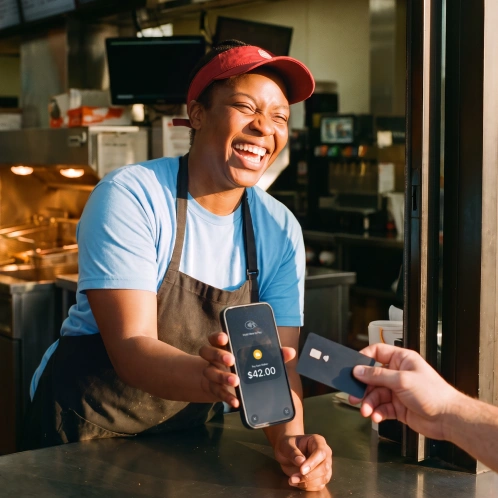
For bamboo clothing businesses that need to accept payments on-site or on-the-go, JIM offers a streamlined solution. With JIM, you can accept debit, credit, and digital wallets directly through your smartphone, with no extra hardware.
At 1.99% per transaction with no hidden costs or extra hardware needed, it is useful for selling at craft fairs or pop-up shops. This rate is lower than the 2.9% plus 30 cents most online processors charge for card sales.
- Get Started: Download JIM app for iOS.
- Make a Sale: Type the sales amount, hit sell, and ask your customer to tap their card or device on your phone.
- Access Funds: Your money is available right on your JIM card as soon as the sale is done, with no waiting for bank transfers.
Here are 3 immediate steps to take:
- Activate Shopify Payments or Stripe for your online storefront.
- Download the JIM app to prepare for in-person sales opportunities.
- Compare the transaction fees of your online processor with JIM's 1.99% rate.
How do you fund a bamboo clothing business?
With your business plan ready, you can pursue funding. The SBA Microloan program provides loans up to $50,000 through nonprofit intermediary lenders, and it is designed for new small businesses. The SBA sets a maximum interest rate cap rather than a fixed rate: for loans over $10,000, the rate cannot exceed the rate the SBA charges the intermediary plus 7.75%, and for loans of $10,000 or less, the cap is the SBA rate plus 8.5%. In practice, borrowers often see effective rates between 8% and 13%. Lenders typically look for a credit score above 600 and a solid business plan, and a complete guide to starting a business from scratch can help you assemble the forecasts lenders expect.
Online lenders like Accion Opportunity Fund also cater to e-commerce startups. Their requirements can be more flexible than traditional banks, but they will still want to see clear revenue projections, so have your financial forecasts prepared before you apply.
Look into small business grants
Grants provide funds you do not have to repay. Programs like the Amber Grant for Women or the FedEx Small Business Grant Contest are popular options. They are competitive, but winning a grant gives your budget a meaningful boost without adding debt.
For your first six months, plan on $10,000 to $20,000 in working capital. Underestimating this runway is one of the costliest errors new founders make, because the capital has to cover ongoing marketing, unexpected fees, and inventory reorders before your sales stabilize.
Here are 3 immediate steps to take:
- Research SBA Microloan lenders in your state and review their requirements.
- Create a 6-month operating budget that includes at least $1,000 per month for marketing.
- Identify two business grants and add their application deadlines to your calendar.
When should you hire your first team member?
In the beginning, you are the entire team. You will handle everything from marketing to packing orders, which keeps your overhead low and lets you understand every part of your business intimately. Resist the urge to hire full-time staff right away.
Your first hire should solve your biggest bottleneck. This is often a part-time E-commerce Assistant who can manage customer service emails and process orders. Expect to pay between $18 and $25 per hour for this role, and wait until you hit $10,000 in monthly revenue before you make the hire.
Another smart early hire is a freelance Social Media Manager. For a monthly retainer of $500 to $1,500, a freelancer can create content and engage with your community, which frees you to focus on product development and strategy. Use platforms like Upwork to find experienced candidates.
Tools for daily operations
To keep your small team organized, use a project management platform like Asana or Trello to track inventory orders, marketing campaigns, and daily tasks. For team communication, Slack is the standard and keeps conversations organized by topic rather than buried in email.
Here are 4 immediate steps to take:
- Set a monthly revenue goal that will trigger your first hire.
- Draft a job description for a part-time E-commerce Assistant.
- Research freelance social media managers on Upwork.
- Create a free Asana account to start organizing your business tasks.
How do you market a bamboo clothing brand?
Focus your initial efforts on visual platforms like Instagram and TikTok. Your customers want to see the softness and drape of the fabric, so post high-quality lifestyle photos and short videos 3 to 5 times per week to build momentum before you launch.
Set up a pop-up form on your website from day one, because many new owners delay building an email list and lose their cheapest marketing channel. Offer a 10% discount in exchange for an email address, and this list becomes a direct line to your most interested customers.
Use targeted outreach and ads
Collaborate with micro-influencers who have 10,000 to 50,000 followers, since their audiences are often more engaged. You can start by offering free products for a post or pay a flat fee, which typically ranges from $100 to $300.
Once you have consistent organic sales, you can test Meta ads. A healthy online conversion rate falls in the 1% to 2% range, and a Customer Acquisition Cost under $40 is a reasonable target for a new apparel brand. These are general e-commerce benchmarks rather than bamboo-specific figures, so track your actual numbers in your Shopify dashboard and adjust from there.
Here are 4 immediate steps to take:
- Create a content plan for your first month on Instagram.
- Set up a 10% discount email capture form on your website.
- List 10 micro-influencers who align with your brand values.
- Calculate your target Customer Acquisition Cost for paid ads.
How do you price bamboo clothing?
Determine your landed cost per item first. This is the total expense to get one unit into your inventory, including manufacturing, shipping, and import duties. Many new owners only consider the factory price, which leads to underpricing and thin margins.
A solid starting point for apparel is keystone pricing, which is a 100% markup or double your landed cost. If a bamboo baby sleeper costs you $12 landed, you would price it at $24, which targets a 50% gross profit margin before other business expenses.
For unique or premium designs, you might use a 2.5x or 3x markup. Look at your top competitors, but do not just copy their prices. See where your product offers more value and adjust your price to reflect that quality and design. Account for operational costs like marketing, payment processing fees, and packaging, because these expenses must be covered by your retail price to keep the business profitable.
Here are 4 immediate steps to take:
- Calculate the full landed cost for one of your main products.
- Research the retail prices of 3 direct competitors for a similar item.
- Apply the keystone pricing model (2x landed cost) to set a baseline price.
- List all operational costs like marketing and platform fees to ensure your price covers them.
How do you run quality control and scale operations?
To maintain a premium brand, you need strict quality standards. Ask your suppliers if their fabric is OEKO-TEX Standard 100 certified. This certification means every component of the textile, including thread and accessories, has been tested against a list of over 1,000 harmful substances, and the stricter the skin contact, the stricter the testing requirements. It is a powerful trust signal for customers who care about what touches their skin.
When your inventory arrives, inspect at least 10% of the units. Create a simple checklist for flaws like loose threads, inaccurate sizing, or fabric blemishes, and aim for a defect rate below 3%. Tracking this metric helps you hold suppliers accountable.
When to expand your operations
Once you consistently ship 15 to 20 orders per day, it is time to research a Third-Party Logistics, or 3PL, provider. They handle storage and fulfillment, which frees you to focus on growth instead of packing boxes.
As your product catalog expands, manual tracking becomes unreliable. Inventory management software like Cin7 or Skubana integrates with Shopify to prevent overselling and helps you forecast when to reorder popular items.
Here are 4 immediate steps to take:
- Ask your suppliers about OEKO-TEX Standard 100 certification.
- Create a quality checklist for inspecting your next inventory shipment.
- Set a reminder to research 3PL providers once you hit 15 daily orders.
- Watch a demo for an inventory management system like Cin7 or Skubana.
Your next 24 hours
Pick one niche, price three competitors, and draft your LLC paperwork today. The bamboo clothing market rewards founders who get the fundamentals right early: a focused niche, compliant FTC labels, a vetted supplier, and a payment setup that works online and in person. Start there, and the rest of the roadmap follows.
And when you make those first sales, whether at a market or online, JIM can help. It turns your phone into a card reader for a 1.99% fee per transaction, with no extra hardware. Download JIM to get ready.
Frequently Asked Questions
Is bamboo clothing profitable?
Do I need an LLC for a bamboo clothing brand?
Can I label rayon fabric as bamboo?
What are typical MOQs for bamboo clothing suppliers?
How do I accept payments for a bamboo clothing business?



Sell and get paid in seconds with Jim