Starting a body butter business can be a rewarding venture, blending your creative flair for formulation with smart business sense. With the global skincare market worth billions, there is consistent demand for natural products that cater to daily moisturizing, luxury self-care, and sensitive skin needs.
This guide will walk you through the practical steps, from validating your concept and sourcing ingredients to handling licenses, to help you launch a successful body butter business in the U.S.
Step 1: Plan your business and validate your idea
Find your market niche
Start by researching what customers want. Use Google Trends to compare search interest for terms like "mango butter" versus "shea butter." Browse Etsy and filter by "Bestsellers" in the body butter category to see popular scents, ingredients, and packaging styles.
Also, spend time in online communities like Reddit’s r/skincareaddiction. Pay attention to complaints about existing products. This can reveal unmet needs, like butters for extremely sensitive skin or non-greasy formulas, which could become your unique selling point.
Analyze your competition and estimate costs
Identify 3-5 potential competitors, both online and local. Note their pricing, jar sizes, and what makes them special. For online brands, you can use databases like Semrush to see what keywords they rank for, which gives you insight into their marketing focus.
Speaking of costs, a small-scale launch can range from $500 to $1,500. A frequent mistake is underestimating these initial expenses. Be sure to account for everything before you set your prices to protect your profit margin.
- Initial Ingredients: $200 - $500 for butters, oils, and scents.
- Packaging & Labels: $150 - $300 for jars, lids, and professional labels.
- Business License & Fees: $100 - $400 depending on your state and city.
- Website/Platform Fees: $30 - $100 for platforms like Shopify or Etsy.
Here are 3 immediate steps to take:
- List five popular scent combinations you see on Etsy or at local markets.
- Use Google Trends to check search volume for two different body butter types.
- Create a simple spreadsheet to budget for your first batch of ingredients and packaging.
Step 2: Set up your legal structure and get licensed
Choose your business structure
You might want to consider forming a Limited Liability Company (LLC). It protects your personal assets if the business faces debt or legal issues. A Sole Proprietorship is simpler to set up but offers no such separation, putting your personal finances at risk.
Navigate cosmetic regulations
The FDA governs cosmetics under the Fair Packaging and Labeling Act (FPLA). This means you must label ingredients accurately. A frequent misstep is to make a drug claim. If your label says it “treats” a condition, it becomes a drug, which has far stricter rules.
In addition to federal rules, you will need a general business license from your city or county. These typically cost between $50 and $150 and can take 1-4 weeks to process. Check your local government’s website for the specific application form.
Here are 3 immediate steps to take:
- Research your state’s requirements for forming an LLC.
- Review the FDA’s cosmetic labeling guide online to understand ingredient list formats.
- Find the business license application on your city or county’s official website.
Step 3: Secure your insurance and manage risk
Protect your business with the right insurance
You will need General Liability insurance, which often includes Product Liability. This is non-negotiable as it covers claims if a customer has an allergic reaction. A $1 million policy is standard and typically costs between $400 and $800 annually.
A frequent mistake is to assume a general policy is enough. You must confirm it explicitly covers product liability for cosmetics. Without it, a single lawsuit could put you out of business. If you store significant inventory, you should also consider Commercial Property insurance.
For providers, look at companies that specialize in handmade goods. The Handcrafted Soap & Cosmetic Guild (HSCG), Veracity Insurance Solutions, and Next Insurance understand the unique risks of a body butter business and can offer tailored policies.
Here are 3 immediate steps to take:
- Request quotes from two insurance providers that specialize in handcrafted cosmetics.
- Ask each provider to confirm in writing that their policy includes Product Liability coverage.
- Review the policy exclusions to see if any of your specific ingredients are not covered.
Step 4: Set up your workspace and source equipment
Designate your production space
You can start in a dedicated 50-100 square foot area of your home. Check your city’s zoning regulations for home-based businesses. Some areas have specific rules for cosmetic production, so confirm you are compliant before you begin.
A frequent misstep is to assume any room will do. Choose a space that is easy to clean and separate from household traffic to prevent contamination. This protects your product integrity and shows professionalism from the start.
If you lease a commercial space later, negotiate a 1-2 year term. Also ask about a tenant improvement allowance to help pay for necessary additions like sinks or dedicated ventilation systems.
Gather your production equipment
With your space planned, you can acquire your equipment. Stainless steel and heat-resistant silicone are your best options for sanitation and durability. Avoid using your everyday kitchen tools to prevent cross-contamination.
Here is a list of starter items and their typical costs:
- Digital Scale: $20 - $40 for precise measurements.
- Immersion Blender: $30 - $60 for smooth emulsification.
- Double Boiler or Stainless Steel Pots: $50 - $100 to melt butters gently.
- Pouring Pots & Spatulas: $20 - $30 for clean handling.
Find your ingredient suppliers
Now you can source your raw materials. Suppliers like Bulk Apothecary and Bramble Berry cater to small businesses. Their minimum order quantities are often low, around 1-4 lbs for butters and oils, which lets you test formulas without a large investment.
Here are 3 immediate steps to take:
- Review your city’s website for home-based business zoning ordinances.
- Create a shopping list for your starter equipment with estimated costs.
- Compare the price and minimum order for 1 lb of shea butter from two bulk suppliers.
Step 5: Set up your payment processing
Most e-commerce platforms like Shopify or Etsy have built-in payment systems. These typically charge around 2.9% plus $0.30 per transaction. A frequent mistake is to overlook these fees, which can eat into your profits if not factored into your pricing.
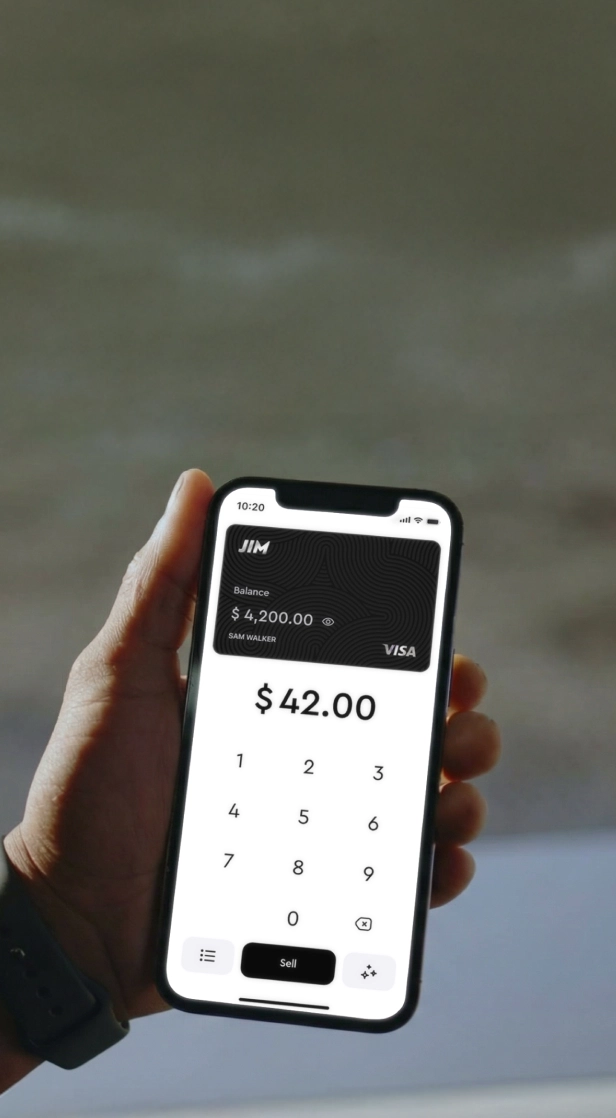
If you plan to sell at farmers' markets or pop-up events, you will need a way to accept card payments on the spot. For body butter businesses that need to accept payments on-site or on-the-go, JIM offers a streamlined solution.
With JIM, you can accept debit, credit, and digital wallets directly through your smartphone—just tap and done. At just 1.99% per transaction with no hidden costs or extra hardware needed, it's particularly useful for selling at craft fairs. Other payment solutions often charge between 2.5% and 2.9%.
Here is how it works:
- Get Started: Download the JIM app for iOS.
- Make a Sale: Type the sales amount, hit sell, and ask your customer to tap their card or device on your phone.
- Access Funds: Your money is available right on your JIM card as soon as the sale is done—no waiting for bank transfers.
Here are 3 immediate steps to take:
- Decide if you will sell online, in-person, or both to determine your payment needs.
- Compare the transaction fees for your e-commerce platform with JIM’s rate.
- Download the JIM app to see how it works on your phone.
Step 6: Fund your business and manage finances
Secure your startup capital
Most body butter businesses start with personal savings. If you need external funds, consider an SBA Microloan. These loans range from $500 to $50,000 and are designed for new small businesses. Interest rates are typically between 8% and 13%.
You can also look for grants. The Amber Grant, for example, awards funds to women-owned businesses monthly. Unlike loans, you do not have to repay grants. Competition is high, but the opportunity is worth the application effort.
Set up your financial systems
Open a dedicated business bank account before you make your first sale. A frequent mistake is to use a personal account. This complicates bookkeeping and can remove the personal liability protection your LLC provides. Keep all receipts for business purchases.
Plan for your first six months of operating costs. Beyond your initial setup, you will need about $1,500 to $3,000 in working capital. This covers inventory replenishment, marketing experiments, and transaction fees, ensuring you do not run out of cash.
Here are 3 immediate steps to take:
- Open a separate business checking account.
- Research the SBA Microloan program requirements on the official SBA website.
- Create a six-month budget that includes inventory, marketing, and platform fees.
Step 7: Build your team and streamline operations
Plan your first hire
Initially, you will handle most tasks. Your first hire is often a part-time Production Assistant to help with mixing, pouring, and packaging. Expect to pay an hourly rate of $15 to $20, depending on your location. This frees you up to focus on marketing and sales.
A frequent mistake is to not document your formulas and procedures. Create a detailed guide for each product. This makes training a new person straightforward and ensures your quality stays consistent, no matter who makes the batch.
Streamline your workflow
As orders increase, you need a system. Simple task management apps like Trello or Asana can help you track production schedules and marketing campaigns. While no specific certifications are required, knowledge of Good Manufacturing Practices (GMP) is a valuable skill for any employee.
When you start to pay yourself or an employee, aim to keep total payroll costs under 20% of your revenue. This is a healthy benchmark for small-scale producers and helps protect your profitability as you expand your team.
Here are 3 immediate steps to take:
- Document your primary body butter recipe and production steps.
- Outline the responsibilities for a future Production Assistant role.
- Create a free account on Trello or Asana to map out your weekly tasks.
Step 8: Market your products and find customers
Build your brand on social media
Focus on visual platforms like Instagram and TikTok. Post short videos showing your butter being whipped, packaged, or applied. A simple "before and after" shot on dry hands can be very effective. Consistency matters more than perfect production at first.
You can also collaborate with micro-influencers who have under 20,000 followers. Many will post about your product in exchange for free samples. This strategy builds social proof and reaches a targeted audience without a large upfront cost.
Use paid ads and email to drive sales
Once you have some content, you can amplify it with paid ads. Start with a small budget, perhaps $5 to $10 per day on Facebook or Instagram. Target users interested in "natural skincare" or brands like "Lush Cosmetics" to find potential customers.
A frequent misstep is to run ads without a clear goal. Decide if you want website traffic or direct purchases. Track your Customer Acquisition Cost (CAC). For a new brand, a CAC below $25 is a healthy target for a typical body butter product.
In addition, build an email list from day one. Offer a 10% discount for new subscribers on your website. Email lets you speak directly to your most engaged customers about new scents or promotions, often with a high return on investment.
Here are 3 immediate steps to take:
- Create an Instagram business account and post one video of your production process.
- Identify three micro-influencers in the skincare niche you could send products to.
- Set up an email capture form on your website that offers a 10% discount.
Step 9: Price your products for profit
Calculate your costs and set a markup
First, determine your Cost of Goods Sold (COGS) for a single jar. This includes ingredients, the jar, the lid, and the label. A frequent misstep is to forget packaging costs. If your COGS for a 4 oz jar is $3, a standard markup is 300-400% to set your retail price.
This means your retail price would be between $12 and $15. This markup ensures you cover not just materials but also your time, marketing, and platform fees. Aim for a gross profit margin of at least 60-75% to build a sustainable business.
Analyze competitors and position your brand
Now that you have a baseline, look at what your competitors charge. Browse Etsy or local market stalls for body butters of a similar size and quality. If comparable 4 oz jars sell for $18, pricing yours at $12 might make customers think it is lower quality.
Your price tells a story. A higher price can signal luxury ingredients or premium branding. A lower price can attract budget-conscious shoppers. Adjust your price based on where you want to fit in the market, but do not go below a 60% profit margin.
Here are 3 immediate steps to take:
- Calculate the total COGS for one unit of your signature body butter.
- Research the prices of three direct competitors on Etsy for a similar-sized product.
- Set your retail price using a 300% markup and see how it compares to the market.
Step 10: Maintain quality and scale your operations
Establish quality control standards
To ensure consistency, create a batch sheet for every production run. Record ingredient lot numbers, final product weight, and notes on texture and scent. This document becomes your quality benchmark and is non-negotiable for a serious brand.
A frequent oversight is to skip this record-keeping. Without batch sheets, you have no way to trace a customer complaint or an off-batch back to its source. This simple process protects your reputation and helps you identify production issues quickly.
Know when to grow
Growth should be a deliberate decision. Once you consistently spend over 20 hours per week on production alone or sell out of inventory before each restock, it is a clear signal to expand. This is typically the point to hire a part-time production assistant.
As your orders increase, managing supplies gets complicated. You might want to use software designed for makers, like Inventora or Craftybase. They help you track raw materials and finished goods, so you know exactly when to reorder your oils and butters.
Here are 3 immediate steps to take:
- Create a digital template for your batch production sheets.
- Set a weekly production hour limit that will trigger your search for an assistant.
- Explore the features on the Inventora or Craftybase website to see how they fit your workflow.
You have the steps, from formulation to finance. Remember, your unique scent and texture are what will make customers return. Trust your formula, follow your plan, and get ready to launch your brand. You've got this.
As you prepare for your first sales, think about payments. For in-person events, JIM lets you accept cards right on your smartphone for a simple 1.99% fee, no hardware needed. Download JIM and you're ready to sell.
.avif)