Starting a branding company is an exciting venture that combines creative strategy and design skills with business savvy. The global branding market is a multi-billion dollar industry, with steady demand for strong brand identities from startups, established companies, and e-commerce businesses.
This guide will take you through the practical steps of validating your business concept, securing funding, obtaining necessary licenses, and building your team to help you launch a successful branding company in the U.S.
Step 1: Plan and validate your business concept
First, define your target market. A frequent oversight is trying to serve every type of business. Instead, you might focus on a niche you understand well, such as tech startups or local retail shops. This sharpens your marketing and expertise.
Validate your niche by talking to at least 10-15 potential clients. Ask about their branding challenges and what they would pay for solutions. Use industry reports from sites like Statista to understand market size and trends for your chosen sector.
Once you have a niche, analyze your competitors. Use platforms like Ahrefs to review their online presence and Behance or Dribbble to study their portfolio quality. Note their service packages, pricing structures, and the types of clients they attract.
Estimate your startup costs
A lean launch requires careful financial planning. Initial investments often range from $2,000 to $5,000. This covers key areas to get your company off the ground and running smoothly.
- Legal Fees: Expect to pay $100-$500 for LLC formation.
- Software: Adobe Creative Cloud is about $60 per month. Project management apps like Asana have free or low-cost plans.
- Website: A domain, hosting, and a premium theme can total $200-$500 for the first year.
Here are 3 immediate steps to take:
- Identify and research three potential client niches.
- Analyze five direct competitors, noting their services and pricing.
- Create a detailed startup budget that lists all expected software, legal, and marketing fees for the first six months.
Step 2: Establish your legal structure and licensing
Choosing a business structure is your first legal move. Most new branding agencies start as a Limited Liability Company (LLC). This structure protects your personal assets, like your home and car, if the business faces legal trouble. It also offers simple pass-through taxation.
A frequent misstep is mixing personal and business money. To maintain your LLC's protection, open a dedicated business bank account right away. This separation is non-negotiable for clean bookkeeping and legal compliance. It makes tax time much simpler too.
Next, you will need an Employer Identification Number (EIN) from the IRS. Think of it as a Social Security number for your company. Getting one is free on the IRS website and only takes a few minutes. You need it to open that bank account and file taxes.
Finally, make it official with your state and city. File your LLC with your state's Secretary of State, which can cost $100 to $500. Then, get a general business license from your local city or county clerk. This is often an annual fee of around $50 to $100.
Here are 4 immediate steps to take:
- Decide on an LLC structure to protect your personal assets.
- Apply for a free Employer Identification Number (EIN) on the IRS website.
- File your LLC formation documents with your state's Secretary of State.
- Contact your local city or county office to secure a business operating license.
Step 3: Protect your agency with the right insurance
With your legal structure in place, the next move is to manage risk. Insurance protects your new company from unexpected events that could be financially damaging. You will want to look at a few specific policies to shield your business from common industry risks.
Key insurance policies
Professional Liability, also known as Errors & Omissions (E&O), is your primary defense. It covers you if a client claims your work caused them financial harm, such as from a costly typo or a missed deadline. A $1 million policy is a typical starting point.
You will also need General Liability insurance. This policy handles claims for bodily injury or property damage. If you plan to hire employees, even part-time, you will also need Workers’ Compensation insurance, as it is required in most states.
A combined package for these policies can cost between $800 and $2,000 annually. A frequent misstep is skipping professional liability to save money. This leaves you exposed to the most probable risks for a branding agency, like claims of copyright infringement.
When you shop for quotes, consider insurers that understand creative businesses. Companies like Hiscox, The Hartford, and Next Insurance offer tailored packages. They are more familiar with your risks than a general agent might be.
Here are 4 immediate steps to take:
- Request quotes for a $1 million Professional Liability (E&O) policy.
- Get pricing for a combined General and Professional Liability package.
- Contact at least two insurers that specialize in creative professions, like Hiscox or The Hartford.
- Check your state's requirements for Workers’ Compensation if you plan to hire.
Step 4: Set up your workspace and equipment
Choose your workspace
You can start your agency from a home office, which keeps initial costs down. A dedicated space of 100-150 square feet is plenty. Home-based service businesses are usually permitted in residential zones, but a quick check of local rules is always a good idea.
Many new owners make the mistake of leasing a formal office too soon. Instead, you might consider a co-working membership for client meetings. This gives you a professional setting without a long-term lease, with plans often starting around $200-$400 per month.
If you do need a dedicated office, negotiate for a shorter one or two-year lease. This provides flexibility as your company grows. Also ask about a tenant improvement allowance to help pay for initial setup costs like paint or furniture.
Get your equipment
Your primary investment will be a high-performance computer capable of handling design software. Here is a look at the gear you will need to get started.
- Computer: A MacBook Pro or a powerful Windows PC like a Dell XPS is a solid choice. Plan to spend between $1,500 and $3,000.
- Monitor: A color-accurate external monitor is vital for professional design work. A quality display from Dell or BenQ will cost $300 to $700.
- Accounting Software: Use a program like QuickBooks Online from day one to track finances. Plans start around $30 per month.
Here are 4 immediate steps to take:
- Confirm your local regulations for operating a home-based business.
- Research two local co-working spaces and compare their monthly rates.
- Create a budget for your computer and monitor purchase.
- Sign up for an accounting software trial to manage your finances.
Step 5: Set up your payment processing
Establish clear payment terms from the start. A standard practice is to require a 50% deposit to begin a project. The remaining 50% is due upon completion, before you deliver the final brand assets. This structure protects your cash flow and client commitment.
Many new agency owners forget to detail these terms in their contracts. Be sure your client agreement specifies all due dates, payment methods you accept, and any late fee policies. This prevents misunderstandings and ensures you get paid on time.
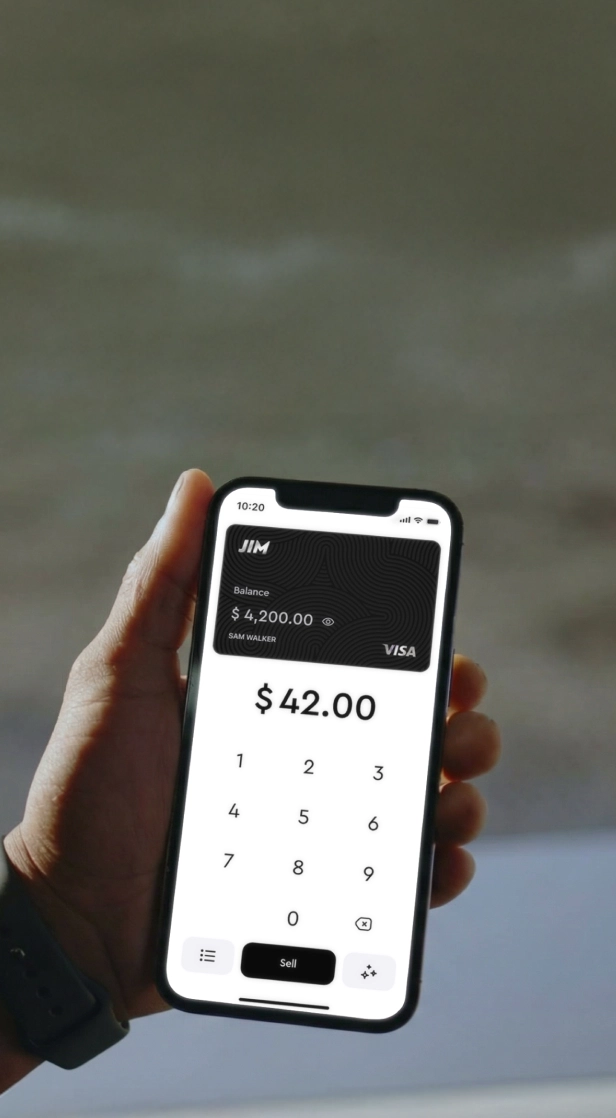
For branding companies that need to accept payments on-site or on-the-go, JIM offers a streamlined solution. You can accept debit, credit, and digital wallets directly through your smartphone. Just tap and the payment is done.
Many payment solutions have commission rates from 2.5% to 3.5%. At just 1.99% per transaction with no hidden costs or extra hardware, it's particularly useful for collecting deposits during initial client meetings or selling strategy workshops.
Getting started is simple:
- Get Started: Download the JIM app for iOS.
- Make a Sale: Type the sales amount, hit sell, and ask your customer to tap their card or device on your phone.
- Access Funds: Your money is available on your JIM card as soon as the sale is done, with no wait for bank transfers.
Here are 3 immediate steps to take:
- Draft your standard payment terms, such as 50% upfront.
- Incorporate your payment policy into your client contract template.
- Download the JIM app to explore its features for in-person payments.
Step 6: Secure funding and manage your finances
For the first six months, you should have $5,000 to $10,000 in working capital. This covers your salary, software subscriptions, and marketing costs before client revenue stabilizes. A frequent oversight is to only budget for initial startup gear, not the cash needed to operate.
Funding your agency
The SBA Microloan program is a solid fit for new agencies. You can borrow up to $50,000, with interest rates often between 8-13%. These funds are ideal for equipment or marketing. Qualification usually depends on your business plan and personal credit score.
Another option is a business credit card with a 0% introductory APR. This can finance your initial software and website costs without immediate interest. Just be sure you have a plan to pay the balance off before the promotional period ends to avoid high interest charges.
While some creative grants exist, they are highly competitive. Loans or personal funds offer a more direct path to getting started. Focus your energy on funding sources with clear application processes and faster turnaround times so you can launch without delay.
Here are 3 immediate steps to take:
- Calculate your working capital needs for the first six months.
- Research SBA Microloan lenders in your area through the SBA website.
- Compare two business credit cards that offer a 0% introductory APR.
Step 7: Build your team and workflow
Your first hires
You will likely start by hiring freelancers to manage costs. A freelance Graphic Designer is your first key partner. They handle visual identity work, from logos to brand guides. Expect to pay experienced designers between $50 and $100 per hour based on their portfolio.
Once you have a few clients, a part-time Project Manager or Virtual Assistant can be a game-changer. They will manage timelines and client communication, which frees you up for sales. A frequent mistake is waiting too long to delegate. This leads to burnout and slows growth.
Setting up your operations
Use project management software like Asana or Trello to keep projects organized from day one. These platforms help you track tasks and deadlines for each client. Most offer free plans that are powerful enough to get you started.
As you grow, a good financial benchmark is to target $100,000 to $150,000 in annual revenue per full-time employee. This metric helps you decide when it is financially sound to bring someone on full-time. For designers, a strong portfolio is more valuable than any certification.
Here are 4 immediate steps to take:
- Create a list of tasks to delegate to a freelance designer.
- Write a brief job description for a freelance Graphic Designer.
- Sign up for a free plan on Asana or Trello to map out a sample project.
- Set a revenue target for your first full-time hire using the industry benchmark.
Step 8: Market your agency and get clients
Build your core marketing assets
Your portfolio is your most powerful sales asset. Many new owners launch a website but have no work to show. Create two or three high-quality spec projects for fictional companies in your niche. This demonstrates your skills before you have paying clients.
Then, write detailed case studies for these projects. Explain the problem, your strategic process, and the final design solution. This content shows potential clients how you think, which builds trust and justifies your prices.
Start your outreach
With a solid portfolio, you can begin direct outreach. Use LinkedIn to find marketing managers or founders in your target niche. A personalized message that offers a specific idea gets a much better response than a generic sales pitch.
For example, you might record a short video analyzing a competitor's branding and share one key insight for their company. This high-value approach cuts through the noise. Aim for a lead-to-client conversion rate of around 10% from these qualified conversations.
Here are 4 immediate steps to take:
- Develop two spec projects to build your initial portfolio.
- Write a detailed case study for one of your spec projects.
- Identify 20 potential clients in your niche on LinkedIn.
- Draft a personalized outreach message that includes a specific insight.
Step 9: Develop your pricing strategy
Your pricing model directly impacts your profitability. Most branding agencies use project-based pricing for packages with clear deliverables, like a logo and brand guide. A basic package might start at $5,000, while a comprehensive one could be $15,000 or more.
Pricing your services
For consulting or tasks with an undefined scope, an hourly rate of $100-$250 is common. You might also offer a monthly retainer for ongoing brand management, typically starting at $2,000-$5,000. This provides you with predictable revenue.
Many new agency owners make the mistake of underpricing to win their first clients. This can devalue your work and make it difficult to raise rates later. Instead, aim for a profit margin of 20-30% on your projects after all costs are covered.
To set your rates, research competitors on platforms like Clutch or Upwork to see their pricing tiers. You can also directly ask prospects about their budget during discovery calls. This helps you align your proposals with their expectations from the start.
Here are 4 immediate steps to take:
- Define three service packages with project-based prices.
- Set your standard hourly rate for consulting or add-on work.
- Research five competitors to benchmark their pricing tiers.
- Create a pricing sheet that outlines your packages and rates.
Step 10: Control quality and scale your agency
Maintain service quality
To keep your work consistent, create an internal quality checklist. This document should outline every step for deliverables, from logo file formats to brand guide structure. It ensures every project meets your standard, regardless of who works on it. A frequent error is to rely only on memory.
You can measure client satisfaction with a Net Promoter Score (NPS) survey after each project. Ask clients how likely they are to recommend your agency on a scale of 1-10. Aim for a score of 9 or 10 from most clients. This feedback is gold for improvement.
Plan your growth
Once you hit $100,000 to $150,000 in annual revenue per employee, it is a good signal to consider a full-time hire. This benchmark helps you grow sustainably without overextending your finances. It prevents the common issue of hiring too soon and straining cash flow.
As your client list expands, a Customer Relationship Management (CRM) system becomes very useful. A platform like HubSpot offers free plans to track leads and client communications. For team management, you might look at resource planners like Float to schedule projects and staff capacity.
Here are 4 immediate steps to take:
- Create a quality checklist for all project deliverables.
- Set up a simple client feedback survey using a platform like SurveyMonkey.
- Track your revenue per employee to know when to hire.
- Explore a free CRM like HubSpot to manage your client pipeline.
Building a branding company is about strategic thinking, not just design. Your first clients are buying your process, so show them how you solve problems. The value will become clear. You have the roadmap, now go build something memorable.
To keep things smooth, make payments simple from the start. JIM turns your smartphone into a card reader for a flat 1.99% fee, with no extra hardware. This lets you get paid on the spot. Download JIM to be ready for your first client.
.avif)