Starting a cable company is an exciting venture that combines technical know-how in telecommunications with sharp business savvy. The U.S. cable industry represents a market worth hundreds of billions of dollars, driven by steady demand for high-speed internet and entertainment in homes, businesses, and apartment complexes.
This guide will take you through the practical steps of validating your business concept, securing funding, obtaining necessary licenses, and acquiring the right equipment to help you launch a successful cable company.
Step 1: Plan your business and validate your market
Start by defining your service area. Use U.S. Census Bureau data to find neighborhoods with population growth but limited high-speed options. You can also conduct local online surveys to gauge demand and what prices residents are willing to pay for internet and TV packages.
Next, analyze your competition. The FCC's National Broadband Map shows every registered internet provider in a given area. Many newcomers make the mistake of trying to compete on price alone against giants. Instead, find a niche they ignore, like a new housing development or a business park.
Understand your startup costs
Initial capital requirements are significant. A small-scale launch often requires between $200,000 and $500,000. Mapping out these figures early helps build a realistic financial forecast and is vital for securing loans or investment.
Here is a typical cost breakdown:
- Headend Equipment: $50,000 - $150,000 for servers, encoders, and modulators.
- Cabling & Installation: $10,000 - $50,000 per mile, depending on whether you use aerial or underground lines.
- Licensing & Legal Fees: $5,000 - $25,000 for franchise agreements and legal counsel.
Here are three immediate steps to take:
- Use the FCC broadband map to identify competitors in two potential service areas.
- Draft a preliminary budget listing expected costs for headend equipment and one mile of cable.
- Survey 30 potential customers in your target neighborhood about their current internet provider.
Step 2: Establish your legal structure and secure licenses
Choose your business structure
You might want to form a Limited Liability Company (LLC). It protects your personal assets from business debts and allows profits to pass directly to you without corporate taxes. This structure is often the simplest for new owner-operators.
A C Corporation is an alternative if you plan to seek venture capital. However, it involves double taxation—once on corporate profits and again on dividends. This structure adds complexity that may not be necessary at the start.
Navigate federal and local licensing
Your most important document is the franchise agreement from the Local Franchising Authority (LFA), typically your city or county government. This agreement grants you the right to operate and often requires a fee, usually capped at 5% of your gross revenue.
Many new operators get stuck here. Negotiating a franchise agreement is a lengthy process that can take 6 to 18 months. Start conversations with your LFA immediately after you validate your market. You will also need permits for pole attachments and right-of-way access from utility companies.
While the Federal Communications Commission (FCC) has a limited role in cable, you must still comply with its regulations. This includes signal quality standards and customer service rules. Specific FCC licenses are only needed if you use microwave systems to transmit signals.
Here are 3 immediate steps to take:
- Register your business as an LLC with your state's Secretary of State.
- Contact your target city or county clerk to identify the Local Franchising Authority (LFA).
- Request pole attachment guidelines from the local electric and telephone companies.
Step 3: Secure your insurance and manage risk
With your legal structure in place, the next move is to protect your company. You will need several types of insurance to cover the specific risks of running a cable business, from property damage during installations to service outages.
Key insurance policies for your cable company
A mistake many new operators make is to buy a basic liability policy, which leaves them exposed. You should budget for a comprehensive insurance package, as premiums are a recurring operational cost.
- General Liability Insurance: This covers third-party property damage and bodily injury. A $1 million policy is standard, with annual premiums often between $1,200 and $5,000.
- Professional Liability (E&O): This protects you if a service outage causes financial loss for a client. It is not covered by general liability. Expect to pay $1,500 to $4,000 annually for $1 million in coverage.
- Workers’ Compensation: If you have employees, this is a legal requirement in most states. It covers medical costs and lost wages from on-the-job injuries.
- Commercial Auto Insurance: You need this for any vehicles used for business operations.
You might want to work with an insurance broker who specializes in telecommunications. General agents may not understand the industry's unique risks. Consider providers like The Hartford, Chubb, or Travelers, as they have experience with technology and telecom companies.
Here are 3 immediate steps to take:
- Request quotes for both General Liability and Professional Liability insurance.
- Check your state’s requirements for Workers’ Compensation coverage.
- Contact an insurance broker who has experience with telecommunications businesses.
Step 4: Set up your location and buy equipment
Find your operational base
Your headend is the nerve center of your network. It needs a climate-controlled space, usually between 500 and 1,000 square feet. Look for properties zoned for light industrial or commercial use. A simple warehouse or a large office suite will work well.
When you negotiate a lease, you might want to ask for a shorter initial term, like one or two years. This gives you flexibility as your company grows. Landlords are often more open to this if you can show a solid business plan.
Purchase your core hardware
Now it is time to buy the hardware for your headend. This includes servers, encoders, modulators, and a Cable Modem Termination System (CMTS). The CMTS is what communicates with the cable modems in your customers’ homes. A complete package can run from $50,000 to $150,000.
A mistake some new operators make is buying equipment that cannot scale, which creates performance bottlenecks later. You should plan for future growth by selecting hardware that can handle at least double your initial subscriber target.
You can find new or refurbished equipment from suppliers like Cisco, CommScope (which owns Arris), and Harmonic. Refurbished carrier-grade gear from a reputable vendor can offer significant savings without sacrificing reliability. These suppliers often sell complete "headend-in-a-box" solutions.
Here are 3 immediate steps to take:
- Identify three potential commercial properties in your service area that meet the size and zoning requirements.
- Request quotes for a complete headend package from two different telecom equipment suppliers.
- Ask a commercial real estate agent about standard lease terms for 1,000-square-foot industrial spaces.
Step 5: Set up your payment processing
Your revenue will come from monthly subscriptions, so you need a system for automated recurring billing. This lets you avoid the time-consuming task of manual invoicing. Most customers expect to pay by credit card or ACH bank transfer.
When you select a payment processor, look beyond the transaction fee. A mistake many make is to choose a system with high monthly charges or one that poorly handles subscriptions. This can lead to billing errors and frustrated customers.
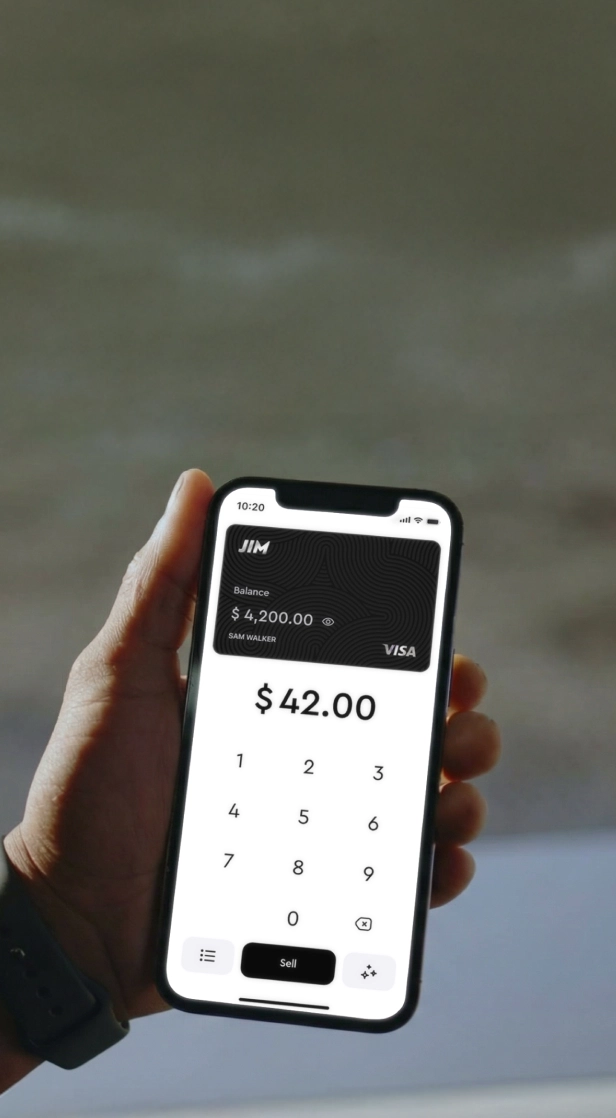
For one-time charges like installation fees, JIM offers a streamlined solution. With JIM, you can accept debit, credit, and digital wallets directly through your smartphone. Just tap and you are done. The rate is just 1.99% per transaction with no hidden costs.
This is a great rate, as many other providers charge between 2.5% and 3.5%. It is particularly useful when you collect payment immediately after a new home installation. Here is how it works:
- Get Started: Download the JIM app for iOS.
- Make a Sale: Type the sales amount, hit sell, and ask your customer to tap their card or device on your phone.
- Access Funds: Your money is available right on your JIM card as soon as the sale is done - no waiting for bank transfers.
Here are 3 immediate steps to take:
- Research two payment processors that specialize in recurring billing.
- Compare their total costs, including transaction and monthly fees.
- Download the JIM app to test its on-site payment process.
Step 6: Secure funding and manage your finances
Find the right funding source
You might want to start with the Small Business Administration (SBA). The SBA 7(a) loan program can provide up to $5 million, though cable startups often seek between $350,000 and $500,000. You will need a strong business plan and a personal credit score over 700 to qualify.
Another path is equipment financing. Lenders provide funds specifically for your hardware, and the equipment itself acts as collateral. This can make the loan easier to secure than a traditional business loan. Some operators get stuck after a bank denial, but this is a solid alternative.
Plan your first six months of cash flow
With funding in mind, you need to calculate your working capital. This is the cash required to operate for the first six months before subscription revenue stabilizes. A good estimate is between $60,000 and $120,000 to cover rent, insurance, marketing, and salaries.
Many new owners focus on the large equipment purchase and forget about these recurring operational costs. A detailed six-month budget helps you avoid a cash flow shortage just as your business starts to gain traction. This forecast is a key part of any loan application.
Here are 3 immediate steps to take:
- Contact your local Small Business Administration (SBA) office about the 7(a) loan program.
- Ask your equipment supplier if they partner with any equipment financing companies.
- Draft a six-month operating budget to determine your exact working capital needs.
Step 7: Hire your team and set up operations
Build your core team
You might want to start by hiring one or two Field Technicians. They handle installations and service calls. A typical salary is between $45,000 and $65,000. Look for candidates with certifications from the Society of Cable Telecommunications Engineers (SCTE) to ensure they have the right skills.
Some new operators hire general handymen to cut costs, but this often leads to faulty installations and customer complaints. You will also need a Network Engineer to manage the headend. This is a more technical role, with salaries ranging from $70,000 to $95,000.
Set up your operational software
Once your team is in place, you need a system to manage the workflow. You might want to use an all-in-one platform like Sonar or Powercode. These systems combine billing, customer management, and technician dispatch, which helps you avoid using separate, disconnected software.
As you grow, a good benchmark is to have one field technician for every 200 to 300 subscribers. This ratio helps you manage workloads and maintain service quality without overstaffing. Planning your hiring around this metric will keep your operations efficient.
Here are 3 immediate steps to take:
- Draft a job description for a Field Technician, listing SCTE certification as a preferred qualification.
- Schedule a demo with an operational platform like Sonar or Powercode.
- Calculate your initial staffing needs based on a target of 250 subscribers.
Step 8: Market your services and acquire customers
Execute a hyperlocal campaign
You might want to start with door hangers and yard signs in neighborhoods where your service is live. An introductory offer, like "First 50 Customers Get 50% Off," can create urgency. Your initial goal should be to sign up your first 50 to 100 subscribers this way.
A mistake many new operators make is advertising too broadly. You should focus your budget only on streets where you can install service immediately. This keeps your Customer Acquisition Cost (CAC) manageable, which for a new ISP is often between $300 and $500 per subscriber.
Use digital ads and referrals
In addition to direct outreach, you can run Facebook or Google ads targeted to specific zip codes. Use messaging that highlights your local presence and better customer service. This is a powerful angle against the large, impersonal providers that dominate the market.
Once you have your first customers, you can launch a referral program. A simple "give one month, get one month free" offer encourages word-of-mouth marketing. This is often the most cost-effective way to grow your subscriber base after your initial launch.
Here are 3 immediate steps to take:
- Design a door hanger with an introductory offer for your first 50 customers.
- Set up a Facebook ad campaign targeted to the zip codes in your service area.
- Outline a customer referral program that rewards both the new and existing subscriber.
Step 9: Set your pricing and define your packages
You might want to start with a tiered pricing model. This is the industry standard. For example, you could offer a 50 Mbps plan for $49.99, a 200 Mbps plan for $69.99, and a 1 Gbps plan for $89.99 per month. This structure appeals to different customer needs and budgets.
Analyze competitors and set your rates
Next, look at what your competitors charge by visiting their websites. Many new operators make the mistake of only competing on price. Instead, you should justify your rates with better value, such as symmetrical speeds (equal upload and download) or superior local customer service.
Once your network is built, gross profit margins for internet service can be high, often between 60% and 80%. Your main ongoing costs will be customer support and network maintenance. If a competitor offers a 200/10 Mbps plan for $70, you could offer a 150/150 Mbps plan for the same price and highlight the speed difference.
Here are 3 immediate steps to take:
- Document the public pricing and speeds for two competitors in your service area.
- Create three distinct internet service tiers with prices based on your analysis.
- Calculate your target profit margin per subscriber based on your projected operational costs.
Step 10: Maintain quality and scale your operations
Once your network is live, your focus shifts to service quality. You should track key metrics like network uptime, aiming for 99.9% or higher. Another important number is Mean Time to Repair (MTTR). A goal of under four hours keeps customers happy.
Many new operators only react when an outage occurs. You might want to use network monitoring software from the start. This lets you spot issues like packet loss or high latency before they cause widespread problems for your subscribers.
Know when to grow
With quality under control, you can plan for expansion. A good benchmark for hiring is to maintain one field technician for every 200 to 300 subscribers. This ratio prevents your team from getting overwhelmed with service calls and installations.
You can also set targets for physical expansion. Once you reach 30-40% subscriber penetration in your initial area, it is a strong signal to start planning your next neighborhood build-out. Watch your network utilization reports in a platform like Sonar or Powercode.
When peak usage consistently exceeds 70% of your capacity, it is time to invest in hardware upgrades. This proactive step prevents network congestion and keeps your service fast for everyone, protecting your reputation as you scale.
Here are 3 immediate steps to take:
- Set up a dashboard to monitor network uptime and Mean Time to Repair (MTTR).
- Calculate your current technician-to-subscriber ratio to plan your next hire.
- Check your network utilization reports to see if you are approaching the 70% upgrade threshold.
Launching your cable company is about strong local ties as much as the technical setup. Remember your advantage over the giants is your personal touch and community focus. With this plan, you are ready to connect your first neighborhood.
As you handle those first installation fees, a simple payment solution helps. JIM turns your smartphone into a card reader to accept payments on the spot for a flat 1.99% fee, with no extra hardware. Download JIM and be ready for day one.
.avif)