How to start a car wrap business: a founder's guide
See article summary
- Plan on $20,000 to $35,000 in startup costs, mostly for a printer and laminator.
- Form an LLC, get a free EIN from the IRS, and secure a seller's permit.
- Buy General Liability plus Garage Keepers insurance before your first job.
- Price wraps at a 100% markup over materials and labor to protect margins.
- Use JIM to collect a 50% deposit and the final balance on the spot at 1.99%.
Expect $20,000 to $35,000 in startup costs and 6 to 12 months to reach profitability. A car wrap business blends creative design with precise installation, and demand stays steady from commercial fleets, small business advertising, and individual car enthusiasts across the U.S.
How do you validate a car wrap business idea?
Validate demand by counting wrapped commercial vehicles in a 5-mile radius over one week. Real-world observation beats generic online data, because you see which businesses already invest in wraps and which gaps you can fill.
Market and competitor research
Start by researching your local market. Drive through commercial areas and count how many vans and trucks use full wraps versus simple decals. This gives you a real-world sense of demand from businesses. Also, visit local car shows to see what individual enthusiasts want.
Next, identify your direct competitors. Use Google Maps to find wrap shops in your service area. You can also check databases like your local Chamber of Commerce directory. Analyze their websites, services, and customer reviews to find gaps you can fill.
What does it cost to start a car wrap business?
Your total initial outlay will likely be between $20,000 and $35,000. A small business loan or equipment financing can make these figures more manageable. The costs can be significant, so it helps to see them itemized. Many new owners get caught out by not budgeting for practice materials, so factor that in from day one.
- Printer and Laminator: $15,000 - $25,000
- Design Software (e.g., Adobe Creative Cloud): $60/month
- Initial Vinyl Stock: $2,000 - $4,000
- Installation Tools (heat guns, squeegees): $500 - $1,000
- Business Formation and Insurance: $500 - $2,000
Here are 3 immediate steps to take:
- List 5-10 local competitors and note the primary services they offer.
- Create a detailed startup budget in a spreadsheet based on the cost estimates above.
- Spend an afternoon to observe commercial vehicle traffic and gauge the local market for wraps.
How do you establish your legal structure and get licensed?
Form an LLC to separate personal assets from business debts, then get a free EIN from the IRS and a seller's permit from your state. Most wrap shops start as a Limited Liability Company (LLC) because it protects your personal assets while keeping taxes simple.
Choose your business structure
Most wrap shops start as a Limited Liability Company (LLC). This structure separates your personal assets from business debts. Profits pass through to your personal tax return, which avoids the double taxation you might see with a C Corporation. State filing fees for an LLC range from about $35 to $500 depending on the state, as documented in the SBA business launch guide.
Secure federal, state, and local paperwork
Your first federal step is to get an Employer Identification Number (EIN) from the IRS. It is free and the online EIN application takes minutes. Next, register your business with your state's Secretary of State. You will also need a seller's permit from your state's tax agency.
Many new owners forget the seller's permit, which is required to collect sales tax on services and materials. Finally, contact your city or county clerk for a general business license. Costs vary widely by city. For example, Mesa, Arizona charges a $25 general business license fee, while Phoenix does not issue a general business license at all and instead regulates specific activities. Always confirm the current fee and requirements with your local city clerk.
Here are 3 immediate steps to take:
- Decide if an LLC is the right structure for your personal financial situation.
- Apply for a free EIN directly on the IRS website.
- Check your state's Department of Revenue website for seller's permit applications.
What insurance does a car wrap shop need?
General Liability is your baseline policy, and Garage Keepers Liability is essential because it covers customer vehicles in your care. You need both before accepting your first job, since a single damaged client vehicle can wipe out months of profit.
Key insurance policies for your wrap shop
General Liability insurance is your baseline protection. It covers claims like bodily injury or property damage that happen at your shop. For a $1 million policy, small businesses typically pay annual premiums that range from roughly $250 to over $3,000, with an average around $542 per year, according to Insureon's general liability cost data. This is a foundational investment in your business's security.
A frequent mistake is to skip Garage Keepers Liability. This policy specifically covers damage to a customer's vehicle while it is in your care. Also, consider Professional Liability, which protects you from claims related to design errors that might require a costly re-wrap.
If you have a physical location, you will need Commercial Property insurance for your equipment. Once you hire staff, Workers' Compensation is legally required. You might want to get quotes from providers like Hiscox, The Hartford, or Next Insurance, as they specialize in small business coverage.
For Garage Keepers, aim for at least $50,000 in coverage, though $100,000 is safer given the value of modern vehicles. Professional Liability policies often start at $25,000. Always confirm your coverage amounts meet the specific risks you face.
Here are 3 immediate steps to take:
- Request a quote for a $1 million General Liability policy.
- Ask potential insurers specifically about adding Garage Keepers Liability to your plan.
- Compare premium packages from at least two providers that specialize in small business insurance.
How do you set up your location and buy equipment?
Look for a 1,000 to 1,500 square foot space with at least one 12-foot high garage door, and budget $15,000 to $25,000 for your printer and laminator. Your workspace and core equipment drive every job, so get these right before opening day.
Find your workspace
Look for a space between 1,000 and 1,500 square feet. This gives you a dedicated bay for one vehicle, plus room for your printer and material storage. Ensure the space has at least one 12-foot high garage door to accommodate larger vehicles like sprinter vans.
Your shop will likely need to be in an area zoned for light industrial or commercial use. Before you sign a lease, confirm the zoning with your local city planning department. When you negotiate the lease, you might ask for a Tenant Improvement (TI) allowance, a landlord credit toward build-out costs like electrical upgrades or better lighting.
Purchase your core equipment
Your printer and laminator are your biggest investments. Brands like Roland and HP offer latex printers in the $15,000 to $25,000 range. Many new owners forget to budget for a vinyl plotter, like a Graphtec or Summa, which can run from $3,000 to $7,000.
You will also need a stock of materials. You can open accounts with national suppliers like Fellers or Grimco. They carry top vinyl brands like 3M and Avery Dennison. Initial orders usually just require you to buy a single roll, which costs between $600 and $900. Per-square-foot material costs vary by film grade and supplier, so request a current price list before you commit to a brand.
Here are 3 immediate steps to take:
- Identify three potential commercial properties with at least 1,000 sq ft and a large garage door.
- Request quotes for a printer and laminator combo package from two different equipment dealers.
- Contact a supplier like Fellers to understand their account setup process and vinyl roll pricing.
How do you set up payment processing for your wrap shop?
Take a 50% non-refundable deposit to book every job, then choose a processor with transparent fees and no hardware cost. Most wrap shops require a 50% non-refundable deposit to book a job. This covers your vinyl order and secures the client's spot. The remaining balance is due upon completion. A frequent misstep is not taking a deposit, which leaves you vulnerable if a client backs out.
When you choose a payment processor, look closely at transaction fees. Many providers charge between 2.5% and 3.5% plus other fees. You want a simple system that works for you and your customers without eating into your profit.
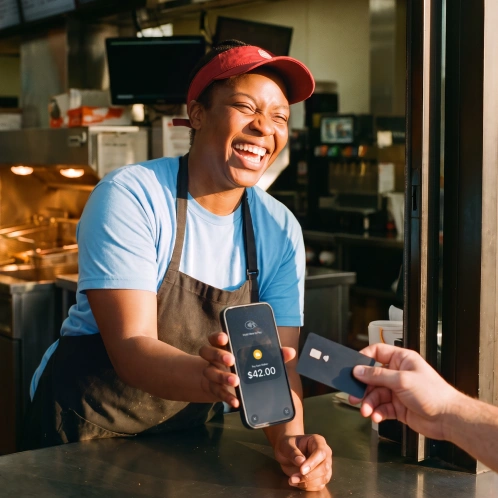
For a business that needs to accept payments on-site, JIM offers a streamlined solution. With JIM, you can accept debit, credit, and digital wallets directly through your smartphone. Just tap and you are done. At just 1.99% per transaction with no hidden costs or extra hardware, it is a strong option. You can learn more about how Tap to Pay works to see if it fits your workflow.
This is particularly useful for taking final payment the moment a client approves the finished wrap, right by their car. It avoids the hassle of sending invoices and waiting for payment. For a deeper comparison of processing fees, read this guide on credit card processing for small businesses.
Getting started is straightforward:
- Get Started: Download the JIM app for iOS.
- Make a Sale: Type the sales amount, hit sell, and ask your customer to tap their card or device on your phone.
- Access Funds: Your money is available right on your JIM card as soon as the sale is done, no waiting for bank transfers.
Here are 3 immediate steps to take:
- Draft your standard payment terms, including a 50% deposit requirement.
- Compare JIM's 1.99% transaction rate to other payment solutions.
- Download the JIM app to explore its interface and features.
How do you fund your car wrap business and manage finances?
An SBA 7(a) loan is a popular funding route, and you should keep at least $15,000 to $20,000 in working capital for your first six months. You need a strong business plan and solid credit to qualify, and a cash reserve to survive before jobs become consistent.
Secure your startup capital
An SBA 7(a) loan is a popular route for funding. The SBA requires that businesses be creditworthy and demonstrate a reasonable ability to repay the loan, but does not publish a specific minimum credit score. Individual lenders set their own credit standards, and many look for a personal FICO score of 680 or higher. You might also consider equipment financing, which secures the loan against the printer and laminator themselves. This option often has faster approval times.
Many new owners get tempted by the top-of-the-line printer. It is often wiser to start with a reliable mid-range model. This approach keeps your monthly payments low while you build a client list. You can always upgrade your equipment as your revenue grows.
Plan your working capital
Your initial loan should cover more than just equipment. You need a cash reserve for the first six months to cover operating costs before jobs become consistent. Plan to have at least $15,000 to $20,000 set aside for this purpose.
This working capital will cover your initial expenses. A typical six-month budget might look like this:
- Rent and Utilities: $9,000 - $12,000
- Insurance Premiums: $1,500 - $2,500
- Marketing and Advertising: $2,000 - $3,000
- Practice Vinyl and Supplies: $1,000 - $2,000
Here are 3 immediate steps to take:
- Check your credit score to see if you meet the typical 680+ requirement that many SBA lenders look for.
- Contact an equipment dealer to ask about their in-house financing options.
- Create a six-month operating budget to determine your exact working capital needs.
How do you hire your team and set up operations?
Your first hire is a certified Vinyl Installer earning $45,000 to $60,000, and a single experienced installer can support about $150,000 to $200,000 in annual revenue. Hire for certification and portfolio quality, not the lowest hourly rate, because re-wraps destroy margins.
Build your installation team
Your first hire is usually a Vinyl Installer, who will handle vehicle prep and application. A skilled installer typically earns between $45,000 and $60,000 annually. A frequent misstep is hiring someone based only on a low hourly rate, which can result in costly re-wraps.
Instead, look for installers with certifications from programs like the 3M Preferred Graphics Installer or the Avery Dennison Certified Wrap Installer programs. You should also ask to see a portfolio and consider a paid trial wrap on a test panel before you commit to a full-time hire.
For your design needs, you might start with a freelance Graphic Designer. This approach keeps your overhead low, as you pay per project. Once your workflow becomes steady, you can think about bringing a designer on full-time.
Manage your workflow
With jobs coming in, you need a system to stay organized. Shop management software like Shopmonkey or Jobber lets you track projects from quote to completion. When you are just starting, a simple digital board on Trello can also do the job effectively.
As a general rule, experienced shop operators report that a single skilled installer can support about $150,000 to $200,000 in annual revenue. This practitioner benchmark helps you know when your business is ready to hire a second installer.
Here are 3 immediate steps to take:
- Draft a job description for a Vinyl Installer, specifying desired certifications.
- Check sites like Indeed to confirm competitive local salary ranges for your area.
- Sign up for a free trial of a tool like Trello or Jobber to map out your workflow.
How do you market your car wrap business and acquire customers?
Build a visual portfolio on Instagram and Google Business Profile first, then wrap your own vehicle as a mobile billboard. A strong portfolio plus local referrals drives most early jobs, with a target customer acquisition cost between $100 and $250.
Build your online portfolio
Your first marketing asset is a strong visual portfolio. Create an Instagram and a Facebook page to showcase your work. Also, set up a Google Business Profile immediately. This action puts you on the map for local searches like "car wraps near me."
Many new shops hurt their brand with poor photos. Use a good camera and proper lighting, as a professional portfolio is your best sales tool. You might want to set a starting budget of $300-$500 per month for targeted local ads on these platforms.
Network for commercial clients
Commercial fleet wraps can become a steady source of revenue. Join your local Chamber of Commerce to meet other business owners. You can also partner with auto dealerships or detail shops for referrals. A simple referral fee often builds strong relationships.
Wrap your own vehicle first. It acts as a mobile billboard and a direct demonstration of your skill. A single wrapped car can get thousands of views per day in a metro area, making it a highly effective marketing asset.
Customer acquisition cost, or CAC, is the total you spend on marketing and sales to win one new client. For a high-value service like a full wrap, a CAC between $100 and $250 is a reasonable target when you start. Expect paid local ads to sit at the higher end of that range early on, while referrals from dealerships and detail shops cost less once those relationships are established. Track your ad spend and signed jobs to calculate this metric and refine your strategy over time.
Here are 4 immediate steps to take:
- Set up your Google Business Profile with high-quality photos of your work.
- Wrap your own vehicle to serve as a mobile advertisement.
- Identify two local businesses, like a car dealership or detailer, to approach for a referral partnership.
- Calculate your initial customer acquisition cost after your first few ad-driven jobs.
How do you price your car wrap services for profit?
Price at a 100% markup over your direct costs, which include materials at $5 to $7 per square foot and labor at $25 to $35 per hour. A standard sedan costs about $1,400 to $1,800 in direct materials and labor, so a $3,000 quote gives you a 50% gross margin.
Calculate your base costs
Your price must cover materials, labor, and overhead. Vinyl and laminate together cost about $5 to $7 per square foot. Labor might run you $25 to $35 per hour. A standard sedan requires about 180 square feet of material and 20-25 hours of labor.
This puts your direct cost for a sedan wrap between $1,400 and $1,800. Add a portion of your monthly overhead, like rent and utilities, to every job's cost calculation. This ensures every project contributes to your fixed expenses.
Set your final price
A cost-plus model is the simplest way to start. A 100% markup on your direct costs is a solid baseline. For a sedan that costs you $1,500, you would quote the client $3,000. This gives you a 50% gross profit margin to cover overhead and generate profit.
As a worked example, suppose you wrap a 2022 sedan that needs 180 square feet of cast vinyl at $6 per square foot, plus 22 hours of labor at $30 per hour. Your materials cost $1,080 and labor costs $660, for a total direct cost of $1,740. At a 100% markup, you quote $3,480 and net $1,740 before overhead. If your monthly overhead is $4,000 and you complete 10 wraps that month, you allocate $400 per job, leaving $1,340 in profit per wrap.
Many new shops make the mistake of underpricing to win their first jobs. This can devalue your brand and make it difficult to become profitable. Instead, research your market. Call a few competitors and ask for a quote on a full wrap for a specific car, like a Ford F-150.
Here are 3 immediate steps to take:
- Calculate your total direct cost to wrap a standard sedan, including materials and labor.
- Call two local competitors to get a price quote for a color-change wrap on a specific SUV model.
- Create a simple price sheet with starting prices for a sedan, an SUV, and a commercial van.
How profitable is a car wrap business and how long to break even?
A single experienced installer can generate $150,000 to $200,000 in annual revenue, and most shops reach break-even within 6 to 12 months of steady operation. Profit margins on full wraps typically run 40% to 50% after materials and labor, which makes scaling predictable once your quality is consistent.
Your break-even point depends on how quickly you fill your schedule. At a $3,000 average ticket and a 50% gross margin, you net roughly $1,500 per wrap. To cover $20,000 in monthly overhead and owner draw, you need about 13 wraps per month, or roughly three per week. Most new shops reach this volume within the first year.
How do you control quality and scale your car wrap business?
Use a final inspection checklist with a 24-hour cure check, and hire a second installer once one installer generates $150,000 to $200,000 in revenue with a four-week backlog. Consistent quality protects referrals, which are your cheapest source of new clients.
Maintain your quality standards
Your reputation depends on flawless work. Create a final inspection checklist for every vehicle. It should include checks for bubbles, wrinkles, clean edge cuts, and proper seam alignment. A good practice is to let the wrap cure for 24 hours and then perform a final check for any lifting.
Many new shops stumble by skipping this final check to save time. This can lead to unhappy clients and costly rework. Also, consider pursuing a certification from 3M or Avery Dennison. These programs provide a high standard to measure your team's skills against.
Know when to grow
Once your quality is consistent, you can look toward growth. A key benchmark is when a single installer generates between $150,000 and $200,000 in annual revenue. If you hit this mark and your job queue is booked out for more than four weeks, it is time to hire a second installer.
As you expand, shop management software like Shopmonkey or Jobber becomes very useful. These platforms help you track multiple projects, manage your schedule, and monitor your revenue metrics. This prevents your workflow from becoming chaotic as your job volume increases.
Here are 3 immediate steps to take:
- Create a final inspection checklist that includes a 24-hour post-wrap review.
- Track your lead installer's monthly revenue to monitor against the annual growth benchmark.
- If your job queue is consistently booked 4+ weeks out, draft a job description for a second installer.
You now have a clear path to start your wrap shop. The key is to treat every car as a mobile billboard for your skill. Perfect your craft on those first jobs, and the clients will follow. When it is time to get paid, JIM lets you collect deposits and final balances right on your smartphone at a flat 1.99% fee, with no extra hardware.
Frequently Asked Questions
Is a car wrap business profitable?
Do you need a license to wrap cars?
How much does it cost to start a car wrap business?
How much can I charge for a car wrap?
What insurance does a car wrap shop need?


Sell and get paid in seconds with Jim