Starting a Christmas light business is a rewarding venture that combines creative design and technical skill with business savvy. The professional holiday decorating industry is a multi-billion dollar market, with steady demand from residential homes, commercial properties, and city centers.
This guide will take you through the practical steps of validating your business concept, acquiring the right equipment, obtaining necessary permits, and building supplier relationships to help you launch a successful christmas light business in the U.S.
Step 1: Plan your business and validate your market
Start by researching your local market. Drive through affluent and high-traffic commercial areas in late November to see who already uses professional installers. Also, monitor local social media groups for discussions about holiday lighting services to gauge demand.
Analyze local competition
Use Google Maps and Thumbtack to identify competitors. Note their service areas, look at photos of their work, and read customer reviews. Many new owners underprice their services; analyze competitor pricing to ensure you charge what your professional work is worth.
Estimate your startup costs
Your initial investment will likely fall between $5,000 and $10,000. It is a manageable startup expense if you plan your purchases. A typical budget includes:
- Equipment: $1,500 - $3,000 for extension ladders, harnesses, and specialized tools.
- Initial Inventory: $3,000 - $5,000 for commercial-grade lights, clips, and cords. Avoid cheaper retail products.
- Insurance & Licensing: $500 - $1,200 for general liability insurance and business registration.
- Basic Marketing: $300 - $700 for door hangers, flyers, and a simple website.
Here are 4 immediate steps to take:
- Scout three potential neighborhoods to assess existing light displays.
- List five local competitors you find on Google Maps and review their websites.
- Contact an insurance agent to get a preliminary quote for general liability coverage.
- Price out a starter inventory of commercial-grade C9 bulbs and wire from a supplier.
Step 2: Establish your legal structure and get licensed
You should consider forming a Limited Liability Company (LLC). This structure protects your personal assets, like your home and car, from business debts. Many new installers operate as sole proprietors to avoid fees, but this puts your personal finances at risk if a lawsuit happens.
An LLC offers pass-through taxation, meaning business profits pass to your personal tax return, which simplifies tax filing. Filing for an LLC with your Secretary of State typically costs between $50 and $500 and takes one to two weeks to process.
Secure the right permits and licenses
First, get a free Employer Identification Number (EIN) from the IRS website; you need this to open a business bank account. Next, register your business name and LLC with your state's Secretary of State. This officially establishes your company.
Your city or county clerk's office will issue a general business license. Also, check with your local building department about low-voltage electrical permits. Most areas do not require a full electrician's license for temporary holiday lighting, but you must confirm local rules.
Here are 4 immediate steps to take:
- File LLC formation documents with your Secretary of State.
- Apply for a free Employer Identification Number (EIN) online with the IRS.
- Inquire at your city hall about the cost of a general business license.
- Call your local building department to clarify rules for low-voltage lighting installation.
Step 3: Secure insurance and manage risk
General liability insurance is your top priority. It covers property damage and injuries. You should get a policy with at least $1 million in coverage, which often costs between $600 and $1,500 per year. Many commercial clients will not hire you without it.
If you use a vehicle exclusively for your business, you need a commercial auto policy. Also, once you hire your first employee, you must have workers' compensation insurance. This covers medical expenses and lost wages if an employee is injured on the job.
Find a specialized insurance provider
You might want to work with an agent who understands contractor risks. Some new owners make the mistake of using a general agent who misses key coverages. Look into providers like Hiscox, Next Insurance, or The Hartford, as they are familiar with seasonal businesses.
Be direct about your work. Confirm your policy covers falls from ladders, accidental damage to roofs or gutters, and electrical faults. An inadequate policy is as risky as no policy at all. You want no surprises if you have to file a claim.
Here are 4 immediate steps to take:
- Contact an agent who specializes in contractor insurance.
- Request a quote for a $1 million general liability policy.
- Ask if the policy explicitly covers work performed on ladders.
- Inquire about the cost of workers' compensation if you plan to hire help.
Step 4: Buy your equipment and find suppliers
Your most important purchases are ladders. You should get a 24-foot and a 32-foot extension ladder, which will cost between $300 and $600 each. A common mistake is to buy a ladder that is too short for two-story homes. Also, purchase a fall protection harness for around $150.
Source commercial-grade lights
Avoid big-box retail stores because their products are not durable enough for professional use. Instead, set up accounts with wholesale suppliers like Christmas Light Source or Holiday Light Hooks. They sell the commercial-grade gear you need to do the job right.
You will need to buy in bulk to get good pricing. For example, purchase C9 bulbs by the case of 500 and wire by the 1,000-foot spool. Your initial inventory of lights, clips, and cords will likely cost between $3,000 and $5,000.
You do not need a commercial storefront to start. A clean garage or a 10x10 self-storage unit provides enough space for your initial equipment and inventory. Just confirm the facility allows business inventory storage before you sign a lease.
Here are 4 immediate steps to take:
- Price a 24-foot and 32-foot extension ladder online.
- Open a wholesale account with a supplier like Christmas Light Source.
- Create a starter inventory list with 1,000 feet of C9 wire and 500 bulbs.
- Call a local self-storage facility to ask about rates for a 10x10 unit.
Step 5: Set up your payment processing
A standard practice is to require a 50% deposit to schedule the installation and the remaining 50% upon completion. This secures your calendar and covers initial material costs. You should accept multiple payment types, including credit cards, to appear professional.
Find the right payment solution
When you evaluate payment solutions, look for low transaction fees and quick access to your money. Many processors charge between 2.5% and 3.5% per transaction and may hold your funds for several days. Some new installers make the error of only accepting cash, which can deter clients.
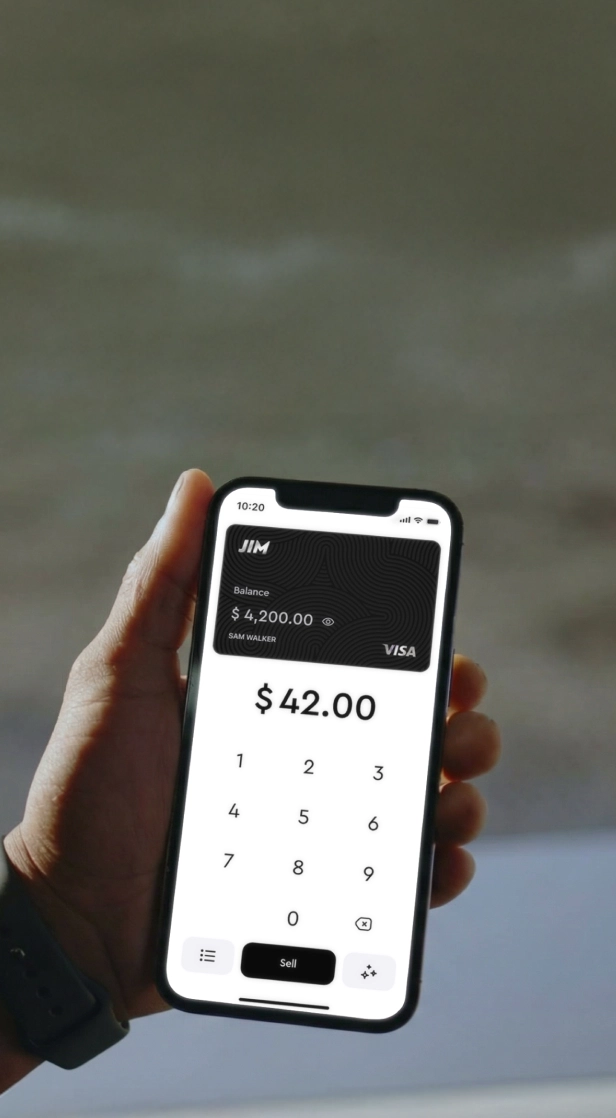
For a business that needs to accept payments on-site, JIM offers a streamlined solution. With JIM, you can accept debit, credit, and digital wallets directly through your smartphone. Just tap and you are done. At just 1.99% per transaction with no hidden costs or extra hardware, it is particularly useful for collecting final payments immediately after you complete an installation.
- Get Started: Download the JIM app for iOS.
- Make a Sale: Type the sales amount, hit sell, and ask your customer to tap their card or device on your phone.
- Access Funds: Your money is available right on your JIM card as soon as the sale is done - no waiting for bank transfers.
Here are 4 immediate steps to take:
- Decide on your payment terms, such as a 50% deposit policy.
- Download the JIM app to explore its features.
- Compare JIM's 1.99% transaction fee to other payment processors.
- Create a simple invoice template that outlines your payment terms.
Step 6: Fund your business and manage finances
Most new installers self-fund with personal savings. If that is not an option for you, a small business loan can cover your initial equipment and inventory costs. A personal loan or a business credit card are also common choices, but watch out for high interest rates.
Explore loan options
The SBA Microloan program is a great fit. These loans go up to $50,000 and are offered through local nonprofit lenders. Interest rates typically range from 8% to 13%. You will need a decent credit score and a solid business plan to qualify.
You might also consider a business line of credit. This gives you flexible access to cash for unexpected costs or to buy more inventory mid-season. Unlike a loan, you only pay interest on the amount you use. It is perfect for managing seasonal cash flow swings.
Plan for at least $2,000 to $4,000 in working capital for your first six months. Some owners make the mistake of only budgeting for the busy season. They forget about off-season costs like insurance, storage, and marketing for the next year, which can leave them short on cash.
Here are 4 immediate steps to take:
- Check your personal credit score to see where you stand.
- Research one or two local SBA microlenders online.
- Ask your bank about its requirements for a business line of credit.
- Draft a simple six-month budget that includes off-season expenses.
Step 7: Hire your team and set up operations
Build your installation crew
Your first hire will likely be a Lighting Installer. This person handles the physical work, so look for someone comfortable on ladders. Expect to pay between $18 and $25 per hour. Many owners hire friends, but this can cause issues if expectations are not clear from the start.
Regardless of who you hire, provide a simple employment agreement. It should outline their pay rate, responsibilities, and the seasonal nature of the job. This prevents misunderstandings down the road.
Establish safety and scheduling protocols
Proper training is a must. Your team needs to understand ladder safety thoroughly. You can find free guidelines on the OSHA website to build your training program. Also, cover the basics of low-voltage electrical systems to prevent faults.
Once you have a crew, you need to manage jobs efficiently. Software like Jobber or Housecall Pro helps with scheduling, quoting, and invoicing. As a benchmark, a skilled two-person crew should be able to complete between $1,000 and $1,500 worth of installations per day.
Here are 4 immediate steps to take:
- Draft a job description for a Lighting Installer that lists key duties.
- Review OSHA's online resources for ladder safety guidelines.
- Compare the features of two scheduling software options like Jobber or Housecall Pro.
- Set a daily revenue goal for a two-person installation team.
Step 8: Market your business and get customers
Your marketing should start hyper-local. Door hangers and yard signs are effective and cost between $200 and $500 for an initial run. Distribute them in the affluent neighborhoods you scouted earlier. Many new owners use generic designs; instead, feature a high-quality photo of your work and a clear call to action.
Build an online presence
Create profiles on Nextdoor and Thumbtack. Also, join local Facebook community groups to post about your services. A well-crafted post with good photos can generate leads within hours. Respond to inquiries quickly to show you are professional and reliable.
A reasonable customer acquisition cost (CAC) for a new business is between $50 and $150 per job. For door hangers, a 0.5% to 1% response rate is standard. This means 1,000 hangers could generate five to ten solid leads. Track your results to see which channels work best.
You might want to offer a 10-15% discount to your first few clients. In exchange, ask for permission to take professional photos of their display and for a testimonial. This builds your portfolio and provides the social proof you need to attract more customers.
Here are 4 immediate steps to take:
- Design and order 500 door hangers with an introductory offer.
- Post an announcement about your services in three local online groups.
- Create a business profile on a platform like Thumbtack.
- Draft a plan to get high-quality photos from your first three jobs.
Step 9: Price your services for profit
Most installers use a per-foot pricing model. For a standard roofline with C9 bulbs, charge between $4 and $10 per linear foot. This price should include the lights, installation, takedown, and off-season storage. For custom work, use project-based pricing.
Calculate your markup and margins
You should mark up your materials by 100% to 200%. This covers the cost of the lights plus your time to source them and the implicit warranty you provide. Some new owners only charge for the product cost, which is a mistake that erodes profit.
With this in mind, aim for a 50-65% gross profit margin on each job. For example, a $1,200 job should have a total cost of around $480 to $600 for materials and labor. This ensures you have enough left over to cover overhead and make a profit.
To research competitors, call a few and ask for a quote on a hypothetical two-story house. This gives you direct insight into their rates and what is included. Use this information to position your pricing competitively but profitably. Do not just try to be the cheapest.
Here are 4 immediate steps to take:
- Calculate a per-foot price for a standard C9 roofline installation.
- Determine your material markup percentage, aiming for at least 100%.
- Call two local competitors to get a sample quote for a fictional property.
- Create a price sheet for add-ons like wreaths and small trees.
Step 10: Maintain quality and scale your operations
Your reputation depends on flawless work. Create a post-installation checklist for your crew. It should confirm uniform bulb spacing, secure clips that do not damage surfaces, and neatly hidden wires. The ultimate quality metric is a zero callback rate for fixes.
Track your customer satisfaction closely. Aim for a callback rate under 5% and an average review score of 4.8 stars or higher on public profiles. These numbers tell you if your service quality is ready for expansion.
Know when to grow
A common mistake is to scale too quickly. Before you hire a second crew, your first team should operate flawlessly and you need a steady stream of leads. A good benchmark to expand is when you hit $30,000 in seasonal revenue and your schedule is booked two weeks out.
Once you start to see consistent profit, reinvest about 20% of it. Use these funds for next season's marketing campaigns, equipment upgrades, or to place larger inventory orders for better wholesale pricing. This financial discipline fuels sustainable growth.
Here are 4 immediate steps to take:
- Create a 5-point quality checklist for your crew to use on-site.
- Set a revenue target, like $30,000, as the trigger to hire a second crew.
- Calculate 20% of your projected profit to set aside for next season.
- Explore advanced features in your scheduling software for multi-crew dispatch.
This business is built on happy clients and beautiful displays. Remember that your attention to detail, from hiding wires to protecting roofs, is your best marketing. You have the roadmap for success. Now it is time to light up your first neighborhood.
And when the job is done, getting paid should be simple. JIM lets you accept cards right on your phone with no extra hardware, for just 1.99% per transaction. It makes collecting final payments easy. Download JIM and you are ready.
.avif)