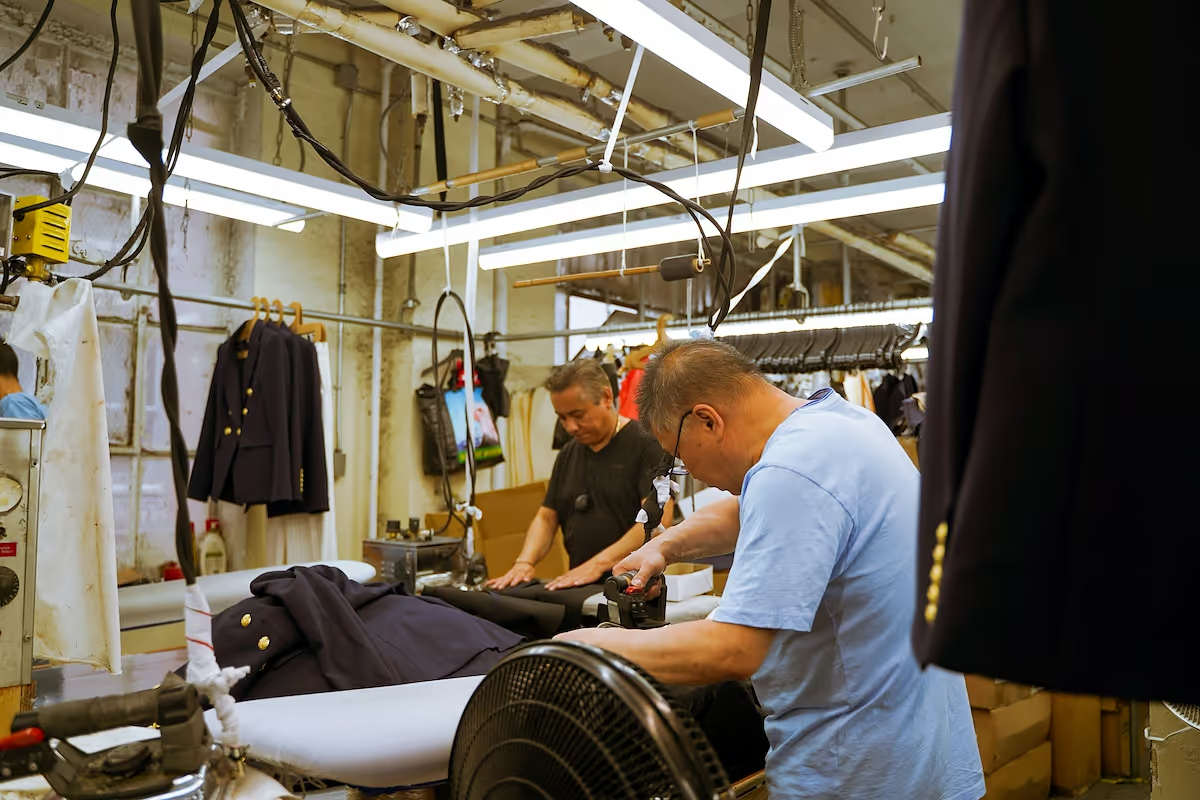
Starting a clothing manufacturing business is a rewarding venture that combines creative skills like design and pattern-making with sharp business savvy. The industry is a multi-billion dollar market, with steady demand for everything from everyday wear and formal attire to specialized sportswear.
This guide will take you through the practical steps of validating your business concept, securing funding, acquiring the right equipment, and building supplier relationships to help you launch a successful clothing manufacturing business in the U.S.
Step 1: Develop your business plan and validate your idea
First, define your niche. Will you produce sustainable activewear or custom formal wear? This focus helps you identify your ideal customer. You can then analyze market demand with trend reports from platforms like WGSN or by surveying potential buyers directly on social media.
Next, research your competitors. Use databases like Thomasnet to find other manufacturers and see their capabilities. You might also analyze their online presence to understand their marketing and customer base. This gives you a clear picture of the competitive landscape.
Startup cost breakdown
With your market research done, you can build a realistic budget. Initial costs for a small-scale operation often range from $10,000 to $25,000. This covers your primary expenses.
- Industrial Sewing Machines: $2,000 - $5,000 each
- CAD Software (e.g., Gerber AccuMark): Subscriptions start around $200/month
- Initial Fabric & Trim Inventory: $5,000 - $15,000
- Business Registration & Permits: $500 - $1,500
Many new owners underestimate fabric needs. A good practice is to budget for 15-20% more material than your patterns require. This buffer accounts for test runs, pattern matching, and potential defects in the fabric roll, which saves you from costly delays later.
Here are 3 immediate steps to take:
- Draft a one-page business plan that outlines your niche and target customer.
- Research three direct competitors to understand their offerings and pricing.
- Create a detailed startup budget based on actual quotes for equipment and materials.
Step 2: Establish your legal framework and licensing
First, choose a business structure. An LLC is a popular choice because it separates your personal and business assets. This structure also offers pass-through taxation, which simplifies your annual tax filings. A C Corp is more complex but may be better if you plan to seek venture capital.
Navigate federal, state, and local requirements
You will need a federal Employer Identification Number (EIN) from the IRS to hire employees and open a business bank account. It is free to obtain online. At the state level, a seller’s permit allows you to purchase fabric and materials wholesale without paying sales tax.
Many new owners overlook local rules. Before you sign a lease, confirm your location's zoning with the city planning department to ensure it allows manufacturing. You will also need a general business operating license from your city or county, which typically costs between $50 and $400.
The Consumer Product Safety Commission (CPSC) governs apparel labeling through the Textile Fiber Products Identification Act. Your product labels must accurately list fiber content, country of origin, and your business identity. Processing times for local permits can take two to four weeks.
Here are 4 immediate steps to take:
- File for an LLC with your state's Secretary of State.
- Apply for a free EIN on the IRS website.
- Contact your city clerk about business license and zoning requirements.
- Review the CPSC's guide on textile labeling rules.
Step 3: Secure your insurance and manage risk
With your legal structure in place, the next step is to protect your business. Insurance for a clothing manufacturer is not one-size-fits-all. You will need a few different policies to cover your unique operations from day one.
Key insurance policies for your factory
Your primary coverage will shield you from accidents, product issues, and employee injuries. Budgeting for this coverage early on prevents major financial shocks later. You might want to consider these policies:
- General Liability: Covers third-party injuries on your premises. Expect annual premiums of $500 - $1,500 for $1 million in coverage.
- Product Liability: Protects against claims if your clothing causes harm, like an allergic reaction to a dye. This can cost $1,000 - $3,000 annually.
- Workers’ Compensation: This is required in most states once you hire your first employee. It covers medical costs and lost wages from work-related injuries.
Many new owners underestimate product liability needs. A single claim from a defective zipper or a fabric that causes a rash could put you out of business. Always confirm your policy specifically covers apparel-related risks.
You should work with an agent who understands manufacturing. Consider providers like The Hartford, Hiscox, or Chubb, as they have experience with the specific risks of production, such as equipment failure or supply chain disruptions.
Here are 3 immediate steps to take:
- Get quotes for a business owner's policy that bundles general and product liability.
- Contact an insurance agent who specializes in manufacturing to review your needs.
- Check your state’s workers' compensation board for specific requirements.
Step 4: Set up your factory and source equipment
Start by looking for a space between 1,500 and 3,000 square feet. Your location needs to be zoned for light industrial or manufacturing use, which you can confirm with the city's planning department. This ensures you can operate without legal issues down the road.
When you review a lease, pay close attention to the electrical capacity. Many new owners find their space lacks the 3-phase power needed for industrial machines. Also, check for adequate ventilation to handle fabric dust. These are key negotiation points that can save you thousands in upgrades.
Source your production equipment
With your space chosen, you can now purchase machinery. You will need a few core machines to handle different seams and fabrics. Getting reliable equipment from the start prevents production delays and costly repairs.
- Lockstitch Machines: These are your workhorses for basic seams. Expect to pay $1,500 - $4,000 per machine.
- Overlock (Serger) Machines: These finish raw edges and create durable seams. Prices range from $2,000 to $5,000.
- Coverstitch Machines: Used for hemming knits and creating professional finishes. These cost about $2,500 - $6,000.
For machinery, look at suppliers like Atlanta Attachment Company. For fabrics, wholesalers like Carr Textile often have minimum order quantities. Be prepared to purchase a full bolt, which can be 50 to 100 yards per color.
Here are 4 immediate steps to take:
- Research commercial properties zoned for light industrial use in your area.
- Ask landlords about 3-phase power availability during property tours.
- Get quotes for lockstitch and overlock machines from a reputable supplier.
- Contact two fabric wholesalers to confirm their minimum order quantities.
Step 5: Set up your payment processing
Establish your payment terms
Most manufacturers require a 50% deposit to cover material costs, with the final 50% due upon shipment. This protects your cash flow. For large B2B orders, ACH transfers and checks are standard payment methods.
A frequent oversight is not formalizing these terms. Always use a signed contract that outlines due dates, deposit amounts, and late fees before you purchase any fabric for a client. This prevents payment disputes later.
Choose a payment solution
For manufacturers who need to accept payments on-site or on-the-go, JIM offers a streamlined solution. You can accept debit, credit, and digital wallets directly through your smartphone—just tap and done. It is useful for selling sample garments from your studio.
At just 1.99% per transaction with no hidden costs, it is more affordable than other providers who often charge 2.5% to 3.5%. Getting started is simple:
- Get Started: Download the JIM app for iOS.
- Make a Sale: Type the sales amount, hit sell, and ask your customer to tap their card or device on your phone.
- Access Funds: Your money is available on your JIM card as soon as the sale is done, with no waiting for bank transfers.
Here are 3 immediate steps to take:
- Draft standard payment terms (50% deposit) for your client contracts.
- Research ACH transfer services through your business bank account.
- Download the JIM app to explore its features for in-person sales.
Step 6: Secure funding and manage your finances
Explore your funding options
The SBA 7(a) loan is a popular choice for manufacturers. You can borrow up to $5 million, though loans for new businesses often fall in the $50,000 to $250,000 range. Interest rates typically hover around the Prime rate plus 2-3%.
If you only need funds for machinery, equipment financing is a direct route. Lenders finance the specific purchase, and the equipment itself serves as collateral. This often means a faster approval process than a traditional loan.
You might also look into grants. The Council of Fashion Designers of America (CFDA) sometimes offers programs. Also, check with your state's economic development agency for manufacturing-specific grants that do not require repayment.
Plan your working capital
You will need enough cash to cover operations for the first six months. This includes rent, payroll, and material costs before client payments create a steady income stream. A safe buffer is typically between $30,000 and $75,000 for a small factory.
What often surprises new owners is the delay in client payments, even with a 50% deposit. Budgeting for a 30- to 60-day payment cycle on final invoices protects your cash flow from this common strain.
Here are 4 immediate steps to take:
- Review the SBA 7(a) loan checklist on the SBA website.
- Contact a lender about equipment financing for your machinery needs.
- Search the CFDA website for current grant opportunities.
- Create a six-month operating budget to determine your working capital needs.
Step 7: Hire your team and set up operations
Your first hires will likely be sewing machine operators and a fabric cutter. These roles are the backbone of your production line. From there, you can build out your team as your order volume increases.
Key roles and expected salaries
When you write job descriptions, focus on experience with specific machines and fabrics. A mistake some new owners make is hiring for speed alone, which can compromise quality. Look for a balance of efficiency and attention to detail.
- Sewing Machine Operator: Operates lockstitch and serger machines. Expect to pay $18 to $25 per hour depending on skill and location.
- Cutter: Lays out patterns and cuts fabric accurately. Pay is often similar to an operator.
- Pattern Maker: You can hire a freelancer for this role initially. If you bring one in-house, salaries range from $50,000 to $75,000 annually.
Be sure to factor these wages, plus payroll taxes, into your garment pricing. Underestimating labor costs is a frequent issue that can quickly erode your profit margins.
Streamline your production workflow
A clear workflow prevents bottlenecks. Map out every step, from receiving fabric to the final quality check. You might want to use a production management system like Katana to track orders, manage inventory, and monitor progress on the factory floor.
As you grow, a good target is to generate $150,000 to $250,000 in revenue per employee. This metric helps you gauge your operational efficiency and decide when it is time to hire more staff.
Here are 4 immediate steps to take:
- Draft job descriptions for a sewing operator and a cutter.
- Research local hourly wages for apparel workers to create a competitive pay scale.
- Outline your production workflow, from fabric cutting to final quality check.
- Sign up for a free trial of a production management system like Katana.
Step 8: Market your business and acquire customers
Your first clients will likely come from B2B platforms. Create a detailed profile on Maker's Row or Thomasnet that showcases your factory's capabilities and equipment. These platforms connect you directly with designers and brands who need production partners.
You should also attend industry trade shows like Texworld USA or the Sourcing at MAGIC event. These are excellent for face-to-face networking. Prepare a line sheet with your pricing and minimum order quantities (MOQs) to hand out to potential clients.
Build your online presence
A professional website is your digital storefront. Feature high-quality photos of your work and list your services. Use SEO keywords like "cut and sew manufacturer USA" or "small batch apparel production" to attract organic traffic from search engines.
Many new owners create a portfolio that is too general. Instead, focus your website on a specific niche, like organic cotton t-shirts or technical outerwear. This demonstrates expertise and attracts higher-quality clients who seek specialized skills.
As you spend on marketing, track your customer acquisition cost (CAC). A reasonable CAC for a new manufacturing client can be between $500 and $2,000. This metric helps you measure the effectiveness of your marketing channels and adjust your budget accordingly.
Here are 4 immediate steps to take:
- Create a profile on a B2B platform like Maker's Row.
- Research SEO keywords relevant to your production niche.
- Develop a line sheet with your pricing and MOQs for trade shows.
- Plan your budget to attend one industry trade show this year.
Step 9: Develop your pricing strategy
Your pricing model determines your profitability. Most manufacturers use either a Cut, Make, Trim (CMT) model where clients provide materials, or a Full Package Production (FPP) model where you source everything. FPP offers higher margins but requires more working capital for fabric.
Calculate your cost per garment
To set a price, you first need your cost of goods sold (COGS). This includes direct labor, materials, and factory overhead. Many new owners forget to add overhead like rent and utilities into their per-unit cost, which eats into profits.
For example, the cost for one t-shirt might look like this:
- Direct Labor: $5.00 (15 minutes at $20/hour)
- Materials: $3.50 (fabric, thread, labels)
- Overhead: $1.70 (20% of labor and materials)
- Total COGS: $10.20
With your COGS calculated, you can add your profit margin. A healthy margin for apparel manufacturing is between 20% and 35%. If your COGS is $10.20 and you want a 25% margin, your price to the client would be $13.60 per unit.
Your pricing should also scale with order volume. A small batch of 50 units will have a higher per-unit price than a large order of 1,000 units. This is because your setup time and costs are spread across more items, which increases efficiency.
Here are 3 immediate steps to take:
- Decide between a CMT or FPP pricing model for your services.
- Calculate your factory's hourly overhead rate to apply to each job.
- Create a sample price sheet for a simple garment at different order volumes.
Step 10: Implement quality control and scale operations
With production underway, your focus shifts to consistency. A formal quality control (QC) process is your best defense against costly errors. Create a detailed checklist for every garment that specifies stitches per inch (SPI) and seam allowance tolerances, like +/- 1/8 inch.
You should track your defect rate, which is the number of faulty items per 100 units. A good target is below 3%. Also, monitor your on-time shipment rate. Aim to keep this above 95% to build client trust and secure repeat business.
Know when to grow
Growth should be data-driven. Once your revenue per employee exceeds $150,000 and your machine utilization is consistently above 80%, it might be time to hire or add another production line. Some owners jump at large orders too soon, which can strain the team and spike defect rates.
As you scale, a system like Katana might become limiting. You can look into more robust ERP software like ApparelMagic to manage complex inventories, multi-stage production orders, and financials all in one place. This helps maintain efficiency as your operation expands.
Here are 4 immediate steps to take:
- Create a QC checklist with specific SPI and seam allowance tolerances.
- Calculate your defect rate and on-time shipment rate from last month.
- Analyze your revenue per employee to see if it meets growth benchmarks.
- Schedule a demo for an ERP system like ApparelMagic to understand its features.
You have the steps to build your clothing factory. Success often comes from mastering the small things, like precise stitches and clear payment terms. Your attention to both craft and commerce will define your business. Now you have the plan, it's time to execute.
For handling those first payments, especially for samples, JIM turns your phone into a card reader. You can accept payments for a simple 1.99% fee without extra hardware. Download JIM and simplify your sales from day one.
.avif)