How to start a clothing rental business from idea to launch
See article summary
- Startup costs for a clothing rental business range from $7,000 to $30,000, covering inventory, software, and permits.
- Form an LLC and get a free EIN from the IRS before applying for state and local business licenses.
- A $1 million General Liability policy typically costs $400 to $900 annually for a small rental shop.
- Charge 10 to 20 percent of an item's retail value per 4-day rental and target a 40 to 60 percent gross margin.
- Track utilization rate, CAC, repair rate, and rental cycles per item to decide when to scale.
Starting a clothing rental business is a rewarding venture that blends a passion for fashion with sharp business savvy. The market is a multi-billion dollar industry, fueled by consistent demand for outfits for special occasions, professional events, and themed parties.
Startup budgets for a small clothing rental business typically run from $7,000 to $30,000, split across inventory, cleaning contracts, licensing, and marketing. The steps below show how to validate your concept, acquire inventory, secure funding, and obtain the right permits to launch in the U.S.
How do you plan and validate a clothing rental business idea?
Your first move is to pick a niche with provable demand and a gap you can fill. Define a specific category, such as maternity wear, high-end designer bags, or formal wear for men, instead of a general wardrobe. Use Google Trends to compare search volume across these niches before you buy a single garment.
Next, analyze your competition with real pricing data. National players set the ceiling for what customers expect to pay. Nuuly charges $98 per month for six items, while Rent the Runway tiers run from $129 to $275 per month for five to ten items. Source: Nuuly's and Rent the Runway's official websites, accessed August 2026. Search for local rental boutiques in your area too. This research helps you find a gap, such as a missing menswear formal category or a local same-day pickup option, that your business can fill.
Estimate your startup costs
Create a detailed budget before you spend a dollar. Initial investment can range from $7,000 to over $30,000 depending on your niche and inventory quality. Many new owners underestimate recurring expenses for professional dry cleaning and repairs, so factor those in from day one.
- Initial Inventory: $5,000 - $20,000
- Website & Booking Software: $1,000 - $5,000
- Dry Cleaning Contract/Setup: $500 - $2,000
- Marketing & Photography: $500 - $1,500
- Business Licenses & Permits: $300 - $1,000
Here are 4 immediate steps to take:
- Poll your target audience on social media about three potential niches.
- Analyze the website and pricing of two national and one local competitor.
- Create a preliminary budget spreadsheet with the cost categories above.
- Research business license requirements on your city's official website.
How do you set up your legal structure and get licensed?
Form a Limited Liability Company (LLC) to protect your personal assets and apply for a free federal tax ID before you open a business bank account. An LLC shields your personal assets if the business faces debt or lawsuits. Many new owners operate as a sole proprietor, which offers no such protection.
An LLC also offers pass-through taxation. Profits pass directly to you without the business itself paying federal corporate taxes. Once your structure is chosen, get a free Employer Identification Number (EIN) from the IRS. You will need it to open a business bank account.
State and local permits
Next, focus on state requirements. You will need a seller's permit, sometimes called a resale certificate, from your state's Department of Revenue. This allows you to collect sales tax. Expect to pay between $0 and $100, with processing times from a few days to several weeks.
Your city or county will also require a general business license to operate legally. Costs vary widely from $50 to over $400 depending on your location. Also, be aware of the FTC's Care Labeling Rule (16 CFR Part 423), which requires you to have clear cleaning instructions for all garments.
Here are 4 immediate steps to take:
- Decide between an LLC and a sole proprietorship for your business structure.
- Apply for a free Employer Identification Number (EIN) on the IRS website.
- Research seller's permit requirements on your state's Department of Revenue site.
- Contact your city clerk's office to ask about a general business operating license.
How do you protect a clothing rental business with insurance?
General Liability is your foundation, and a $1 million policy typically runs $400 to $900 annually based on quotes from small business insurers. Insurance for a rental business has unique considerations, so get the right coverage from the start.
Key insurance policies to consider
General Liability covers claims like a customer slipping in your showroom. A $1 million policy typically runs $400 to $900 annually. You will also want Property Insurance to protect your valuable inventory from theft, fire, or damage.
If you hire employees, Workers' Compensation is legally required in most states. For deliveries, you will need Commercial Auto insurance. Many new owners assume personal auto policies cover business use, but they often do not, creating a significant coverage gap.
When you shop for quotes, connect with insurers familiar with retail. Companies like The Hartford, Next Insurance, and Thimble often have relevant packages. A specialist can better understand the risks of damaged or unreturned designer garments.
Here are 4 immediate steps to take:
- Get quotes for a $1 million General Liability policy from two different providers.
- Draft a rental agreement clause that outlines fees for damaged or lost items.
- Research insurance providers like The Hartford, Next Insurance, or Thimble.
- Confirm if your personal auto policy covers business-related deliveries.
How do you set up a location and get the right equipment?
Find a 500 to 1,000 square foot retail space with commercial zoning and budget for garment racks, a steamer, and quality hangers before you sign a lease. Check that the location has a commercial zoning classification, often listed as C-1 or C-2. Many new owners underestimate the space needed for back-of-house tasks like steaming, repairs, and inventory storage.
When you negotiate a lease, ask about a Tenant Improvement (TI) allowance. This is a sum the landlord provides for you to build out fitting rooms or install custom lighting. Also, clarify rules on signage and any restrictions on alterations to the space before you sign.
Stock your space with the right gear
Your equipment directly impacts your customer experience and workflow. Invest in quality items from the start. For fixtures and packaging, check suppliers like Uline or Store Supply Warehouse, many of whom have no minimum order quantities.
- Commercial Garment Racks: $100 - $300 each
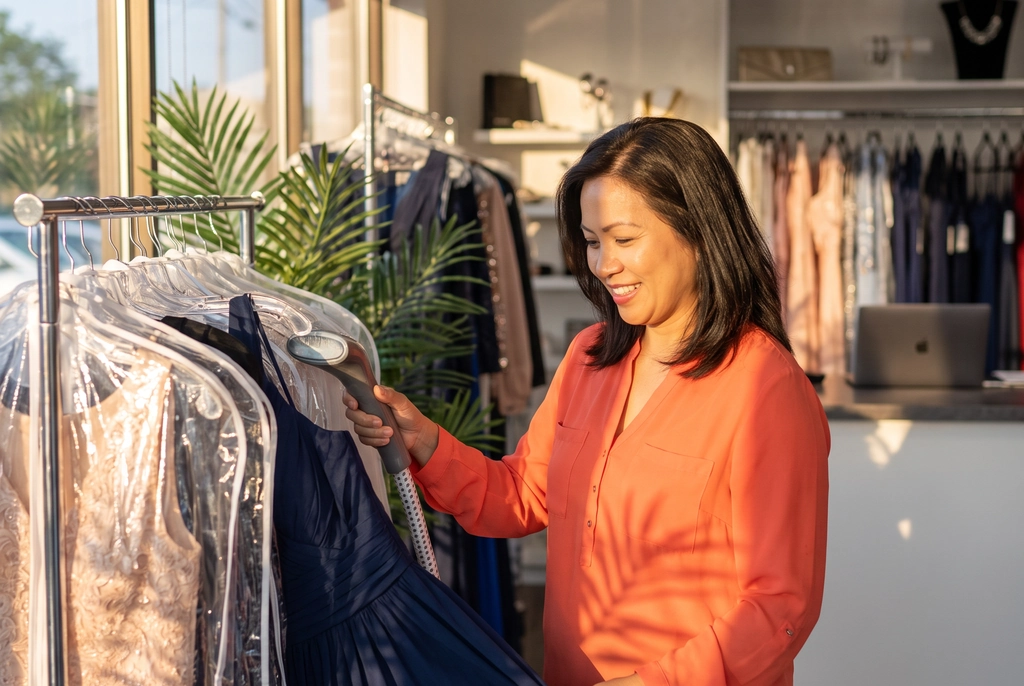
- Professional Garment Steamer: $200 - $500
- High-Quality Hangers (Velvet or Wood): $1 - $3 per hanger
- POS & Booking System: $50 - $150 per month
Velvet or wood hangers protect delicate fabrics from the stretch marks that cheap plastic hangers leave on shoulders and waistbands. One Austin boutique replaced its plastic hangers after a batch of silk dresses showed visible shoulder distortion within three rental cycles.
Here are 4 immediate steps to take:
- Research commercial spaces between 500-1,000 sq ft in your target neighborhood.
- Contact your city's planning department to confirm zoning for a retail business.
- Price out a commercial garment steamer and 100 wood hangers from a supplier.
- Draft a list of questions to ask landlords about tenant improvement allowances.
How do you set up payment processing for rentals?
Most rentals require full payment upfront plus a security deposit held on the customer's credit card, so your processor must handle pre-authorizations. The hold is released after the item returns safely. Many new owners pick any processor, then find it cannot manage deposit holds.
When you look for a payment solution, confirm it can manage pre-authorizations. Also, compare transaction fees. Average commission rates from other providers often range from 2.5% to 3.5% plus monthly charges, which can reduce your profit margins over time.
For a business that needs to accept payments on-site, JIM offers a streamlined solution. With JIM, you can accept debit, credit, and digital wallets directly through your smartphone. Just tap and the payment is done. At just 1.99% per transaction with no hidden costs or extra hardware, it is particularly useful for pop-up shops or fitting appointments.
- Get Started: Download the JIM app for iOS.
- Make a Sale: Type the sales amount, hit sell, and ask your customer to tap their card or device on your phone.
- Access Funds: Your money is available right on your JIM card as soon as the sale is done, no waiting for bank transfers.
Here are 4 immediate steps to take:
- Decide on the security deposit amount for your most valuable items.
- Compare two payment processors on their ability to handle deposit holds.
- Download the JIM app to see how it works for in-person sales.
- Draft your official payment terms for your rental agreement.
How do you secure funding and manage your finances?
The SBA Microloan program offers up to $50,000 for startup inventory and working capital, with interest rates typically between 8% and 13%. These loans are great for buying your initial inventory collection. Lenders often look for a solid business plan and a credit score above 640.
For a 0% interest option, consider Kiva. It is a crowdfunding platform where you can borrow up to $15,000. This route requires you to rally support from your personal network first, which also helps validate your business idea with real-world interest.
Plan your cash flow
You will need enough cash to cover at least six months of operating costs. This includes rent, marketing, and your dry cleaning bills. A frequent oversight is to underestimate how these recurring costs eat into revenue before your business gains momentum.
For example, if your monthly expenses are $3,000, aim for at least $18,000 in working capital. This buffer ensures you can handle repairs and slow months without stress. Also, look into the Amber Grant, which awards three $10,000 grants each month to women entrepreneurs, with monthly winners eligible for one of three $50,000 year-end grants. Source: Amber Grant Foundation.
Here are 4 immediate steps to take:
- Research two SBA Microloan lenders in your state.
- Calculate your estimated operating expenses for the first six months.
- Review the application requirements for the Amber Grant.
- Open a dedicated business bank account for your LLC.
How do you hire a team and set up daily operations?
Your first hire will likely be a part-time Style Consultant who handles fittings, processes rentals, and manages returns for $15 to $22 per hour. Expect to pay an hourly wage between $15 and $22, depending on your location and their experience in retail or fashion.
Streamline your daily workflow
To manage shifts, use scheduling software like Homebase or When I Work. These platforms help you create schedules and track hours. Manual scheduling becomes difficult during prom or wedding season when shift swaps and last-minute bookings pile up.
You should plan to hire your first employee once your business generates consistent income. A good benchmark is when revenue can comfortably cover their wages plus other operating costs. For example, you could decide to hire after you hit $5,000 in monthly sales.
While no formal certifications are required, look for candidates with customer service experience. You will need to train them on your specific booking software and garment care procedures to ensure every customer gets the same high-quality experience.
Here are 4 immediate steps to take:
- Draft a job description for a part-time Style Consultant.
- Research average retail wages in your city to set a competitive pay rate.
- Explore scheduling software options like Homebase or When I Work.
- Set a monthly revenue target that will trigger your first hire.
How do you market a clothing rental business and acquire customers?
Focus your initial marketing on visual platforms like Instagram and Pinterest, where rental fashion sees strong engagement from users planning events. Post high-quality photos of your garments on different body types, not just on hangers. Use a mix of local hashtags, like #NYCdressrental or #LAformalwear, to attract customers in your service area.
Beyond social media, local partnerships are powerful. Many new owners rely too heavily on paid ads. Instead, connect with wedding photographers and event planners. You can offer them a 10% referral fee for each client they send your way, creating a low-cost acquisition channel.
Measure your results
You need to know what works. Track your Customer Acquisition Cost (CAC) by dividing your monthly marketing spend by the number of new customers. For a rental business, a CAC under $50 is a good target. This metric tells you if your marketing dollars are spent effectively.
Consider a micro-influencer campaign. You could offer a free rental to a local fashion blogger with 5,000-10,000 followers in exchange for one feed post and three stories. This often yields a better return than a single post from a much larger, more expensive influencer.
Here are 4 immediate steps to take:
- Identify three local fashion influencers to propose a collaboration.
- Draft an outreach email to five local event planners about a referral program.
- Create a spreadsheet to track your monthly marketing spend and calculate your CAC.
- Plan your first two weeks of Instagram content, focusing on styled outfits.
How do you set a profitable pricing strategy?
Charge 10 to 20 percent of an item's retail value for a 4-day rental, or offer a monthly subscription, and target a 40 to 60 percent gross margin per rental. Your pricing model directly impacts your profitability. Most clothing rental businesses use either a per-item rental model or a subscription service. You might want to start with one and add the other later as you grow.
Price per garment
A solid starting point for a 4-day rental is to charge 10-20% of an item's retail value. For instance, a $500 designer dress would rent for $50 to $100. This approach is straightforward for customers who need an outfit for a single event.
Many new owners set prices without a full cost analysis. Remember to factor in dry cleaning ($10-$25 per item), repairs, and shipping. These expenses can consume over 30% of your rental fee if you do not account for them upfront.
Offer a subscription
With a subscription, customers pay a flat monthly fee for a set number of items. You could offer a plan like four items per month for $99. This model helps create predictable, recurring revenue, which smooths out cash flow during slower seasons.
Unit economics for one designer dress
The table below shows a worked example for a single $500 designer dress rented ten times before retirement. It assumes a $75 rental fee, $15 dry cleaning per cycle, and $5 in repairs and packaging per cycle.
| Line item | Amount |
|---|---|
| Purchase cost | $500 |
| Rental fee per cycle | $75 |
| Cleaning and repairs per cycle | $20 |
| Net revenue per cycle | $55 |
| Total net revenue (10 cycles) | $550 |
| Lifetime gross profit | $50 |
Even at the low end of the 10-20% pricing rule, this dress breaks even on the seventh rental and turns a modest profit by cycle ten. Track each item's revenue against its associated costs to confirm every piece in your collection is profitable.
Regardless of the model, you should aim for a gross profit margin of 40-60% per rental. Use a simple spreadsheet to track each item's revenue against its associated costs to ensure every piece in your collection is profitable.
Here are 4 immediate steps to take:
- Analyze the pricing of two national competitors and one local boutique.
- Calculate a 4-day rental price for three items at 15% of their retail value.
- Outline a per-item and a subscription pricing tier for your business plan.
- List all costs per rental (cleaning, repairs, shipping) to calculate your margin.
How do you maintain quality and scale your business?
Implement a quality control system
To protect your brand, create a strict quality check for every garment. Use a three-point inspection upon return and before dispatch. Check for stains, tears, and faulty zippers. This simple process prevents sending a damaged item to a customer.
You should track your performance with data. Aim for a customer complaint rate below 2%. Also, log repairs for each garment. If a dress needs repairs after every other rental, it might be time to retire it from your collection.
Track your rental health with four KPIs
A simple Rental Health Scorecard helps you decide when to buy more inventory, raise prices, or retire a garment. Track these four metrics monthly:
- Utilization rate: percentage of inventory out on rental. Above 75% for a category means buy more.
- Customer Acquisition Cost (CAC): marketing spend divided by new customers. Keep under $50.
- Repair rate: repairs per garment per cycle. Above 0.5 signals retirement.
- Rental cycles per item: total rentals before retirement. Higher means better unit economics.
When a category, like formal gowns, has a utilization rate over 75%, it is time to invest in more inventory for that section. This ensures you grow based on proven demand, not just trends.
Know when to grow
As you expand, you cannot do everything yourself. Once you handle over 100 rentals a month, you might want to hire a dedicated person for inspections and repairs. This frees you to focus on strategy and marketing.
To manage a larger operation, consider rental-specific software like Booqable or Rentle. These platforms help you track hundreds of items, manage bookings, and automate customer communication, which is difficult to do with spreadsheets alone.
Here are 4 immediate steps to take:
- Create a three-point inspection checklist for garment returns.
- Set up a spreadsheet to track utilization rates for your top five categories.
- Define a monthly rental volume that will trigger your first specialist hire.
- Explore a demo for a rental management software like Booqable or Rentle.
Starting a clothing rental business is a journey that blends fashion with logistics. Remember that your success depends on the quality of each rental experience, from inspection to return. You have the roadmap, so go ahead and build the closet your community has been waiting for.
And when you make that first rental, a simple payment process helps. JIM lets you accept cards directly on your smartphone for a flat 1.99% fee, with no extra hardware needed. Download JIM and you are ready for business.
Frequently Asked Questions
Is a clothing rental business profitable?
How much does it cost to start a clothing rental business?
Do you need a license to rent out clothes?
What insurance does a clothing rental business need?
How many items should you start with for a clothing rental business?



Sell and get paid in seconds with Jim