Starting a coloring book business is a rewarding venture that combines artistic creativity with smart business planning. The global market for these books is a multi-billion dollar industry, with steady demand from adults who seek relaxation, parents who want educational activities, and even therapeutic settings.
This guide will take you through the practical steps of validating your concept, building supplier relationships, obtaining licenses, and securing funding to help you launch a successful coloring book business in the U.S.
Step 1: Plan your business and validate your idea
Find your niche
Start by researching specific niches. Use Google Trends to compare search interest for terms like "mindfulness coloring books" versus "botanical coloring books." This data helps you spot popular or rising themes.
Many new sellers make the mistake of creating a generic book. Instead of a general "animal" theme, focus on a sub-niche like "deep-sea creatures" or "farmyard animals for toddlers" to attract a dedicated audience.
With a niche in mind, analyze competitors on Amazon. You can use software like Publisher Rocket to view estimated sales data for existing books. Also, browse Etsy and Pinterest to identify visual trends and gaps in the market.
Estimate your startup costs
Your initial investment can vary. If you hire an illustrator from a site like Upwork, expect to pay $50 to over $500 for the artwork. An initial print run of 100-200 books could range from $500 to $1,500.
You will also need an ISBN for each unique book. A single ISBN from Bowker costs $125, but a block of 10 for $295 is more economical if you plan to publish multiple titles. Budget another $100-$500 for basic marketing.
Here are 3 immediate steps to take:
- Identify three potential coloring book niches using Google Trends and Amazon's best-seller lists.
- Analyze the top five competitors in your primary niche to find their strengths and weaknesses.
- Create a startup budget that includes estimates for illustration, a small print run, and purchasing an ISBN.
Step 2: Form your legal entity and secure licenses
Choose your business structure
You should consider forming a Limited Liability Company (LLC). This structure separates your personal assets from business debts. State filing fees typically range from $50 to $500. Many new owners make the mistake of operating as a sole proprietor, which offers no liability protection.
You can file the LLC paperwork directly through your state's Secretary of State website. As your business grows, you might discuss an S Corp election with an accountant to potentially reduce your tax burden on profits.
Secure copyrights and permits
Protect your artwork by registering it with the U.S. Copyright Office. An online application costs about $45-$65 and is the best way to defend your intellectual property. This step is fundamental before you go to print.
You will also need a seller's permit from your state's department of revenue to collect sales tax. This is usually free. Finally, obtain a general business license from your city or county, which can cost between $50 and $200 annually.
Here are 3 immediate steps to take:
- File for an LLC with your state's Secretary of State to protect your personal assets.
- Register your completed coloring book designs with the U.S. Copyright Office.
- Apply for a state seller's permit and a local business license.
Step 3: Protect your business with insurance
Your main focus should be a policy that combines general and product liability. Product liability is non-negotiable; it protects you if someone claims your book caused harm, such as from toxic materials. A general liability policy covers other accidents, like property damage.
Many new publishers overlook product liability, assuming their home-based business is low-risk. This is a mistake. You should look for a policy with at least $1 million in coverage. This combined protection often comes in a Business Owner's Policy (BOP).
For a small operation, expect annual premiums between $500 and $1,200. You might want to get quotes from providers that work with e-commerce sellers. Consider companies like Hiscox, The Hartford, or Next Insurance to start your search.
If you store significant inventory, add commercial property insurance to your BOP to cover theft or damage. Once you hire employees, workers' compensation is legally required. This covers medical costs and lost wages if an employee gets hurt on the job.
Here are 3 immediate steps to take:
- Request quotes for a Business Owner's Policy (BOP) that includes both general and product liability.
- Confirm with an agent that your policy specifically covers claims related to physical products sold to the public.
- Compare annual premium costs from at least three insurers, such as Hiscox, The Hartford, and Next Insurance.
Step 4: Set up your workspace and source materials
Design space and equipment
Most coloring book businesses begin in a home office. You only need about 100-150 square feet. Check your local city ordinances for rules on home-based businesses, especially if you plan to store significant inventory later on.
Your main purchases will be for design. A starter drawing tablet from Wacom or Huion costs between $50 and $200. For software, you can use Adobe Illustrator for a monthly fee or buy Affinity Designer with a one-time payment of around $70.
Printing and production
You have two main printing paths. Print-on-demand (POD) services like Amazon KDP and IngramSpark let you upload files and print books only when a customer orders one. This route has no upfront inventory cost, which is perfect for testing your first book.
For better profit margins, you can use an offset printer for a bulk order. Minimums are typically 500-1,000 books. This dramatically lowers your per-book cost but requires you to manage storage and shipping. Many new sellers underestimate the space needed for 500 books.
Here are 3 immediate steps to take:
- Compare the royalty structures of Amazon KDP and IngramSpark for print-on-demand.
- Create a budget for starter design tools, including a drawing tablet and software like Affinity Designer.
- Request a price quote from a local offset printer for a 500-book run to see the cost difference.
Step 5: Set up your finances and payment processing
First, open a dedicated business bank account. This separates your personal and business funds, which simplifies bookkeeping and tax filing. It also reinforces the liability protection you established with your LLC.
Set up payment processing
For online sales through a platform like Shopify, you will use its built-in system. These processors typically charge around 2.9% + $0.30 per transaction. Many new sellers simply absorb this cost for the convenience it offers.
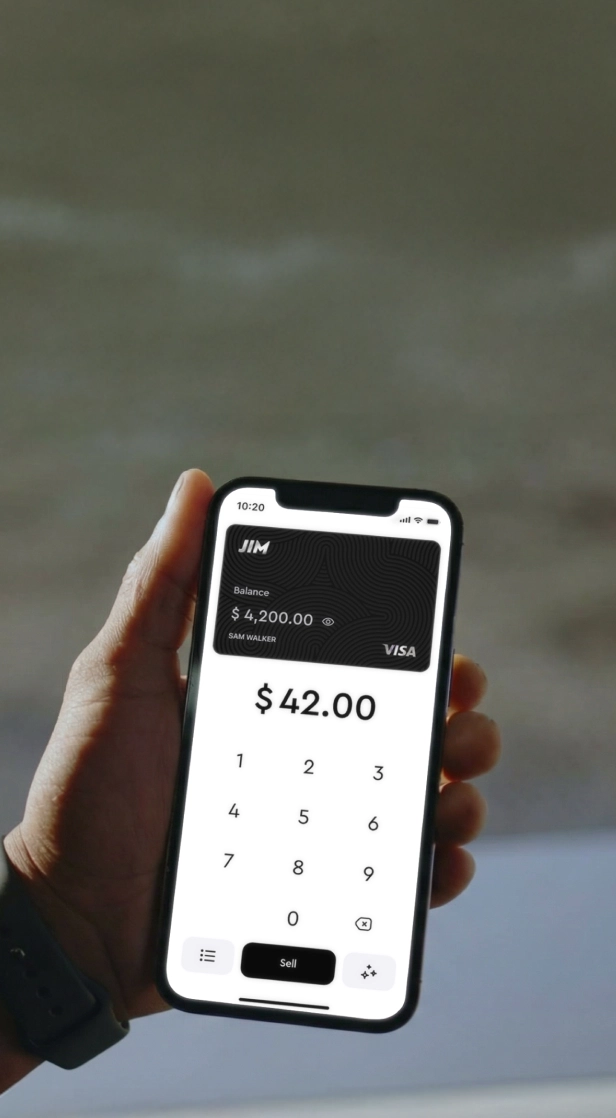
When you sell in person at markets or events, you have more control over fees. For coloring book businesses that need to accept payments on-site or on-the-go, JIM offers a streamlined solution. With JIM, you can accept debit, credit and digital wallets directly through your smartphone - just tap and done.
At just 1.99% per transaction with no hidden costs or extra hardware needed, it's particularly useful when you sell at art fairs or local pop-ups. This rate is competitive, as other processors often charge between 2.5% and 3.5% plus monthly fees.
- Get Started: Download the JIM app for iOS.
- Make a Sale: Type the sales amount, hit sell, and ask your customer to tap their card or device on your phone.
- Access Funds: Your money is available right on your JIM card as soon as the sale is done - no waiting for bank transfers.
Here are 3 immediate steps to take:
- Open a dedicated business bank account to keep your finances separate.
- Review the transaction fees for the payment processor on your chosen e-commerce platform.
- Download the JIM app to prepare for in-person sales opportunities.
Step 6: Secure funding and manage your finances
Find your startup capital
For a coloring book business, you likely will not need a massive bank loan. Instead, look at smaller, more accessible options. SBA Microloans are a great fit, with amounts from $500 to $50,000 offered through nonprofit lenders. Interest rates typically fall between 8% and 13%.
You might also explore grants. The Amber Grant gives $10,000 monthly to women entrepreneurs. In addition, check with your local arts council. They often have small grants for creative projects, which a unique coloring book concept could qualify for.
Calculate your working capital
With your funding source in mind, calculate your working capital for the first six months. If you use print-on-demand, a budget of $2,000 to $5,000 is a realistic start. This covers marketing, new illustrations, software fees, and other operational costs.
Many new owners only budget for the initial print run and forget about the ongoing expenses. This oversight can stall your business just as it starts to gain momentum. A clear six-month budget helps you avoid this cash flow trap.
Here are 3 immediate steps to take:
- Research two SBA Microloan lenders that operate in your state.
- Identify one local arts grant or a national program like the Amber Grant to apply for.
- Create a detailed six-month budget to determine your exact working capital needs.
Step 7: Hire your team and set up operations
Hiring your first collaborators
You will likely start as a one-person operation, but your first hire will be a freelance illustrator. You can find talent on platforms like Upwork or Fiverr. Expect to pay between $20 and $50 per page, or a flat fee per book.
Many new publishers stumble by not using a "work-for-hire" agreement. Without this contract, the artist may retain rights to the artwork. Always have a signed agreement that clearly transfers all intellectual property rights to your business before any work begins.
Managing your daily workflow
As a solopreneur, you can manage projects with simple software like Trello or Asana. Once you start selling, your e-commerce platform's dashboard will handle most order management. Avoid paying for extra software until you have consistent sales.
When you reach around $1,000 in monthly revenue, consider hiring a part-time Virtual Assistant (VA) for $15-$25 per hour. A VA can manage customer service emails and social media posts, which frees you up to focus on creating new books and marketing.
Here are 3 immediate steps to take:
- Draft a simple "work-for-hire" agreement template for freelance illustrators.
- Review the portfolios of three illustrators on Upwork to gauge style and pricing.
- List the specific customer service and social media tasks you would delegate to a VA.
Step 8: Market your book and find customers
Build an audience on social media
Focus your efforts on visual platforms like Pinterest and Instagram. Create boards on Pinterest that match your niche. You can share finished coloring pages from your book, which helps people discover your art style and drives traffic to your sales page.
On Instagram, post short video clips of pages being colored. Time-lapse videos perform very well. You might also collaborate with micro-influencers in the "adult coloring" or "planner community" niches. They often have highly engaged audiences and charge less than larger accounts.
Run targeted ads
Once you have a presence, consider running Amazon Ads. A daily budget of $10-$20 can get your book in front of active shoppers. Aim for an Advertising Cost of Sale (ACoS) below 30% to stay profitable. Many new sellers just boost a post, which rarely leads to sales.
Instead, use Facebook's Ads Manager to create a campaign that targets users interested in coloring, mindfulness, or your specific niche. This gives you much more control and better results than a simple boosted post.
Here are 3 immediate steps to take:
- Create a Pinterest board for your book's theme and pin 10 relevant images.
- Identify and contact three micro-influencers in the art or mindfulness space for potential collaboration.
- Set up a small Amazon Ads campaign with a daily budget of $10 to test keywords.
Step 9: Set your prices and choose sales channels
Develop your pricing strategy
Your pricing depends heavily on your printing method. With print-on-demand (POD) like Amazon KDP, you set a list price and earn a royalty. For a $12.99 book, your royalty might be around $4-$5 after printing and platform fees.
If you use offset printing, your per-book cost could be $2-$4. A common strategy is to apply a 4x-5x markup for your retail price. So, a book that costs $3 to print would be priced between $12 and $15.
Many new sellers underprice their books to compete, but this can signal low quality. Look at the top five books in your niche on Amazon. You should price your book within that range, factoring in your page count and illustration complexity.
Select your sales channels
Where you sell impacts your profit. Selling on your own Shopify site gives you the highest margin. Marketplaces like Amazon and Etsy take a larger cut but provide a huge built-in audience. You might also consider local opportunities.
If you plan to sell to local bookstores, your pricing model must account for wholesale. Shops typically expect a 50% discount off the retail price. Your $14.99 book must still be profitable when you sell it to them for about $7.50.
Here are 3 immediate steps to take:
- Use Amazon KDP's calculator to find the royalty for your book at three different price points ($9.99, $12.99, and $15.99).
- Analyze the prices of the top three best-selling books in your specific niche.
- Calculate a retail price for an offset-printed book that ensures profitability after a 50% wholesale discount.
Step 10: Maintain quality and scale your business
Establish your quality standards
Your book's physical quality is a major selling point. You should aim for paper that is at least 70-80 lb stock. This thickness prevents markers from bleeding through. Also, print your designs on single-sided pages to give customers a better coloring experience.
Before any large print run, always order a physical proof copy. Many new sellers skip this step and later find printing errors like misaligned pages or smudged ink. A proof lets you catch these issues when they are cheap to fix.
Know when to grow
With your quality locked in, you can set benchmarks for scaling. A good rule of thumb is to explore offset printing once you consistently sell 50-100 books per month. This move can significantly improve your profit margins per book.
As for hiring, track your time. If you spend more than 10 hours a week on administrative work like answering emails, it is time to find a virtual assistant. This frees you to focus on creating new products and marketing your business.
Here are 3 immediate steps to take:
- Define a quality checklist for your books, including a minimum paper weight and a rule to always order a proof.
- Set a monthly sales goal (e.g., 75 units) that will trigger your research into offset printing options.
- Track your administrative hours for one week to determine if you need to hire a virtual assistant.
Your coloring book journey is about more than just art; it's about creating a tangible product people love. Remember that paper quality and a focused niche are what build a loyal audience. You have a clear path forward, so trust your creative vision and get started.
And when you make your first sales at a local fair, a simple payment solution helps. JIM lets you accept cards right on your smartphone for a flat 1.99% fee, with no extra hardware. Download JIM to be ready for your first customer.
.avif)