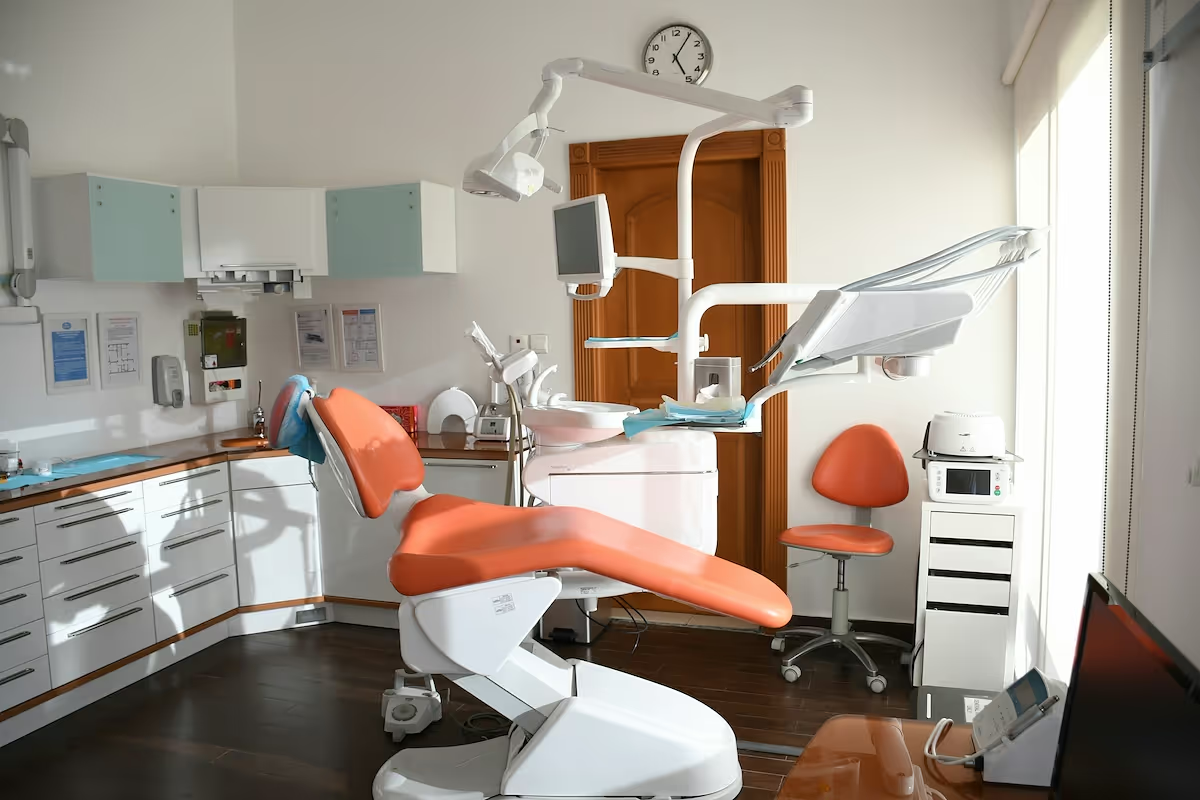
Starting a dental clinic is a rewarding venture that combines clinical expertise and patient care with business savvy. The industry is valued in the hundreds of billions, driven by a steady demand for dental care from families, professionals, and older adults.
This guide will take you through the practical steps of securing funding, obtaining licenses, selecting the right location, and acquiring equipment to help you launch a successful dental clinic business in the U.S.
Step 1: Create your business plan and validate the market
First, define your ideal patient. Use data from the U.S. Census Bureau to analyze the age, income levels, and population density of potential neighborhoods. The American Dental Association also provides reports that can help you understand local market saturation and patient needs.
Analyze your local competition
Map out every dental office in your target area using Google Maps. Visit their websites and review platforms like Healthgrades to see their offered services, patient feedback, and specialization. A common oversight is to ignore specialized practices that may still compete for your target patients.
Forecast your startup costs
A realistic financial forecast is key for loan applications. Initial investments for a new dental clinic typically range from $350,000 to over $500,000. Your budget should account for several major expenses.
- Dental Equipment: $125,000 - $200,000
- Office Construction/Renovation: $75 - $250 per square foot
- Technology and Software: $20,000 - $40,000
- Working Capital (3-6 months): $50,000 - $100,000
Here are 3 immediate steps to take:
- Analyze demographic data from the U.S. Census Bureau for two potential locations.
- List five direct competitors and note their primary services and online review scores.
- Draft a preliminary startup budget using the cost categories provided.
Step 2: Secure your legal structure and licenses
You might want to consider an LLC or an S-Corp for your business structure. Both offer liability protection and pass-through taxation, which is often ideal for new practices. A frequent oversight is choosing a structure without professional advice, so consult a CPA to review your options.
Your state's Board of Dentistry is the primary regulatory body. You will need a state dental license to practice, but your clinic also needs its own facility permit. Start the application for the facility permit early, as processing can take 60-90 days.
Handle federal and local requirements
You will also need a National Provider Identifier (NPI), which is free but mandatory for billing. To prescribe medications, you must register with the Drug Enforcement Administration (DEA). This registration currently costs $888 and is valid for three years.
On the local level, secure a general business license and a Certificate of Occupancy from your city or county. If you plan renovations, you will need building permits, which can add several thousand dollars to your budget and take weeks to approve.
Here are 4 immediate steps to take:
- Consult a CPA to choose between an LLC and an S-Corp.
- Contact your state's Board of Dentistry for a facility permit application.
- Apply for your free National Provider Identifier (NPI) number.
- Check local city requirements for a business license and Certificate of Occupancy.
Step 3: Set up your insurance and manage risk
Protecting your new practice from day one is non-negotiable. You will need several types of insurance to cover risks from patient claims to equipment failure. A good starting point is to budget between $5,000 and $12,000 annually for your initial insurance package.
Key insurance policies for your clinic
Professional liability, or malpractice insurance, is your top priority. A standard policy provides $1 million per claim and $3 million total coverage, with annual premiums for a new dentist often ranging from $2,000 to $5,000.
Next, look for a Business Owner's Policy (BOP). This bundles general liability and property insurance. Many new owners forget to include business interruption coverage, which protects against lost income if you must temporarily close after an incident like a fire or flood.
You will also need workers' compensation insurance as soon as you hire your first employee. If the clinic owns a vehicle, a commercial auto policy is also required. With this in mind, you might want to get quotes from providers who specialize in dental practices.
- The Doctors Company
- MedPro Group
- Dentist's Advantage
- Fortress Insurance
Here are 4 immediate steps to take:
- Get a quote for a $1M/$3M professional liability policy.
- Ask about adding business interruption coverage to your Business Owner's Policy.
- Request quotes from two dental-specific insurers, such as MedPro Group or The Doctors Company.
- Confirm your state's workers' compensation requirements before you hire staff.
Step 4: Find your location and equip your clinic
Look for a space between 1,500 and 2,500 square feet, which can accommodate two or three operatories. Confirm the property is zoned for medical or commercial use. This check upfront helps you avoid significant delays with city permits later on.
Negotiate your lease terms
When you find a spot, negotiate a Tenant Improvement (TI) allowance. You can often ask for $50 to $100 per square foot to offset construction costs. Many new owners also forget to secure an exclusivity clause, which prevents the landlord from leasing to another dentist.
Purchase your core equipment
With your location secured, it is time to equip your operatories. This part of your budget requires careful planning. You can get package deals from suppliers like Henry Schein or Patterson Dental. Expect to allocate funds for several key items.
- Dental Chairs: $8,000 - $15,000 each
- Digital X-ray System: $25,000 - $40,000
- Sterilization Autoclave: $4,000 - $8,000
- Handpieces and Instruments: $10,000 - $20,000
Here are 4 immediate steps to take:
- Identify three potential locations zoned for medical or commercial use.
- Ask for a Tenant Improvement (TI) allowance in your lease proposal.
- Request an equipment package quote from a supplier like Henry Schein.
- Insist on an exclusivity clause during lease negotiations.
Step 5: Set up your payment and billing systems
You should require payment at the time of service. Most patients will pay with credit or debit cards, but you also need a process to handle financing through providers like CareCredit. A mistake many new clinics make is not having a clear financial policy from day one.
Choose your payment processor
Your payment processor should integrate with your practice management software. Many providers charge between 2.5% and 3.5% per transaction, plus monthly fees. You will want to compare these rates carefully as they impact your clinic's profitability directly.
For clinics that need a simple way to take payments on-site, JIM offers a streamlined solution. With JIM, you can accept debit, credit, and digital wallets directly through your smartphone—just tap and done. At just 1.99% per transaction with no hidden costs or extra hardware needed, it is particularly useful to collect co-pays at the front desk.
Getting started is straightforward:
- Get Started: Download the JIM app for iOS.
- Make a Sale: Type the sales amount, hit sell, and ask your customer to tap their card or device on your phone.
- Access Funds: Your money is available right on your JIM card as soon as the sale is done—no waiting for bank transfers.
Here are 3 immediate steps to take:
- Draft a financial policy that clearly states payment is due at the time of service.
- Compare the transaction fees of two traditional payment processors with JIM.
- Confirm that your chosen payment system integrates with your practice management software.
Step 6: Secure your funding and manage finances
You might want to look at lenders with dedicated healthcare divisions. Banks like Wells Fargo Practice Finance or Bank of America Practice Solutions understand the dental industry and often provide loans up to $500,000 for new practices with competitive rates.
In addition, the Small Business Administration (SBA) offers strong programs. The SBA 7(a) loan is a popular choice that can cover equipment, working capital, and real estate. Interest rates are typically the Prime rate plus 2.25% to 2.75%.
Plan your working capital
Many new owners focus on equipment costs but underestimate their initial operating expenses. You will need enough working capital to cover at least six months of payroll, rent, supplies, and marketing. A safe target is between $75,000 and $150,000 before you have consistent patient revenue.
Here are 4 immediate steps to take:
- Contact a lender with a healthcare finance division to discuss loan options.
- Review the eligibility requirements for an SBA 7(a) loan.
- Calculate your estimated operating costs for six months to set a working capital goal.
- Ask your equipment supplier about their in-house financing options.
Step 7: Hire your team and set up operations
Build your core clinical and admin team
Your initial team will likely include a Dental Hygienist, a Dental Assistant, and an Office Manager. A hygienist handles cleanings and patient education, with salaries around $77,000 annually. A dental assistant supports you chairside and manages sterilization, typically earning about $42,000 per year.
The office manager is your front-desk anchor for scheduling and billing, with a salary near $45,000. Many new owners hire based on personality alone. You should always verify credentials and call references to confirm experience and reliability before you make an offer.
Choose your systems and ensure compliance
Your hygienist must have a state license. For dental assistants, certification requirements vary by state, especially for tasks like taking X-rays. You will want to confirm your state's specific rules with the Board of Dentistry to avoid compliance issues down the road.
Next, select your practice management software. Systems like Dentrix, Eaglesoft, and Open Dental integrate scheduling, patient records, and billing. As a financial benchmark, aim to keep total staff salaries between 20% and 25% of your clinic's gross revenue to maintain profitability.
Here are 4 immediate steps to take:
- Draft job descriptions for a dental hygienist, dental assistant, and office manager.
- Check your state's dental board for assistant certification requirements.
- Schedule demos for two practice management systems like Dentrix or Eaglesoft.
- Set a preliminary staff budget at 20-25% of your projected revenue.
Step 8: Market your clinic and acquire patients
Focus on digital marketing
Your Google Business Profile is your most powerful free marketing asset. Fill it out completely and encourage your first patients to leave reviews. Aim to get 10-15 positive reviews within your first 90 days to build immediate credibility online.
You will also need a professional website. It does not need to be complex. Just ensure it clearly lists your services, insurance information, and provides a simple way for patients to request an appointment. This is your digital front door.
Use targeted local outreach
Direct mail can still be very effective for a dental clinic. Consider sending postcards to new residents or specific zip codes near your practice. A campaign can cost between $0.50 and $1.50 per mailer.
Many new owners focus only on digital ads and forget community engagement. Sponsoring a local youth sports team or participating in a neighborhood health fair can build trust and name recognition far more effectively than a simple online ad.
A good benchmark for patient acquisition cost (CAC) is between $150 and $300 per new patient. Plan your initial marketing budget to be around 3-5% of your projected first-year revenue to support these efforts.
Here are 4 immediate steps to take:
- Create and fully optimize your Google Business Profile.
- Plan a direct mail campaign for two zip codes near your clinic.
- Set a marketing budget at 3-5% of your first-year revenue projection.
- Ask your first 10 patients to leave a Google review.
Step 9: Develop your pricing and financial strategy
Establish your fee schedule
Most clinics use a Fee-for-Service model. Your fees should align with the Usual, Customary, and Reasonable (UCR) rates in your area. You can research these costs for your zip code using the FAIR Health Consumer database to set a competitive baseline.
A mistake some new practices make is to compete solely on price. This can devalue your expertise. Instead, you might want to create an in-house membership plan for uninsured patients. An annual fee could cover preventive care and offer a 10-15% discount on other treatments.
Calculate your profit margins
A healthy dental practice often targets a net profit margin between 35% and 40%. To hit this, you need to mark up your costs appropriately. For procedures that require lab work, like crowns, a standard markup is 2 to 2.5 times the lab fee.
You should review and adjust your entire fee schedule annually. Costs for supplies and labor increase over time, and your pricing must reflect that to protect your profitability. This is a step many owners forget after their first year.
Here are 4 immediate steps to take:
- Research UCR fees for five common procedures in your zip code.
- Outline a basic in-house membership plan with pricing and included services.
- Call three local competitors to ask for their new patient exam and cleaning price.
- Draft a preliminary fee schedule that includes a 2x markup on lab costs.
Step 10: Maintain quality and scale your practice
Measure your clinical performance
To ensure quality, you should track your patient retention rate. A healthy practice keeps over 85% of its patients year-over-year. Also, monitor your case acceptance rate for major treatments. A rate of 50-60% shows patients trust your recommendations.
You can use patient satisfaction surveys to get direct feedback. A simple Net Promoter Score (NPS) survey after each visit provides valuable insight. Many owners overlook this, missing a chance to fix small issues before they become big problems.
Know when to grow
Growth decisions should be data-driven. When your hygienist is booked 3-4 weeks in advance, it is time to hire another one. You might want to consider an associate dentist once your own schedule is full 4-6 weeks out.
For physical expansion, watch your operatory usage. If your chairs are in use more than 80% of the time, you can justify adding another operatory. This prevents burnout and long wait times for patients.
To manage this growth, look at practice analytics software like Dental Intelligence or Jarvis Analytics. These platforms integrate with your existing systems to track key performance indicators and help you make informed decisions without manual spreadsheets.
Here are 4 immediate steps to take:
- Calculate your patient retention rate from the last 12 months.
- Review your hygienist’s schedule to check booking density.
- Schedule a demo for a practice analytics platform like Dental Intelligence.
- Set a goal for your case acceptance rate for the next quarter.
You now have a clear path to open your dental clinic. Beyond the licenses and equipment, remember that your success hinges on patient trust. Every interaction matters. With this guide, you are well-equipped to build a practice that lasts.
And for those interactions, a smooth payment process helps. JIM lets you accept cards right on your smartphone for a 1.99% transaction fee, no extra hardware needed. This keeps checkout simple for everyone. Download JIM and see for yourself.
.avif)