Starting a direct mail marketing business is a rewarding venture that combines creative design and data analysis with sharp business savvy. The industry pulls in tens of billions of dollars annually, fueled by a steady demand from local businesses, real estate agents, and service providers who rely on it to reach customers.
This guide will take you through the practical steps of validating your business concept, acquiring the right equipment, building supplier relationships, and securing funding to help you launch a successful direct mail marketing business in the U.S.
Step 1: Plan your business and validate your market
Market research and competitor analysis
Start by defining your target area. Use the USPS Every Door Direct Mail (EDDM) online tool to view demographic data and mail routes in specific zip codes. This shows you potential client density and helps you understand the landscape.
Next, identify your competitors. Search online for "direct mail services" in your city and analyze their offerings. You can also check advertising databases like SRDS to see who is active and what rates they command.
Many new owners make the mistake of targeting everyone. Instead, find a niche. You could focus on real estate agents, restaurants, or home service providers. A specialized approach makes your marketing more effective.
Estimate your startup costs
Speaking of costs, your initial investment will likely fall between $10,000 and $40,000. This figure depends on whether you buy equipment upfront or lease it. A thoughtful budget prevents financial strain as you launch.
Here is a typical breakdown:
- Equipment: A production printer can run from $5,000 to $20,000. A folder and inserter machine might add another $3,000 to $15,000.
- Software: Plan for design software like Adobe Creative Cloud ($60/month) and list management software ($50-$200/month).
- Initial Operations: Set aside $1,000-$3,000 for business registration, permits, and your own marketing materials.
Remember to account for postage in your pricing model from day one. It can represent over half of a project's cost, and underestimating it can quickly erase your profits.
Here are 3 immediate steps to take:
- Research five local competitors and document their services and pricing.
- Use the USPS EDDM tool to analyze mail volumes in three target zip codes.
- Create a detailed startup budget with low and high estimates for equipment and software.
Step 2: Set up your legal structure and get licensed
Choose your business structure
You should consider forming a Limited Liability Company (LLC). It separates your personal and business liabilities. This structure also allows for pass-through taxation, meaning profits are taxed on your personal return, which simplifies filings. An S-Corp is another option for potential tax savings later on.
Once you decide, register your business with your state's Secretary of State. You will also need a federal Employer Identification Number (EIN) from the IRS, which is free and takes minutes to get online.
Secure mailing permits and licenses
The U.S. Postal Service (USPS) is your primary regulatory partner. You need a Mailing Permit to send bulk mail. Apply using USPS Form 3615 for a Permit Imprint authorization. The annual fee is around $300, and it allows you to pay postage without affixing stamps.
Many new owners underestimate postage management. You must pre-fund your permit account. A low balance can delay an entire mailing, so always check your funds before dropping off a job. This simple check avoids client frustration and protects your reputation.
Finally, obtain a general business license from your city or county clerk. Costs typically range from $50 to $150. This license is often required to operate legally in your local area.
Here are 4 immediate steps to take:
- File for an LLC with your state's Secretary of State.
- Apply for a free Employer Identification Number (EIN) on the IRS website.
- Complete and submit USPS Form 3615 to get your Mailing Permit.
- Contact your city clerk's office to inquire about a local business license.
Step 3: Secure your insurance and manage risk
Key insurance policies to consider
Protection for your new business is a must from day one. You will want to look into a few specific policies. General liability insurance covers physical risks like a client who slips in your office. A $1 million policy typically costs between $400 and $700 annually.
Professional liability, or Errors and Omissions (E&O), is arguably more important for this business. It protects you if a mistake in your work causes a client financial loss. Imagine a typo on a phone number for a 50,000-piece mail run. E&O covers that.
For a $1 million E&O policy, you can expect to pay around $500 to $1,000 per year. You might also consider commercial property insurance to protect your expensive printers and paper stock. If you hire staff, you will need workers' compensation.
When you shop for policies, look at providers like The Hartford, Hiscox, and Next Insurance. They often have packages tailored for small businesses. Bundling policies can also lead to better rates and simplifies management of your coverage.
Here are 3 immediate steps to take:
- Get quotes for a $1 million general liability and professional liability policy.
- Contact providers like The Hartford or Hiscox to compare bundled rates.
- Develop a multi-point proofreading checklist to use before every print job.
Step 4: Set up your location and buy equipment
Find your workspace
You can start with a 500 to 1,000-square-foot space. Look for areas zoned for light industrial or commercial use. A ground-floor unit is a good idea, as it simplifies moving heavy paper pallets and equipment. This avoids logistical headaches from day one.
When you review a lease, confirm the space has adequate electrical capacity. A production printer needs a dedicated 220-volt outlet. Also, check that the HVAC system can handle the heat your machines will generate, especially during large print runs.
Purchase your core equipment
Your equipment is a major part of your budget. Many new owners think a high-end office printer will work, but they quickly find it cannot handle the volume. You need production-grade machines to be competitive and reliable.
- Production Printer: A used Xerox or Ricoh model can cost $5,000 to $15,000.
- Folder-Inserter: A machine from Pitney Bowes or Neopost will run you $3,000 to $10,000.
- Guillotine Paper Cutter: A manual or electric cutter costs between $500 and $2,500.
Line up your suppliers
With your space and equipment sorted, you need to find suppliers. For paper, contact major distributors like Veritiv or Lindenmeyr Munroe. They can set you up with a commercial account. Expect minimum orders, which might be a carton of 5,000 sheets or a full pallet.
Here are 4 immediate steps to take:
- Identify three local commercial properties zoned for light industrial use.
- Get quotes for a used production printer and a folder-inserter.
- Contact a paper supplier like Veritiv to inquire about opening an account.
- Ask landlords about electrical capacity and HVAC systems during property tours.
Step 5: Set up your finances and payment processing
Set your payment terms
You should require a 50% deposit before starting any work. This covers your initial outlay for paper, printing, and postage. The remaining 50% can be due upon mail drop-off. Clearly state these terms in your client service agreement to avoid misunderstandings.
Choose a payment processor
Accepting credit cards is standard, but watch the processing fees. Many providers charge 2.9% plus a per-transaction fee, which adds up quickly. For direct mail businesses that need to accept payments on-site, JIM offers a streamlined solution.
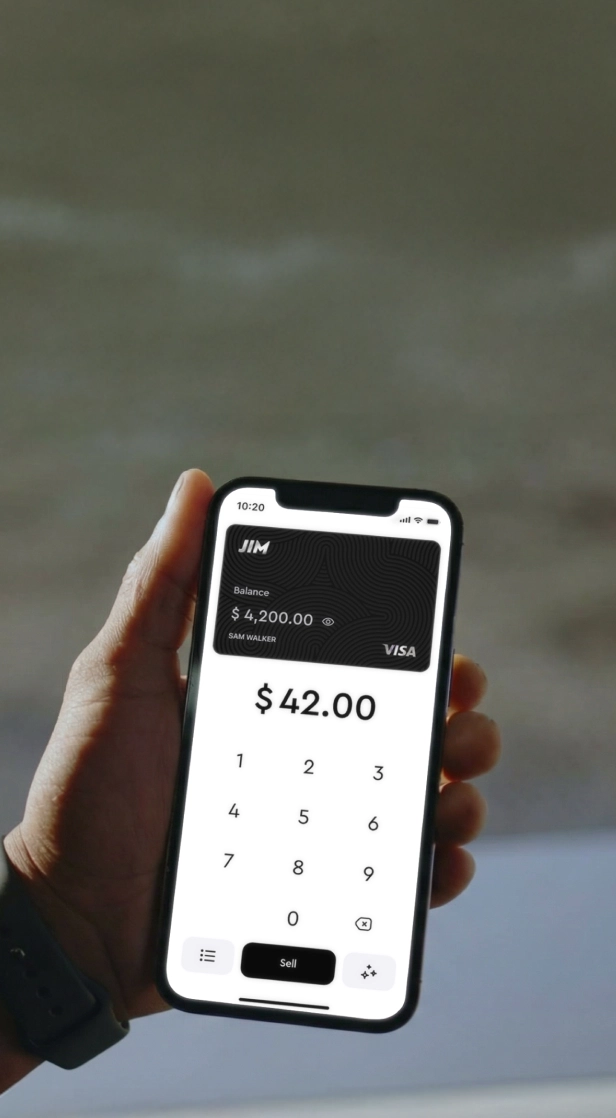
With JIM, you can accept debit, credit and digital wallets directly through your smartphone. At just 1.99% per transaction with no hidden costs or extra hardware needed, it's particularly useful for taking deposits when meeting clients face-to-face.
- Get Started: Download the JIM app for iOS.
- Make a Sale: Type the sales amount, hit sell, and ask your customer to tap their card or device on your phone.
- Access Funds: Your money is available right on your JIM card as soon as the sale is done.
Here are 4 immediate steps to take:
- Decide on your payment terms, such as a 50% upfront deposit.
- Draft a standard client contract that includes your payment terms.
- Compare JIM's 1.99% rate to other payment solutions.
- Download the JIM app to set up your account.
Step 6: Secure funding and manage your finances
Explore your funding options
You should plan for $15,000 to $25,000 in working capital for your first six months. This amount covers your initial paper inventory, marketing costs, and the all-important postage float for client jobs.
An SBA 7(a) loan is a popular choice for startups. While they go higher, a loan between $50,000 and $100,000 is realistic. Lenders typically look for a personal credit score over 680 and a solid business plan. Interest rates often land between the prime rate plus 2.75% and 4.75%.
You might also consider equipment financing. This preserves your cash for operations. Many new owners make the mistake of buying equipment outright, which can quickly drain the capital you need for postage and payroll.
Set up your financial systems
Open a dedicated business bank account before you make your first purchase. This separation is vital for clean bookkeeping and simplifies tax season. From there, set up accounting software like QuickBooks Online to track income and expenses per job.
Your cash flow projections must account for pre-funding your USPS permit. A low balance can delay an entire mailing, so monitor it closely. This simple habit protects your cash flow and your reputation with clients.
Here are 4 immediate steps to take:
- Research SBA 7(a) loan requirements on the SBA website.
- Get two or three quotes for equipment financing.
- Open a dedicated business bank account.
- Create a six-month cash flow projection that includes postage floats.
Step 7: Hire your team and set up operations
Hiring your first employees
You will not need a full staff immediately. A freelance graphic designer is a great first hire. Many new owners hire a web designer, which can lead to print errors. You need someone who understands CMYK color, bleed, and USPS mail panel regulations to avoid costly reprints.
Expect to pay a skilled freelance designer between $30 and $50 per hour. Your next hire is often a print operator who runs machines and manages inventory. A full-time operator typically earns between $35,000 and $50,000 annually, depending on experience.
As a benchmark, aim to generate around $100,000 in annual revenue for each full-time employee. This helps you decide when to transition a freelancer to full-time or hire a sales representative to find new clients and manage accounts.
Setting up your operational workflow
A clear production workflow prevents errors. Map out every step: design, client proofing, final sign-off, printing, and mailing. Many owners get burned because they skip a formal client sign-off. Always get written approval before you print a single piece to protect yourself.
You can manage this process with a project management board like Trello or Asana. Create columns for each stage of the workflow. This gives you a visual overview of all jobs and helps you communicate status updates to clients accurately.
Here are 4 immediate steps to take:
- Draft a job description for a freelance graphic designer with print-specific requirements.
- Research average salaries for print operators in your area on sites like Indeed.
- Create a client sign-off form that confirms artwork, quantity, and mailing date.
- Set up a project board in Trello with columns for each stage of your workflow.
Step 8: Market your business and acquire customers
Demonstrate your value with direct mail
Your best marketing tool is your own product. Design a high-quality mail piece that showcases your capabilities. Send it to a targeted list of 50-100 local businesses like dentists, real estate agents, or new restaurants. This puts your work directly into their hands.
Many new owners focus only on digital ads and forget this. A physical mailer makes you memorable and proves you believe in your service. Include a clear call to action, like a free consultation or a special offer for first-time clients.
Build local connections and track results
Join your local Chamber of Commerce or a BNI chapter. These groups are full of potential clients. Attending one or two events a month can build the trust needed to win business. Also, create a simple website with a portfolio of your design concepts.
You should track your response rates. A 1% to 2% response rate from a prospect list is a solid benchmark. If you send 1,000 mailers and get 10 calls, you have a 1% response rate. This data helps you refine your campaigns over time.
Here are 4 immediate steps to take:
- Design a sample mailer to send to 50 local businesses.
- Research and join your local Chamber of Commerce.
- Create a simple portfolio website with 3-5 design concepts.
- Calculate the response rate from your first marketing campaign.
Step 9: Price your services for profitability
Establish your pricing model
Most direct mail businesses use a cost-plus model. You calculate your total costs for paper, printing, and labor, then add a markup. A good starting point is a 30-50% markup on your production costs. Postage is typically passed through to the client at cost.
Some owners make the mistake of competing only on price, which is a quick way to lose money. Instead, you should focus on the quality of your service and design. Clients will pay more for a campaign that gets results and is managed without headaches.
With that in mind, here is how a 5,000-postcard job might break down:
- Printing & Paper: $600
- Design Service: $250
- Postage: $1,700 (First-Class rate)
A 40% markup on your $850 in production costs adds $340. This brings the total client price to $2,890 and gives you a healthy profit margin. To check your rates, call a few local competitors and ask for a quote on a similar job.
Here are 4 immediate steps to take:
- Calculate your all-in cost for a standard 5,000-piece postcard job.
- Decide on a standard markup percentage, like 40%, for your services.
- Call two local competitors to get a quote for a sample project.
- Create a simple price sheet for three common products you will offer.
Step 10: Implement quality control and scale your operations
Establish your quality standards
Your reputation depends on accuracy. Aim for a mail piece error rate below 0.1%. That means fewer than 10 mistakes for every 10,000 pieces you mail. This includes typos, incorrect addresses, or print defects.
A common mistake is to overlook USPS mail panel regulations. An incorrect return address placement can get an entire job rejected. You can avoid this by having a USPS Mailpiece Design Analyst (MDA) review your templates for free.
Beyond that, check for color consistency against a Pantone swatch book. Also, verify print clarity and fold accuracy on every job. A formal sign-off sheet from the client before printing is your best defense against disputes.
Know when to scale
Growth should be deliberate. A good signal to expand is when you consistently operate at 80% of your production capacity for two months straight. This tells you that demand is steady, not just a temporary spike.
As for hiring, stick to the benchmark of $100,000 in annual revenue per full-time employee. Once you approach the $200,000 mark, it is often time to bring on a dedicated account manager to free you up for sales.
When spreadsheets become unwieldy, you might look at a print Management Information System (MIS). Software like Printavo or Ordant helps you manage quotes, job tickets, and invoicing in one place, which is a big step up from manual tracking.
Here are 4 immediate steps to take:
- Create a final proofing checklist that includes USPS mail panel specifications.
- Contact a USPS Mailpiece Design Analyst to review your standard postcard template.
- Calculate your current monthly production capacity in terms of total mail pieces.
- Request a demo for a print MIS software like Printavo to see how it works.
You have the roadmap to launch your direct mail business. Remember that your best marketing is your own product. A well-designed mailer proves your value better than anything else. Now, go build a business that delivers results, one mailbox at a time.
As you get started, make payments simple. JIM turns your phone into a card reader for a flat 1.99% fee, with no extra hardware. This lets you take deposits on the spot. Download JIM and get paid from day one.
.avif)