Starting a dog accessory business is a rewarding venture, blending creativity and a love for dogs with smart business sense. The market is a multi-billion dollar industry, with steady demand for everything from collars for daily walks to seasonal apparel and unique gifts for fellow dog lovers.
This guide will take you through the practical steps of validating your business concept, building supplier relationships, acquiring inventory, and obtaining the necessary licenses to help you launch a successful dog accessory business in the U.S.
Step 1: Validate your business plan
To get a real feel for the market, visit local pet boutiques and large retail stores. Note their product assortment, quality, and price points. Also, use Google Trends to compare search interest for your product ideas, like "biothane leash" versus "rope leash," to gauge online demand.
Analyze the competition
Identify your top five competitors. For online brands, use a platform like Semrush to see their popular keywords and web traffic. For product-specific research on marketplaces like Amazon or Etsy, you can use databases like Jungle Scout to estimate sales volume for certain types of accessories.
Estimate your startup costs
Your initial budget will likely fall between $3,000 and $10,000. A frequent misstep is to over-invest in one product. You might want to start with smaller quantities across several styles to test the market. Here is a sample breakdown:
- Initial Inventory: $2,000 - $5,000
- E-commerce Website (e.g., Shopify): $500 - $2,500
- Business Licenses & LLC Formation: $100 - $500
- Initial Marketing & Photography: $500 - $1,500
Here are 3 immediate steps to take:
- Use Google Trends to compare search volume for three different product ideas.
- Create a spreadsheet listing five competitors, their main products, and their prices.
- Draft a startup budget based on the cost estimates for inventory, web setup, and licensing.
Step 2: Establish your legal structure and get licensed
Choose your business structure
You might want to consider forming a Limited Liability Company (LLC). It separates your personal assets from business debts, a layer of protection many new owners overlook when starting as a sole proprietor, which puts personal finances at risk.
An LLC offers pass-through taxation, meaning profits pass to your personal tax return. This simplifies tax filing compared to a corporation. Filing for an LLC can cost between $50 and $500 depending on your state, with processing times of one to three weeks.
Secure your licenses and permits
First, get an Employer Identification Number (EIN) from the IRS website. It is free and you will need it to open a business bank account. Next, apply for a seller's permit from your state's department of revenue to legally collect sales tax on your products.
Your city or county will likely require a general business operating license, which can cost from $50 to $100 annually. Also, be aware of the Consumer Product Safety Commission (CPSC) guidelines, especially for small parts on toys or collars that could be a hazard.
Here are 3 immediate steps to take:
- Decide on a business structure and file the paperwork for an LLC with your Secretary of State.
- Apply for a free EIN directly on the IRS website.
- Search your state’s department of revenue website for a seller’s permit application.
Step 3: Secure your business insurance
Protect your business from risk
With your legal structure in place, the next move is to get insurance. For a dog accessory business, product liability insurance is your most important policy. It protects you if a collar breaks or a toy part becomes a choking hazard, which general liability alone does not cover.
General liability covers claims like a customer slipping at your market booth. You should aim for at least $1 million in coverage for both policies. Annual premiums for a combined plan typically run from $750 to $2,500, based on your product line and sales volume.
If you have an employee, you will also need workers' compensation. For finding a policy, you might want to look at providers like The Hartford, Hiscox, or Pet Care Insurance, as they specialize in coverage for e-commerce and pet-related businesses.
Here are 3 immediate steps to take:
- Request quotes for a combined general and product liability policy.
- Contact an agent from a provider like Hiscox or The Hartford to discuss your specific products.
- Review your designs for potential safety issues, like small parts that could detach.
Step 4: Set up your workspace and source materials
You can likely start your business from home in a 100-200 square foot space, like a spare room or garage. Check your local city or county ordinances for home-based business regulations, but most allow e-commerce operations that do not involve customer foot traffic.
Equipment and material suppliers
Your main purchase will be an industrial sewing machine capable of handling heavy materials like biothane or leather. A model like the Juki DDL-8700 costs between $700 and $1,200. Budget another $200 to $400 for a rotary cutter, mat, and a hand rivet press.
For materials, you can source webbing from suppliers like Strapworks, which has no minimum order quantity. For hardware like buckles and D-rings, a supplier such as Ohio Travel Bag is a good starting point. Many new owners over-order here; begin with 100-piece bags to test your designs.
Here are 3 immediate steps to take:
- Check your city’s website for its rules on home-based businesses.
- Create a budget for an industrial sewing machine and basic production tools.
- Browse Strapworks and Ohio Travel Bag to compare material and hardware costs.
Step 5: Set up your payment processing
Choose your payment solution
For your e-commerce store, platforms like Shopify have built-in payment processors. These typically charge around 2.9% plus 30 cents per transaction. This setup is straightforward for online sales, but you will also need a plan for in-person transactions at markets or pop-up events.
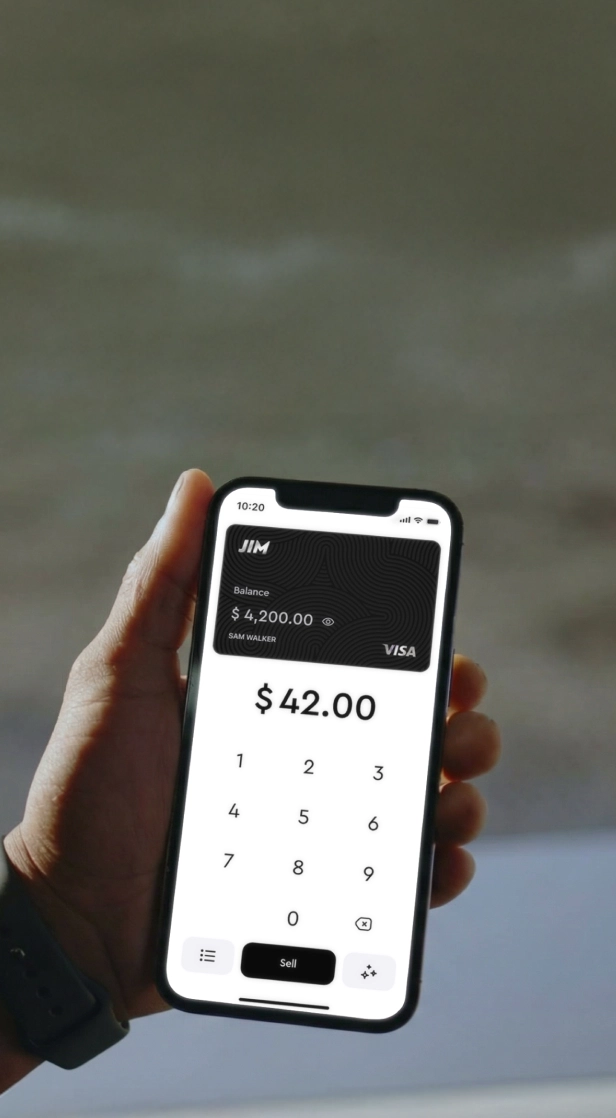
For dog accessory businesses that need to accept payments on-site or on-the-go, JIM offers a streamlined solution. With JIM, you can accept debit, credit and digital wallets directly through your smartphone - just tap and done. This avoids the need for extra card readers.
At just 1.99% per transaction with no hidden costs or extra hardware needed, it's particularly useful for selling at craft fairs or local pet events. This rate is noticeably lower than the average commission rates from other providers, which helps you keep more of your revenue.
Here is how it works:
- Get Started: Download JIM app for iOS
- Make a Sale: Type the sales amount, hit sell, and ask your customer to tap their card or device on your phone
- Access Funds: Your money is available right on your JIM card as soon as the sale is done - no waiting for bank transfers
Here are 3 immediate steps to take:
- Review the transaction fees for your primary e-commerce payment processor.
- Download the JIM app to prepare for in-person sales.
- Calculate the potential savings on a $100 sale using JIM versus a standard processor.
Step 6: Fund your business and manage your finances
Most owners self-fund their launch, but you can also seek external capital. An SBA Microloan is a strong option, as these are designed for startups. Lenders typically offer between $5,000 and $25,000 with interest rates from 8% to 13%.
You might also look into grants. Programs like the Amber Grant for Women or the FedEx Small Business Grant Contest are popular choices. These are competitive, so a strong brand story is important for your application.
Set up your financial systems
Once you have funding, open a dedicated business checking account. Some new owners make the mistake of mixing personal and business funds, which complicates taxes and can put your personal assets at risk, even with an LLC.
You will also need enough working capital to cover at least three to six months of operating expenses. For a new accessory brand, this is often between $3,000 and $6,000 to pay for inventory restocks, marketing, and website fees before your sales become steady.
Here are 3 immediate steps to take:
- Research one SBA Microloan lender in your state.
- Open a dedicated business checking account for your LLC.
- Calculate your estimated operating costs for the first six months to determine your working capital needs.
Step 7: Hire your team and set up operations
You will likely handle everything yourself until sales become consistent. A good benchmark to consider your first hire is when you reach $5,000 to $8,000 in monthly revenue. At this point, production and fulfillment can start to hinder growth.
Your first hire
Your first employee is often a part-time Production Assistant. This person handles tasks like cutting materials, assembling products, and packing orders. A typical pay range is $15 to $20 per hour. No special certifications are needed, just a good eye for detail.
Some new owners try to classify this role as an independent contractor to save on payroll taxes. Be careful here. If you control their work and hours, the IRS will likely see them as an employee, which could lead to penalties if misclassified.
Streamline your workflow
As you grow, you can use software to manage operations. Your Shopify plan includes inventory tracking to monitor stock levels. For scheduling a part-time assistant, an app like When I Work can help you manage shifts and communicate with your team.
Here are 3 immediate steps to take:
- Draft a job description for a part-time Production Assistant, outlining key responsibilities.
- Review the IRS guidelines on the difference between an employee and an independent contractor.
- Explore the inventory management features within your e-commerce platform to track materials.
Step 8: Market your products and find customers
Focus on social media content
Your primary marketing channel will be social media. Focus on Instagram and TikTok, where visual content thrives. Post high-quality photos and videos of dogs using your accessories daily. A frequent mistake is to use mediocre photos; your images must sell the product for you.
Encourage customers to share photos with a unique hashtag for user-generated content (UGC). You can also partner with micro-influencers, who have 10,000 to 50,000 followers. Offer them free products in exchange for a post. This often yields better results than paying larger accounts.
Run targeted ads
Once you have some content, you can run paid ads on Meta. Target users with interests like "dog parks" or "PetSmart." A good starting goal for Customer Acquisition Cost (CAC) is under $50. Expect a conversion rate of around 1-2% for a new store.
Many owners burn through their budget by running ads without a clear objective. Before you spend, decide if your goal is website traffic or direct sales. Start with a small daily budget, like $10-$20, to test which ads perform best before you scale up.
Here are 3 immediate steps to take:
- Create a list of 10 dog micro-influencers to contact for partnerships.
- Set up a Meta Business Account and explore the audience targeting options.
- Draft a content plan for your first two weeks on Instagram.
Step 9: Price your products for profit
Set your pricing strategy
A straightforward approach is cost-plus pricing. Calculate your Cost of Goods Sold (COGS)—materials plus labor—and multiply it. A 3x to 4x markup is a solid target for dog accessories, which yields a 67% to 75% gross margin before other expenses.
For example, if a leash costs $8 in materials and labor, a 3x markup sets your retail price at $24. Some owners make the mistake of only using a 2x markup, which leaves little room for marketing costs, transaction fees, and potential wholesale discounts.
You might also use value-based pricing for unique items. If you offer custom-stamped leather tags, you can charge more based on the perceived value of personalization, not just the cost of the leather and your time. This works well for high-end or bespoke products.
Analyze competitor pricing
Look at what your competitors charge. Browse Etsy and independent Shopify stores for products similar to yours. Pay attention to their materials, hardware quality, and branding. This context helps you position your own prices effectively without starting a race to the bottom.
Here are 3 immediate steps to take:
- Calculate the full COGS for one of your signature products, including labor.
- Apply a 3x and 4x markup to that COGS to find your target retail price range.
- Create a spreadsheet listing five competitors and the prices of their comparable products.
Step 10: Implement quality control and scale production
Your brand's reputation depends on consistent quality. Create a checklist for every item. Inspect all stitching for uniformity, test hardware for strength, and ensure material edges are clean. You should also re-check that your products adhere to CPSC safety guidelines, especially for small parts.
A good metric to track is your defect rate. Aim for a rate below 2% on all finished goods. Many new owners make the mistake of only checking quality after a customer complaint. Instead, build this inspection step into your production workflow from the start.
Benchmarks for growth
With your quality process in place, you can plan for growth. Once you hit $10,000 to $15,000 in monthly revenue, you might consider outsourcing production to a U.S.-based manufacturer. This frees you to focus on design and marketing.
If you spend more than 20 hours a week just on production, it is a good sign you need to hire another assistant. This prevents you from becoming a bottleneck. At this stage, your time is better spent on activities that grow the business, not just fulfill orders.
Systems for scaling
As you grow, your Shopify inventory features may not be enough. You can use a manufacturing ERP like Katana or Craftybase. These systems help you track raw materials, like your buckle supply, and manage production orders so you do not run out of popular items.
Here are 3 immediate steps to take:
- Create a quality checklist to inspect stitching, hardware, and material finish on every product.
- Set a revenue goal, like $10,000 per month, as your trigger to research manufacturing partners.
- Explore an inventory app like Katana to track your raw materials and finished goods.
You now have a complete roadmap to launch your dog accessory business. Remember that your passion for dogs is your greatest asset, so let it shine through in your product quality. With a solid plan, you are ready to build a brand that dog owners will love.
And when you meet those customers at markets or events, a simple payment process helps. JIM turns your phone into a card reader for a flat 1.99% fee, with no extra hardware. Download JIM to get set for your first sale.
.avif)