How to Start a Driving School Business: A 2026 U.S. Roadmap
See article summary
- Opening a driving school costs about $20,000 to $35,000 for a one-car operation.
- Licensing takes 60 to 90 days through your state DMV.
- Commercial auto insurance is your largest expense at $3,000 to $7,000 per vehicle yearly.
- A full-time instructor can generate $1,500 to $1,800 in weekly revenue.
- JIM takes in-car payments at a flat 1.99% with no hardware.
Last updated: August 2026.
Opening a driving school in the U.S. typically costs $20,000 to $35,000 for a lean one-car operation and takes 60 to 90 days of licensing before your first paid lesson. Demand stays steady across three groups: teens getting their first license, adults who never learned, and seniors refreshing their skills after an injury or citation.
The work breaks into ten decisions: validating demand, securing licenses, arranging insurance, setting up a location, accepting payments, funding the business, hiring instructors, marketing, pricing, and scaling. This guide walks through each one with the numbers and the state requirements that gate them.
How do you validate demand for a driving school in your area?
Start with a direct competitor count. Your state's Department of Motor Vehicles (DMV) publishes a list of currently licensed driving schools, which gives you a real count of who already serves your area rather than a guess from Google Maps.
Then size the customer pool. The U.S. Census Bureau's American Community Survey publishes county-level demographic data. Pull the population of 15 to 19-year-olds in your county to estimate your primary customer base, and add adults and seniors as secondary segments.
Analyze your local competitors
Use Google Maps to find nearby schools and read their reviews. Note their pricing, package deals, and the cars they use. The gap you find, whether it is a missing teen package, no weekend road-test service, or poor reviews about punctuality, becomes your opening.
One oversight that inflates budgets early is underestimating insurance. Commercial auto coverage for a driving school runs far higher than personal policies, so request quotes before you finalize your budget rather than after.
Estimate your startup costs
Your main expense is a dual-control vehicle, a car fitted with a second brake and accelerator on the passenger side so an instructor can stop in an emergency. A reliable used model costs $15,000 to $25,000. Annual insurance premiums run $3,000 to $7,000 per car. Budget another $500 to $2,000 for state licensing and instructor certification, and $1,000 to $3,000 for a simple website and initial marketing.
Before you spend more, do three things: contact your state DMV for the licensed-competitor list, request commercial auto insurance quotes, and draft a budget that lists vehicle, insurance, and licensing costs separately.
What licenses do you need to open a driving school?
You need three layers of licensing: a business entity registered with your state, a state-issued driving school license from your DMV, and a local business license from your city or county.
Form a Limited Liability Company to shield personal assets from business debts. An LLC, or Limited Liability Company, is a business structure that separates your personal assets from the business's debts and lets profits pass through to your personal tax return.The SBA notes that state filing fees vary by state and structure, so check your Secretary of State website for the exact amount, which commonly falls between $50 and $500. Once approved, apply for a free Employer Identification Number on the IRS website. An Employer Identification Number (EIN) is a free, nine-digit federal tax ID the IRS issues to identify your business for taxes, hiring, and opening a business bank account.
State and local licensing
Your primary hurdle is the state-issued Driving School License, managed by your DMV or a similar agency. Requirements vary, so use a concrete example as your benchmark. California's DMV, for instance, charges a $150 nonrefundable application fee for a Driving School Owner License and requires a driving school insurance certificate (form OL 207) listing every instructional vehicle, a surety bond, and a physical office verified on form OL 140. Application and fees stay valid for one year from submission. Check your own state DMV's driving school page for the fee schedule and the vehicle-marking rules that apply to you, since ordering decals before approval can waste money if your design violates lettering-size or placement rules.
Finally, get a general business license from your city or county. It is a standard local requirement and typically costs $50 to $150 per year. Your city clerk or county clerk's office has the forms.
How much insurance does a driving school need?
State DMVs set the commercial auto liability minimum for instructional vehicles, and the figures vary widely. California's Vehicle Code §11103 requires at least $150,000 for bodily injury to one person, $300,000 for two or more, and $50,000 for property damage, and the state DMV requires a driving school insurance certificate (form OL 207) covering every instructional vehicle before it issues a license. New York requires $100,000 per person and $300,000 per accident. Commercial auto is your largest policy and can run $3,000 to $7,000 per vehicle each year.
Key policies for your school
Add general liability insurance, which covers third-party injuries or property damage at your office. A Business Owner's Policy (BOP) is an insurance bundle that combines general liability and commercial property coverage at a lower combined price, typically $500 to $1,200 a year. Carry professional liability insurance in case a student claims your instruction was inadequate, and if you hire instructors, workers' compensation is required, with cost driven by your state's payroll rules.
Some owners buy through a general agent to save time and end up with coverage gaps. Work with providers that specialize in small businesses and understand driver education risks. Verify every policy against your state DMV's insurance requirements before your first lesson.
What location and equipment does a driving school require?
Most states require a physical office with a classroom, not a home address. Confirm commercial zoning with your city planning department before you sign anything. A 200 to 400 square foot space is usually enough for a reception desk and a few student chairs.
When you negotiate a lease, propose a one or two-year term for flexibility. Landlords will ask about student traffic, so have your business plan and proof of insurance ready.
Equip your office and vehicles
For the office, budget $1,000 to $2,000 for basic furniture and a computer. The critical vehicle modification is a dual-control brake system, which costs $700 to $1,500 per car to install professionally.
Wait on vehicle decals and rooftop signs until your state license is approved. Ordering early risks a rejected application if your design breaks the lettering or placement rules on your DMV's website. Confirm the rules first, then order.
How do you set up payment processing for a driving school?
Most driving schools sell package deals for a set number of lessons, paid upfront, or run a pay-as-you-go model. Require a small deposit when a student books the first lesson to cut no-shows.
Transaction fees deserve real attention. Most processors charge 2.5% to 3.5% per sale plus monthly costs, and those percentages eat directly into your lesson revenue. Compare credit card processing fees, pricing models, payout speed, and whether a provider requires you to buy a card reader before you commit. Flat-rate processors that charge one predictable percentage regardless of card type are easier to budget than interchange-plus or tiered pricing.
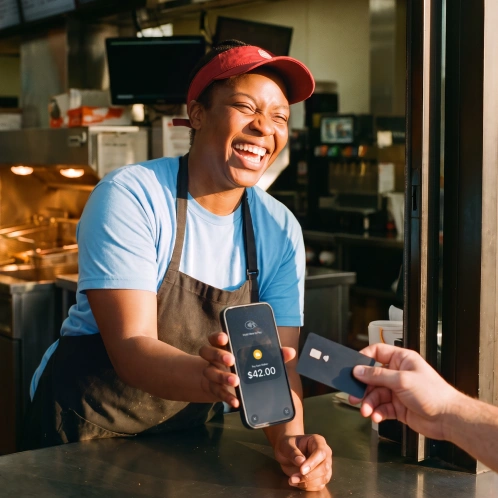
For taking payment in the car right after a lesson, JIM fits a driving school's mobile workflow. JIM turns a smartphone into a card reader with Tap to Pay, accepts Visa, Mastercard, American Express, and Discover, and charges a flat 1.99% per transaction with no hardware purchase. Funds land on your JIM card instantly, so you are not waiting on bank transfers to recognize revenue from that day's lessons.
How do you fund a driving school and manage its finances?
Most new driving schools combine personal savings with a small business loan. An SBA Microloan is a government-backed small business loan of up to $50,000 issued through nonprofit community lenders. The SBA Microloan program provides loans up to $50,000 to help small businesses start up and expand, sets interest rates generally between 8% and 13%, and limits repayment to seven years. The average microloan is about $13,000. Credit standards are set by each intermediary lender rather than published as a single SBA threshold, so ask your local microlender about its requirements.
Another option is equipment financing, a loan specifically for your dual-control vehicle where the car itself serves as collateral and can make approval easier. A business line of credit gives flexible access to cash for unexpected costs.
Plan your first six months
Keep $7,000 to $14,000 in working capital to cover insurance, fuel, office rent, and marketing before you have a steady stream of students. Owners who fund only the car purchase and skip operating cash run out of money in month two or three.
Open a separate business bank account the day your LLC is approved. Commingling personal and business money weakens your liability protection and complicates taxes. Track every dollar from day one with free accounting software like Wave, or a paid option like QuickBooks, so tax season is a matter of export, not reconstruction.
How do you hire instructors and run daily operations?
Find your first instructor
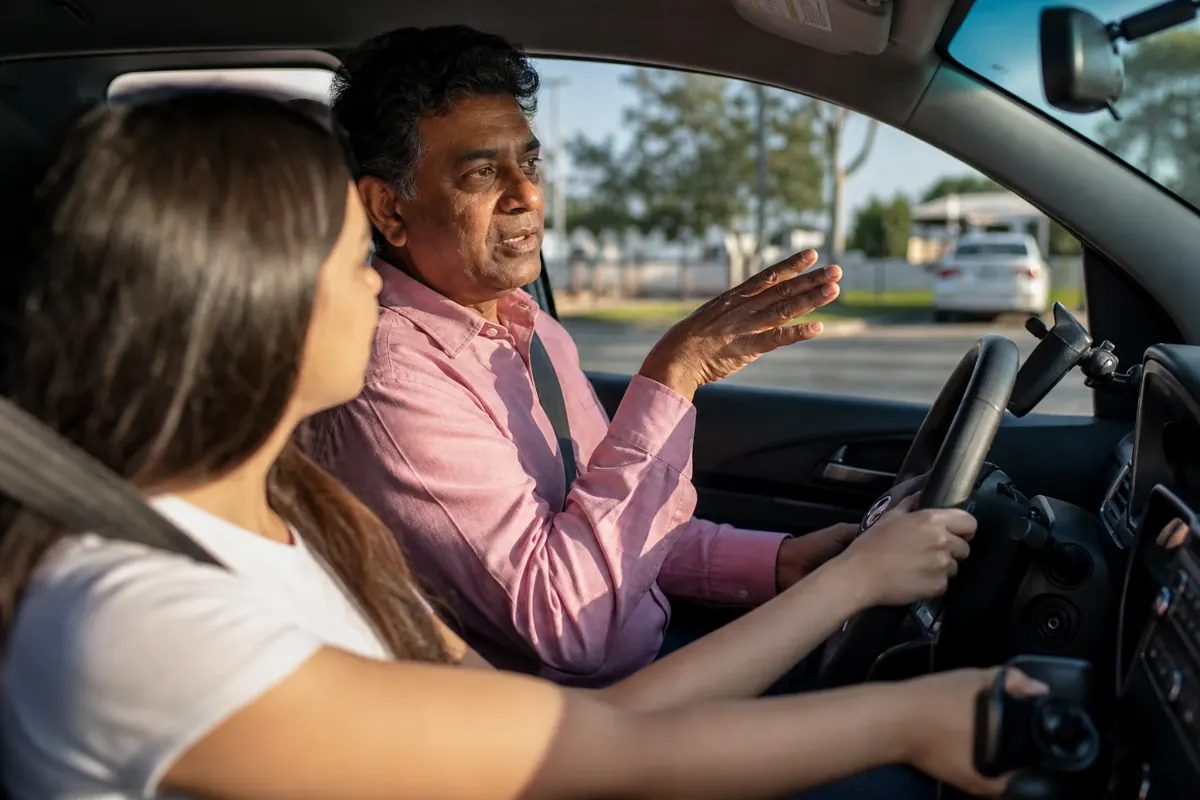
Your first hire is a Driving Instructor. Beyond a clean driving record, they need a state-issued instructor license, which usually requires a background check and a written exam. Pay typically runs $20 to $30 per hour. Hire for teaching ability, not driving skill alone. In interviews, ask each candidate to explain a complex maneuver as if you were a nervous student. A great driver is not always a great teacher.
Run the numbers per instructor
Before you hire, run the full unit economics. As an example, a full-time instructor billing 28 hours a week at $60 an hour generates $1,680 in weekly gross revenue. Subtract wages of about $700, fuel near $120, and a per-vehicle share of insurance of roughly $70 to $135 a week. That leaves roughly $765 to $790 in weekly contribution per instructor before overhead like rent and marketing. The number to track is contribution margin: as long as each instructor clears about $500 a week after variable costs, adding staff grows profit rather than just revenue.
Streamline your scheduling
Use scheduling software so students book online and get automated reminders. Tools like Drive Scout or Acuity Scheduling cut no-shows and free you from constant phone calls. The same capacity trigger applies to scheduling: when an instructor's calendar is consistently 80% full for two months, start hiring.
How do you market a driving school and attract students?
Claim your free Google Business Profile first. It puts your school on Google Maps and in local search results, which is where most parents and teens start looking. Ask your first few students for reviews, since review volume drives local ranking and trust.
Build a simple website that shows your services, pricing, and a clear contact path, and make sure it works on mobile. Spending on paid ads before the site is ready wastes budget. Aim for a customer acquisition cost under $100 per student from paid channels.
Build local partnerships
Contact local high schools to create a referral pipeline. Offer a free talk on teen driving safety at a school assembly. It positions you as a community expert and keeps your school top of mind for parents.
How should you price driving lessons?
Most schools sell packages, since students rarely need one lesson. A 6-hour package might run $350 to $450, and a single 90-minute lesson $90 to $120. Packages pull a larger upfront commitment.
Analyze competitor pricing
Check five local competitors. If prices are not public, call as a potential customer and note package deals, lesson duration, and road-test service. Competing on the lowest price is unsustainable. After fuel, insurance, and instructor pay, your profit margin should sit between 20% and 40%, and a rate below $50 an hour rarely clears that bar.
Structure your packages
Use a tiered approach: a basic 6-hour package, a 10-hour confidence-builder, and a premium package that includes the road-test appointment. Tiers give you a natural upsell path and raise average revenue per student.
How do you maintain quality and scale a driving school?
Establish quality benchmarks
Track your students' first-time road test pass rate. A rate above 85% signals strong instruction. Send a short survey after the final lesson to measure satisfaction.
Inconsistent teaching hurts pass rates. Write a simple curriculum outline every instructor follows for core skills like parallel parking and three-point turns, so every student gets the same quality.
Know when to grow
Scale on data, not instinct. When an instructor is booked at 80% capacity for two months, hire another. Wait for a steady waitlist before you buy a second vehicle. As scheduling gets complex, software like Drive Scout or Acuity Scheduling handles bookings and payroll. For advanced training, look into certifications from the Driving School Association of the Americas (DSAA) for your team.
You now have the full path: validate demand, secure your DMV license and insurance, set up a location, choose a payment processor, fund six months of operations, hire instructors who can teach, market locally, price for margin, and scale on capacity data. When it comes to getting paid in the car, JIM keeps it simple with a flat 1.99% Tap to Pay rate and no hardware, so you can close a lesson and collect payment on the spot. Download JIM to start.
Frequently Asked Questions
How much does it cost to start a driving school?
Do I need a license to teach driving?
How profitable are driving schools?
What insurance does a driving school need?
How long does it take to open a driving school?


Sell and get paid in seconds with Jim