How to start a fish table business: From idea to opening day
See article summary
- Expect $20,000 to $50,000 in startup costs for a small fish table arcade with 2 to 4 machines.
- Plan 4 to 12 weeks for licensing and permits, depending on your state and city.
- Confirm fish tables are legal skill games in your state before you invest a dollar.
- A 40% to 60% hold percentage keeps games profitable while players feel they can win.
- Accept card top-ups alongside cash so players stay in their seats instead of leaving for an ATM.
A fish table is a multiplayer, arcade-style skill game where players shoot animated fish for points redeemable for cash where legal. Starting one pairs gaming entertainment with sharp operational sense, and demand is measurable: U.S. amusement arcades generated about $5.3 billion in revenue in 2022, according to Census Bureau Service Annual Survey data.
Plan for $20,000 to $50,000 in startup costs and 4 to 12 weeks of licensing, and confirm your state treats fish tables as legal skill games before you invest. The steps below cover validating your concept, securing funding, obtaining permits, and acquiring equipment.
Step 1: How to plan and validate your fish table business idea
Research your local fish table market
Before you spend a dollar, gauge your local market. Visit entertainment centers, bars, and social clubs that already have skill-based games. Observe player traffic on different days and times. Note which games are most popular and how much they cost to play.
Fish tables sit in a legal gray zone because they mix skill and chance. Whether a game counts as illegal gambling depends on your state's test. Most states use the predominant factor test: the game is legal if skill, not chance, dominates the outcome. A minority use the stricter material element test, where any meaningful role for chance makes the game gambling. A few apply the any chance test, under which even a small random element makes the game illegal.
Enforcement is active. North Carolina classifies electronic sweepstakes machines as illegal and has raided fish table arcades. South Carolina prohibits betting and pool selling on contests of skill. Florida's Attorney General has also announced seizures of fish table machines in gambling enforcement actions. This table is not exhaustive, and local ordinances can be stricter than state law:
| State | Legal status | Governing statute |
|---|---|---|
| North Carolina | Electronic sweepstakes devices prohibited; fish table arcades raided | N.C. Gen. Stat. § 14-306.4 |
| South Carolina | Betting and pool selling on contests of skill prohibited | S.C. Code § 16-19-130 |
Your first call should be to your local business licensing office and your state's gaming commission or attorney general's office to confirm how fish tables are treated where you operate. This is not a step to skip.
Analyze competitors and estimate fish table costs
Identify direct competitors using Google Maps and local business directories. See what machines they offer and their pricing. For broader industry data, reports from firms like IBISWorld can help you understand market size and growth trends in the arcade and amusement sector.
Your initial investment will be a major focus. A single new fish table cabinet can range from $5,000 to over $15,000, while used units start around $3,000. Do not chase the cheapest option; unreliable hardware causes downtime and lost revenue.
Here is a typical breakdown for a small setup. Treat these ranges as illustrative estimates based on current supplier pricing, not quotes:
- Gaming Machines (2 to 4 units): $10,000 to $30,000
- Business Licensing & Permits: $500 to $5,000
- Lease Deposit & First Month's Rent: $3,000 to $10,000
- Initial Cash for Payouts: $2,000 to $5,000
Here are 3 immediate steps to take:
- Visit three local venues with skill games to observe player traffic and game popularity.
- Contact your city's business licensing department to ask about amusement device regulations.
- Create a preliminary budget spreadsheet listing estimated costs for machines, rent, and permits.
Step 2: What business structure and licenses does a fish table arcade need?
Choose your fish table business structure
Form a Limited Liability Company (LLC) for most new fish table businesses. This structure protects your personal assets from business debts, and profits pass through to your personal tax return, which simplifies tax filing. Setting one up typically costs between $100 and $500.
Once your business grows, an S Corporation election can lower your self-employment taxes, but it adds compliance and payroll requirements. Ask a CPA whether this makes sense after you are consistently profitable.
Navigate fish table permits and licenses
With your structure chosen, apply for an Employer Identification Number (EIN) for free from the IRS. Next, you will need a state-level Amusement Device License. Costs and rules vary, so check with your state's Department of Revenue or Gaming Commission.
Locally, you will need a General Business License and a Certificate of Occupancy for your location. Confirm early that your games meet your state's skill-based definition, since a mismatch can delay or deny your amusement license.
Permit processing can range from 4 to 12 weeks, and costs can add up to several thousand dollars depending on your jurisdiction. Start the application process as soon as you have a location in mind.
Here are 3 immediate steps to take:
- Decide between an LLC and an S-Corp and file the formation documents with your state.
- Apply for a free Employer Identification Number (EIN) on the IRS website.
- Contact your state's gaming commission to get the application for an Amusement Device License.
Step 3: How to insure your fish table business and manage risk
Key insurance policies for a fish table arcade
Your first policy should be General Liability insurance, which covers customer injuries and property damage. A standard $1 million per occurrence policy is a good starting point. This protects you if someone slips and falls in your establishment or has another accident.
Next, you need Commercial Property insurance. This covers your valuable fish tables, cash registers, and other assets against theft, fire, or vandalism. Insure equipment for its full replacement cost, not its current depreciated value, or you face a major gap after a loss.
You can often bundle these into a Business Owner's Policy (BOP). Depending on your location and machine value, annual premiums typically range from $1,500 to $7,000. If you hire employees, you generally need Workers' Compensation insurance. Most states require it for employers, though Texas makes it optional; check the National Association of Insurance Commissioners' workers' compensation overview for your state's rule.
When you shop for coverage, seek out agents with experience in the amusement industry. Specialists such as McGowan Allied Specialty Insurance or CBIZ Entertainment understand the unique risks of gaming businesses better than a general provider. These are independent examples, not affiliated recommendations.
Here are 3 immediate steps to take:
- Request quotes for a Business Owner's Policy (BOP) that includes general liability and property coverage.
- Ask potential insurance agents about their experience with amusement or skill game businesses.
- Calculate the full replacement cost of your gaming machines to ensure you get adequate property coverage.
Step 4: Where to find a location and buy fish table machines
Select and secure your fish table location
Look for spaces between 1,000 and 2,500 square feet in areas zoned for commercial use. High-visibility locations in strip malls or near other entertainment venues attract more foot traffic. Before you sign anything, confirm the zoning allows for amusement devices with your local planning department.
When you negotiate your lease, ask for a tenant improvement allowance to help cover electrical upgrades. Underestimating the power requirements for multiple machines is a common error that leads to expensive retrofits later.
Purchase your fish table machines
New fish tables from suppliers such as 8 Line Supply or Fish Game Kings typically range from $5,000 to over $15,000 per unit, based on current supplier catalogs. You will also need a redemption counter, security cameras, and a point-of-sale system to manage transactions and payouts.
Used machines might seem like a deal at around $3,000, but they often lack warranties and can be unreliable. Downtime from a broken machine means lost revenue, so weigh the long-term cost of repairs against the upfront savings. Always test used equipment thoroughly before you buy.
Here are 3 immediate steps to take:
- Identify three potential locations and verify their zoning classification with the city.
- Ask for a tenant improvement allowance for electrical work in your lease negotiations.
- Request price lists and warranty information from two different fish table suppliers.
Step 5: How to set up payment systems for your fish table arcade
Fish table businesses run mostly on cash. Players use cash to buy game credits, and you pay out winnings in cash. You need a secure system: a quality cash register and a safe for storing excess funds.
Operating cash-only costs you revenue. When players run out of cash, they leave. Accepting cards for credit purchases keeps them in their seats and playing longer, which directly increases your revenue.
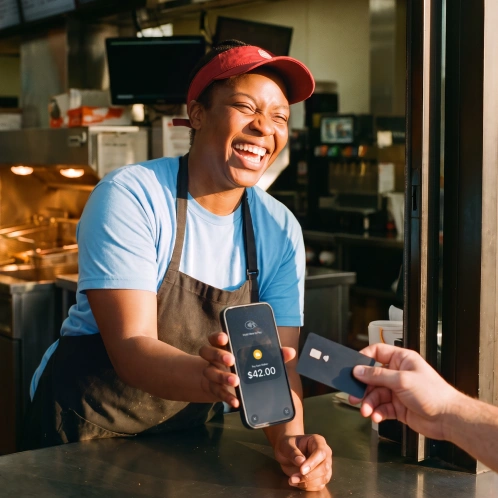
For in-person card top-ups, JIM lets you accept debit, credit, and digital wallets directly through your phone, with no extra hardware. A customer taps their card or device on your phone. JIM charges 1.99% per Tap to Pay sale with no hidden costs, which is lower than the 2.5% to 3.5% many processors charge, so it works well for letting players add credits without an ATM run.
JIM does not cover voucher or ticket-redemption systems. For card-based top-ups, though, its 1.99% rate and no-hardware setup cover most player needs. If vouchers are central to your payout model, compare card readers on voucher acceptance as the deciding criterion.
Here are 3 immediate steps to take:
- Outline a daily cash handling procedure for your staff, including managing the payout float.
- Download the JIM app to accept card top-ups before your grand opening.
- Compare JIM's 1.99% Tap to Pay rate against any card reader you consider for a countertop setup.
Step 6: How to fund your fish table business and manage finances
Find the right funding source
An SBA 7(a) loan can provide up to $5 million, though new fish table businesses often seek $50,000 to $250,000. Lenders typically look for a credit score above 680 and a solid business plan. The SBA sets maximum interest rates by loan size; for loans of $50,001 to $250,000, the rate cannot exceed the base rate plus 6 percentage points.
Another route is equipment financing. This loan specifically covers your gaming machines. Lenders use the machines as collateral, which can make qualification easier than a traditional loan. Rates are often comparable to SBA loans.
Underestimating your working capital is a common error. You need enough cash to cover at least six months of expenses without any revenue, including rent, utilities, insurance, and your initial cash for payouts.
Manage your daily finances
Open a dedicated business bank account as soon as your LLC is formed. This keeps your personal and business finances separate, which is important for liability protection and tax purposes. Also, consider accounting software like Wave or QuickBooks to track income and expenses from day one.
Here are 4 immediate steps to take:
- Contact your local bank to ask about their SBA 7(a) loan application process.
- Request a quote for equipment financing to cover the cost of your fish tables.
- Create a 6-month operating budget that includes rent, utilities, and initial payout cash.
- Open a separate business checking account to keep your finances organized.
Step 7: How to hire a team and run daily operations
Build your frontline team
For a small arcade, you will likely need one or two Game Attendants. Their main jobs are customer service, cash handling, and explaining game rules. Expect to pay between $12 and $18 per hour depending on your location. A Shift Manager might earn $40,000 to $55,000 annually.
Understaffing during peak times is a common error. A good rule of thumb is one attendant for every 4 to 6 active machines. This ensures players get quick service for payouts and credit purchases, which keeps them playing longer.
Establish your daily workflow
You need clear procedures from day one. Create a daily operations manual that covers opening and closing duties, cash handling protocols, and how to troubleshoot common machine errors. This document is your playbook for consistent service and security.
Use a scheduling app such as Homebase or 7shifts to simplify schedule creation and communication with your team. These platforms also help you track hours accurately for payroll, which saves administrative work.
Here are 4 immediate steps to take:
- Draft job descriptions for a Game Attendant and a Shift Manager.
- Research local pay rates on sites like Glassdoor to set competitive wages.
- Outline a daily cash handling procedure for opening, closing, and shift changes.
- Sign up for a free trial of a scheduling app like Homebase to test its features.
Step 8: How to market your fish table business and attract customers
Create a local buzz
Your first marketing push should be a grand opening event. Promote it with flyers at nearby businesses and posts in local community Facebook groups. A "first $5 free" offer is a great way to get new players in the door and trying the games.
Partner with non-competing businesses like bars or convenience stores. Offer them a small referral bonus for sending customers your way. This creates a low-cost marketing network that works for you.
Build your digital footprint
Claim your free Google Business Profile immediately. This is how most new customers will find you. Ignoring online reviews is a common mistake. Respond to all feedback, good or bad, to show you are an engaged owner.
Use social media to showcase the atmosphere. Post short videos of big wins (with the player's permission) and announce special promotions on Facebook or Instagram. This builds excitement and provides social proof that your location is the place to be.
Here are 4 immediate steps to take:
- Create and fully populate your Google Business Profile with photos and hours.
- Design a grand opening flyer that includes a new player promotion.
- Identify three local businesses you could approach for a partnership.
- Plan your first week of social media posts to build excitement for your opening.
Step 9: How to set fish table pricing and manage revenue
Choose your fish table pricing model
Most fish table businesses use a points-per-dollar model. A common setup is offering 100 points for every $1 spent. This simple structure makes it easy for players to understand the value they get. You can also offer bonuses, like 1,200 points for a $10 purchase.
Another option is time-based play, where customers pay a flat fee for a set amount of time, like $20 for 30 minutes. This model provides predictable revenue but can be less appealing to players who prefer to manage their own pace and budget.
Set your profit margin
Your goal is to achieve a "hold" percentage between 40% and 60%. This is the portion of money the game keeps. If a machine takes in $1,000 in a day and pays out $500, your hold is 50%. Setting payouts too low frustrates players and drives them away.
As an illustrative example, suppose a 4-machine location takes in $1,200 in gross play one day and pays out $624 in winnings. That is a 48% hold, leaving $576 before expenses, or about $144 per machine. Your actual numbers will depend on foot traffic, game mix, and local competition.
To find your sweet spot, visit competitors and observe how long people play and how often they win. You want your games to feel fair and exciting. Track your daily hold for each machine on a simple spreadsheet to see which games perform best and adjust as needed.
Here are 3 immediate steps to take:
- Decide if you will use a points-per-dollar or time-based pricing model.
- Visit two competing arcades to note their pricing and bonus offers.
- Create a spreadsheet to track daily revenue, payouts, and hold percentage for each machine.
Step 10: How to maintain quality and scale your fish table operations
Keep your fish tables profitable and running
Your daily hold percentage is your most important quality metric. Continue to track it for each machine, aiming for that 40% to 60% sweet spot. If a game consistently falls below 30%, it might need a payout adjustment or replacement to remain profitable.
Forgetting preventative maintenance is a common oversight. Create a weekly checklist for each machine. Check for sticky buttons, clean the screens, and confirm bill validators work smoothly. This simple routine prevents revenue loss from machine downtime.
Know when to expand
Look for clear signs to grow. If you have lines for machines during peak hours for a month straight, it is time to add another unit. A good benchmark for opening a second location is when your first spot generates a consistent 20% net profit for six months.
As you grow, consider an arcade management system such as Semnox Parafait. While not needed at first, these systems help you manage games, promotions, and staff across multiple sites from one dashboard, which simplifies scaling your business.
Here are 4 immediate steps to take:
- Create a weekly maintenance checklist for your gaming machines.
- Define the player traffic metric that will trigger your next machine purchase.
- Set a 20% net profit goal for your first location before you consider a second one.
- Review an arcade management system to understand its features for future scaling.
You now have a roadmap to launch your fish table business. Success comes down to balancing player excitement with your hold percentage, then keeping players in their seats with convenient payment options. JIM lets you accept card top-ups on your phone at 1.99% per Tap to Pay sale, with no extra hardware. Download JIM to start accepting cards before your grand opening.
Frequently Asked Questions
Is a fish table business legal?
How much does it cost to start a fish table business?
How profitable is a fish table business?
How much does one fish table machine make per day?
What licenses do you need for a fish table arcade?




Sell and get paid in seconds with Jim