How to start a flea market business: a beginner's roadmap

See article summary
- Starting a flea market business costs between $700 and $2,500 for inventory, permits, and display gear.
- Choose an LLC or sole proprietorship, then get a free EIN and a seller's permit from your state.
- General liability insurance runs $300 to $700 a year, and most markets require $1 million in coverage.
- A standard 10x10 booth costs $25 to $100 per weekend, with discounts for multi-weekend bookings.
- Price with a 3x markup and keep $4,100 to $8,900 in working capital for your first six months.
Turning an eye for unique finds into a flea market business takes some business savvy alongside your product knowledge. Demand stays consistent across vintage goods, handmade crafts, and resale inventory, and flea markets draw all kinds of shoppers every weekend.
Below are the exact permits, budget ranges, booth setup steps, and payment tools you need to open your booth and run it profitably.
Step 1: How do you plan your flea market business and validate your idea?
Validate demand with direct observation, then set a budget between $700 and $2,500 for inventory, permits, and display gear.
Define your niche and research the market
Start by visiting several local flea markets and antique malls. Observe what items attract crowds and sell quickly. Newcomers often source inventory based on personal taste instead of focusing on what customers actually purchase.
Use your phone to take notes on popular booths and item pricing. This direct observation beats any generic report for understanding your local market. You can also browse Facebook Marketplace and Etsy to see what trends online in your area.
Calculate your startup costs
Expect initial costs between $700 and $2,500. This range covers your first batch of inventory ($500 to $2,000), business permits ($50 to $200), and display essentials like tables and racks ($100 to $300). A detailed list prevents under-budgeting.
Recurring expenses matter too. Booth fees usually run from $25 to $100 per weekend. Keep a small cash reserve for these fees and any unexpected costs as you get started.
| Expense category | Low end | High end |
|---|---|---|
| First inventory batch | $500 | $2,000 |
| Business permits and licenses | $50 | $200 |
| Display essentials (tables, racks) | $100 | $300 |
| Booth fee (per weekend) | $25 | $100 |
| Total startup range | $700 | $2,500 |
Here are 3 immediate steps to take:
- Visit at least three different local markets to analyze popular products and pricing.
- Create a detailed budget spreadsheet that lists both one-time and recurring costs.
- Draft a simple, one-page plan that defines your product niche and ideal customer.
Step 2: What licenses and legal structure do flea market vendors need?
You need an LLC or sole proprietorship, a free EIN from the IRS, a seller's permit, and a local business license. Total cost runs $100 to $650.
Consider forming a Limited Liability Company (LLC). While a sole proprietorship is simpler, an LLC separates your personal assets from business debts. This protection is valuable. State filing fees for an LLC range from about $50 to $500, depending on your state. Source: SBA business registration guidance.
Once you decide on a structure, get a free Employer Identification Number (EIN) from the IRS. You need this number for tax purposes if you operate as an LLC or plan to hire help. It functions like a Social Security Number for your business.
You also need a seller's permit, sometimes called a resale certificate, from your state's Department of Revenue or equivalent tax agency. This permit allows you to buy wholesale goods tax-free and collect sales tax from your customers. Many new vendors overlook this and face penalties later. Check your state's specific requirements through the SBA license and permit guide.
Finally, contact your city or county clerk's office for a general business license. The cost is usually between $50 and $150 annually. This is a standard requirement to operate legally in your local jurisdiction, and processing can take a couple of weeks.
Here are 3 immediate steps to take:
- Decide between a sole proprietorship and an LLC for your business structure.
- Apply for a free EIN directly on the IRS website.
- Research the seller's permit requirements on your state's Department of Revenue website.
Step 3: How do you protect your flea market business with insurance?
General liability insurance is your first policy, with annual premiums typically between $300 and $700, and most markets require proof of at least $1 million in coverage.
General liability covers claims of bodily injury or property damage from customers in your space. The SBA's business insurance guidance identifies general liability as essential coverage for any business with customer foot traffic. Premium ranges vary by provider, coverage limits, and location, so get multiple quotes before you commit.
You can get quotes from providers that focus on event vendors, such as ACT Insurance or Hiscox. They understand the specific needs of a flea market business and often have streamlined processes.
Once you have valuable inventory, consider adding commercial property insurance. This protects your goods from theft and damage, whether at the market, in storage, or during transport. Weather damage is another real risk that this policy can cover.
If you use a vehicle primarily for your business, you need a commercial auto policy. Relying on a personal auto policy is risky because it typically excludes coverage for commercial activities. This gap could leave you exposed in an accident.
Here are 4 immediate steps to take:
- Confirm the minimum liability coverage required by your target flea markets.
- Get general liability quotes from vendor-focused insurers like ACT Insurance or Hiscox.
- Inventory your products to decide if you need commercial property insurance.
- Review your auto insurance policy to see if business use is covered.
Step 4: How do you choose your flea market location and get equipped?
Find a market that attracts your ideal customer, book a standard 10x10 booth, and equip it with a pop-up tent, tables, and display racks for $200 to $600.
Most flea market booths are a standard 10x10 feet. The market operator handles all the zoning and permits for the venue, so your main focus is to find a market that attracts your ideal customer and to understand their specific vendor rules.
When you inquire about a space, ask if they offer a discount for booking multiple weekends or a full month. Many new vendors just pay the single-weekend rate without realizing they could save 10 to 20% with a longer commitment. Also, clarify the rules on setup times and product exclusivity.
Outfit your booth for sales
Once you secure your spot, you need to equip it. A 10x10 pop-up tent is essential and costs between $100 and $300. You also want at least two 6-foot folding tables, which run about $50 to $80 each, plus a comfortable chair.
For displays, start with simple shelving or racks that cost from $50 to $200. You can find basic equipment at stores like Walmart or Harbor Freight. For more professional fixtures, check out online suppliers like Uline or Store Supply Warehouse.
Here are 4 immediate steps to take:
- Compare the vendor agreements and rules from two different markets.
- Ask market managers about potential discounts for multi-weekend bookings.
- Price out a basic kit: one 10x10 pop-up tent and two 6-foot tables.
- Browse Uline or Store Supply Warehouse for display ideas that fit your products.
Step 5: How do you set up payment processing for your flea market booth?
Accept card payments alongside cash, because most shoppers expect to pay with a card, especially for larger purchases.
Relying on cash alone limits your sales. Many shoppers expect to pay with a card, especially for larger purchases. Not offering this option can cost you significant revenue over a weekend.
When you look for a payment solution, focus on low transaction fees and no monthly costs. New vendors often get caught by hidden fees or hardware rental costs that eat into profits. You need a simple system that works on your phone without extra equipment. For a broader comparison of card acceptance options, see our guide on the best way to accept credit card payments for small business.
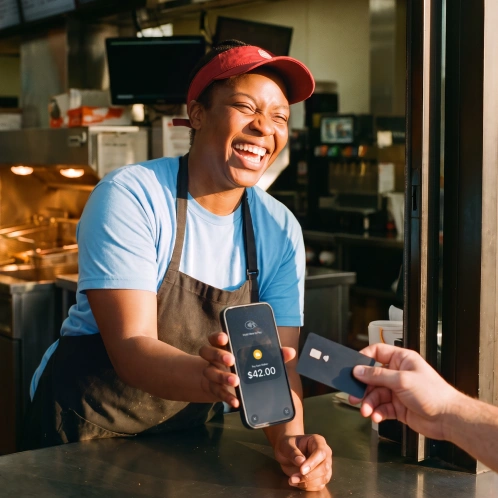
For flea market businesses that need to accept payments on-site or on-the-go, JIM offers a streamlined solution. With JIM, you can accept debit, credit, and digital wallets directly through your smartphone. Just tap and done.
At 1.99% per transaction with no hidden costs or extra hardware needed, JIM is useful for processing quick sales in a busy market. Other providers often charge between 2.5% and 3.5%, so the savings add up. Here is how it works:
- Get Started: Download the JIM app for iOS.
- Make a Sale: Type the sales amount, hit sell, and ask your customer to tap their card or device on your phone.
- Access Funds: Your money is available right on your JIM card as soon as the sale is done. No waiting for bank transfers.
Here are 3 immediate steps to take:
- Decide what percentage of sales you expect from cards versus cash.
- Compare the total cost of two payment solutions, including all transaction and hardware fees.
- Download the JIM app to explore its features before your first market day.
Step 6: How do you secure funding and manage your flea market finances?
Most vendors self-fund with personal savings, but SBA Microloans up to $50,000 are available, and you need $4,100 to $8,900 in working capital for your first six months.
Explore your funding options
Most vendors self-fund with personal savings. If you need a boost, consider a microloan from a Community Development Financial Institution. These nonprofit lenders often focus more on your business plan than your credit score, and their interest rates are typically lower than credit cards.
You can also look into the SBA Microloan program, which provides funds up to $50,000 through local nonprofit lenders. Relying on high-interest credit cards for startup cash is a costly mistake. Rates over 20% can eat into your profits before you even get started.
How much working capital do flea market vendors need?
You need between $4,100 and $8,900 in working capital to operate comfortably for your first six months. This buffer covers booth fees, inventory replenishment, and slower weekends.
For your first six months, budget for recurring costs. This includes booth fees ($600 to $2,400 for 24 weekends), inventory replenishment ($3,000 to $6,000), and a small contingency fund of about $500. A simple spreadsheet helps you track these projected expenses against your actuals.
On taxes, report your flea market income on Schedule C (Form 1040), Profit or Loss from Business if you operate as a sole proprietor or single-member LLC. Keep receipts for booth fees, inventory, and mileage to claim deductions.
If you accept card payments, your processor issues a Form 1099-K for the year's gross card volume. Reconcile that form against your own sales records before you file.
Here are 4 immediate steps to take:
- Calculate your total working capital needed for the first six months.
- Research your local SBA Microloan intermediary lender online.
- Compare the terms of a microloan with a business credit card offer.
- Create a monthly budget that tracks inventory, booth fees, and other costs.
Step 7: How do you hire your flea market team and run operations?
Start solo, then hire a part-time booth assistant at $15 to $20 per hour once your weekend sales consistently top $1,000.
You will likely start as a one-person operation. Consider hiring help once your weekend sales consistently top $1,000, a threshold that signals steady demand at your booth. An extra person can manage customer questions and sales during peak hours, which prevents you from losing business when you are busy with another shopper. For broader guidance on when to bring on your first hire, the same revenue-triggered approach applies to market vendors.
Hire and manage your first helper
Your first hire will probably be a part-time Booth Assistant. Their duties include setup, teardown, and customer service. Pay is typically hourly, around $15 to $20, often paid in cash at the end of the day. No special certifications are needed for this role.
What you need is someone reliable with good people skills. Hiring a friend or family member without clear expectations is risky. Always define the hours, pay, and responsibilities upfront in a simple written agreement to avoid any confusion.
For scheduling, you do not need complex software. A shared digital calendar or even simple text messages work well for coordinating with one or two helpers. The key is clear communication about market dates and times well in advance.
Here are 3 immediate steps to take:
- Set a specific weekend sales goal that will trigger your first hire.
- Draft a one-page agreement that outlines the duties and pay for a booth assistant.
- Choose a simple scheduling method, like a shared Google Calendar, for your future team.
Step 8: How do you market your flea market business and attract customers?
Start marketing before your first market day with social media posts, clear booth pricing, and a customer email list.
Your marketing can start before you even set up your booth. Create a dedicated Instagram or Facebook page to showcase your finds. Post clear, well-lit photos of your best items a few days before each market. Use local hashtags like #[city]fleamarket to reach nearby shoppers.
Many new vendors rely solely on foot traffic, but a little promotion builds anticipation. A single post about a unique item can bring a motivated buyer directly to your booth. Consistency is important; aim to post 3 to 5 times in the week leading up to a market day.
Your booth itself is a marketing tool. Keep it organized with clear pricing. You can also build a customer list with a simple clipboard for email sign-ups. Offer a small incentive, like 10% off their next purchase, for joining your list for future updates.
Simple promotions work well. Announce a weekend-only special on your social media, like "20% off all vintage denim." This creates urgency. To see what works, just ask customers how they heard about you. This simple feedback is more valuable than complex analytics.
Here are 4 immediate steps to take:
- Create an Instagram or Facebook page for your business.
- Post photos of three unique items you will sell this weekend.
- Make a simple email sign-up sheet for your checkout area.
- Plan one weekend-only special to announce on social media.
Step 9: How do you price your flea market products for profit?
Use the 3x markup rule to target a 67% gross margin, then research sold prices on eBay and build a 15 to 25% negotiation buffer into your prices.
A good starting point is the 3x markup rule. If you source an item for $10, price it at $30. This strategy targets a gross profit margin of about 67% and is a simple way to ensure you cover your costs and make a profit on each sale. Pricing based on a gut feeling costs you margin. Instead, do some quick research with sold-price data, the same approach resellers use across categories. Walk around the market to see what your competitors charge for similar goods. You can also use the "Sold Items" filter on eBay to see what people actually paid for an item.
Factor in negotiation and bundling
Most flea market shoppers expect to haggle, so build a buffer into your prices. Pricing an item 15 to 25% higher than your minimum acceptable price gives you room to negotiate. For a $30 item, you could accept an offer of $25 and still hit your target.
Also, consider bundle deals for smaller items. An offer like "3 for $10" can move inventory much faster than selling each item for $4. This approach increases your average transaction value and helps clear out stock that might otherwise sit for weeks.
Here are 4 immediate steps to take:
- Apply the 3x markup rule to ten of your items to set initial prices.
- Use eBay's "Sold Items" filter to research the market value of your top three products.
- Calculate a 20% negotiation buffer for your higher-priced goods.
- Create one bundle deal for a category of your smaller items.
Step 10: How do you control quality and scale your flea market operations?
Grade inventory on a 1-to-5 quality scale, wait three consecutive profitable months before expanding, and track every item in a spreadsheet until you outgrow it.
Establish a simple quality standard for your inventory. You can use a 1-to-5 rating system to grade the condition of each item. This helps you price accurately and maintain a reputation for quality. Items rated 3 or below might be sold in a discounted "as-is" bin.
Know when to grow
Once your sales are steady, you can plan for growth. A good benchmark for hiring help is when you spend over 10 hours a week on non-sales tasks like sourcing and prep. This frees you up to focus on customers and find better inventory.
Expanding too quickly after one successful weekend is a trap. Wait until you have hit your target profit goal for three consecutive months. At that point, you might consider renting a second booth or moving to a larger, higher-traffic market.
To manage this growth, start by tracking your inventory and sales in a simple spreadsheet. When that becomes too cumbersome, you can look at reseller-specific software like My Reseller Genie. It helps you track profit per item, mileage, and other expenses for tax time.
Here are 4 immediate steps to take:
- Create a 1-to-5 rating system to grade your inventory's condition.
- Set a three-month profit goal that will trigger your expansion.
- Build a basic spreadsheet to track inventory, cost, and sale price.
- Review a reseller-specific program like My Reseller Genie to see if it fits your needs.
You now have a clear path from finding treasures to running a profitable booth. Remember that success often comes down to enjoying the conversations with customers as much as the hunt for inventory. Your unique eye for value is your greatest asset, so trust it.
As you get started, JIM makes it easy to accept every payment. It turns your smartphone into a card reader for a flat 1.99% fee, with no extra hardware needed. Download JIM and you're ready for your first market day.
Frequently Asked Questions
Do I need an LLC to sell at a flea market?
Do I need to pay taxes on flea market sales?
Yes. Flea market income is business income. Report it on Schedule C (Form 1040), Profit or Loss from Business, whether you operate as a sole proprietor or a single-member LLC. Keep receipts for booth fees, inventory, and mileage to claim deductions.
If you accept card payments, your processor issues a Form 1099-K for the year's gross card volume. Reconcile that form against your own sales records before you file.
How much does it cost to start a flea market business?
How much do flea market vendors make?
What licenses do flea market vendors need?


Sell and get paid in seconds with Jim