Starting a food manufacturing business is a rewarding venture that combines culinary creativity with business savvy. The industry is worth billions, fueled by steady demand for products from restaurants, grocery stores, and institutional food services.
This guide will take you through the practical steps of validating your business concept, securing funding, obtaining the right permits, and building supplier relationships to help you launch a successful food manufacturing business in the U.S.
Step 1: Plan your business and validate your product
Before you invest a dollar, confirm people want your product. You can test your concept at farmers' markets or with small focus groups. This direct feedback is more valuable than just asking friends and family, who may not give you unbiased opinions.
Analyze the competition and costs
Research your competitors to understand their pricing, packaging, and sales channels. You can use industry databases like Mintel or simply walk through grocery store aisles. Note what successful brands do and where you see a gap in the market.
Speaking of costs, your initial investment can range from $20,000 to over $75,000. Key expenses include commercial kitchen rental ($1,500-$4,000 monthly), initial ingredients ($3,000-$10,000), and permits ($500-$2,000). A frequent oversight is underbudgeting for packaging, so price it out early.
Here are 3 immediate steps to take:
- Draft a one-page business plan that defines your product and ideal customer.
- Research three direct competitors, noting their prices and packaging designs.
- Create a preliminary budget with estimated costs for kitchen space, ingredients, and permits.
Step 2: Set up your legal structure and get licensed
Choose your business entity
Most new food businesses start as a Limited Liability Company (LLC). This structure protects your personal assets if the business faces legal issues. It also offers pass-through taxation, so profits are taxed on your personal return, which simplifies things early on.
Secure federal and state permits
Your operations will be regulated by federal, state, and local agencies. The primary federal body is the Food and Drug Administration (FDA). You must register your facility with the FDA, which is free but mandatory before you begin operations.
Your state and city health departments issue the main permits. Expect to need a Food Processor License, which can cost between $100 and $1,000. A frequent oversight is not allowing enough time for this, as approval can take 30 to 90 days.
Here are 4 immediate steps to take:
- File for an LLC with your state and choose a business name.
- Apply for a free Employer Identification Number (EIN) on the IRS website.
- Contact your local health department for their specific permit application and fees.
- Complete the FDA Food Facility Registration online before you start production.
Step 3: Secure your insurance and manage risk
Key insurance policies and costs
You will want to secure both General Liability and Product Liability insurance. A $1 million policy for each is standard. Expect annual premiums to range from $500 for general liability to over $1,000 for product liability, which specifically covers you if someone gets sick from your food.
A frequent oversight is thinking general liability is enough, but it often excludes foodborne illness claims. If you have employees, Workers’ Compensation is legally required. You should also consider Commercial Property insurance to protect your kitchen space and equipment from damage or theft.
With this in mind, you might want to get quotes from providers who specialize in the food industry. Companies like the Food Liability Insurance Program (FLIP), Hiscox, and NEXT Insurance understand specific risks like product recalls or equipment spoilage better than a general agent might.
Here are 4 immediate steps to take:
- Request quotes for a $1 million General Liability and Product Liability policy.
- Contact an insurance provider specializing in the food industry, like FLIP.
- Determine if you need Workers’ Compensation or Commercial Property insurance.
- Ask potential insurers about their specific coverage for product recalls.
Step 4: Find your location and buy equipment
Secure a commercial kitchen space
You will need a licensed commercial kitchen. Look for spaces between 500 and 1,500 square feet zoned for commercial or industrial use. Shared-use kitchens are a great way to start, as they reduce overhead. Monthly rent can range from $1,500 to $4,000.
When you negotiate a lease, you might ask for a tenant improvement allowance. This can help cover the cost of any necessary plumbing or electrical upgrades. A frequent mistake is to overlook utility capacity, so confirm the space can handle your equipment's power and water demands.
Purchase your production equipment
Your equipment needs depend on your product. Key items often include a commercial mixer ($2,000-$5,000), a convection oven ($3,000-$7,000), and stainless steel work tables ($200-$600). You can find quality used equipment for 30-50% less from local restaurant supply resellers.
For new items, suppliers like WebstaurantStore offer a wide selection without large minimum orders. This allows you to scale your purchases as you grow. Just be sure to factor in freight shipping costs for heavy machinery, which can add several hundred dollars to your total.
Here are 4 immediate steps to take:
- Tour at least two local shared-use commercial kitchens to compare rates.
- Check your city’s zoning map online to confirm potential locations are approved for food production.
- Price out one major piece of used equipment, like a 20-quart mixer.
- Ask potential landlords if they offer a tenant improvement allowance for kitchen upgrades.
Step 5: Set up your payment processing
For wholesale accounts, Net 30 payment terms are standard, which means clients pay 30 days after delivery. You will manage this with invoicing software. A frequent misstep is not accounting for this payment delay in cash flow projections, so plan accordingly.
For direct sales at markets or events, you need to accept payments on the spot. Many payment solutions have fees from 2.5% to 3.5% plus monthly charges, which can reduce your profit. It is wise to factor these costs into your pricing from day one.
Accepting mobile payments
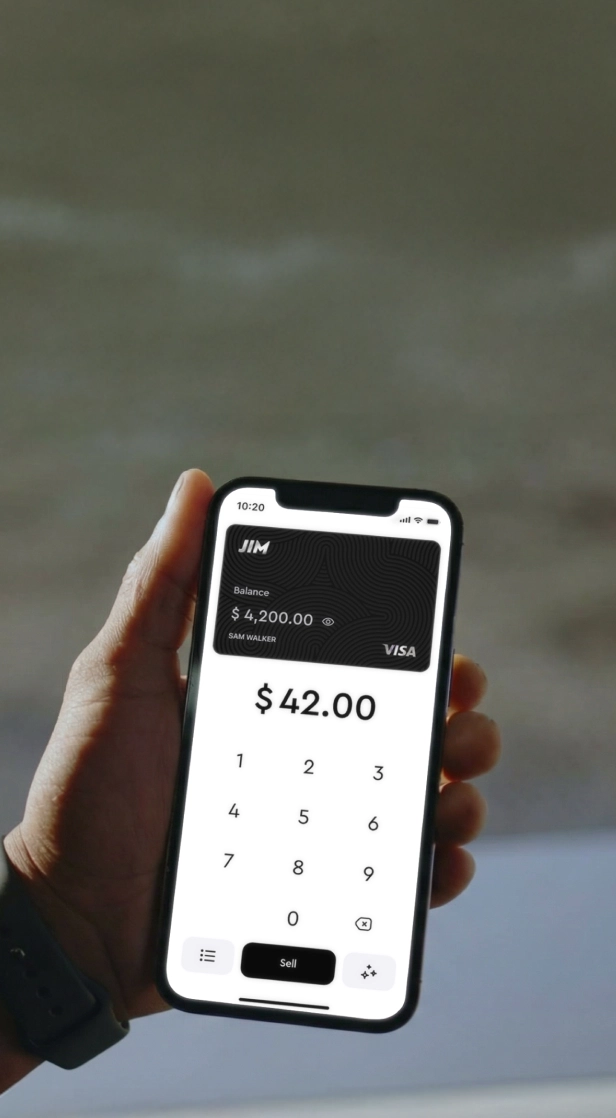
For a food manufacturing business that needs to accept payments on-site or on-the-go, JIM offers a streamlined solution. With JIM, you can accept debit, credit, and digital wallets directly through your smartphone—just tap and done. At just 1.99% per transaction with no hidden costs or extra hardware needed, it's particularly useful for selling at food fairs.
- Get Started: Download the JIM app for iOS.
- Make a Sale: Type the sales amount, hit sell, and ask your customer to tap their card or device on your phone.
- Access Funds: Your money is available right on your JIM card as soon as the sale is done—no waiting for bank transfers.
Here are 4 immediate steps to take:
- Decide on your payment terms (like Net 30) for wholesale clients.
- Compare JIM's 1.99% rate against other mobile payment options.
- Download the JIM app to see how it works before your first event.
- Add a 2-3% payment processing fee into your product pricing model.
Step 6: Secure your funding and manage finances
Explore your funding options
Many new food businesses turn to SBA 7(a) loans. Lenders typically want to see a credit score above 680 and a strong business plan. For startups, these loans can range from $50,000 to $250,000 with interest rates around Prime plus 2-5%.
You might also look into industry-specific grants. The USDA's Value-Added Producer Grant (VAPG) is a great example. While competitive, it provides funds to help agricultural producers enter into value-added activities. Check their website for application cycles.
Plan your financial runway
Before you seek funds, you need to know exactly how much you need. Calculate your working capital for the first six months to cover rent, payroll, and initial inventory. A budget of $30,000 to $50,000 is a realistic starting point for many.
A frequent misstep is not budgeting a large enough cash buffer. Unexpected costs always appear. Having extra funds prevents you from making desperate decisions early on, so build a 15-20% contingency into your financial projections from the start.
Here are 4 immediate steps to take:
- Check your credit score to confirm you meet the 680+ threshold for most SBA loans.
- Look up the USDA Value-Added Producer Grant to see if your product qualifies.
- Create a detailed 6-month budget that includes a 20% contingency fund.
- Draft a one-page summary of your funding needs to share with potential lenders.
Step 7: Hire your team and set up operations
Your first hire will likely be a Production Assistant to help with food prep, packaging, and cleaning. Expect to pay between $15 and $20 per hour. As you grow, you may need a part-time Food Safety Manager to handle compliance and quality control.
Manage your team and costs
Anyone who handles food should have a ServSafe Food Handler certification, which costs about $15 online. You might also want to get the Manager certification for yourself. It provides a deeper understanding of food safety regulations and costs around $125.
To manage schedules, you can use software like When I Work. A frequent oversight is underestimating labor costs. Aim to keep your total labor expenses, including taxes and benefits, between 25-35% of your revenue. This is a standard benchmark in the food industry.
It can be tempting to classify workers as independent contractors to save on payroll taxes. Be careful here. The IRS has strict rules, and misclassification can lead to significant penalties. An employee is anyone you train and direct, using your equipment on your schedule.
Here are 4 immediate steps to take:
- Draft a job description for a Production Assistant, including pay and duties.
- Complete the ServSafe Food Handler certification online.
- Calculate your target labor cost as a percentage of projected sales.
- Review the IRS guidelines on independent contractors versus employees.
Step 8: Market your products and find customers
Start with wholesale outreach to local independent grocers and cafes. Prepare a one-page sell sheet with your pricing, story, and product photos. A realistic goal is to secure three to five wholesale accounts within your first quarter of operation.
Many new owners pour money into social media ads too soon. A better use of your budget is in-person demos at stores that carry your product. These events can lift sales by 200-500% on demo days and create repeat customers.
Build your online brand
Create a simple website with professional photos to tell your story and list retail locations. Once you have a presence, you can run targeted ads on platforms like Instagram. Aim for a customer acquisition cost (CAC) under $25 for these campaigns.
Consider how other brands grew. RXBAR, for instance, sent free samples to fitness influencers. You can adopt a similar strategy. Identify local food bloggers and send them a personalized package, which often yields a better return than paid advertising.
Here are 4 immediate steps to take:
- Create a one-page sell sheet for wholesale buyers.
- Schedule one in-store demo for the upcoming month.
- Identify five local food bloggers to contact for sampling.
- Set up a basic website with a "where to buy" page.
Step 9: Set your pricing strategy
Your pricing determines your profitability. Most food producers use a cost-plus model. This involves calculating your Cost of Goods Sold (COGS) per unit and adding a markup. A frequent miscalculation is forgetting to include indirect costs like a portion of your rent, utilities, and labor in your COGS.
Calculate your price
Aim for a gross profit margin between 30% and 50%. For example, if your COGS for a jar of sauce is $2.50, a 40% margin would mean a wholesale price of $4.17 ($2.50 / (1 - 0.40)). The retailer will then add their own markup, typically 30-50%, to set the final shelf price.
To validate your price, research competitors. Look at their retail prices and work backward. If a similar sauce sells for $7.00, the retailer likely paid around $4.50. This tells you if your own wholesale price is competitive. Your pricing should reflect your brand's perceived value.
Here are 4 immediate steps to take:
- Calculate the full COGS for one unit of your product, including indirect costs.
- Research the retail prices of three direct competitors in local stores.
- Set a target gross profit margin for your product between 30% and 50%.
- Work backward from competitor retail prices to estimate their wholesale costs.
Step 10: Maintain quality and scale production
Your goal is consistency. A good starting point is creating a Hazard Analysis Critical Control Point (HACCP) plan. This system helps you identify and control potential food safety hazards throughout your production process, from raw materials to finished goods.
Track your quality with hard numbers. You can monitor your batch rejection rate or customer complaints per 1,000 units sold. Aim for a complaint rate below 1%. Many new producers only check quality at the end, but you should build checks into each step to avoid costly waste.
When to expand your operations
Once you consistently operate at 80% of your kitchen’s capacity, it is time to look for a larger space. If you spend over half your time on production instead of sales, you should hire another production assistant. This frees you up to focus on growing the business.
As your order volume increases, manual tracking becomes difficult. You might want to look into inventory management software like Fishbowl. It helps manage stock levels, production orders, and supplier information, which prevents stockouts and streamlines purchasing.
Here are 4 immediate steps to take:
- Outline a basic HACCP plan for your main product.
- Set a quality metric, like tracking customer complaints per month.
- Calculate your current production capacity to identify your 80% threshold.
- Research inventory management software like Fishbowl to understand its features.
Starting a food business is a journey of passion and precision. Remember that your success depends just as much on managing your costs as it does on perfecting your recipe. You have a solid plan now, so trust your taste and your numbers. It's time to get started.
As you start selling, you'll need a simple way to get paid. JIM turns your phone into a card reader for a flat 1.99% fee, with no extra hardware. It makes payments easy so you can focus on your product. Download JIM to be ready for your first sale.
.avif)