Starting a freeze-dried candy business is a rewarding venture that blends culinary creativity with smart business sense. The entry barrier is relatively low and the demand for unique sweets is always high, but that accessibility means you'll face competition.
This guide will take you through the practical steps of validating your business idea, obtaining the necessary permits, acquiring equipment, and building supplier relationships to help you launch a successful freeze dried candy business in the U.S.
Step 1: Plan and validate your business idea
Start by researching the market on platforms where you plan to sell. Search for "freeze-dried candy" on Etsy, TikTok, and Facebook Marketplace. Note the top sellers, their pricing per ounce, and packaging. This gives you a real-world baseline for what customers expect and are willing to pay.
Many new owners only look at big brands. Your real competition is often another small business at a local farmers' market or on Etsy. Identify three to five of these direct competitors and analyze their product photos, descriptions, and customer reviews to find your unique angle.
Project your startup costs
Your main investment will be the freeze dryer. A home unit from a company like Harvest Right runs from $2,500 to $5,000. Plan for long cycle times—often 24 hours per batch—which will influence your initial production capacity and profitability projections.
Beyond the machine, budget for initial supplies. You should allocate $500 to $1,000 for bulk candy, Mylar bags, oxygen absorbers, and labels. In addition, set aside $100 to $400 for business registration and any local food permit fees, bringing your estimated startup total to between $3,100 and $6,400.
Here are 3 immediate steps to take:
- Identify and list five direct competitors on Etsy or at local markets.
- Create a spreadsheet to budget for a freeze dryer, initial supplies, and fees.
- Research your state's "cottage food laws" to understand initial permit needs.
Step 2: Establish your legal and licensing framework
You might want to consider forming a Limited Liability Company (LLC). It separates your personal assets from business debts and typically costs between $50 and $500 to register with your Secretary of State. An LLC also offers pass-through taxation, so profits are taxed on your personal return.
Once you have a business structure, you can navigate the licensing. Most home-based candy businesses operate under state-specific "cottage food laws." These laws allow you to produce and sell from your home kitchen without a commercial license, which is a huge advantage when you start.
A mistake many new sellers make is outgrowing these laws without a plan. Cottage food regulations often have an annual revenue cap, sometimes around $50,000, and may restrict you to direct sales. This means you cannot sell wholesale to other stores.
Permits and food safety
Your local health department will likely require you to get a Food Handler's Permit. This usually involves a simple online course and a small fee of about $10 to $15. The permit shows you understand basic food safety practices.
While state laws govern your kitchen, the Food and Drug Administration (FDA) dictates your packaging labels. Your labels must include your business name and address, a full ingredient list, net weight, and any major allergens like nuts or dairy.
Here are 4 immediate steps to take:
- File for an LLC with your state's Secretary of State office.
- Look up your state's specific cottage food law to find its revenue cap.
- Complete the online course to obtain your local Food Handler's Permit.
- Draft a sample package label that meets FDA requirements.
Step 3: Secure your insurance and manage risk
Start with General Liability and Product Liability insurance. Many new sellers assume general liability is enough, but you also need product liability. This specifically protects you if a customer has an allergic reaction or claims your candy made them sick. It is a vital shield for any food business.
Find the right coverage
For a small home-based operation, expect to pay between $400 and $1,200 annually for a combined policy. A typical plan includes $1 million in general liability and $1 million in product liability coverage. This amount is standard and covers most potential claims.
Some insurance providers specialize in small food businesses. You might want to consider companies like the Food Liability Insurance Program (FLIP), NEXT Insurance, or Hiscox. They understand the unique risks, from equipment failure with your freeze dryer to mislabeling allergens on your packaging.
Here are 3 immediate steps to take:
- Get quotes from FLIP and NEXT Insurance for a product liability policy.
- Ask your homeowner's insurance agent if your current policy covers a home-based business.
- Review your product list to identify all potential allergens for your labels.
Step 4: Set up your production space and equipment
Under cottage food laws, your production space is your home. You should dedicate a clean, separate area of 50 to 100 square feet. A spare room or a section of your garage works well. Specific zoning is rarely an issue for home operations, but a quick check of local rules is smart.
A mistake many new owners make is to underestimate storage. You need distinct, sanitary spots for bulk candy, packaging materials like Mylar bags, and your finished products. Good organization prevents cross-contamination and streamlines your workflow when orders come in.
Key equipment and suppliers
Beyond the freeze dryer, you will need an impulse sealer to create an airtight seal on your bags. These cost between $30 and $100. You also need a digital scale, which runs about $20 to $50, to ensure your net weight on labels is accurate.
This brings us to suppliers. You can source bulk candy from online shops like CandyStore.com or wholesale clubs like Costco. For packaging, Uline is a common source for bags and oxygen absorbers. Be mindful of minimum order quantities and start with smaller orders to protect your cash flow.
Here are 4 immediate steps to take:
- Measure a dedicated 50-100 square foot production space in your home.
- Price an impulse sealer and a digital scale from online retailers.
- Compare bulk candy prices from two different suppliers.
- Request packaging samples from a supplier like Uline.
Step 5: Set up your payment processing
Your sales channels dictate your payment setup. If you sell on Etsy, payment processing is built-in. For in-person sales at farmers' markets or pop-ups, you need a mobile solution to accept credit and debit cards on the spot.
Many new sellers overlook transaction fees, which can eat into profits. Look for a system with low rates and no monthly charges. Some solutions have rates between 2.6% and 2.9% plus other fees, which adds up quickly on small candy purchases.
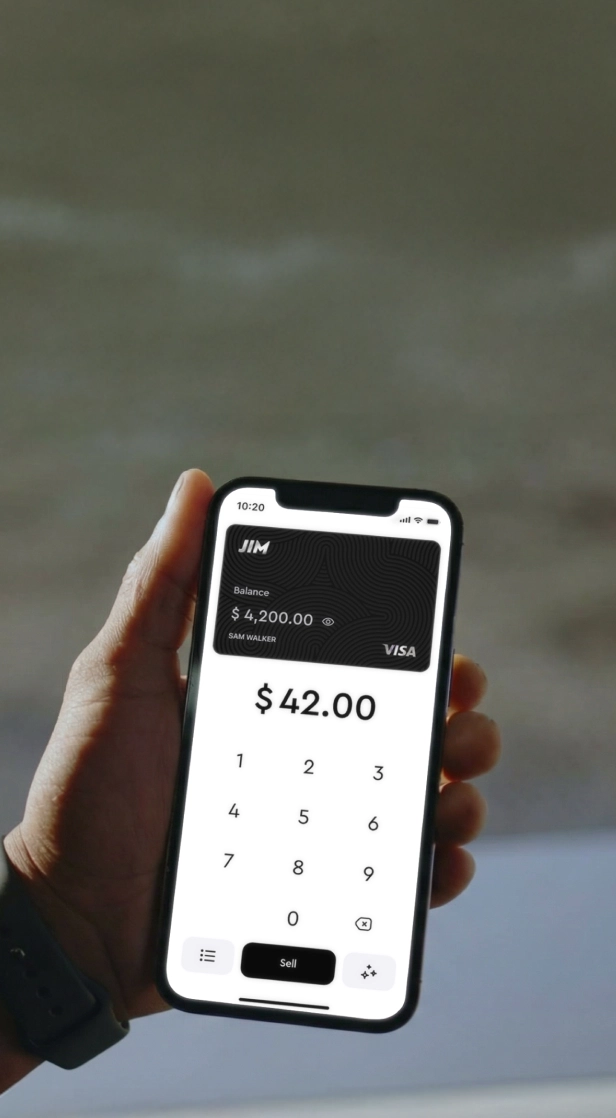
For freeze-dried candy businesses that need to accept payments on-site or on-the-go, JIM offers a streamlined solution. With JIM, you can accept debit, credit and digital wallets directly through your smartphone - just tap and done. At just 1.99% per transaction with no hidden costs or extra hardware needed, it's particularly useful for market stalls.
Getting started is straightforward:
- Get Started: Download the JIM app for iOS.
- Make a Sale: Type the sales amount, hit sell, and ask your customer to tap their card or device on your phone.
- Access Funds: Your money is available right on your JIM card as soon as the sale is done - no waiting for bank transfers.
Here are 3 immediate steps to take:
- Decide if you will sell online, in-person, or both to determine your needs.
- Download the JIM app to see how it works for in-person transactions.
- Calculate your potential savings with a 1.99% rate versus a 2.9% rate.
Step 6: Fund your operation and manage finances
Most founders self-fund with personal savings. If you need a loan, consider an SBA Microloan. These loans go up to $50,000 and are designed for new businesses that need to purchase equipment. Interest rates typically range from 8% to 13%.
Secure your initial funding
You can also look into grants. While candy-specific grants are rare, programs like the Amber Grant for Women award funds monthly. Your business plan and a clear story are what matter for these applications. A common mistake is to rely on a single funding source, so explore a few options.
Manage your cash flow
Once you have funds, open a dedicated business checking account. Mixing personal and business finances creates tax headaches and makes it hard to track profitability. This simple step is one many new owners skip, causing problems later.
You should also plan for about $3,000 to $5,000 in working capital to cover your first six months. This budget accounts for ongoing inventory, packaging, and market fees before your sales build momentum. Track every expense to understand your true cost per bag.
Here are 4 immediate steps to take:
- Research SBA Microloan lenders in your state.
- Open a separate business checking account.
- Create a six-month budget for your working capital needs.
- Compare accounting software like Wave and QuickBooks Self-Employed.
Step 7: Hire and manage your team
In the beginning, you are the entire team. You might want to consider your first hire once you consistently approach your cottage food law revenue limit. This person can free you up to focus on sales and growth instead of just production.
Your first hire: Production Assistant
A Production Assistant is a great first role. This person handles tasks like loading the freeze dryer, packaging finished candy, and applying labels. Expect to pay an hourly wage between $15 and $20, depending on your local market. Many new owners hire someone without a documented process, which leads to inconsistent quality.
Before you hire, make sure your new team member gets a Food Handler's Permit. This is the same certification you needed. It ensures they understand safe food practices. Also, create a simple, one-page guide that outlines your production steps to maintain consistency with every batch.
Scaling your operations
As you grow beyond one employee, scheduling software like Homebase or When I Work can help manage shifts. Many offer free plans for small teams. A good benchmark for this business is to aim for one full-time employee for every $100,000 to $150,000 in annual revenue.
Here are 4 immediate steps to take:
- Draft a simple job description for a Production Assistant role.
- Create a one-page document outlining your production workflow.
- Research the hourly wage for food prep workers in your city.
- Review your state's labor website for employer registration requirements.
Step 8: Market your products and find customers
Your marketing should focus on visual platforms where your product's unique texture can shine. TikTok and Instagram Reels are perfect for this. Short videos that show candy puffing up in the freeze dryer or someone enjoying a loud, satisfying crunch can attract thousands of views overnight.
Many new sellers only post static photos of the final product. You can stand out by showing the transformation. A simple "before and after" video is far more engaging and shareable. This visual proof builds curiosity and drives traffic to your online store or social media page.
Optimize your online sales channels
For platforms like Etsy, your success depends on search visibility. Use specific, long-tail keywords in your titles and descriptions. Instead of just "freeze-dried candy," use terms like "crunchy sour worms," "puffy Skittles," or "astronaut candy gift box" to capture targeted searches.
At local farmers' markets, samples are your best sales tool. A good goal is to convert at least 10% of people who try a sample into paying customers. Be prepared with small, cost-effective samples to hand out. This direct interaction often creates loyal, repeat buyers.
Here are 4 immediate steps to take:
- Brainstorm and film one "before and after" video for TikTok or Instagram.
- List ten long-tail keywords for your first Etsy product listing.
- Calculate the cost of giving away 100 samples at a local market.
- Research the booth fees and application process for two local markets.
Step 9: Price your products for profit
Calculate your cost of goods sold
First, calculate your cost per bag. Add up the price of the candy, the Mylar bag, the oxygen absorber, and your label. A mistake many owners make is to forget hidden costs like electricity for the 24-hour freeze-dry cycle and a small amount for your own labor.
Choose a pricing model
The most direct method is cost-plus pricing. Once you have your total cost per bag, apply a markup. A good starting range for freeze-dried candy is a 300% to 500% markup. For example, if your cost per bag is $1.25, a 400% markup (4x) gives you a sale price of $5.00.
You should also analyze your competitors' pricing per ounce. If top sellers on Etsy charge $2.00 per ounce for a 4-ounce bag ($8.00 total), pricing your similar bag at $5.00 might be too low. Find a balance between your costs and what the market expects.
Consider offering bundle deals to increase the average order value. For instance, you could sell single bags for $6 but offer a "3 for $15" deal. This encourages larger purchases and can move inventory faster, especially at in-person markets.
Here are 4 immediate steps to take:
- Calculate the total cost for one bag of your main product.
- Research the price per ounce of three direct competitors.
- Set a test price for your first product using a 4x markup.
- Create one bundle deal, such as "3 bags for $15."
Step 10: Maintain quality and scale your operations
Establish your quality standards
Your brand's reputation depends on consistency. Create a simple quality checklist for every batch. Key checks include texture, appearance, and weight. A perfect piece of freeze-dried candy should snap cleanly with an audible crunch, not feel chewy or soft.
You should also inspect for uniform color and shape. A bad batch can result from overloading trays or an incorrect cycle time. Test the seal on a few bags from each run to ensure they are airtight. A poor seal lets in moisture and ruins the product on the shelf.
Know when to grow
A good benchmark for buying a second freeze-dried is when you consistently sell 80% of your inventory before the next batch is ready. A mistake many owners make is buying more equipment before they master their process with one machine. This can lead to a drop in quality.
Once you approach your state's cottage food revenue cap, start researching commercial kitchens. This transition can take a few months, so plan ahead. This move is necessary if you want to sell wholesale to retail stores, which cottage food laws typically prohibit.
As you grow, inventory management becomes more complex. A system like Katana can help you track raw candy, packaging supplies, and finished goods. This prevents overselling and helps you manage stock levels across multiple sales channels.
Here are 4 immediate steps to take:
- Create a one-page quality checklist to use for every batch.
- Set a weekly sales goal that would justify buying a second machine.
- Research the rental costs for a shared commercial kitchen in your area.
- Define the weekly production hours that would trigger your first hire.
Your freeze-dried candy journey is a chance to turn a simple treat into a crunchy, visual experience. Remember, your best marketing is often a video that shows the transformation. You have the roadmap, now go build your sweet success.
When you start to sell, a simple payment solution helps. JIM turns your phone into a card reader for a flat 1.99% fee, with no extra hardware. This makes market sales easy. Download JIM and get started.
.avif)