How to start a freeze drying business from the ground up
See article summary
- Expect $3,100 to $6,500 in startup costs, led by a $2,500 to $5,000 freeze dryer.
- An LLC protects your personal assets and simplifies taxes compared to a sole proprietorship.
- A Food Processor License and a dedicated kitchen are required in most states.
- A combined General and Product Liability policy runs $300 to $1,500 per year.
- JIM charges 1.99% per Tap to Pay sale with no hardware, ideal for market stalls.
Starting a freeze-drying business is a rewarding venture that combines culinary creativity with business savvy. The global freeze-dried food market was valued at roughly $46 billion in 2024 and continues to expand as backpackers, emergency preppers, and health-conscious families drive steady demand for long-lasting foods.
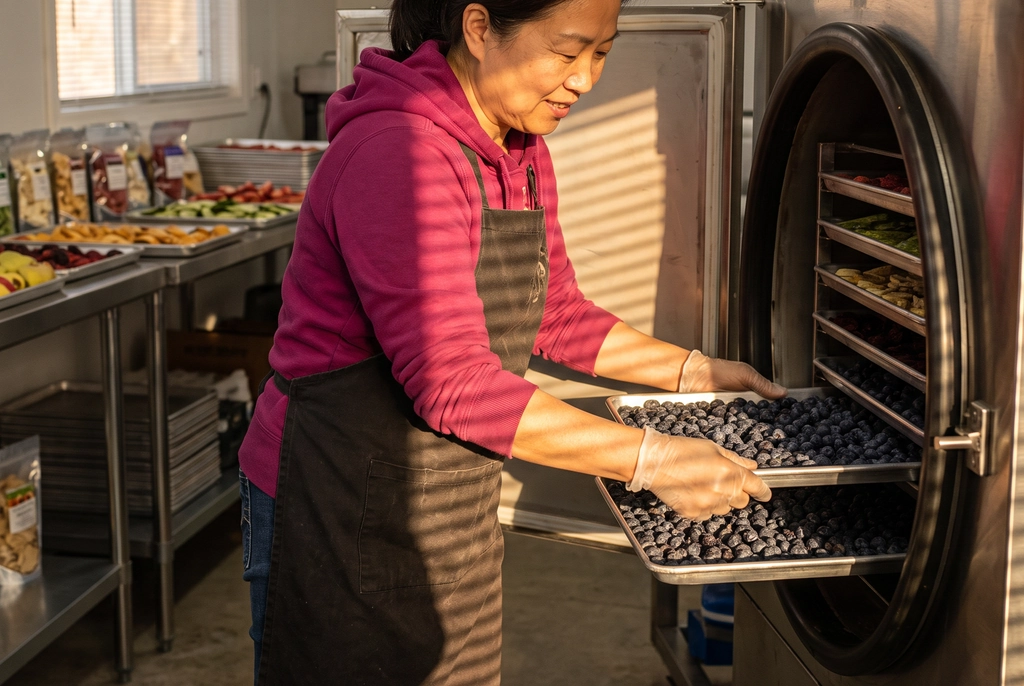
Freeze-drying, also called lyophilization, removes about 95% of the water from food through sublimation, turning ice directly into vapor without passing through a liquid phase. That process preserves flavor, color, and nutrients while extending shelf life to 20-plus years when packaged correctly.
How much does it cost to start a freeze drying business?
Expect $3,100 to $6,500 in startup costs, with the freeze dryer as your largest line item. The exact total depends on the unit size you choose, your packaging strategy, and your state's permit fees.
Define your niche before you buy anything. Freeze-dried candy, fruits, pet food, and full camper meals each demand different equipment cycles, packaging, and pricing. Research popular products on Etsy or Amazon to see what customers buy right now, and read reviews to find gaps in the market.
Use Google Trends to compare search interest across your product ideas. Freeze-dried candy has been one of the fastest-growing segments, with Grand View Research tracking an 8.5% compound annual growth rate for the category. Choosing a niche without checking demand first is the most common reason new operators stall, so verify interest before you commit.
Startup cost breakdown
Your freeze dryer is the largest initial investment, typically from $2,500 to $5,000 for a home-commercial unit. Also, budget for packaging like Mylar bags ($200 to $500), initial ingredients ($300 to $600), and business permits ($100 to $400). Your total initial outlay will likely be between $3,100 and $6,500.
When you calculate costs, remember to factor in electricity. A home freeze dryer can add $30 to $60 to your monthly bill. Many new owners overlook this recurring expense, which can erode your profit margins over time.
Compare niches before you choose
Each niche has a different margin profile, production complexity, and customer base. Use this comparison to narrow your focus before you buy equipment.
| Niche | Typical margin | Production complexity | Demand signal |
|---|---|---|---|
| Freeze-dried candy | High | Low | Fast-growing on Etsy and TikTok |
| Freeze-dried fruit | Medium | Low | Steady, competitive |
| Freeze-dried pet food | Medium | Medium | Growing, loyal repeat buyers |
| Full camper meals | Medium | High | Niche, seasonal |
Source: JIM editorial analysis of supplier pricing and marketplace demand, August 2026.
Action checklist:
- Research three potential niches on Etsy or Amazon.
- Create a spreadsheet to estimate your startup costs using the ranges provided.
- Identify two direct competitors and analyze their product offerings and pricing.
How do you set up your legal structure and get licensed?
Form an LLC and secure a Food Processor License before you sell anything. An LLC protects your personal assets, and the license keeps you on the right side of state and local food regulations.
Most new freeze-drying businesses choose a Limited Liability Company (LLC). This structure protects your personal assets, like your home, from business debts or lawsuits. You can often complete the setup online through your state's Secretary of State website for $50 to $200. For a broader walkthrough of business structure options, including how an LLC compares to a sole proprietorship, JIM's startup guide lays out the tradeoffs.
It can be tempting to operate as a sole proprietorship to save on fees. This choice offers no legal separation between you and the business. An LLC also provides pass-through taxation, so profits are taxed once on your personal return. The IRS classifies a single-member LLC as a disregarded entity by default, which means business income flows to your personal taxes without the double taxation that C corporations face when they distribute dividends.
Secure your licenses and permits
Food businesses are regulated at multiple levels. You will need to comply with your state's Department of Agriculture and your local county health department. These agencies ensure your food is safe. Start by calling your local health department for specific guidance on your setup.
You will likely need a Food Processor License. Costs and processing times vary by state, so check your state's Department of Agriculture or health department website for the current fee and timeline. Many people assume standard cottage food laws apply, but freeze-drying is a specialized process and the rules differ sharply by state. Texas allows freeze-dried foods under its cottage food law, while Oregon prohibits home freeze-drying entirely. Your state may require a dedicated kitchen space separate from your home kitchen.
Action checklist:
- Decide on your business structure and research LLC formation in your state.
- Contact your local health department to ask about their requirements for selling freeze-dried food.
- Look up your state's Food Processor License application to understand the costs and timeline.
What insurance does a freeze drying business need?
A combined General and Product Liability policy is your primary shield against customer claims. Food businesses face specific risks, so work with an insurer that understands the industry rather than a general agent.
Your primary shield is a combined General and Product Liability policy. This covers claims from bodily harm, like a customer's allergic reaction, or property damage. Many new owners assume their homeowner's policy is enough, but it almost always excludes business-related incidents.
For a $1 million policy, annual premiums typically range from $300 to $1,500. The Food Liability Insurance Program (FLIP) starts around $299 per year for food vendors, while broader policies from Next Insurance and other specialists run higher. You should also get Commercial Property insurance to protect your freeze dryer from theft or malfunction, which keeps your largest investment secure from day one.
If you hire help, you will also need Workers' Compensation. A Commercial Auto policy is necessary if you use a vehicle for business tasks like making deliveries, as personal auto insurance will not cover claims that occur during business operations.
Action checklist:
- Request quotes from two food business insurance specialists.
- Review your homeowner's policy to confirm its business activity exclusions.
- List your business equipment and its value for a commercial property quote.
Where do you set up your location and buy equipment?
Find a dedicated 100 to 150 square foot space with enough electrical capacity for your freeze dryer. Most home kitchens do not meet commercial food production rules, so plan for a separate production area.
You will need a dedicated space. A 100 to 150 square foot area is a good start. Look for properties zoned for commercial or light industrial use. Many people find their home kitchen does not meet local health department rules for commercial food production.
When you look at a lease, confirm the space has adequate electrical capacity for your freeze dryer. A standard 110v outlet is usually fine, but check the machine's specs. Also, ask about ventilation, as the dryers produce some heat and noise.
Your core equipment setup
Once your space is sorted, you can focus on equipment. Your freeze dryer is the main purchase, costing between $2,500 and $5,000. Beyond that, you need a few other items to package your products for sale and long-term storage.
You will need an impulse sealer ($50 to $150), Mylar bags ($0.20 to $1.00 per bag), and oxygen absorbers ($10 to $20 per 100). PackFreshUSA and Discount Mylar Bags sell these items without large minimum orders, which helps manage your initial cash flow. Order samples before you commit to a bulk purchase so you can test seal quality and bag thickness.
Action checklist:
- Check your city's zoning map for areas approved for commercial food processing.
- Compare prices for a medium freeze dryer from two different manufacturers.
- Create a shopping list with costs for an impulse sealer, 500 Mylar bags, and 500 oxygen absorbers.
How do you set up payment processing?
You need a way to accept payments both online and in person. Online platforms charge 2.5% to 3.5% per sale, while in-person Tap to Pay through JIM charges 1.99% with no hardware.
You need a way to accept payments both online and in person. For an online store on a platform like Shopify or Etsy, you can use their built-in payment systems. These are simple to set up, but check the transaction fees, which are usually 2.5% to 3.5%.
Many new sellers do not realize how much these fees affect profit, especially on smaller items. When you choose a payment solution, look for low rates and no monthly charges. This is particularly important when sales might be inconsistent at the start. For a deeper look at how payment processing works behind the scenes, JIM's merchant account guide explains the flow from tap to payout.
Accepting in-person payments
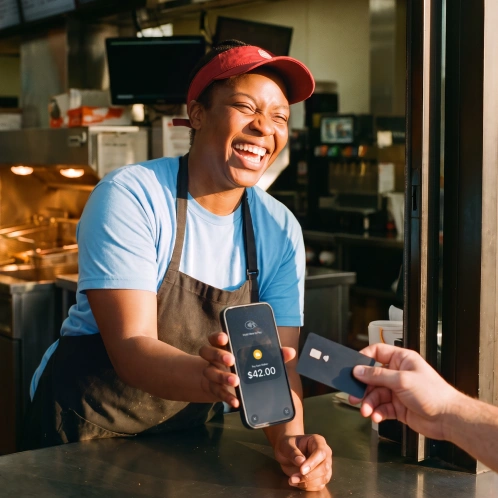
For selling at farmers' markets or local events, JIM offers a streamlined solution. With JIM, you can accept debit, credit, and digital wallets directly through your smartphone. Just tap and the sale is done, which is perfect for a busy market stall.
JIM charges 1.99% per Tap to Pay transaction with no hidden costs or extra hardware needed. That rate undercuts the 2.5% to 3.5% that traditional processors charge, which matters most on small-ticket items like individual bags of freeze-dried candy. If you need a credit card reader comparison across providers, JIM's small business guide breaks down hardware costs and fees side by side.
Getting started is straightforward:
- Get Started: Download JIM app for iOS.
- Make a Sale: Type the sales amount, hit sell, and ask your customer to tap their card or device on your phone.
- Access Funds: Your money is available right on your JIM card as soon as the sale is done, with no waiting for bank transfers.
Action checklist:
- Compare the transaction fees for two online payment processors.
- Download the JIM app to see how it works for in-person sales.
- Calculate your potential fee savings on $1,000 of sales using JIM's 1.99% rate versus a typical 2.9% rate.
How do you fund your business and manage finances?
An SBA Microloan up to $50,000 is the most accessible starting point, followed by six months of working capital to cover expenses before sales stabilize.
Secure your funding
An SBA Microloan is a good starting point. These loans go up to $50,000, with interest rates generally between 8% and 13% set by the nonprofit intermediary lender. The maximum repayment term is seven years. Lenders will want to see a solid business plan, so have yours ready. Many people apply without one, which is a quick path to denial. You can find an SBA-approved intermediary in your area through the SBA Microloan program.
You might also look into grants, though they are highly competitive. The USDA Value-Added Producer Grant (VAPG) is one option, but it often favors businesses with a proven track record. Keep it on your radar for the future.
Calculate your working capital
Plan for at least six months of working capital. This covers your day-to-day expenses before sales become consistent. Budget around $4,000 to $6,000 for ingredients, packaging, utilities, and marketing to keep your operations smooth.
Set aside $100 to $200 monthly for farmers' market fees or simple online ads. This small spend is what drives your first customers and builds momentum for your new business.
Action checklist:
- Draft a one-page business plan to support a loan application.
- Research two SBA-approved microlenders in your region.
- Create a spreadsheet to project your working capital needs for the first six months.
When should you hire staff and set up operations?
Bring on a Production Assistant once you consistently hit $3,000 in monthly revenue or spend over 20 hours a week on production. A shared calendar is enough for scheduling at first.
You will likely start as a one-person show. Once your orders grow, you can bring on a Production Assistant to help with food prep, packaging, and cleaning. This frees you up to focus on sales and business growth.
Bringing on your first employee
A Production Assistant typically earns $15 to $20 per hour. Their main duties involve preparing ingredients, loading the freeze dryer, and packaging finished products. A common mistake is hiring friends or family without a formal agreement, so always set clear expectations from the start.
Anyone who handles food must have a Food Handler's Permit. These courses are usually online, cost around $10 to $15, and take a few hours to complete. For scheduling, a shared Google Calendar is enough at first. As you expand, you might use software like When I Work.
A good benchmark for hiring your first part-time helper is when you consistently reach $3,000 in monthly revenue. Another sign is when you spend over 20 hours a week on production tasks alone, which limits your ability to grow the business.
Action checklist:
- Look up the Food Handler's Permit requirements and approved courses for your state.
- Draft a job description for a Production Assistant with key responsibilities.
- Set a monthly revenue goal that will trigger your first hire.
How do you market your products and find customers?
Start with farmers' markets and visual social media. Direct samples and short process videos convert browsers into buyers faster than paid ads at launch.
Start with local channels like farmers' markets. A table fee is usually $20 to $50. Offer free samples. The unique texture of freeze-dried food often surprises people and leads directly to a sale. This direct feedback is also invaluable for product development.
You can also approach local specialty shops, like candy stores or outdoor gear retailers. Bring a professional-looking sell sheet with your product list and wholesale pricing. Many small shops prefer to support local producers.
Build your online presence
For online sales, start on Etsy. It has a built-in audience looking for unique items. Be mindful of their fees, which total around 6.5% per sale plus a listing fee. This helps you test products without the cost of a full website.
Use visual social media like Instagram and TikTok. Post short videos of the freeze-drying process. A clip of candy expanding can attract thousands of views. This content builds brand awareness before you ask for a sale.
Poor product photos cost you sales. Your images must look delicious and professional. Use natural light and a clean background. You do not need a fancy camera; a modern smartphone is often enough to get great shots.
Action checklist:
- Research two local farmers' markets and their vendor application process.
- Create an Instagram account and post one video of your products.
- Draft a simple sell sheet with your top three products and prices.
How do you price your products for profit?
Use a cost-plus model: multiply your full cost of goods sold by three to five to set your retail price, then check it against competitor pricing on Etsy and at local markets.
Calculate your cost of goods sold
First, figure out your cost per bag. Add up the price of your ingredients, Mylar bag, and oxygen absorber. Also, include an estimate for electricity and your time. Many new sellers only count ingredients and end up with prices too low to sustain the business.
For example, if a bag of candy costs $0.75, the bag is $0.30, the absorber is $0.10, and you estimate $0.35 for utilities and labor, your total cost of goods sold (COGS) is $1.50.
Set your retail price
A good starting point is to use a cost-plus model. Multiply your COGS by three to five to get your retail price. For that $1.50 bag of candy, this means a price between $4.50 and $7.50. This markup ensures you cover all costs and make a healthy profit.
Once you have a price range, check your competitors on Etsy or at local markets. If similar products sell for $6, pricing yours at $5.75 could give you an edge. If they sell for $8, you might have room to increase your price and margin.
Action checklist:
- Calculate the full cost of goods sold for one of your products.
- Research the prices of three direct competitors on Etsy or Amazon.
- Apply a 3x, 4x, and 5x markup to your COGS to find your potential price range.
Is a freeze drying business profitable?
Yes, when you track your full costs and price on a cost-plus basis. A single freeze dryer can produce enough volume to generate a sustainable monthly profit once you sell at two to three markets or move 50-plus online orders per month.
The break-even math is straightforward. Suppose your COGS for a bag of candy is $1.50 and you sell it at $6.00, a 4x markup. After a 1.99% JIM processing fee on a $6 sale, you keep $5.88. Subtract your $1.50 COGS and you have $4.38 in gross profit per bag. At 200 bags per month, that is $876 in gross profit before fixed costs like electricity, insurance, and marketing.
The business becomes unprofitable when sellers underprice. If you sell that same bag at $3.00, your gross profit drops to $1.44, and after fixed costs you may lose money on every sale. The fix is to track every cost line, including electricity and labor, and hold to a minimum 3x markup.
How do you maintain quality and scale your operations?
Target a water activity level at or below 0.85, the FDA threshold for shelf-stable low-moisture foods. Add a second freeze dryer once you consistently hit $5,000 in monthly revenue.
Your first quality check is water activity. The FDA water activity guidance considers foods with a water activity of 0.85 or below to be shelf-stable and not subject to the low-acid canned food regulations, so target that level with a meter before you package. You can also perform simple visual and snap tests. Properly dried food should be brittle and retain its color. Many sellers skip this, which leads to spoiled products.
When to expand
Once your quality is consistent, you can plan for growth. Consider a second freeze dryer when you consistently hit $5,000 in monthly revenue or spend over 30 hours a week on production. This prevents you from investing in more equipment before your sales can support it.
As orders increase, tracking inventory in a spreadsheet becomes difficult. You might want to look at manufacturing software like Katana. It helps manage raw materials and finished goods, which prevents stockouts and reduces waste. This is a step to take once you have steady order flow.
You can also work toward Good Manufacturing Practices (GMP). This involves documenting your cleaning, production, and packaging steps. GMP is not always required for small businesses, but it builds trust with customers and prepares you for larger wholesale accounts.
Action checklist:
- Document your quality check process, including visual inspections and water activity targets.
- Set a monthly revenue goal that will trigger your next equipment investment.
- Review the basics of Good Manufacturing Practices (GMP) for food producers.
You have a clear path to launch your freeze-drying business. The unique texture of your products is your best marketing. With these steps, you have a solid foundation to build upon.
When you make those first sales at a market, keep your checkout simple. JIM turns your phone into a card reader for a flat 1.99% fee, with no extra hardware needed. Download JIM and you are ready to sell.
Frequently Asked Questions
Is a freeze drying business profitable?
How much does it cost to start a freeze drying business?
Do I need a license to sell freeze-dried food?
How long does freeze-dried food last?
What insurance does a freeze drying business need?



Sell and get paid in seconds with Jim