Starting a gift card business is a rewarding venture that blends creativity and marketing skills with solid business savvy. The gift card market is a multi-billion dollar industry, with steady demand for them as birthday gifts, holiday presents, and corporate rewards.
This guide will take you through the practical steps of validating your business concept, building supplier relationships, acquiring inventory, and obtaining necessary permits to help you launch a successful gift card business in the U.S.
Step 1: Create your business plan and validate the concept
Your first move is to research the market. To get a real feel for it, analyze search data on Google Trends for terms like "bulk gift cards" or "discounted gift cards." This reveals seasonal demand and popular brands. Industry reports from the Retail Gift Card Association (RGCA) also offer valuable market insights.
Next, analyze your direct competitors. Use a platform like SEMrush to see what keywords sites like GiftCardGranny or Raise rank for. This shows you what customers search for. Browse their websites to understand their inventory, pricing structure, and shipping policies.
Understand your startup costs
Initial costs can range from $2,000 to $10,000. Many new owners underestimate inventory expenses. You might want to budget at least $1,500 to $5,000 for your initial stock of gift cards to ensure you have a competitive variety from day one.
Other expenses include business registration with your state ($100-$500), website development ($500-$3,000), and a small marketing budget to get started ($200-$500). These figures give you a realistic financial target to work toward.
Here are 3 immediate steps to take:
- Analyze three competitors using a platform like SEMrush to identify their top-selling card categories.
- Draft a preliminary budget that outlines your estimated inventory, legal, and website costs.
- Research your state's business registration requirements on the Small Business Administration (SBA) website.
Step 2: Establish your legal structure and obtain licenses
You might want to consider forming a Limited Liability Company (LLC). This structure protects your personal assets from business debts and allows profits to pass directly to you without double taxation. Filing costs range from $50 to $500, depending on your state.
Understand the regulatory landscape
At the federal level, the Credit CARD Act of 2009 governs gift card expiration dates and fees. The Financial Crimes Enforcement Network (FinCEN) also has rules you must follow to prevent money laundering, which is a risk in this industry.
State regulations are more complex. Many states require gift card resellers to obtain a money transmitter license. This process can take 3-6 months and cost between $1,000 and $5,000. A frequent oversight is ignoring state escheatment laws for unclaimed card balances, so check your state's treasury website.
Finally, you will need a general business license from your city or county. This is straightforward and typically costs under $150. You can usually apply for this directly on your local government's website.
Here are 3 immediate steps to take:
- File for an LLC with your Secretary of State to protect your personal assets.
- Research money transmitter license requirements on your state's Department of Financial Institutions website.
- Apply for a general business license through your city or county clerk’s office.
Step 3: Secure insurance and manage risk
Choose the right insurance policies
You will want to start with General Liability Insurance. This policy covers third-party claims like property damage. A standard $1 million policy typically costs between $400 and $900 annually, providing a foundational layer of protection for your business operations.
Next, consider Professional Liability, also known as Errors and Omissions (E&O). This protects you if a customer claims a financial loss due to a mistake, such as selling a card with an incorrect balance. Expect to pay $600 to $1,200 annually for $1 million in coverage.
For an online business, Cyber Liability Insurance is a high priority. It covers costs from data breaches or cyberattacks. Some new owners overlook this, but it addresses a significant vulnerability. A policy can range from $1,000 to $2,500 annually.
When you look for quotes, check with providers like Hiscox, The Hartford, or Chubb. An insurance broker who specializes in e-commerce can also help you find the best package for your specific risks, which include fraudulent cards and customer data theft.
Here are 3 immediate steps to take:
- Request quotes for General, Professional, and Cyber Liability insurance policies.
- Compare coverage details and premiums from at least three different providers.
- Consult an insurance broker who has experience with e-commerce businesses.
Step 4: Set up your workspace and source inventory
Choose your workspace
For an online gift card business, a dedicated home office of 100-150 square feet is usually sufficient. Check your local zoning laws for home-based businesses, but most residential areas permit this type of e-commerce operation without special permits. This approach keeps your overhead low from the start.
Equip your operation
Your main equipment costs will be a reliable computer ($800-$1,500) and a thermal label printer like the Dymo 4XL ($200-$300) for shipping. You will also need packaging supplies. A mistake some new owners make is to skip a magnetic stripe reader to verify card balances, which can expose you to fraud.
Source your gift cards
Once your space is sorted, you can focus on inventory. You can source cards directly from bulk distributors like Blackhawk Network or InComm. Their minimum order requirements can be $5,000 or more, a detail to consider as you plan your finances. This path offers better margins.
A more accessible route is to buy from secondary marketplaces like CardCash or directly from consumers. This approach allows you to build inventory with less initial cash. The trade-off is lower profit margins per card compared to bulk purchasing. Start with popular brands like Target or Amazon.
Here are 3 immediate steps to take:
- Review your city’s website for home-based business regulations.
- Price out a Dymo 4XL printer and a basic magnetic stripe reader.
- Contact a bulk distributor like Blackhawk Network to request their new partner application.
Step 5: Set up your payment processing
Your online store needs a payment gateway to accept customer payments. Solutions like Stripe or PayPal integrate directly with most e-commerce platforms. A mistake new owners often make is overlooking transaction fees, which directly impact your thin profit margins on each card.
Many processors charge around 2.9% plus $0.30 per transaction. When you sell a high volume of low-margin cards, these fees add up quickly. You should look for a payment solution with transparent, low-cost pricing to protect your bottom line from the start.
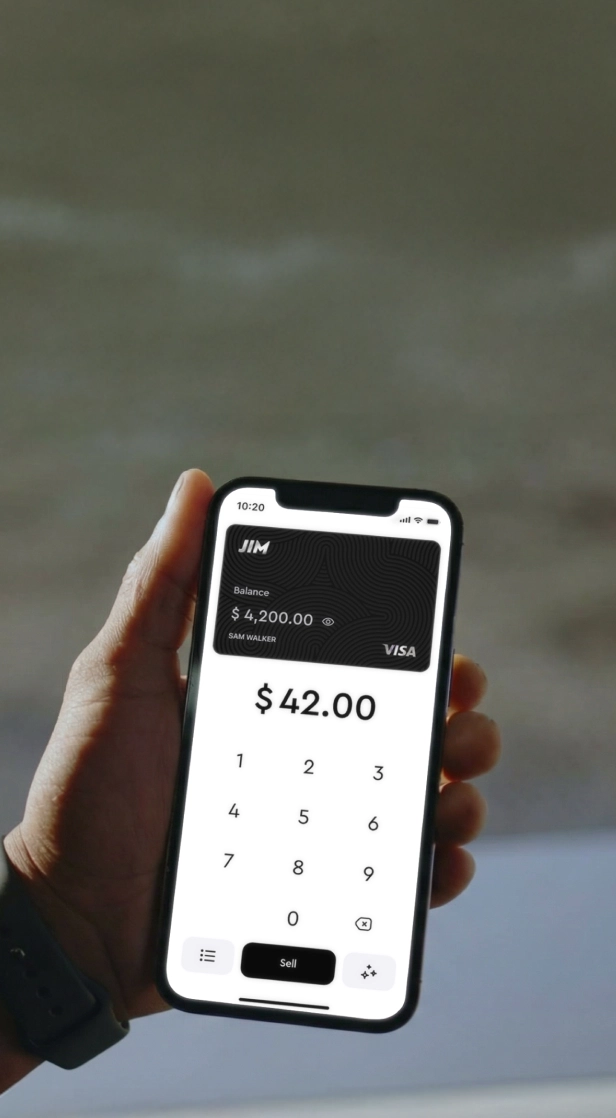
If you plan to sell cards at local markets or pop-up events, you will also need a way to handle in-person payments. For this, JIM offers a streamlined solution. With JIM, you can accept debit, credit, and digital wallets directly through your smartphone.
At just 1.99% per transaction with no hidden costs or extra hardware, it is a strong choice for face-to-face sales. This rate is much lower than the industry average, which helps you keep more of your earnings on every sale.
Here is how it works:
- Get Started: Download the JIM app for iOS.
- Make a Sale: Type the sales amount, hit sell, and ask your customer to tap their card or device on your phone.
- Access Funds: Your money is available right on your JIM card as soon as the sale is done—no waiting for bank transfers.
Here are 3 immediate steps to take:
- Compare transaction fees for online payment gateways like Stripe and PayPal.
- Download the JIM app to evaluate its features for in-person sales.
- Calculate your profit on a $50 gift card after a typical 2.9% transaction fee versus JIM's 1.99% fee.
Step 6: Fund your business and manage finances
You might want to look into an SBA Microloan, which offers up to $50,000. These loans are great for startups and have interest rates between 8-13%. Another option is a business line of credit from your bank, which gives you flexible access to cash when you need it.
Plan your working capital
For the first six months, you should have $5,000 to $15,000 in working capital. A frequent oversight is only budgeting for the first inventory purchase. You need cash on hand to restock popular cards quickly, otherwise you risk losing sales and momentum.
Once you have funding, open a dedicated business bank account immediately. This separates your finances for clear bookkeeping. You can then connect it to an accounting platform like Wave or QuickBooks Online to track your revenue, fees, and profit margins from day one.
Here are 3 immediate steps to take:
- Research SBA Microloan lenders and their qualification requirements.
- Calculate your working capital needs for the first six months, including inventory replenishment.
- Open a dedicated business bank account and compare accounting platforms like Wave and QuickBooks.
Step 7: Hire your team and set up operations
When you start processing 50-100 orders per week, it becomes difficult to manage everything yourself. This is a good time to hire a part-time Inventory and Fulfillment Assistant. Their duties would include verifying card balances, packaging orders, and managing shipments.
You can expect to pay an hourly rate of $15 to $20 for this role. A mistake some new owners make is hiring too soon, which drains cash before sales are stable. It is better to wait until your order volume consistently justifies the expense.
Set up your daily workflow
Your daily operations need a simple, repeatable process. You do not need complex management software at this stage. A shared Google Calendar works well for blocking out time for fulfillment and customer service tasks, which keeps you organized without extra cost.
A key part of your workflow is fraud prevention training. Show any new hire how to use the magnetic stripe reader to confirm every card's balance before it ships. Also, create a checklist for spotting tampered packaging or altered card numbers to avoid significant losses.
Here are 3 immediate steps to take:
- Define the weekly order volume that will trigger your first hire.
- Create a one-page training guide for verifying gift cards and identifying fraud.
- Set up a shared Google Calendar to schedule your daily operational tasks.
Step 8: Market your business and acquire customers
You can attract your first customers through search engine optimization (SEO). Focus on long-tail keywords like “discounted Home Depot gift card” to capture buyers with high intent. Since a good e-commerce conversion rate is around 1-2%, you need consistent traffic to drive sales.
For quicker results, you might want to run Google Ads. Many new owners waste money on broad terms like “gift cards.” Instead, target your ads to specific brands you have in stock. This keeps your Customer Acquisition Cost (CAC) below $5, which is a sustainable target for this industry.
Build an email list for repeat business
Offer a small discount on a customer's first purchase if they subscribe to your email list. This is a simple way to build a loyal audience. You can then send weekly emails that announce new inventory or special promotions to drive repeat sales.
A successful campaign could be a "Just In" email that features a fresh batch of discounted Amazon or Target cards. This creates urgency and encourages immediate purchases from customers who are already familiar with your business.
Here are 3 immediate steps to take:
- Use a keyword research tool to identify 10 long-tail keywords for your top-selling brands.
- Draft a Google Ad campaign that targets one specific gift card category, like "restaurants" or "retail."
- Outline a welcome email for new subscribers that includes a small discount code.
Step 9: Develop your pricing strategy
Your pricing model is straightforward. You buy cards at a discount and sell them for a slightly smaller discount. For instance, you might acquire a $100 card for $85 and list it for $90. The $5 difference is your gross profit.
Profit margins in this business are typically thin, often between 3% and 8% per card. Some new sellers price too aggressively to beat competitors. This approach can wipe out your profit entirely after you account for payment processing fees.
Analyze competitor pricing
To set your prices effectively, you need to watch your competitors. Check sites like Raise and CardCash daily for the brands you carry. Pay close attention to how discounts fluctuate for high-demand cards like those from Target or Amazon.
A simple spreadsheet works well for this task. Track the selling price for $25, $50, and $100 cards from at least three competitors. This data reveals the current market rate and helps you find a profitable price point for your own inventory.
You can also implement a tiered pricing strategy. Offer a smaller discount (e.g., 8%) on highly popular cards that sell quickly and a larger discount (e.g., 15%) on less common cards to move them faster. This balances your inventory and cash flow.
Here are 3 immediate steps to take:
- Create a spreadsheet to track competitor prices for five popular gift card brands.
- Calculate your net profit on a $100 card sold at a 10% discount, after a 2.9% transaction fee.
- Set initial selling prices for three card brands using a tiered discount strategy.
Step 10: Maintain quality and scale your operations
Establish your quality standards
Your goal should be an order accuracy rate above 99%. You can track this weekly in a simple spreadsheet. Also, monitor your customer complaint rate and aim to keep it below 1% of total orders. These numbers show you where your process is strong or weak.
A frequent misstep is to relax verification as order volume grows. You must continue to check the balance on every single card before shipment. This single action prevents most customer disputes and protects your reputation. It is your most important quality check.
Plan your growth
Once you consistently process over 150 orders per week, it is time to hire a dedicated customer service assistant. This frees you to focus on sourcing and marketing. You might also consider expanding your inventory when you sell through 80% of your stock each month.
Your initial spreadsheet will become cumbersome. When you manage over 300 unique gift card types, you can move to an inventory management system. Platforms like Sellbrite sync your stock across multiple sales channels automatically, which reduces errors and saves time.
Here are 3 immediate steps to take:
- Define and track three quality metrics: order accuracy, on-time shipping, and customer complaint rate.
- Set a weekly order volume, like 150 orders, as the trigger for hiring a customer service assistant.
- Demo an inventory management platform like Sellbrite to understand its features for your business.
Conclusion
You now have the steps to launch your gift card business. Success in this niche comes from disciplined inventory management and watching your margins. With a clear path forward, you can take that first step with confidence.
For in-person sales, a solution like JIM turns your smartphone into a card reader. It helps you accept payments for a flat 1.99% fee, with no extra hardware needed, so you keep more of your profit. Download JIM and be ready for any sale.
.avif)