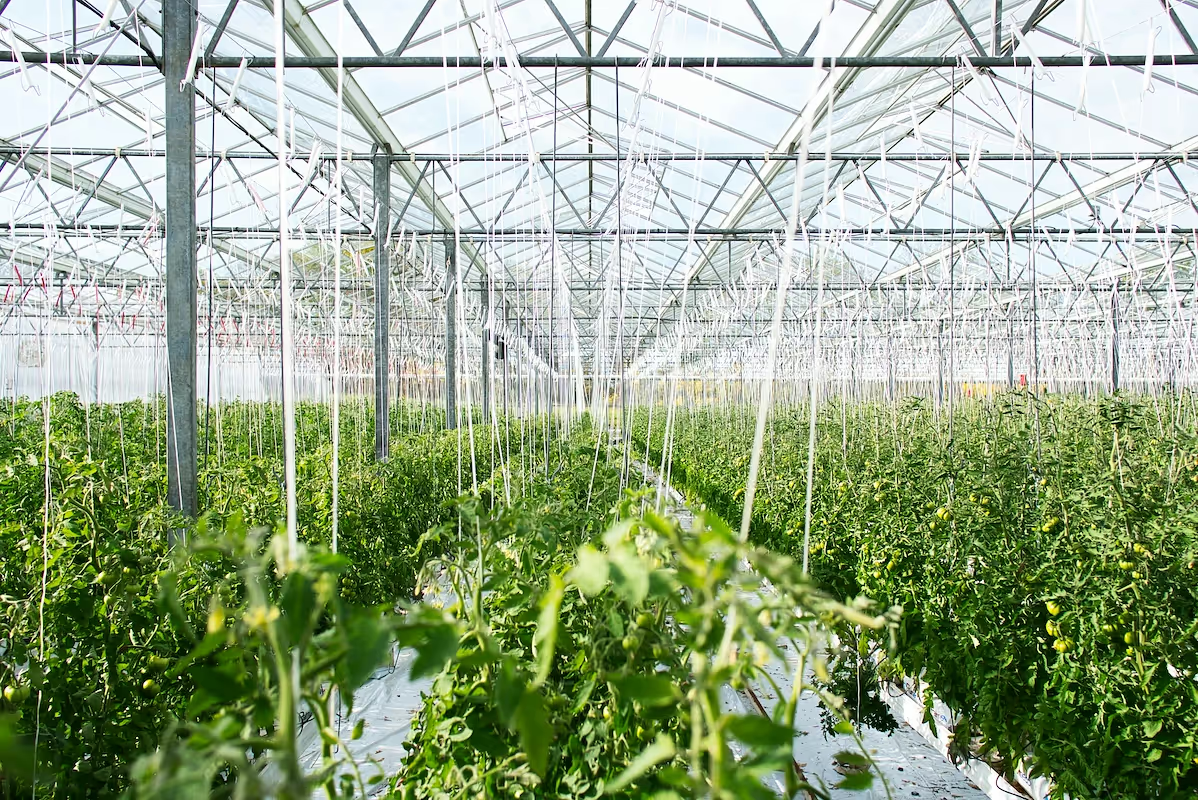
Starting a greenhouse business is a rewarding venture that combines a passion for horticulture with business savvy. The market itself is worth billions, fueled by a steady demand for fresh produce and plants from customers like home gardeners, restaurants, and local florists.
This guide will take you through the practical steps of validating your concept, securing funding, selecting a location, and obtaining the necessary permits to help you launch a successful greenhouse business in the U.S.
Step 1: Create your business plan and validate your concept
Begin by researching your local market to see what sells. Talk to potential wholesale buyers like restaurant chefs, florists, and grocery managers. You can also review data from the USDA National Agricultural Statistics Service to understand regional crop values and demand.
A mistake many new growers make is planting what they love, not what the local market demands. Your research should guide your crop selection to ensure profitability from day one.
Next, identify your direct competitors. A simple search on Google Maps will show nearby greenhouses. Visit local farmers' markets to see who is selling what and at what price point. This gives you a real-world sense of the competitive landscape.
Estimate your startup costs
Initial investment can range from $35,000 to over $150,000. Understanding the financial scope helps you plan effectively. Here is a typical breakdown for a small commercial operation:
- Greenhouse structure: $25,000 - $100,000
- Heating and ventilation: $5,000 - $30,000
- Irrigation system: $2,000 - $10,000
- Initial supplies (seeds, soil, pots): $1,000 - $5,000
- Permits and licenses: $500 - $2,000
Remember to budget for ongoing operational costs, not just the initial setup. Utility bills, especially for heating and cooling, can be a surprise expense if not properly forecasted.
Here are 3 immediate steps to take:
- Interview at least two local restaurant chefs or florists about their produce needs.
- Create a spreadsheet of startup costs using the ranges provided.
- Map out all competing greenhouses and farmers' markets within a 25-mile radius.
Step 2: Set up your legal structure and get licensed
You might want to consider forming a Limited Liability Company (LLC). It protects your personal assets if the business faces debt or lawsuits. Many new owners make the mistake of operating as a sole proprietorship, which offers no such protection.
An LLC also offers pass-through taxation, meaning profits are taxed once on your personal return. This avoids the double taxation that can occur with a C-Corporation, which is a more complex structure better suited for larger operations seeking outside investment.
Secure your permits and licenses
Once your business entity is established, contact your state's Department of Agriculture. You will likely need a Nursery License or Plant Dealer License, which can cost between $50 and $300 annually. Also, secure a general business license from your city or county.
Before you build, check your local zoning ordinances. You will need a building permit for the greenhouse structure. This process can take 4-8 weeks and cost anywhere from $500 to $2,000, so it is important to plan ahead for this timeline and expense.
Here are 3 immediate steps to take:
- File for an LLC with your state's Secretary of State office.
- Contact your local planning department to confirm zoning rules for agricultural structures.
- Find the Nursery License application on your state's Department of Agriculture website.
Step 3: Secure your insurance and manage risk
Protecting your new business is a top priority. The right insurance prevents a single hailstorm or equipment failure from ending your venture. You will need a few specific policies tailored to agricultural businesses to cover your unique risks from weather, pests, and equipment breakdown.
Key insurance policies for your greenhouse
General Liability insurance, with at least $1 million in coverage, typically costs $500 to $1,200 annually. Also get Property Insurance to cover the greenhouse structure and all equipment inside. Some owners forget to insure their expensive heating and irrigation systems, a mistake that can be costly.
Crop Insurance protects your revenue if you lose plants to disease, pests, or extreme weather. In addition, you will need Workers' Compensation if you hire any employees. If you plan to deliver products, a Commercial Auto policy is also necessary for your vehicle.
It is best to work with an agent who understands agribusiness. General agents may not grasp your specific needs. Consider specialized providers like Hortica, Great American's AgriBusiness division, or your local Farm Bureau to find policies that fit your operation and get better rates.
Here are 3 immediate steps to take:
- Request quotes for a $1 million General Liability policy and a Property Insurance policy.
- Research Crop Insurance options to protect your specific plants from loss.
- Contact an agent from an agribusiness provider like Hortica or your state's Farm Bureau.
Step 4: Select your location and equipment
Look for at least a quarter-acre of land for a standard 30' x 96' high-tunnel greenhouse. Your property must have the right zoning, usually "Agricultural" or a specific commercial type that permits agricultural structures. Confirm this with the local planning office before you sign anything.
If you decide to lease, try to secure a 3-5 year term to protect your investment. Be upfront about water usage and your plan to build. Many new growers face issues because their lease does not explicitly permit a permanent structure or high utility draw.
Purchase your core equipment
Your setup will require benches, fans, and an irrigation system. Budget around $500-$2,000 for benches, $300-$1,500 for ventilation fans, and $2,000-$10,000 for a complete drip irrigation setup.
With equipment in mind, turn to commercial suppliers like Growers Supply or FarmTek. They offer durable gear built for production. You might be tempted to use cheaper, residential-grade items from a big-box store, but they often fail under constant use.
Here are 3 immediate steps to take:
- Identify two potential properties and verify their zoning classification.
- Request a catalog or price list from a commercial supplier like Growers Supply.
- Draft three key questions for a potential landlord about water rights and structures.
Step 5: Set up your payment processing
For wholesale clients like restaurants, Net 30 terms are standard, which means they have 30 days to pay. For retail customers at your greenhouse or a farmers' market, payment is immediate. You should be ready to accept cash, checks, and cards from day one.
When you take on large custom orders or landscaping contracts, it is wise to require a deposit. A 25-50% upfront payment helps cover your initial material costs and secures the client's commitment. A simple written agreement outlining the terms is enough.
Many new owners get surprised by high credit card processing fees. While many providers charge 2.5% to 3.5% plus monthly fees, you should look for a solution with transparent, low rates and no extra hardware, especially for mobile sales.
For greenhouse businesses that need to accept payments on-site or on-the-go, JIM offers a streamlined solution. With JIM, you can accept debit, credit and digital wallets directly through your smartphone - just tap and done.
At just 1.99% per transaction with no hidden costs or extra hardware needed, it's particularly useful for sales at farmers' markets or for taking deposits on jobs right at a client's property.
- Get Started: Download the JIM app for iOS.
- Make a Sale: Type the sales amount, hit sell, and ask your customer to tap their card or device on your phone.
- Access Funds: Your money is available right on your JIM card as soon as the sale is done - no waiting for bank transfers.
Here are 3 immediate steps to take:
- Decide on your payment terms for wholesale versus retail customers.
- Download the JIM app to see how it works for on-the-go payments.
- Draft a simple contract template for large orders that includes a deposit requirement.
Step 6: Secure funding and manage your finances
Find your funding
Start by looking into USDA Farm Service Agency (FSA) loans. Their Direct Operating Loans can provide up to $400,000 with interest rates often between 3-5%. You will need a strong business plan and a credit score of at least 640 to be a competitive applicant.
For smaller needs, an SBA Microloan offers up to $50,000. You apply for these through local nonprofit lenders, not the SBA directly. They are a good fit for purchasing initial supplies or smaller equipment without the complexity of a larger bank loan.
You might also explore grants from the Sustainable Agriculture Research and Education (SARE) program. Their Farmer/Rancher Grants can provide up to $15,000 for innovative projects, though the application process is competitive.
Manage your working capital
Plan to have at least six months of operating expenses in cash before you open. This working capital should cover utilities, payroll, and supplies, and typically ranges from $15,000 to $40,000 for a small operation.
Many new growers underestimate their first few utility bills. Heating a greenhouse through a cold season can be a significant cost. If you factor this into your working capital from the start, you can prevent a cash flow crisis before your sales become steady.
Here are 3 immediate steps to take:
- Review the eligibility for a USDA FSA Direct Operating Loan on their website.
- Find your regional SARE program online and look at past funded projects.
- Calculate your estimated 6-month operating costs to set a working capital goal.
Step 7: Hire your team and set up operations
Define key roles and responsibilities
As you scale, you will need help. Your first hire is often a Greenhouse Worker to handle daily tasks like watering, potting, and harvesting. Expect to pay between $15 and $22 per hour for this role, depending on your location and their experience.
A mistake some owners make is trying to do everything themselves, which leads to burnout. Bringing on even part-time help for 15-20 hours a week during busy seasons can make a huge difference in your output and personal well-being.
Once you have consistent revenue, you might consider a Greenhouse Manager to oversee crop schedules and pest management. This role typically earns $45,000 to $70,000 annually. If you use regulated pesticides, your state may require this person to hold a Pesticide Applicator License.
Streamline your daily workflow
A good benchmark is to aim for one full-time employee for every $100,000 in projected annual revenue. With that in mind, you can use management software to keep your team organized. Platforms like Artemis or GrowFlow help track planting schedules, inventory, and tasks.
This avoids confusion and ensures everything gets done on time, especially with a small team. It replaces messy whiteboards and spreadsheets with a single source of truth for your entire operation, from seed to sale.
Here are 3 immediate steps to take:
- Draft a job description for a part-time Greenhouse Worker.
- Check your state's Department of Agriculture website for Pesticide Applicator License rules.
- Schedule a demo for a management platform like Artemis to see its features.
Step 8: Market your business and find customers
Build your online presence
Start with a simple website that shows your products and has your contact information. Also, create an Instagram or Facebook page. Post high-quality photos of your plants and share behind-the-scenes updates from the greenhouse. This builds a following before you even make your first sale.
Many new owners use poor, low-light photos. Your visuals are your best sales tool, so make them sharp and vibrant. You do not need a fancy camera; a modern smartphone works well if you use good natural light.
Connect with wholesale buyers
For wholesale clients, create a weekly "fresh sheet" that lists available products and prices. Email this list every Monday to local chefs, florists, and grocers. Consistency is key here. An email open rate of 20% is a good benchmark to aim for.
You can also attend local food festivals or farm-to-table events. These are great places to meet potential buyers face-to-face and let them sample your products. Bring business cards and copies of your availability list.
Here are 3 immediate steps to take:
- Create an Instagram business profile and post three high-quality photos of your plants.
- Draft a template for your weekly "fresh sheet" to send to wholesale prospects.
- Research and list two local food or farmer-focused events to attend in the next six months.
Step 9: Set your pricing strategy
Determine your pricing model
Most greenhouses use a tiered model. For wholesale, a 100% markup over your cost of goods sold (COGS) is a good starting point. For retail sales directly to customers, you can aim for a 200-300% markup. This accounts for the extra time spent on individual sales.
Many new owners miscalculate their COGS. They only factor in seeds and soil but forget about labor, utilities, and container costs. For example, if a lavender plant costs you $1.50 in total to grow, your wholesale price should be $3 and your retail price $4.50 to $6.
Analyze your competition
With your costs in mind, visit local farmers' markets and garden centers. Take notes on what your competitors charge for similar plants. Do not just copy their prices. Instead, use this data to position your products. You might price higher if your quality is visibly better.
You can also check online plant shops for pricing on specialty or rare items. This helps you understand the national market value, which is useful if you plan to ship products or sell unique varieties that local competitors do not offer.
Here are 3 immediate steps to take:
- Calculate the full cost of goods sold for one of your primary crops, including all overhead.
- Visit one farmers' market and one garden center to create a competitive price list.
- Draft a price sheet with separate wholesale and retail prices for your top five plants.
Step 10: Maintain quality and scale your operations
As your business grows, consistent quality is what will set you apart. Create a simple checklist for your plants. Healthy crops should have dense, white roots, uniform color, and be completely free of pests or diseases. A crop loss rate below 5% is a good target.
Know when to grow
For a more formal standard, you might pursue a USDA Organic certification. This process can take over a year and involves detailed record-keeping, but it allows you to charge a premium, often 20-30% more for your products.
Many owners expand too quickly, before their sales can justify the cost. A good rule is to add a new greenhouse only after you have three straight months of unmet demand from your wholesale clients. This ensures your investment pays off immediately.
When your personal work week consistently exceeds 60 hours, it is time to hire your first part-time employee. As you add people and structures, operational software like Artemis or GrowFlow becomes very useful to manage the increased complexity of your schedules and inventory.
Here are 3 immediate steps to take:
- Create a quality checklist for your top-selling plant, covering root health, foliage, and pests.
- Review the USDA Organic certification requirements on their website.
- Analyze your sales data to see if you have sold out of any crops for three consecutive months.
Your greenhouse journey is about growing a business, not just plants. The key is to sell what your market demands, not only what you love to grow. With these steps, you have a clear path to turn your passion into a successful operation.
When you make your first sales, getting paid should be simple. JIM lets you accept cards on your phone for a flat 1.99% fee, no hardware needed. This keeps your cash flow steady from the start. Download JIM and you are ready for business.
.avif)