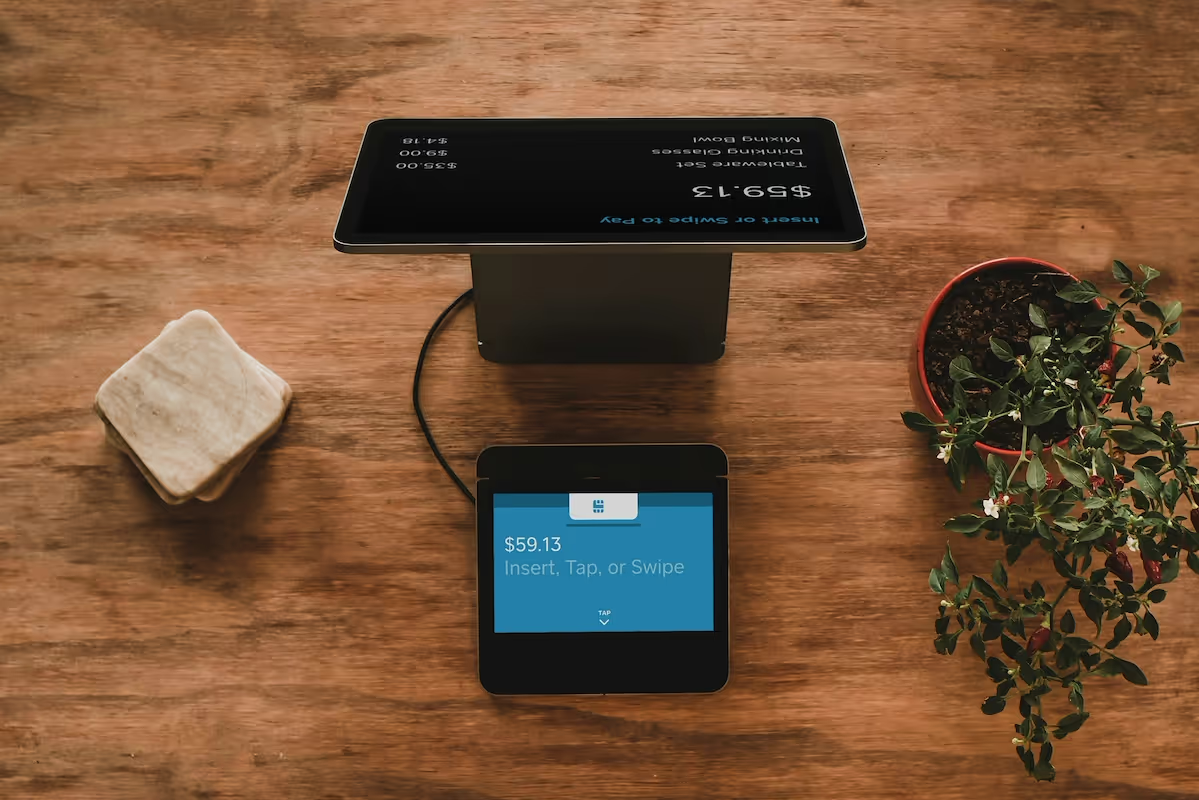
Starting a hardware business is a rewarding venture that combines technical skills like engineering and product design with sharp business savvy. The market for mobile point-of-sale systems is a multi-billion dollar industry, with steady demand from retail shops, restaurants, and service businesses.
This guide will take you through the practical steps of validating your business concept, developing a prototype, securing funding, and building supplier relationships to help you launch a successful hardware business in the U.S.
Step 1: Plan and validate your hardware concept
Start by validating your idea. Before you design anything, conduct 20-30 customer discovery interviews. Talk to retail managers and restaurant owners to understand their daily frustrations with current POS systems. This direct feedback is more valuable than any generic market report.
Many founders build in a vacuum, which is a costly error. To avoid this, analyze what competitors are doing. You can use Crunchbase to see who is getting funded in the mobile POS space and check the USPTO database for existing patents that might conflict with your idea.
Understanding your startup costs
With a validated idea, you can map out your initial finances. A clear budget is necessary for securing funding later. These figures can fluctuate, but they provide a realistic starting point for a mobile POS hardware business.
Expect to allocate $5,000-$20,000 for initial prototyping and industrial design. Legal fees for incorporation and a provisional patent application typically run from $8,000 to $15,000. Firmware development can add another $10,000-$30,000, bringing the initial pre-manufacturing total to between $23,000 and $65,000.
Here are 3 immediate steps to take:
- Schedule interviews with 20 small business owners to discuss their payment system needs.
- Research three competitors on Crunchbase to analyze their funding and product history.
- Draft a preliminary budget with estimated costs for prototyping and legal setup.
Step 2: Establish your legal and regulatory foundation
Most hardware founders start with a Limited Liability Company (LLC). This structure separates your personal assets from business debts. You might consider a C-Corporation if you plan to raise venture capital, but be aware of its more complex tax requirements and administrative overhead.
Navigating hardware certifications
For electronic hardware, you must comply with federal regulations. The Federal Communications Commission (FCC) requires Part 15 certification for devices that emit radio frequencies. This process can take 4-8 weeks and cost $10,000-$15,000. Underestimating this timeline is a frequent misstep that delays launches.
You will also need safety certifications like UL or ETL. While not always legally mandatory, most major retailers require them. On a local level, you will need a general business license from your city or county and a seller’s permit from your state’s tax agency.
Here are 3 immediate steps to take:
- Consult a lawyer to determine if an LLC or C-Corp is right for you.
- Research FCC Part 15 testing labs and request quotes for certification.
- Contact your local city clerk’s office about applying for a business license.
Step 3: Secure insurance and manage risk
Key insurance policies for hardware startups
A single product liability claim can derail your business. You need specific insurance coverage. Start with a general liability policy of at least $1 million to cover third-party injuries. This often gets bundled with product liability insurance, which is vital for hardware companies.
Product liability covers damages from faulty devices. A combined policy for both can cost $1,500 to $5,000 annually. A frequent mistake is to secure only general liability. This leaves you exposed if your product malfunctions and causes harm or property damage.
You might also consider professional liability insurance, also known as Errors and Omissions, to cover design flaws. If you have a physical office or hold inventory, you will need commercial property insurance. Workers’ compensation is a legal requirement in most states once you hire your first employee.
Work with a broker who understands technology hardware. Providers like The Hartford, Embroker, or CoverWallet have experience with risks unique to hardware, such as the high costs of a product recall or supply chain disruptions. A generalist agent may not find the right coverage.
Here are 3 immediate steps to take:
- Request quotes for a $1 million combined general and product liability policy.
- Find an insurance broker who specializes in technology hardware startups.
- Review your state’s legal requirements for workers’ compensation insurance.
Step 4: Set up your workspace and equipment
Your first workspace can be modest. Look for a 500-1,000 square foot area zoned for commercial or light industrial use. This provides enough room for a small lab and assembly bench without excessive overhead. A frequent misstep is signing a long 5-year lease you quickly outgrow.
When you review a lease, you might want to negotiate a shorter 1-2 year term with an option to renew. Also ask about a tenant improvement allowance to help cover the cost of electrical upgrades for your lab equipment, which landlords will sometimes provide.
Outfitting your electronics lab
With a space secured, you can build your workbench. You do not need top-of-the-line gear at first, but reliable equipment is a must. Plan to spend $1,000-$2,500 on initial gear. A quality soldering station costs around $120, and a dependable digital oscilloscope is about $400.
For components, set up accounts with distributors like Digi-Key and Mouser Electronics. They have no minimum order quantities for prototyping, so you can buy single parts. This lets you experiment without a large cash outlay for inventory before your design is finalized.
Here are 3 immediate steps to take:
- Research commercial spaces between 500-1,000 sq ft with light industrial zoning.
- Create a budget for lab equipment, pricing out an oscilloscope and soldering station.
- Open free business accounts with component suppliers like Digi-Key and Mouser.
Step 5: Set up your payment processing
For B2B sales, Net 30 terms are standard, but for direct sales, you should require payment upfront. If you do custom work, a 50% deposit is a good practice to cover component costs before you begin.
Choosing a payment solution
A frequent mistake is to overlook processing fees. Many providers charge 2.5% to 3.5% per transaction plus monthly costs, which eats into your margins. You will want a solution with transparent pricing and no long-term contracts.
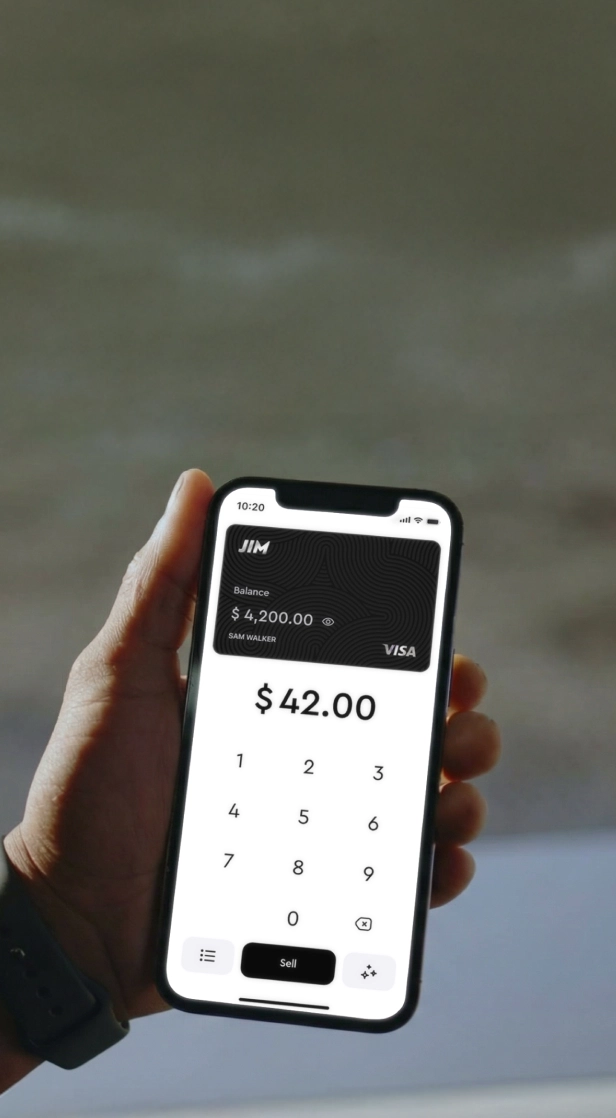
For hardware businesses that need to accept payments on-site or on-the-go, JIM offers a streamlined solution. With JIM, you can accept debit, credit, and digital wallets directly through your smartphone—just tap and done.
At just 1.99% per transaction with no hidden costs or extra hardware needed, it is particularly useful when you take deposits at client meetings or sell directly at trade shows. Here is how to get started with JIM:
- Get Started: Download the JIM app for iOS.
- Make a Sale: Type the sales amount, hit sell, and ask your customer to tap their card or device on your phone.
- Access Funds: Your money is available right on your JIM card as soon as the sale is done—no waiting for bank transfers.
Here are 3 immediate steps to take:
- Define your payment terms for different sales, such as requiring a 50% deposit for custom orders.
- Calculate the potential savings of a 1.99% transaction fee versus the industry average of 2.5-3.5%.
- Download the JIM app to explore its interface for on-the-go sales.
Step 6: Secure funding and manage your finances
Funding options for hardware
Hardware startups often attract venture capital. Firms like HAX and Bolt specialize in this space because they understand the unique challenges. You might also explore crowdfunding on platforms like Kickstarter, which can validate market demand while you raise funds.
A frequent mistake is to give away too much equity in early rounds. Be cautious. You can also look into government-backed options. The SBA 7(a) loan program offers up to $5 million, with interest rates typically between 11% and 15%.
For non-dilutive funding, consider the Small Business Innovation Research (SBIR) program. It provides grants to small businesses engaged in federal research and development, a perfect fit for innovative hardware projects.
Managing your early-stage finances
With funding in sight, you need to plan your cash flow. Expect to need $50,000 to $150,000 in working capital for your first six months. This covers inventory, initial marketing spend, and payroll before you have consistent revenue.
Many founders get tripped up by underestimating their cash burn rate. Map out every expense meticulously. This financial discipline is what separates the businesses that survive from those that run out of money before their product even ships.
Here are 3 immediate steps to take:
- Research hardware-focused VCs like HAX and Bolt.
- Review the eligibility criteria for an SBA 7(a) loan on the SBA website.
- Create a detailed 6-month budget to estimate your working capital needs.
Step 7: Hire your team and set up operations
Start with a lean technical team. Your first two hires should be a firmware engineer to handle the device’s software and a mechanical engineer for the physical design. These roles are the foundation of your product development before you bring on sales or marketing.
For compensation, a firmware engineer can expect a salary of $90,000-$140,000, while a mechanical engineer typically earns $80,000-$120,000. You can check sites like Glassdoor for precise local rates. Many founders hire a sales team too early, which burns cash before the product is finalized.
Building your operational workflow
With your team in place, you need a system to manage projects. Platforms like Asana or Jira are industry standards for tracking development sprints and keeping everyone aligned. This prevents critical tasks from getting lost as complexity grows.
As you scale, a good benchmark to aim for is $150,000 to $250,000 in revenue per employee. For managing parts and inventory, you might look into manufacturing resource planning software like Katana MRP to avoid stockouts and production delays.
Here are 3 immediate steps to take:
- Draft job descriptions for a firmware engineer and a mechanical engineer.
- Research salary benchmarks for technical roles in your city on Glassdoor.
- Compare the features of project management platforms like Asana and Jira.
Step 8: Market your product and acquire customers
Start with content marketing. Write articles that solve real problems for your target audience, like retail managers or restaurant owners. This establishes you as an expert before you even ask for a sale and builds trust with potential buyers.
For direct outreach, you might use targeted ads on platforms like LinkedIn. You can filter for job titles like "Restaurant Owner." A reasonable customer acquisition cost (CAC) to aim for in the B2B hardware space is between $300 and $500 per customer.
Find customers through events and partnerships
Industry trade shows offer direct access to buyers. A booth at a restaurant or retail expo might cost $5,000 to $15,000. The goal is not just sales but also to get direct product feedback from hundreds of potential users over a single weekend.
Many new founders pour their entire budget into ads. A smarter move is to build partnerships. You could connect with accounting firms or business consultants who already serve your ideal customers and offer them a referral fee for every new client they send your way.
Here are 3 immediate steps to take:
- Outline three article topics that address common POS frustrations for small businesses.
- Research the cost of a booth at one major retail or restaurant trade show.
- Identify two potential partner companies that serve your target audience.
Step 9: Price your product and define your strategy
A good rule of thumb for hardware is cost-plus pricing. You calculate your total landed cost per unit—which includes the Bill of Materials (BOM), assembly, packaging, and shipping—and then apply a markup. A 3x to 4x markup is a standard starting point.
Many founders make the mistake of only using the BOM for this calculation. This overlooks other expenses like tariffs, payment processing fees, and return handling, which can quickly erode your profit. A complete cost picture is necessary before you set a final price.
Analyze the market landscape
With your cost baseline established, look at what competitors charge. You can also use trade databases to see the declared value of their imported goods, which offers clues about their manufacturing costs. This helps you understand if your pricing is competitive.
Your target gross margin should be at least 50%. This margin gives you enough room to cover marketing, R&D, and salaries. It also allows you to offer discounts to distributors or retailers, which are typically 20-30% off the retail price.
Here are 3 immediate steps to take:
- Calculate your total landed cost per unit, including all manufacturing and shipping expenses.
- Research the retail prices of three direct competitors.
- Model a price with a 3x markup and check if it supports a 50% gross margin.
Step 10: Implement quality control and scale production
Defining your quality standards
Before you mass produce, you need a quality baseline. For your electronics assembly, use the IPC-A-610 standard as your guide. You should also work toward an ISO 9001 certification for your quality management system, as many large distributors will ask for it.
To measure quality, track your First Pass Yield (FPY), which is the percentage of units that pass inspection without rework. An FPY above 95% is a good target. Also monitor your customer return rate. If it climbs above 2-3%, you have a quality issue to address.
Knowing when to scale
Many founders get tripped up by scaling production before their processes are stable. A good benchmark to move from a local to an overseas contract manufacturer is when you exceed 10,000 units per year. This move can lower your cost per unit by 20-40%.
As your production scales, spreadsheets become unmanageable. You might want to look into Product Lifecycle Management (PLM) software like Arena PLM or Propel. These systems help you manage your Bill of Materials (BOM) and engineering changes across your entire supply chain.
Here are 3 immediate steps to take:
- Create a quality inspection checklist based on the IPC-A-610 standard.
- Calculate the First Pass Yield (FPY) from your most recent production run.
- Research two PLM software options to manage your BOM and engineering changes.
You have the roadmap to launch your mobile POS hardware business. Remember that customer feedback is your most valuable asset, more than any component or patent. Use that insight to iterate and improve. With a clear plan, you are ready to build and sell.
And when you sell, getting paid should be simple. JIM lets you accept payments right on your smartphone for a flat 1.99% fee, with no extra hardware needed. It helps manage your cash flow from day one. Download JIM to simplify your process.
.avif)