How to start a pallet business in 2026: 10-step guide
See article summary
- Startup costs range from $12,000 to $27,000 for truck, trailer, tools, and LLC filing.
- Refurbished pallets can yield 50 to 70 percent gross margins with controlled costs.
- Form an LLC, get a free EIN from the IRS, and check your state's USDOT requirements.
- Secure general liability, commercial auto, and workers' compensation insurance before launching.
- Maintain $15,000 to $25,000 in working capital to cover three to six months of operations.
The U.S. wood container and pallet manufacturing industry produced $17.9 billion in output in 2022, according to Bureau of Labor Statistics data tracking NAICS sector 321920. Steady demand from shipping, warehousing, and manufacturing fuels this market, and refurbished pallets can carry 50 to 70 percent gross margins for operators who control their costs.
This guide covers the practical steps to validate your concept, build supplier relationships, acquire equipment, secure funding, and launch a pallet business in the U.S.
Step 1: How do you validate your pallet business idea and plan your finances?
Validate your concept by researching local demand and building a costed budget before you spend a dollar. Call warehouses, distribution centers, and manufacturing plants. Ask what they pay for new or refurbished pallets and what they do with used ones. This gives you real-world pricing data and potential customers before you invest.
Analyze your competition
Identify existing pallet suppliers in your area. Use online directories like Thomasnet to find them or drive through local industrial parks. Note their services. Do they only sell, or do they also offer pallet removal and pallet recycling? This helps you find a gap to fill.
Estimate your startup costs
Your initial investment will vary, but you can build a solid budget. One pitfall is focusing only on the big items and forgetting smaller operational costs. Plan for a financial cushion.
- Used Truck: $10,000 to $20,000
- Flatbed Trailer: $2,000 to $5,000
- Tools (nail gun, saw, gloves): $500 to $1,000
- Business Registration (LLC): $100 to $500
Step 2: How do you set up your legal structure and get licensed?
Form a Limited Liability Company (LLC) to protect your personal assets from business debts, then secure your tax ID and operating licenses. Many new owners skip this to save money, but operating as a sole proprietor leaves you personally liable if something goes wrong.
Get your paperwork in order
First, get a free Employer Identification Number (EIN) from the IRS. You need this to open a business bank account and hire employees. Then, register your LLC with your state's Secretary of State. Filing costs vary significantly by state.
| State | LLC Filing Fee | Annual/Biennial Fee |
|---|---|---|
| California | $70 | $800 franchise tax + $20 biennial |
| Texas | $300 | $0 annual report |
| Florida | $125 | $138.75 |
| New York | $200 | $9 biennial |
| Delaware | $110 | $300 franchise tax |
Source: State Secretary of State offices, filing fees as of 2026.
Next, check with your city or county clerk for a general business operating license. If you plan to repair pallets at home, verify local zoning laws. Some residential areas restrict commercial activities, especially those involving noise or heavy equipment.
Understand your USDOT requirements
Because you will operate a truck, you need a USDOT number if you transport cargo in interstate commerce with a vehicle that has a gross vehicle weight rating of 10,001 pounds or more. Check the FMCSA USDOT number requirements to confirm whether your vehicle meets the threshold. Some states also require a USDOT number for intrastate operations, so check your state's transportation department rules.
Also, familiarize yourself with OSHA woodworking machinery requirements, which cover guarding, blade safety, and machine maintenance. The Occupational Safety and Health Administration, OSHA, enforces these standards to prevent serious injuries when using saws and nail guns.
Step 3: How do you secure insurance and manage risk?
Secure general liability, commercial auto, and workers' compensation coverage before you make your first delivery. General Liability insurance, typically with $1 million in coverage, protects you from third-party claims like property damage. Based on commercial insurer data, annual premiums for higher-risk operations like pallet repair typically range from $600 to $1,200. This policy is separate from your vehicle coverage.
Commercial Auto insurance covers your truck and trailer. A personal auto policy is not enough for business use. Expect to pay between $3,000 and $7,000 annually per truck for a $1 million combined single limit policy, based on commercial trucking insurer estimates.
Understand your specific risks
Your main risks involve vehicle accidents and employee injuries. Pallet repair involves saws and nail guns, which increases the chance of accidents. If you hire anyone, you must have Workers' Compensation insurance. Rates vary by state but are calculated as a percentage of your payroll.
Get quotes from providers who specialize in commercial business and trucking insurance, such as Progressive Commercial, The Hartford, or CoverWallet. An agent who understands your industry can find better rates and ensure you have the right coverage without gaps.
Step 4: How do you find a location and buy your equipment?
Find a 1,000 to 2,000 square foot workshop or yard zoned for light industrial use, then source your truck, trailer, and repair tools. Many pallet businesses start in a large garage or a rented section of a larger commercial yard to keep initial costs low.
When you talk to landlords, ask for a one or two-year lease instead of the standard three or five. Some owners get stuck in long leases for spaces that quickly become too small. A shorter term gives you flexibility as you grow.
Get your equipment
With a location secured, focus on your gear. Your truck and trailer are the largest expense, but the repair tools are just as important for daily operations. Buying quality used equipment can save you thousands upfront.
Here is a breakdown of what you will need for repairs:
- Pneumatic Nail Gun: $100 to $300
- Reciprocating Saw: $100 to $250
- Air Compressor: $200 to $500
- Safety Gear (gloves, glasses): $50 to $100
Make sure the truck you buy can handle the weight. Check its Gross Vehicle Weight Rating (GVWR) to ensure it meets legal requirements and the practical demands of hauling hundreds of pallets at once. An underpowered truck creates safety risks and operational delays.
Step 5: How do you set up your payment processing?
Set clear payment terms for different customer types and choose a processing method that protects your cash flow. For large, recurring clients, Net 30 payment terms are standard, meaning they have 30 days to pay an invoice. For smaller, one-off sales or new customers, request payment on delivery to reduce the risk of non-payment.
Some new owners get stuck chasing payments because they offer credit too freely. Start with stricter terms and relax them as you build trust with a client. Checks and bank transfers work for invoiced jobs, but you need a way to take immediate payment on site.
For pallet businesses that need to accept payments on-the-go, payment processing does not require expensive hardware. JIM lets you accept debit, credit, and digital wallets directly through your smartphone at 1.99 percent per transaction, with no hidden costs or extra hardware. This works for collecting payment on delivery for smaller loads or when selling refurbished pallets directly from your yard.
Step 6: How do you secure funding and manage your finances?
Start with personal savings or a small loan, and maintain enough working capital to cover three to six months of operating costs. The SBA Microloan program offers loans up to $50,000 through nonprofit intermediary lenders. The Small Business Administration, SBA, caps the maximum loan size at $50,000. Interest rates are set by the intermediary lender and typically fall between 8 and 13 percent. Lenders generally want to see a credit score over 650 and a clear business plan.
You might also consider equipment financing for your truck and trailer. Since the vehicle serves as collateral, these loans can be easier to secure than a general business loan, even with a newer business.
Plan your working capital
Many new owners focus on startup costs but forget about working capital. You need cash for the first three to six months to cover fuel, insurance, and pallet purchases while you wait for clients to pay invoices. This is where businesses often get into trouble.
A good target is to have $15,000 to $25,000 set aside. This buffer ensures you can keep operating if a large client pays late. Without it, your cash flow can dry up quickly, forcing you to pause operations or turn down new jobs.
Step 7: How do you hire your team and set up operations?
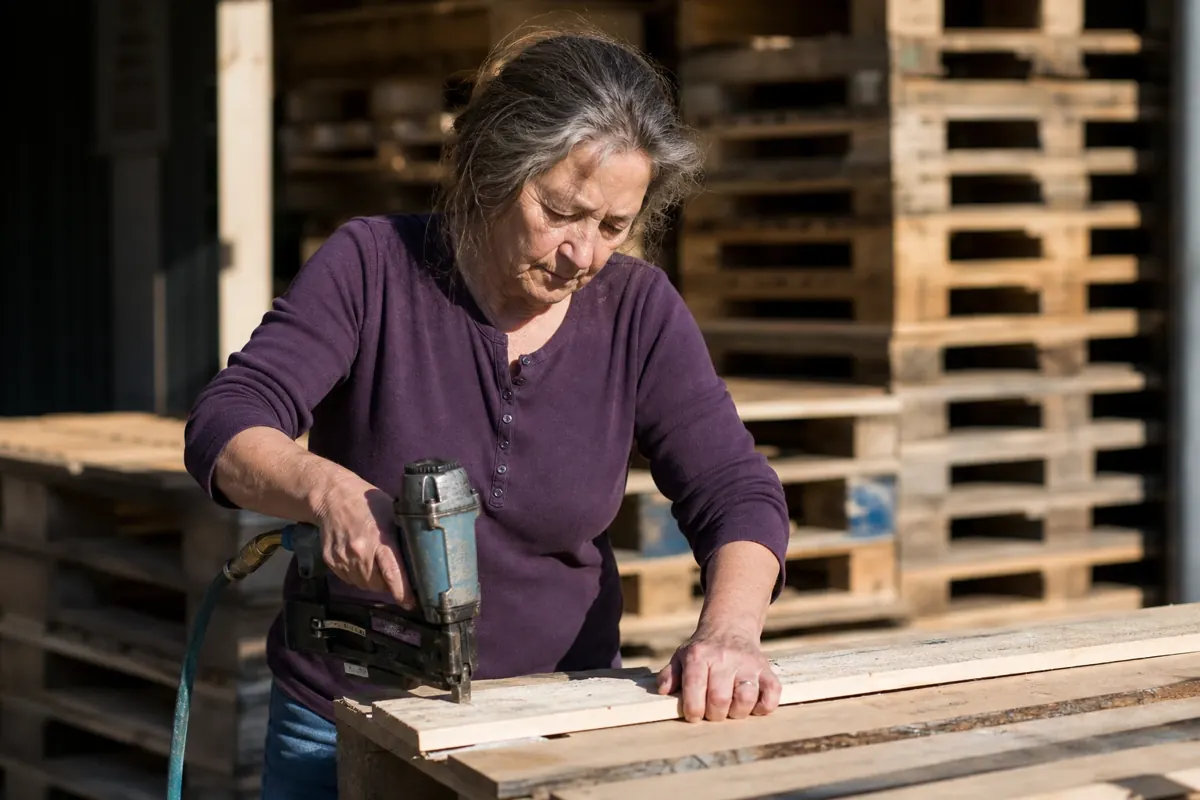
Handle repairs yourself at first, then hire a Pallet Repair Technician once you have steady orders and consistent work. Their job is to sort, repair, and stack pallets using saws and nail guns.
A fair starting wage is between $16 and $20 per hour, depending on your market. One pitfall is hiring someone before you have enough consistent work. Wait until you are turning down jobs or working over 60 hours a week yourself.
Prioritize safety and training
Your team needs proper training. Forklift certification is a must if you use one, and courses are available locally. Make sure everyone understands OSHA safety standards for your workshop. This small investment prevents costly accidents and insurance claims.
As you grow, a reasonable operational target is for each full-time employee to support $100,000 to $150,000 in annual revenue. Track this metric to decide when to add staff. For scheduling, a simple shared calendar or a free scheduling app works well initially. You do not need complex management software to start.
Step 8: How do you market your business and get customers?
Start with direct outreach to local warehouses and industrial parks, then build a simple online presence. Your first clients will come from hitting the pavement. Drive through local industrial parks and make a list of businesses with pallets stacked outside. Walk in and ask for the shipping or warehouse manager. A simple, "Hi, I buy and sell pallets, who would be the right person to talk to?" is all you need.
Some new owners hesitate with cold calls, but this method works. Aim to contact 10 businesses a day. If you can turn just 5 percent of those calls into clients, you will land a new account every two days. Your initial goal should be to secure two or three recurring clients.
Build a simple online presence
Create a free Google Business Profile. This is how local customers will find you when they search for "pallet removal" or "pallets for sale near me." Also, post ads on Craigslist and Facebook Marketplace to sell refurbished pallets or offer your removal service.
Some people spend too much on a fancy website at the start. A basic one-page site with your phone number and services is enough. Focus your time on direct sales, not web design. You can build a better website once you have steady income.
Step 9: How do you set your pricing and profit margins?
Use a tiered pricing system based on pallet grade, and aim for 50 to 70 percent gross margins on refurbished units. Most pallet businesses use a tiered system based on quality.
Develop your pricing model
A Grade A pallet is a structurally sound 48x40 GMA (Grocery Manufacturers Association) pallet with no missing or repaired boards. A Grade B pallet has had one or more boards repaired but remains functional. A standard 48x40 Grade A pallet might sell for $12 to $18, while a Grade B pallet could go for $7 to $11. These ranges vary by region and market conditions, so verify local pricing before you set your rates.
You can also charge for pallet removal. Some businesses will pay you $1 to $2 per pallet just to clear their yard. This creates a second revenue stream. A hybrid approach works well: you pay for good pallets and charge to haul away the junk.
Calculate your profit
Aim for a 50 to 70 percent gross margin on refurbished pallets. If you acquire a broken pallet for $3 and spend $1.50 on wood and nails, your total cost is $4.50. Selling that pallet for $8 gives you a healthy profit on your work.
One pitfall is forgetting to factor in all costs. A source of "free" pallets 30 miles away is not free once you add fuel and time. Calculate your cost-per-mile to make sure every trip makes financial sense.
Step 10: How do you implement quality control and scale your operations?
Use the industry-standard grading system to maintain consistency, then scale only when your volume consistently exceeds your capacity. Your reputation depends on consistent quality.
Establish your quality standards
Use the industry-standard Grade A and Grade B system. You can find official guidelines in the Uniform Standard for Wood Pallets published by the National Wooden Pallet and Container Association (NWPCA). This ensures your clients know exactly what they are getting.
Understand the two main pallet construction types. Stringer pallets use parallel boards between the top and bottom decks and are typically lifted on two sides. Block pallets use cylindrical or rectangular blocks between decks and allow four-way entry. The 48x40 GMA pallet is the most common stringer pallet in North America.
If you handle international shipments, be aware of ISPM-15 heat treatment requirements. The International Standards for Phytosanitary Measures No. 15 requires wood packaging materials to be heat-treated or fumigated to prevent the spread of pests. Pallets marked with the HT stamp meet this standard.
A simple metric to watch is your customer rejection rate. Aim to keep it below 2 percent. If a client rejects more than two pallets out of a hundred, review your repair process. This prevents costly return trips and protects your relationships.
Know when to grow
Many new owners hire too late and burn out. A good rule of thumb is to hire your first repair technician when you consistently handle over 500 pallets per week yourself. For expansion, consider a second truck once you turn down more than three jobs a week due to capacity.
As you add clients and employees, a shared calendar will not be enough. You might want to look at industry-specific software like Pallet Connect to manage inventory and dispatch. Hold off on this investment until you have at least two trucks and a steady stream of complex orders.
Conclusion
Starting a pallet business comes down to controlling your costs, maintaining consistent quality, and building relationships with local suppliers and customers. With startup costs between $12,000 and $27,000, a target gross margin of 50 to 70 percent on refurbished units, and three to six months of working capital in the bank, you have a clear path to profitability.
When you make those first sales, getting paid should be simple. JIM turns your phone into a card reader for a flat 1.99 percent fee, with no extra hardware needed. Download JIM to get started.
Frequently Asked Questions
Is a pallet business profitable?
How much does it cost to start a pallet business?
Do I need a USDOT number for a pallet business?
What is the difference between Grade A and Grade B pallets?
Do I need workers' compensation insurance for a pallet business?


Sell and get paid in seconds with Jim