How to start a parking lot striping business and get it right
See article summary
- Startup costs range from $10,000 to $25,000, mostly equipment and insurance.
- Form an LLC, get a free EIN, and check your state contractor license requirements.
- Carry $1 million general liability, commercial auto, and workers' comp when you hire.
- Charge $0.35 to $0.75 per linear foot with a 50% to 70% gross margin target.
- Accept card payments on-site to secure deposits and avoid cash flow delays.
A two-person striping crew can launch for $10,000 to $25,000 in startup costs. Property managers, retail centers, and schools need line painting year after year, and faded lots are easy to spot from the road.
Below are 10 steps covering startup costs, licenses, insurance, equipment, pricing, and marketing to launch a parking lot striping business in the U.S.
How do you plan and validate a parking lot striping business?
Start by scouting your area for faded lines and new lots, then map your local competition to confirm enough demand to support a new crew.
Drive through commercial parks, retail centers, and new housing developments. Look for faded lines, poorly designed layouts, or new lots that need their first coat of paint. This gives you a real-world sense of immediate demand.
Next, identify your competition using Google Maps to find other striping services nearby. A mistake many make is only looking at large companies. Pay attention to the smaller operators, as they often compete heavily on price for smaller jobs.
Estimate your startup costs
A clear financial picture is vital. Your initial investment will likely fall between $10,000 and $25,000. Planning for these costs upfront helps you create a realistic budget and avoid surprises. This is where that money typically goes.
- Equipment: A quality gas-powered striper, like a Graco LineLazer, will run you $3,000 to $7,000.
- Supplies: Budget for traffic paint at about $30 to $50 per gallon and a complete stencil kit, which can cost from $200 to $1,000.
- Business Overhead: Set aside around $500 for LLC formation and expect to pay $1,000 to $2,500 for your first year of general liability insurance.
Here are 3 immediate steps to take:
- Scout three local commercial zones and note properties with poor line striping.
- Identify your top three local competitors and review their services online.
- Create a preliminary budget spreadsheet with estimated costs for equipment and insurance.
What licenses and legal structure do you need for striping?
Form an LLC for liability protection, get a free EIN from the IRS, and check your state contractor licensing board for pavement marking requirements.
Form a Limited Liability Company (LLC). This structure protects your personal assets, like your house and car, if the business faces a lawsuit. For tax purposes, an LLC offers pass-through taxation. A single-member LLC is treated as a disregarded entity, with profits on your personal return. A multi-member LLC defaults to partnership taxation. Source: IRS Limited Liability Company (LLC).
Once you choose a structure, get your Employer Identification Number (EIN) from the IRS. It is your federal tax ID, and you need it to open a business bank account. The application is free on the IRS website and takes about 15 minutes to complete.
Navigate state and local requirements
Licensing varies greatly by location. Start with your state's contractor licensing board. Some states, like California, require a specific C-32 Parking and Highway Improvement license. Others may only require a general business license from your city or county clerk's office, which typically costs $50 to $150.
A mistake many new owners make is thinking a general business license is all they need. Larger clients often require proof of a specific contractor's license before they will even consider your bid. Also, some jobs may need a temporary encroachment permit if your work blocks a sidewalk.
Here are 4 immediate steps to take:
- File for your LLC with your state's Secretary of State office.
- Apply for a free EIN directly from the IRS website.
- Check your state contractor board's website for pavement marking license rules.
- Call your city clerk to ask about local business permit costs and applications.
What insurance does a parking lot striping business need?
Carry at least $1 million in General Liability coverage and a separate commercial auto policy, with workers' compensation once you hire.
Most clients will not hire you without proof of General Liability insurance. Plan for a policy with at least $1 million in coverage. This typically costs between $600 and $2,000 annually and protects you if you damage property, like getting overspray on a customer's car.
Your personal auto policy will not cover accidents that happen while you work. You need a separate commercial auto policy for your work truck or van. This is a frequent oversight for new owners, and it can create a huge financial risk if you are in an accident.
Consider these other policies as your business grows.
- Workers' Compensation: The employee threshold varies by state. Some states require coverage with your first employee, while others set the threshold at three to five. Check your state's workers' compensation agency for the exact rule.
- Inland Marine Insurance: This policy protects your equipment, like your line striper, while it is in transit or at a job site.
You can get quotes from providers like Hiscox, Next Insurance, or The Hartford, which specialize in contractor insurance. An independent broker who understands the trades can also shop around for the best rates and coverage for your specific operation.
Here are 4 immediate steps to take:
- Get a quote for a $1 million General Liability policy.
- Ask your auto insurance agent about adding a commercial policy for your work vehicle.
- Check your state's requirements for workers' compensation insurance.
- Contact an insurance broker who works with trade contractors.
What workspace and equipment do you need to start striping?
A 500 to 1,000-square-foot storage space and a gas-powered airless line striper are your core requirements, with no retail storefront needed.
You do not need a retail storefront. A 500 to 1,000-square-foot commercial storage unit or a large garage works perfectly for storing your equipment and supplies. Before you sign a lease, confirm with your local planning department that the property is zoned for light industrial or commercial use.
Start with a month-to-month rental. This gives you flexibility as you figure out your operational needs without locking you into high overhead costs from day one.
Choose your core equipment
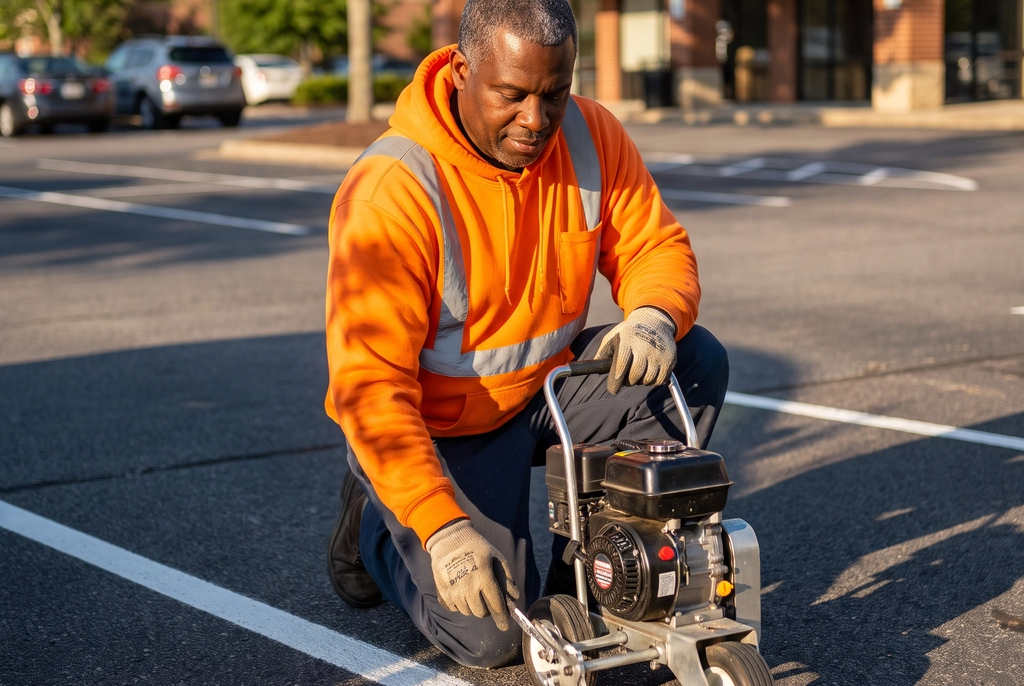
Your line striper is the heart of your operation. A reliable machine prevents costly downtime. While entry-level models exist, a gas-powered airless striper is the professional standard. It provides the power and precision needed for clean, sharp lines that clients expect.
- Line Striper: A Graco LineLazer 3400 is a solid industry workhorse and will cost between $3,500 and $4,500.
- Stencil Kit: A complete, ADA-compliant plastic stencil set runs from $500 to $1,200.
- Paint: Set up a trade account with suppliers like Sherwin-Williams or PPG. Traffic paint is sold in 5-gallon buckets, typically for $150 to $250 each.
Here are 4 immediate steps to take:
- Research local storage units with 24/7 access and confirm their commercial use policy.
- Get a current price for a Graco LineLazer 3400 from an equipment dealer.
- Contact a local Sherwin-Williams or PPG store to ask about opening a contractor account.
- Price a complete ADA-compliant stencil kit from a supplier like Pavement Stencil Company.
How do you set up payments for your striping business?
Require a 50% deposit upfront, offer Net 30 terms to established commercial clients, and accept card payments on-site to avoid cash flow delays.
For most jobs, require a 50% deposit upfront to cover your paint and material costs. The balance is then due upon completion. With larger commercial clients, you may need to offer Net 30 payment terms, but only after you have established a trusted relationship.
Many new owners make the mistake of only accepting checks, which can delay your cash flow by days or weeks. You need a way to accept credit and debit cards, especially to secure payment immediately after finishing a smaller job.
Choose your payment solution
When you look at payment solutions, watch the fees. Many processors charge between 2.5% and 3.5% per transaction, and some add monthly fees on top. These costs can quickly reduce your profit margins.
For on-site payment collection, JIM lets you accept debit, credit, and digital wallets directly through your smartphone. At 1.99% per transaction with no extra hardware, it works for collecting deposits on the spot. Funds are available on your JIM Card as soon as the sale is done.
Here are 3 immediate steps to take:
- Decide on your standard payment terms, including deposit percentage.
- Compare card processing rates from at least two providers.
- Draft a simple payment clause to include in your customer quotes.
How do you fund a parking lot striping business?
Finance your line striper through equipment loans, apply for an SBA Microloan up to $50,000, and keep a $5,000 to $10,000 working capital buffer.
Your most significant expense is the line striper, so look at equipment financing first. Dealers often partner with lenders who specialize in construction gear. These loans use the equipment as collateral, which can make approval easier even for a new business.
Explore loan and grant options
The SBA Microloan program offers loans up to $50,000 through nonprofit intermediary lenders. Those lenders set their own credit requirements and interest rates, which typically range from 8% to 13%. Source: SBA Microloans. Also, consider a business line of credit from your bank for ongoing costs like paint and fuel.
Many new owners focus only on equipment and forget about working capital. Budget an extra $5,000 to $10,000 to cover your first six months of expenses. This buffer keeps you afloat before payments from jobs start to arrive consistently.
A frequent misstep is relying on personal credit cards. Their high interest rates can quickly erode your profits. A business loan or line of credit almost always offers a more favorable rate, protecting your bottom line as you get started.
Here are 4 immediate steps to take:
- Check your personal credit score to see where you stand for loan applications.
- Ask your equipment dealer about their financing partnership options.
- Calculate your estimated operating costs for the first six months.
- Research the SBA Microloan program on the official SBA website.
How do you hire and manage a striping crew?
Your first hire is a Pavement Marking Technician at $18 to $25 per hour, managed with a simple calendar that scales to field service software as you grow.
You will not be able to do every job alone. Your first hire should be a Pavement Marking Technician. This person will handle site prep, operate the striper, and manage stencils. Look for someone with a keen eye for detail, not just a general laborer.
Build your first crew
Expect to pay a technician between $18 and $25 per hour, based on their experience. A common mistake is to hire cheap, unskilled help. This almost always leads to sloppy lines, costly rework, and unhappy clients. Invest in someone who takes pride in their work.
Most training happens on the job. However, for future growth, look into the Pavement Marking Technician certification from ATSSA. This can help you qualify for larger municipal or state contracts down the road. It shows a higher level of professionalism.
Streamline your daily workflow
When you start, a simple Google Calendar is enough to manage your job schedule. As you add clients, consider field service software like Jobber or Housecall Pro. These platforms help you manage quotes, scheduling, and customer communication in one place, which saves administrative time.
A lean two-person crew can be very profitable. Once established, a skilled crew in a mid-sized market might target $200,000 to $300,000 in annual revenue as a growth benchmark. This gives you a solid target for performance and growth.
As an illustration, suppose a two-person crew in a mid-sized market like Austin takes on 4 lots per week at an average ticket of $1,100. At that pace, the crew bills roughly $228,000 in a 52-week season. That is an illustrative scenario, not a guarantee. Your actual revenue depends on your win rate, lot sizes, and how many months your local season allows.
Here are 4 immediate steps to take:
- Draft a job description for a Pavement Marking Technician.
- Research hourly pay for painters in your area on sites like Indeed.
- Look up the ATSSA certification to understand future training options.
- Set up a free Google Calendar to start scheduling your first jobs.
How do you market a parking lot striping business?
Target property management companies and paving contractors with direct outreach, a free Google Business Profile, and before-and-after photos.
Your first clients will likely come from direct outreach. Focus on property management companies, commercial real estate brokers, and paving contractors. These contacts manage multiple sites and can provide a steady stream of repeat business, which is more valuable than one-off jobs.
A mistake many new owners make is waiting for the phone to ring. You have to be proactive. Create a simple one-page flyer with your services, contact information, and a few high-quality before and after photos. Drop these off in person to build a connection.
Build your online presence
Set up a free Google Business Profile immediately. This is how local customers will find you. Upload photos of every completed job, list your services, and encourage your first clients to leave a review. Positive reviews are a powerful signal of trust for new leads.
You do not need a complex website at first. A clean, one-page site built with Squarespace or Wix is enough. Its main job is to showcase your portfolio and make it easy for potential clients to contact you. Your photos will do most of the selling.
Here are 4 immediate steps to take:
- Create a Google Business Profile and upload at least five photos of your work.
- Design a one-page flyer with your services and contact details.
- Identify and contact five local property management companies.
- Start a photo gallery on your phone to document every job you complete.
How do you price parking lot striping jobs?
Charge $0.35 to $0.75 per linear foot for standard 4-inch lines or $4 to $8 per stall, with a target gross margin of 50% to 70%.
Your pricing strategy directly impacts your profitability. Most striping jobs are priced per linear foot or per stall. For standard 4-inch lines, typical industry pricing ranges from $0.35 to $0.75 per linear foot. Pricing per stall, which includes the lines and a number, can range from $4 to $8.
Factor in all costs
A frequent error is to base quotes only on paint costs. You must also account for labor, travel time, insurance overhead, and equipment wear. Your goal should be a gross profit margin of 50% to 70%. This means a job that costs you $300 in materials and labor should be billed at $600 to $1,000.
Remember to price stencils separately. A standard handicap stencil might add $25 to $50 per application. Custom logos or complex lettering should be quoted at a much higher rate based on the time and detail required. This is often overlooked but adds significant profit.
To see what your market will bear, call a few local competitors for a quote on a small, 20-stall lot. This gives you a real-world baseline. Use this information to position your prices competitively but avoid underbidding just to win work.
Stripe ADA-compliant accessible spaces
Federal ADA rules set the minimum number of accessible parking spaces based on total lot size. A lot with 1 to 25 spaces needs at least 1 accessible space, while 76 to 100 spaces requires 4. At least one of every six accessible spaces must be van-accessible. Source: ADA accessible parking requirements.
| Total parking spaces | Minimum accessible spaces |
|---|---|
| 1 to 25 | 1 |
| 26 to 50 | 2 |
| 51 to 75 | 3 |
| 76 to 100 | 4 |
| 101 to 150 | 5 |
| 151 to 200 | 6 |
| 201 to 300 | 7 |
| 301 to 400 | 8 |
| 401 to 500 | 9 |
| 501 to 1,000 | 2% of total |
| 1,001+ | 20, plus 1 per 100 over 1,000 |
Confirm the ratio with your client before you lay out the lot. Restriping an existing lot to meet current ADA standards is a common source of repeat business.
Here are 4 immediate steps to take:
- Calculate your price per linear foot to achieve a 60% profit margin.
- Call two local competitors for a quote on a small parking lot.
- Create a price list for common stencils like handicap symbols and arrows.
- Draft a basic quote template that includes your payment terms.
How do you maintain quality and scale a striping business?
Track a callback rate under 2% and hold line deviation to 1 inch over 50 feet, then add a second crew once you pass $150,000 in annual revenue.
Your reputation is built on clean lines. For line quality, industry practice targets no more than a 1-inch deviation over a 50-foot span. Use a final walk-through with the client and a quality checklist to confirm every line is sharp and every stencil is crisp before you leave the job site. For professional standards, the American Traffic Safety Services Association (ATSSA) offers a Pavement Marking Technician certification that can help you qualify for larger municipal contracts.
A mistake some owners make is not tracking callbacks. Your goal should be a callback rate under 2%. If you find yourself returning to more than one job out of every 50, review your team's site prep and application process immediately.
Know when to grow
Once you are consistently booked 3 to 4 weeks in advance, it is time to consider hiring your next technician. A good financial trigger for adding a second crew and striper is when your business surpasses $150,000 in annual revenue. This ensures you have the cash flow to support the expansion.
As you grow, a simple calendar will not be enough. Move your operations to field service software like Jobber or Housecall Pro. These platforms consolidate your quoting, scheduling, and invoicing, which frees up your time to focus on landing bigger contracts.
Here are 4 immediate steps to take:
- Create a quality checklist for your final client walk-throughs.
- Look up the ATSSA Pavement Marking Technician course for advanced standards.
- Set a revenue goal, like $150,000, as your trigger to plan for a second crew.
- Sign up for a free trial of Jobber or Housecall Pro to explore their features.
When is the best time to start a parking lot striping business?
Striping is weather-dependent, so your season depends on your climate. In northern states, the season runs from April through October, with peak demand in May through September when property managers refresh lots before winter. In southern states like Florida, Arizona, and Texas, you can stripe year-round, with a slowdown only during the heaviest summer rains.
In the off-season, complement striping with sealcoating, curb painting, or snow removal to keep revenue steady. Sealcoating uses the same client base and extends the life of the asphalt you stripe, which makes it a natural add-on.
Your next step is concrete: drive through three commercial zones this week and note every lot with faded lines. Those properties are your first prospects. Every straight line and clean stencil builds the reputation that secures repeat business.
When it is time to get paid, keep it simple. JIM lets you take card payments right on your smartphone with no extra hardware, for 1.99% per transaction. Download JIM to handle payments from day one.
Frequently Asked Questions
Is a parking lot striping business profitable?
How much does it cost to start a parking lot striping business?
Do I need a license to stripe parking lots?
What equipment do I need to stripe parking lots?
How much do parking lot stripers charge per stall?


Sell and get paid in seconds with Jim