Starting a poster business is a rewarding venture that combines artistic creativity and design skills with business savvy. The market is quite accessible thanks to print-on-demand services and online marketplaces, but this also means you'll face plenty of competition.
This guide will take you through the practical steps of validating your concept, building supplier relationships, acquiring the right equipment, and obtaining necessary permits to help you launch a successful poster business in the U.S.
Step 1: Plan your business and validate your idea
Start by defining your niche. Use Google Trends to check search interest for themes like "minimalist movie posters" or "vintage botanical prints." Spend a few hours on Etsy and Pinterest to see what currently sells well and identify potential gaps in the market.
Once you have a niche, look at the competition. A platform like Semrush can show you what keywords successful stores rank for. A frequent mistake is to copy top performers. Instead, find a unique style or subject that sets you apart from the crowd.
Break down your startup costs
Your initial investment will vary. You could purchase a professional-grade printer, like a Canon imagePROGRAF, which might run from $1,000 to $3,000. This path gives you full control but requires a larger budget to start.
Alternatively, you can begin with a print-on-demand service like Printful or Gooten, which removes equipment costs. Your main expenses would then be your e-commerce platform, like Shopify at about $29/month, and business registration fees, which range from $50 to $500.
Here are 4 immediate steps to take:
- Research three potential niches using Google Trends and Etsy.
- Analyze two competitors with Semrush to understand their keywords.
- Create a startup budget that compares the cost of a printer to using a print-on-demand service.
- Compare the product catalogs and pricing of Printful and Gooten.
Step 2: Establish your legal structure and get licensed
You should consider a Limited Liability Company (LLC). This structure protects your personal assets from business debts. Many new owners skip this, but if you operate as a sole proprietor, your personal finances are at risk. You can file for an LLC for about $50 to $500.
Next, get an Employer Identification Number (EIN) from the IRS. It is a federal tax ID number for your business. You will need it to open a business bank account, and it is free to apply for on the IRS website.
Secure your state and local permits
You will need a seller's permit from your state's department of revenue to collect sales tax. This is sometimes called a resale license. The application is usually free but processing can take a couple of weeks, so plan ahead.
Also, check with your city or county clerk for a general business license. If you plan to run the business from your home, you may need a Home Occupation Permit. This permit typically costs between $25 and $100.
Here are 4 immediate steps to take
- Decide on a business structure like an LLC or sole proprietorship.
- Apply for a free Employer Identification Number (EIN) online.
- Look up the seller's permit requirements for your state.
- Contact your city clerk's office about local business licenses.
Step 3: Secure your business insurance
With your legal structure in place, the next move is to manage risk. Insurance protects your business from unexpected events. For a poster business, you are not just selling paper, you are selling a product that will be in someone's home or office.
Protect your business with the right coverage
General liability insurance is your baseline. It covers claims like property damage or bodily injury. A $1 million policy is standard and typically costs between $400 and $700 per year. This often includes product liability, which is important if a frame falls or a customer has a reaction to your materials.
If you buy a professional printer, you should add commercial property insurance. This protects your equipment and inventory from theft or damage. Many new owners assume their homeowner's policy covers business equipment, but it almost never does without a specific rider.
Find an insurance provider
Look for insurers that specialize in e-commerce or small businesses. Providers like Hiscox, The Hartford, or Next Insurance understand the risks and can offer tailored packages. A general agent might not grasp the specific needs of an online retail business.
Here are 4 immediate steps to take:
- Get quotes for a $1 million general liability policy.
- Ask if product liability is included or if it needs to be a separate rider.
- Review your homeowner's policy for business-related exclusions.
- Compare plans from two providers that specialize in e-commerce.
Step 4: Set up your workspace and source materials
Secure your production space
You can likely start from home in a dedicated 100-square-foot area. This gives you enough room for a printer, computer, and storage. Just confirm your operations align with the Home Occupation Permit rules you researched earlier, as some areas have restrictions on business traffic.
Choose your equipment
For professional quality, you might want to consider a wide-format inkjet printer like an Epson SureColor P-series, which can run from $800 to $2,500. A common mistake is to start with a cheap desktop printer, but the high ink cost and poor print quality will disappoint customers.
You will also need a rotary paper trimmer for clean edges, which costs about $150. Then, think about packaging. You can find mailing tubes and end caps from suppliers like Uline. A starter batch of 100 tubes will cost around $100 to $150.
Find your paper suppliers
If you print in-house, your paper choice matters. Look at specialists like Red River Paper and order a sample kit for about $20 to feel the different finishes. A 230 gsm matte paper is a great, versatile option to start with. This avoids a large upfront paper investment.
Here are 4 immediate steps to take:
- Price out an Epson SureColor P700 or a similar wide-format printer.
- Order a paper sample kit from a supplier like Red River Paper.
- Get a quote for 100 mailing tubes and end caps from Uline.
- Review your city’s Home Occupation Permit guidelines again.
Step 5: Set up your payment processing
Your e-commerce platform, like Shopify, has a built-in payment processor. These are convenient but watch the fees. Many providers charge 2.9% plus a fixed fee per transaction, which can reduce your profit on each poster sold. Most poster sales are paid in full upfront online.
Accept payments anywhere
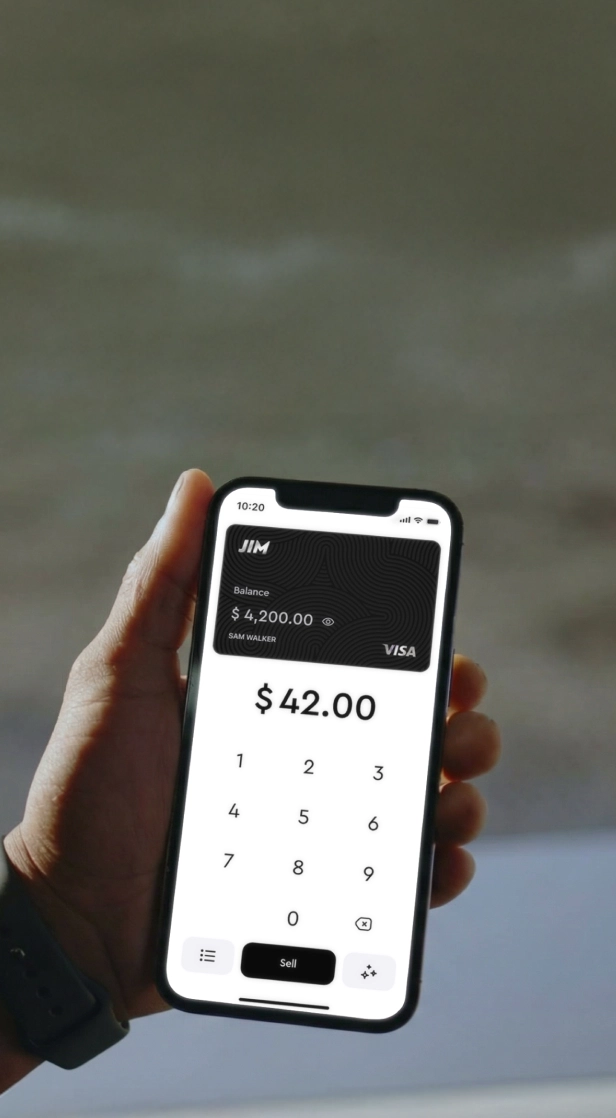
For selling at art fairs or local markets, you need a way to accept payments on the go. For this, JIM offers a streamlined solution. With JIM, you can accept debit, credit, and digital wallets directly through your smartphone. Just tap and you are done.
At just 1.99% per transaction with no hidden costs or extra hardware needed, it is a better deal than the average commission rates from other providers. It's particularly useful for making quick sales at a pop-up event without needing a separate card reader.
Here is how it works:
- Get Started: Download the JIM app for iOS.
- Make a Sale: Type the sales amount, hit sell, and ask your customer to tap their card or device on your phone.
- Access Funds: Your money is available on your JIM card as soon as the sale is done, with no waiting for bank transfers.
Here are 3 immediate steps to take:
- Review the transaction fees for your e-commerce platform's default payment processor.
- Compare those fees to the 1.99% flat rate offered by JIM.
- Brainstorm two in-person events, like a local market, where you could make sales.
Step 6: Fund your business and manage finances
Most poster businesses start with personal savings. If you need outside capital, an SBA Microloan is a solid option. These loans range from $500 to $50,000 and are great for equipment or inventory. Interest rates are typically between 8% and 13%.
You might also look into grants. While highly competitive, programs like the Amber Grant award funds to women-owned businesses. Also, check with your local arts council, as they sometimes offer small project grants that could fit your new venture.
Estimate your working capital
Plan for your first six months of operation. You will need about $1,500 to $3,000 for working capital. This covers your e-commerce plan, marketing spend, and initial supply orders. A frequent misstep is to forget marketing costs, so budget at least $100 per month for ads.
Once you have funding, open a dedicated business bank account. This keeps your personal and business finances separate, which is important for tax time and protects your personal assets if you have an LLC. For bookkeeping, you can start with a free platform like Wave.
Here are 4 immediate steps to take:
- Research one SBA Microloan lender in your state.
- Calculate your working capital needs for the first six months.
- Open a separate business bank account.
- Create an account on a bookkeeping platform like Wave.
Step 7: Build your team and streamline operations
Make your first hire
You will likely start as a one-person operation, and that is perfectly fine. Focus on your designs and initial sales. Once you consistently hit around $3,000 in monthly revenue, you might consider a part-time Studio Assistant to help with production.
This role typically handles printing, trimming, and packaging orders. A fair wage would be between $15 and $20 per hour. No specific certifications are needed, but experience with design software or printers is a plus. A frequent mistake is to hire too early, which can strain your cash flow.
Set up your operational workflow
To keep things organized, use a free platform like Trello or Asana. You can create boards to track poster ideas, designs in progress, and printing queues. This gives you a clear visual of your entire production pipeline from start to finish.
Also, document your processes from the beginning. Write down the exact steps for printing, trimming, and packaging each order. This simple guide ensures consistent quality and makes it much easier to train your first employee when the time comes.
Here are 4 immediate steps to take:
- Define the monthly revenue goal that will trigger your first hire.
- Write a one-page job description for a part-time Studio Assistant.
- Set up a Trello board to manage your design and order pipeline.
- Create a short document outlining your standard packaging process.
Step 8: Market your business and find customers
Build your online presence
Start with visual platforms like Pinterest and Instagram. Create boards that reflect your niche, such as "Scandinavian Art Prints." Post high-quality mockups of your posters in real-life settings. Use specific hashtags to attract your target audience.
For search engines, focus on long-tail keywords. Instead of just "posters," try "vintage botanical prints for kitchen." This helps you reach buyers with specific intent. A good initial goal is to rank a few products on Google's first page within six months.
Many new owners rely only on organic traffic. You might want to set aside a small budget for paid ads. Start with $5 to $10 per day on Meta ads, targeting users interested in home decor or specific art styles.
Work with influencers and track your metrics
Collaborations can be very effective. Reach out to micro-influencers with 10,000 to 50,000 followers in the home decor space. You can offer free products for a post. This often yields a better return than ads alone.
Keep an eye on your numbers. A typical e-commerce conversion rate is 1-2%. Aim to keep your Customer Acquisition Cost (CAC) below $25. If your ad spend for one customer is higher, it might be time to adjust your targeting.
Here are 4 immediate steps to take:
- Set up a Pinterest business account and create five niche-specific boards.
- Identify ten long-tail keywords for your top three poster designs.
- Draft a sample Meta ad campaign with a $10 daily budget.
- List five home decor micro-influencers to contact for a collaboration.
Step 9: Set your pricing strategy
Start with a cost-plus pricing model. Calculate your Cost of Goods Sold (COGS) for one poster, which includes paper, ink, and the mailing tube. If your total cost is $6, a 300% markup would set your retail price at $24.
With that baseline, research the market. Your unique art has value beyond its materials. Look at what five similar posters sell for on Etsy. Many new sellers underprice their work, which can make your products seem low-quality instead of a bargain.
Factor in all your costs
Your price needs to cover more than just materials. Account for platform fees and payment processing, which can take about 5-8% of your revenue. Aim for a gross profit margin of 50-70% to leave room for marketing and other business expenses.
You might also offer tiered pricing. For example, sell a standard 12x18 inch print for $25, a larger 24x36 inch version for $45, and a signed, limited-edition print for $80. This strategy caters to different customer budgets and interests.
Here are 4 immediate steps to take:
- Calculate the total cost to produce one standard-size poster.
- Analyze the prices of five similar posters on Etsy.
- Set a price for your main product using a 300% markup as a starting point.
- Create a tiered price list for two different sizes.
Step 10: Implement quality control and scale your operations
Maintain consistent quality
Create a simple quality checklist. Every print should be at least 300 DPI, use your standard 230 gsm paper, and have perfectly clean edges. Before you package an order, check it under good light for any color banding or smudges.
Many new owners start to rush as order volume grows, which leads to mistakes and returns. Track your return rate and customer reviews. If your return rate climbs above 2%, it is a sign that your quality process needs attention before you scale further.
Know when to grow
Once your quality is consistent, you can plan for growth. When you regularly process more than 15 orders a day, it is time to bring on part-time help. This frees you up to focus on design and marketing instead of just fulfillment.
The same logic applies to your equipment. If you get constant requests for larger prints or your printer runs all day, it is time to upgrade. For managing inventory, an app like Katana can help you track paper and ink levels as your business gets more complex.
Here are 4 immediate steps to take:
- Create a one-page quality checklist for every order.
- Track your return rate for one month, aiming for less than 2%.
- Set an order volume goal, like 15 orders per day, to trigger your first hire.
- Review an inventory management app like Katana to see its features.
You have a clear path to launch your poster business. Remember, success often comes from a distinct niche and consistent quality, not just from copying trends. The planning is done, now go make something people will want to hang on their walls.
As you grow and sell at markets, keep your payments simple. JIM lets you accept cards right on your smartphone for a flat 1.99% fee, with no extra hardware needed. To be ready for any sale, Download JIM.
.avif)