Starting a private label wine business is a rewarding venture that blends a passion for winemaking and branding with sharp business savvy. The American wine market is a multi-billion dollar industry, with steady demand for unique labels from restaurants, retailers, and for corporate events.
This guide will take you through the practical steps of validating your business concept, securing funding, obtaining necessary licenses, and building supplier relationships to help you launch a successful private label wine business in the U.S.
Step 1: Plan your business and validate your concept
Market and competitor research
Begin with market research to find your niche. You can review reports from NielsenIQ for broad consumer trends. Also, search the public TTB COLA registry to see what labels other companies get approved, which shows you what is currently entering the market.
For competitor analysis, use databases like Wine-Searcher to check product pricing and availability. A frequent misstep is to only look at national brands. You should also analyze the private labels sold in your target restaurants and retailers to see what already works for them.
Estimate your startup costs
Your initial investment will likely range from $5,000 to over $25,000. This figure can feel large, but breaking it down helps with planning. Your budget should account for licensing, branding, and your first inventory purchase. A typical cost breakdown looks like this:
- Federal and State Licensing: $1,000 - $3,000
- Label Design and Branding: $2,000 - $7,000
- Initial Wine Purchase (56 cases/1 pallet): $2,000 - $15,000+
Here are 3 immediate steps to take:
- Draft a preliminary budget with low, medium, and high cost estimates for each category.
- Search the TTB COLA registry for five recently approved wine labels in your chosen category.
- Identify three local restaurants or retailers and analyze their current wine lists.
Step 2: Set up your legal structure and get licensed
Choose your business structure
You might want to form a Limited Liability Company (LLC). It protects your personal assets and offers pass-through taxation, which simplifies your tax filings. An S Corporation is another option, but its compliance requirements are often more complex for a new business.
Secure your licenses
Navigating the licensing process requires patience. You will need permits from federal, state, and sometimes local authorities. Many new owners underestimate this timeline, so it is smart to start early. The entire process can take over six months.
First, apply for a Federal Basic Permit from the Alcohol and Tobacco Tax and Trade Bureau (TTB). This permit is free, but expect a processing time of 60-90 days. You cannot sell wine without it.
Next, you will need a state-level license from your state's Alcoholic Beverage Control (ABC) board. This could be a Wholesaler or Importer license, often costing between $500 and $2,000. State approvals can take an additional 3-6 months.
Here are 3 immediate steps to take:
- Decide between an LLC and an S Corp and register your business with your Secretary of State.
- Begin the application for your Federal Basic Permit through the TTB's Permits Online system.
- Identify your state's ABC board and find the specific application for a wine wholesaler license.
Step 3: Secure your insurance and manage risk
Select your insurance policies
You will need a General Liability policy with at least $1 million in coverage. This often includes Product Liability, which protects you if a customer claims your wine made them sick. Expect annual premiums to range from $700 to $2,000 for this combined coverage.
If you plan to use a vehicle for deliveries, you must have Commercial Auto insurance. Also, if you hire employees, most states require you to carry Workers' Compensation insurance. These policies are separate from your general liability.
Find a specialized provider
A frequent mistake is to use a general insurance agent. You should work with a broker who understands alcohol businesses. They can find policies that properly cover liquor liability. Consider providers like the Food Liability Insurance Program (FLIP), Heffernan Insurance Brokers, or Vintner's Insurance Services.
With your inventory in mind, discuss specific risks like spoilage or breakage. A policy rider, sometimes called Inland Marine insurance, can cover your wine while it is in transit from the winery to your warehouse or customer. This protects your initial investment.
Here are 3 immediate steps to take:
- Request a quote for a $1 million general liability policy that includes product liability.
- Contact a specialized beverage industry insurer to compare their offerings.
- Ask about adding Inland Marine coverage to protect your inventory during shipment.
Step 4: Secure your space and equipment
Find your storage space
You can start with a 100-200 square foot climate-controlled space for your first pallet of wine. Check with your local planning department about zoning. Some areas require a commercial warehouse for alcohol storage, while others may permit specialized self-storage units.
A frequent misstep is renting a standard storage unit to save money. Wine is highly sensitive to temperature. You must secure a space that stays between 55-65°F year-round or you risk spoiling your entire inventory before you ever sell it.
Source your wine and supplies
Your initial equipment needs are simple. A used pallet jack, which you can find for $300-$600, will let you move your full pallet. A hand truck for around $150 is also useful for moving individual cases. This makes managing the 56 cases much easier.
With your storage sorted, you can find a winery partner. Many wineries in regions like Napa Valley or Oregon's Willamette Valley have private label programs. A typical minimum order is one pallet, which contains 56 cases or 672 bottles, making it an accessible starting point.
Here are 3 immediate steps to take:
- Contact your local planning department to confirm zoning for alcohol warehousing.
- Get quotes from three climate-controlled storage facilities for a 10x20 unit.
- Research three wineries that offer private label services with a one-pallet minimum.
Step 5: Set up your payment processing
Establish your payment terms
For wholesale clients like restaurants, Net 30 terms are standard, giving them 30 days to pay. You might also request a 50% deposit on large custom orders. This helps cover your upfront costs for the wine and bottling before you commit the inventory.
When you sell directly at events or pop-ups, you need a way to accept payments instantly. Look for a payment solution with low transaction fees and no long-term contracts. Many processors charge 2.5% to 3.5% plus monthly fees, which can add up quickly.
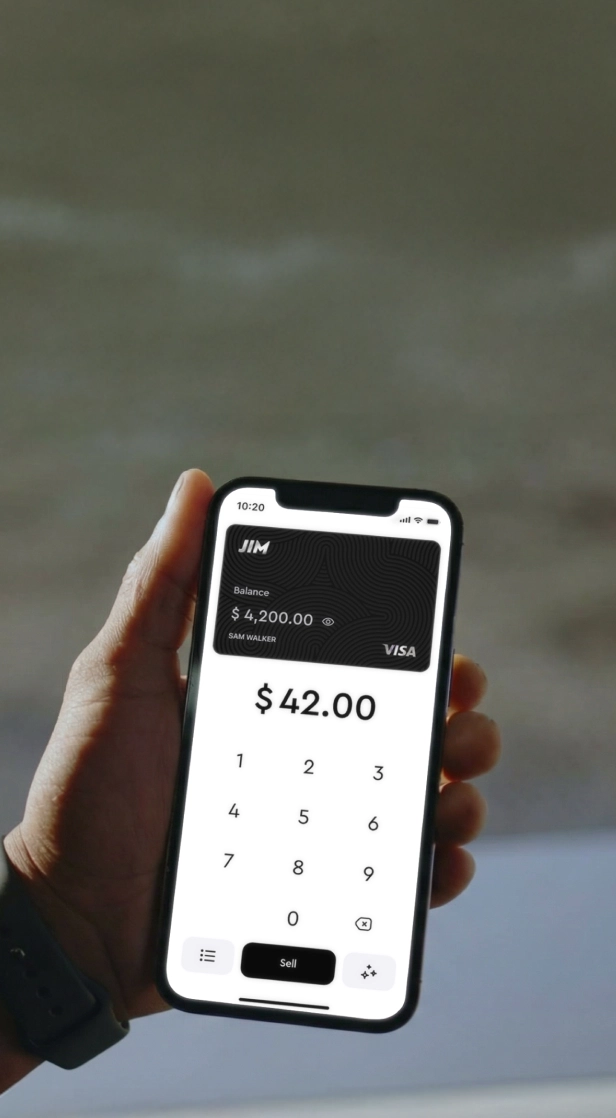
For private label wine businesses that need to accept payments on-site or on-the-go, JIM offers a streamlined solution. With JIM, you can accept debit, credit and digital wallets directly through your smartphone - just tap and done. At just 1.99% per transaction with no hidden costs or extra hardware needed, it's particularly useful for selling at wine festivals or local markets.
Using it is straightforward:
- Get Started: Download the JIM app for iOS.
- Make a Sale: Type the sales amount, hit sell, and ask your customer to tap their card or device on your phone.
- Access Funds: Your money is available right on your JIM card as soon as the sale is done - no waiting for bank transfers.
Here are 3 immediate steps to take:
- Draft your standard payment terms for wholesale clients, such as Net 30.
- Download the JIM app to explore its interface and features for in-person sales.
- Decide on a deposit policy for large or custom private label orders.
Step 6: Fund your business and manage finances
Secure your startup capital
You might want to explore an SBA 7(a) loan, which can provide $50,000 or more. Lenders will want to see a solid business plan and good personal credit. Interest rates typically hover around the Prime rate plus 2-4%, making them a competitive option.
For smaller funding needs, an SBA Microloan is often more accessible. These loans, usually under $50,000, come from nonprofit community lenders. The requirements can be more flexible, which is helpful for a new venture without a long financial history.
Plan your working capital
With funding in mind, you should map out your working capital for the first six months. Plan for $15,000 to $30,000 to cover inventory, marketing, and storage costs before your sales generate a steady income stream. This buffer is your safety net.
Many new owners get tripped up by wholesale payment terms. Your restaurant clients will likely pay on Net 30 terms, meaning you carry the costs for 30-60 days after a sale. Your working capital must be sufficient to bridge this gap so you can operate smoothly.
Here are 3 immediate steps to take:
- Contact your local Small Business Development Center (SBDC) for free help with an SBA loan application.
- Calculate your six-month working capital needs, including a buffer for payment delays.
- Open a dedicated business bank account to keep your finances organized from day one.
Step 7: Staff your business and manage operations
Your first hire
You will likely handle all roles yourself at first. Your first hire is often a Sales Representative. This person focuses on getting your wine into restaurants and retail stores, which frees you to manage supplier relationships and finances.
For this role, you might offer a base salary of $40,000-$55,000 plus a 5-10% commission. While not required, a WSET certification shows expertise and builds trust with buyers. It is a credential worth looking into for any sales hire.
Operational systems
To support your sales, you need solid operational systems. You can manage inventory with software like QuickBooks Online, which also handles your accounting. As you grow, platforms like Ekos offer more advanced features for the beverage industry.
Many new owners wait too long to hire help, which can become a bottleneck. Once your revenue approaches $200,000-$250,000, a dedicated salesperson can accelerate growth far beyond what you can do alone.
Here are 3 immediate steps to take:
- Draft a job description for a Sales Representative with a commission structure.
- Research local WSET Level 1 or 2 certification courses for future hires.
- Review QuickBooks Online pricing to see its inventory management features.
Step 8: Market your wine and find customers
Create your sales kit
Your first step is to create a professional sales kit. This includes a one-page sell sheet with your wholesale price, SKU, and tasting notes. You will also need a high-quality bottle shot. A common misstep is to use a phone photo, which can look amateur to professional buyers.
You might want to hire a product photographer for this. A good shoot can cost between $300 and $800, but the polished images will help you stand out. These assets are your introduction to sommeliers and retail managers, so they need to make a strong impression.
Secure your first wholesale accounts
With your sales kit ready, you can approach local restaurants and independent retailers. Create a target list of 20-30 businesses that fit your brand. A direct, in-person approach with a sample bottle often works best to get a conversation started.
Be patient with the sales process. It can take 30-90 days to close a new account. After you drop off a sample, plan to follow up within a week. Many new owners fail to follow up, which leaves potential sales on the table.
Build an online presence
A simple website that tells your brand story and lists your contact information is a great start. In addition, an Instagram profile helps build brand awareness. You can post about your wine's origin, suggest food pairings, and show where customers can find your bottles.
Once you have a few accounts, consider listing your wine on a wholesale platform. Services like SevenFifty or LibDib are where many restaurant and retail buyers discover new products. This can expand your reach beyond your local area.
Here are 3 immediate steps to take:
- Draft a one-page sell sheet with your wholesale pricing and tasting notes.
- Build a target list of 20 local restaurants and retailers to approach.
- Set up a professional Instagram profile for your brand.
Step 9: Price your wine and set your strategy
First, calculate your landed cost per bottle. This number includes the wine, freight, taxes, and any storage fees. For example, if your total cost for a pallet of 672 bottles is $5,376, your landed cost per bottle is $8.
With your cost figured out, you can set your wholesale price. A typical gross profit margin for a wine wholesaler is 30-40%. To hit a 35% margin on an $8 bottle, you would price it at approximately $12.30 for restaurants and retailers.
Analyze your competitors' pricing
Your pricing does not exist in a vacuum. Use a database like Wine-Searcher to see the retail prices of similar wines. This helps you understand what the end consumer is willing to pay and ensures your wholesale price allows retailers to apply their standard markup.
A frequent mistake is to price too low just to win an account. This can signal low quality and makes it difficult to become profitable. Set a price that reflects your brand's value and covers your costs from day one.
Here are 3 immediate steps to take:
- Calculate your total landed cost per bottle for your first pallet.
- Set a target wholesale price that gives you a 30-40% gross profit margin.
- Research the retail prices of three comparable wines on Wine-Searcher.
Step 10: Maintain quality and scale your operations
Keep your wine consistently great
Your reputation depends on quality. For each batch, request a Certificate of Analysis (COA) from your winery. This document confirms key metrics like sulfur dioxide (SO2) and volatile acidity (VA) levels are within spec. You should also taste every batch yourself before it ships.
A frequent misstep is to rely solely on the winery's quality control. You are the brand owner, so the final approval is yours. A bad batch can damage your relationships with your first hard-won accounts, so this step is non-negotiable.
Know when to expand
Once your revenue approaches the $200,000 mark, it is time to hire a salesperson. This frees you to focus on operations. As you grow to over 50 wholesale accounts, consider software like Ekos or WineDirect to manage inventory and orders more efficiently than spreadsheets.
This software helps you track depletion rates at your accounts, which is a key metric. If a restaurant reorders your wine every 45 days, you know you have a successful placement. This data helps you forecast future inventory needs and manage your cash flow.
Here are 3 immediate steps to take:
- Ask a potential winery partner for a sample Certificate of Analysis (COA).
- Set a revenue goal that will trigger your first sales hire.
- Watch a demo for an inventory management platform like Ekos or WineDirect.
Building a private label wine brand is about more than just logistics; it's about relationships. Your success will hinge on the quality you source and the trust you build with your first accounts. The path is clear, and your brand story is ready to be told.
And when you make those first sales at a market or event, getting paid should be simple. JIM turns your smartphone into a card reader, so you can accept payments for a flat 1.99% fee with no extra hardware. Download JIM to get started.
.avif)