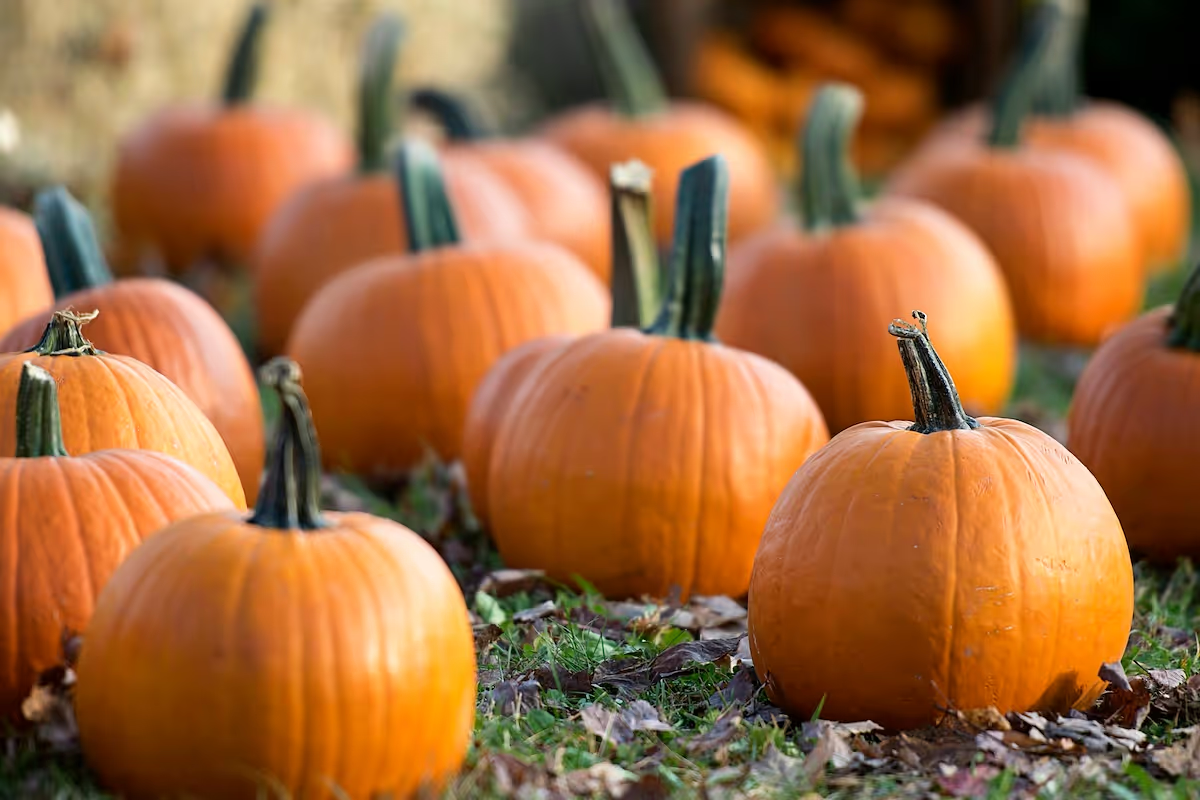
Starting a pumpkin patch business is a rewarding venture that blends a love for agriculture with sharp business savvy. The industry sees millions in sales each year, driven by steady demand from families, school groups, and fall festival enthusiasts.
This guide will take you through the practical steps of selecting the right location, validating your business concept, securing funding, and obtaining necessary permits to help you launch a successful pumpkin patch business in the U.S.
Step 1: Plan your business and validate your idea
First, gauge local interest. Visit nearby farmers' markets and fall festivals to see what draws a crowd. You should also review local social media groups to understand what families want from a fall outing, whether it is a simple U-pick field or a full festival experience.
Next, identify your direct competitors using Google Maps and local business directories. Analyze their websites and social media to note their pricing, hours, and special attractions. A frequent misstep is to simply imitate a competitor instead of creating your own unique draw.
Figure out your startup costs
Your initial investment will vary, but you can expect startup costs to range from $5,000 to over $20,000. This depends heavily on whether you lease or buy land and equipment. Leasing is often a more manageable entry point for your first season.
Let's look at a sample budget. Plan for land lease costs around $150-$350 per acre. Pumpkin seeds and supplies may run $200-$500 per acre. Basic irrigation can cost $1,000-$5,000, while business permits and liability insurance might add another $1,500.
Here are 3 immediate steps to take:
- Analyze three local competitors to identify their offerings and pricing.
- Create a draft budget that lists potential expenses from land to marketing.
- Contact your local county clerk's office about agricultural business permits.
Step 2: Set up your legal structure and get licensed
Choose your business structure
Forming a Limited Liability Company (LLC) is a smart move. It protects your personal assets if the business faces debt or lawsuits. An LLC also offers pass-through taxation, meaning profits are taxed on your personal return, which simplifies paperwork.
Operating as a sole proprietor might seem easier, but it leaves your personal finances vulnerable. The small cost to establish an LLC, typically $50 to $500 depending on your state, is a worthwhile investment for peace of mind.
Secure the right permits
First, get an Employer Identification Number (EIN) from the IRS website if you plan to hire staff. You will also need to register your business with your state's Secretary of State and obtain a seller's permit to collect sales tax.
Your local county or city government is your next stop. You will likely need a Temporary Use Permit for seasonal operations, which can cost $100-$500 and take 30-90 days to process. Check with your local health department for food permits if you sell snacks.
The main agencies you will deal with are your county planning department, the state Department of Agriculture, and your local health department. Contact them early, as their requirements will shape your operational plans and timeline.
Here are 4 immediate steps to take:
- Decide on a business structure and research your state's LLC filing fees.
- Apply for a free Employer Identification Number (EIN) on the IRS website.
- Contact your county planning department to ask about Temporary Use Permit requirements.
- Check your state's tax agency website for information on obtaining a seller's permit.
Step 3: Secure insurance and manage risk
Get the right insurance coverage
General liability insurance is your top priority. A policy with $1 million to $2 million in coverage is standard and protects you from visitor injury claims. Annual premiums for this typically range from $500 to $2,000 for a seasonal operation.
You may also need other policies. If you hire even one employee, most states require you to have workers' compensation insurance. Property insurance will cover your equipment and any structures, while a commercial auto policy is necessary if you use a vehicle for business purposes.
Some new owners make the mistake of getting a generic policy. It often fails to cover agritourism risks like hayride accidents or injuries from a petting zoo. You should work with an agent who understands these unique liabilities to get the right endorsements.
Speaking of agents, consider providers like Farm Bureau Financial Services, Nationwide Agribusiness, or Liberty Mutual. They have deep experience with agricultural businesses and can find policies that fit your specific operational risks, which a general agent might miss.
Here are 4 immediate steps to take:
- Request quotes from at least three agribusiness insurance providers.
- Ask agents specifically about coverage for activities like hayrides or corn mazes.
- Confirm your state's requirements for workers' compensation insurance.
- Review your general liability policy to ensure it covers at least $1 million per incident.
Step 4: Find a location and get equipment
Select the right land
You will want at least 5-10 acres. This provides space for 1-2 acres of pumpkins, a parking area, and activities like a corn maze. Look for land zoned for agricultural use, and confirm with your county planning department that a pumpkin patch is a permitted activity.
When you negotiate a lease, aim for a seasonal agreement from August to November to manage costs. A mistake some new owners make is to sign a standard farm lease. Make sure your agreement includes a clause that allows for public access and parking for your visitors.
Purchase your equipment
With your location sorted, the next piece is equipment. A used compact tractor for tilling and transport might cost $8,000-$15,000. Drip irrigation for one acre runs about $1,000-$2,000, and a used hayride wagon can be found for around $1,500-$3,000.
For seeds, you can check suppliers like Harris Seeds or Johnny's Selected Seeds. They sell in quantities suitable for small farms, often starting with packets that cover a quarter-acre. This lets you test different pumpkin varieties without a large upfront purchase.
Here are 4 immediate steps to take:
- Contact your county planning department about agricultural zoning.
- Review sample seasonal land lease agreements for public access clauses.
- Research local prices for a used compact tractor and irrigation system.
- Browse seed catalogs from suppliers like Harris Seeds or Johnny's Selected Seeds.
Step 5: Set up your payment system
Accept credit cards and digital payments
Most visitors expect to pay with a card or phone, so relying only on cash can limit your sales. You will need a way to process debit, credit, and digital wallet payments on-site.
Many payment processors charge 2.5% to 3.5% per transaction and may require you to rent or buy a separate card reader. A mistake some owners make is choosing a system that tethers them to one spot, which is inefficient when you have attractions spread across several acres.
For a pumpkin patch that needs to accept payments on-the-go, JIM offers a streamlined solution. With JIM, you can accept debit, credit, and digital wallets directly through your smartphone. At just 1.99% per transaction with no hidden costs or extra hardware needed, it is particularly useful for selling hayride tickets or pumpkins right from the field.
Here is how it works:
- Get Started: Download the JIM app for iOS.
- Make a Sale: Type the sales amount, hit sell, and ask your customer to tap their card or device on your phone.
- Access Funds: Your money is available right on your JIM card as soon as the sale is done, with no waiting for bank transfers.
Here are 3 immediate steps to take:
- Decide which payment methods you will accept at your patch.
- Compare the transaction fees of different payment solutions.
- Download the JIM app to see how it works on your phone.
Step 6: Fund your business and manage finances
Secure your startup funding
Your best bet for funding is often the USDA's Farm Service Agency (FSA). They offer loans specifically for agricultural businesses. The FSA Microloan program is a great fit, offering up to $50,000 with interest rates typically between 2% and 5%.
To qualify, you will need a solid farm operating plan. A mistake some new owners make is submitting a plan that lacks detail on crop rotation, pest management, and a sales forecast. Your local FSA office can provide guidance on what to include.
You can also look into SBA Community Advantage loans, though they are less farm-focused. Beyond startup costs, plan for working capital. You will need $5,000 to $10,000 set aside for the first six months to cover marketing, supplies, and payroll before revenue starts to flow.
Here are 4 immediate steps to take:
- Research the USDA FSA Microloan program on their website.
- Draft a farm operating plan that includes a detailed sales forecast.
- Calculate your working capital needs for the first six months of operation.
- Contact your local Small Business Development Center (SBDC) for free help with your financial projections.
Step 7: Hire staff and set up operations
Build your team
You will need a few key people. Hire "Patch Hands" for general labor like stocking pumpkins and cleanup, paying around $15-$18 per hour. You should also have "Activity Leads" to manage hayrides or the corn maze, who typically earn $18-$22 per hour.
A good rule of thumb is to have one staff member for every 50-75 daily visitors on peak weekends. It is also smart to have at least one person on-site with a basic first-aid and CPR certification. The American Red Cross offers these courses.
Manage your operations
With your team in place, you need to manage schedules. Apps like Homebase or When I Work are great for seasonal businesses. They let you build schedules and communicate with staff easily. Many offer free plans for small teams, which is perfect for your first season.
Some new owners try to save money by understaffing on weekends. This often backfires with long lines and frustrated visitors. It is better to have one extra person on hand than to lose sales because customers are tired of waiting.
Here are 4 immediate steps to take:
- Draft job descriptions for a Patch Hand and an Activity Lead.
- Check local job boards to confirm competitive pay rates in your area.
- Explore the free plans for scheduling apps like Homebase or When I Work.
- Find a local first-aid and CPR certification course for a key employee.
Step 8: Market your business and attract customers
Create a social media buzz
Start by creating a Facebook Business Page and an Instagram profile. In August, begin to post photos of the pumpkins as they grow. This builds anticipation before you even open. Share behind-the-scenes looks at setting up your corn maze or other attractions.
A small Facebook ad budget of $10-$20 per day can reach thousands of local families. A mistake many owners make is to target too broadly. You should focus your ads within a 15-20 mile radius of your location to keep your cost per click under $1.00.
Build local partnerships
Contact local elementary schools in late summer to offer field trip packages. You can also partner with nearby cafes or bakeries for cross-promotions. For example, they could sell your small pumpkins, and you could offer their customers a discount coupon for admission.
Do not underestimate physical marketing. Place flyers at community centers, libraries, and grocery stores. A professionally made sign at a busy local intersection can also drive significant traffic. Make sure your address and opening date are easy to read from a distance.
Here are 4 immediate steps to take:
- Create a Facebook Business Page and an Instagram profile for your patch.
- Draft an email to send to three local schools about field trip options.
- Design a simple flyer with your location, hours, and main attractions.
- Set a small daily budget for a targeted Facebook ad campaign.
Step 9: Set your pricing strategy
You have two main options for pumpkin pricing: per-pound or a flat rate by size. Per-pound, often around $0.60-$0.90, is fair but requires a certified scale. Flat rates, like $8 for small and $20 for large, are simpler to manage at checkout.
Some new owners choose per-pound pricing without a reliable scale, which can cause customer disputes and slow down lines. If you go this route, invest in a state-certified scale. Otherwise, flat-rate pricing is often the smoother choice for a new operation.
Price your activities and admission
Decide if you will charge a general admission fee. A fee of $10-$20 per person can help cover your fixed costs. You could also offer free entry but charge for each activity, like $5 for a hayride or $8 for the corn maze.
A popular strategy is to offer an all-inclusive wristband. For example, a $30 wristband could include admission, the corn maze, a hayride, and one small pumpkin. This encourages visitors to stay longer and spend more, which increases your average revenue per guest.
Your profit margin on pumpkins themselves can be high, often over 400% of the seed and fertilizer cost. However, your real profit comes after you cover land, insurance, and labor. Aim for an overall business profit margin of 20-30% in your first few seasons.
Here are 4 immediate steps to take:
- Visit two local competitors to note their admission and activity prices.
- Decide if you will use per-pound or flat-rate pumpkin pricing.
- Create a draft price list for admission, pumpkins, and all attractions.
- Calculate your break-even point using your budget and proposed prices.
Step 10: Maintain quality and scale your operation
Maintain your quality standards
Your reputation depends on quality. Regularly walk the patch to check pumpkin health, removing any with soft spots or rot. Aim to discard less than 5% of your pumpkin inventory due to poor condition. This keeps the field looking fresh and appealing for visitors.
You can also measure visitor satisfaction. Use a simple QR code survey at the exit to ask about their experience. Track feedback on cleanliness, staff friendliness, and activity enjoyment. This data shows you exactly where to make improvements for next season.
Know when to grow
Growth should be data-driven. If you sell out of pumpkins before the last weekend of October for two consecutive seasons, it is a strong signal to plant an additional acre. Also, if weekend activity lines consistently exceed 10 minutes, you need more staff.
Many owners wait too long to expand their offerings. If you have to turn away school groups because your schedule is full, think about adding another hayride wagon or opening on more weekdays next year. These are clear signs of unmet demand.
To manage this growth, you might look at farm management software like Agrivi or FarmLogs. These platforms help you track yields and expenses, which makes it easier to plan for expansion and justify new investments based on solid numbers.
Here are 4 immediate steps to take:
- Set a quality goal to keep discarded pumpkins under 5% of your total stock.
- Create a simple one-question customer feedback survey using a QR code.
- Track weekend wait times for your most popular activity for two weeks.
- Review the features of a farm management software like Agrivi or FarmLogs.
Starting a pumpkin patch is about creating memories. Remember that families seek an experience, not just a pumpkin. Focus on the small details that make a visit special. With careful planning, your patch can become a beloved local tradition.
And when those visitors arrive, make their checkout easy. JIM turns your smartphone into a card reader to accept payments for a flat 1.99% fee, with no extra hardware. It keeps things simple so you can focus on your guests. Download JIM to get set up.
.avif)