Starting a railroad company is a rewarding venture that combines logistical planning and operational expertise with sharp business savvy. The freight rail industry generates tens of billions in revenue each year, driven by steady demand to transport everything from raw materials and agricultural goods to consumer products.
This guide will take you through the practical steps of validating your business concept, securing funding, obtaining necessary licenses, and acquiring equipment to help you launch a successful railroad company in the U.S.
Step 1: Validate your market and plan your finances
First, define your service area and the specific goods you intend to transport. Analyze freight flow data from the Bureau of Transportation Statistics to find high-volume corridors. Reports from the Association of American Railroads (AAR) can also reveal opportunities in commodities like grain, coal, or intermodal freight.
With that data, you can research competitors. Review public filings on the Surface Transportation Board (STB) website to identify existing operators in your target region. This helps you pinpoint underserved industrial parks or customers who may need better rail access.
Estimate your startup costs
A realistic financial forecast is your foundation. Many new ventures falter by underestimating capital needs, so a detailed budget is a must. A common mistake is to focus only on the big-ticket items while overlooking major operational expenses.
For example, a single used locomotive can cost between $500,000 and $2 million. Securing trackage rights or leasing a line will likely add several million more. You should also budget for insurance and Federal Railroad Administration (FRA) compliance, which can easily exceed $1 million in the first year.
Here are 4 immediate steps to take:
- Identify three potential industrial customers in your proposed service area.
- Use the STB database to map existing rail operators on your target routes.
- Create a preliminary budget that lists major equipment and compliance costs.
- Download and review the FRA's guide for new railroad operators.
Step 2: Establish your legal structure and secure licenses
First, decide on a business structure. An LLC is a popular choice as it protects your personal assets while allowing for pass-through taxation. A C-Corporation offers a more formal structure but introduces double taxation. You might want to consult an attorney who specializes in transportation law.
Navigate federal and state agencies
With your legal entity chosen, you can address federal oversight. The Surface Transportation Board (STB) grants the authority to operate. You will file a petition for common carrier authority, with fees often over $2,000 and a review period that can take 60-90 days.
A frequent misstep is attempting STB filings alone. Procedural errors cause long delays, so hiring experienced legal counsel is a sound investment. In addition, the Federal Railroad Administration (FRA) governs all safety. You must create and implement a System Safety Program (SSP) under their guidelines.
Finally, handle state and local registrations. This includes filing with your Secretary of State and securing any necessary business or environmental permits from county or city authorities for your specific route.
Here are 4 immediate steps to take:
- Consult a transportation attorney to select your business structure.
- Register your business name with your state's Secretary of State.
- Begin drafting your operating authority petition for the STB.
- Contact your regional FRA office about System Safety Program (SSP) requirements.
Step 3: Secure insurance and manage risk
Line up your coverage
Your insurance portfolio needs several layers. General liability is the baseline, but Railroad Protective Liability (RPL) is specific to our industry. It covers claims from operations near other railroad tracks. You will also need property insurance for equipment and workers’ compensation.
Expect to need at least $5 million in general liability. RPL policies often require $10 million to $25 million in coverage, depending on the Class I railroad you connect with. Annual premiums can easily run from $50,000 to over $200,000 for a new short line.
A frequent oversight is underestimating environmental liability. A hazmat spill cleanup can be financially devastating, so this coverage is not a place to cut corners. Make sure your policy explicitly covers spills and other environmental incidents related to your specific cargo.
Find a specialized broker
General insurance agents rarely understand railroad risks. You might want to work with brokers who specialize in rail, such as Liberty Mutual, Travelers, or Acrisure. They understand the unique requirements and can find appropriate coverage that satisfies both FRA and STB regulations.
Here are 4 immediate steps to take:
- Contact a specialized railroad insurance broker for initial quotes.
- Request sample Railroad Protective Liability (RPL) policy terms.
- Estimate workers’ compensation costs based on your state's rates.
- Assess your need for environmental liability coverage based on your cargo.
Step 4: Acquire equipment and secure trackage rights
Secure your route
Your railroad needs track to run on. You can either lease an existing short line or negotiate trackage rights with a Class I railroad like Union Pacific or BNSF. Expect to pay per-car fees or a percentage of revenue. A common negotiation point is the annual traffic minimum.
A detail many overlook is the interchange agreement. This document dictates how your cars are handed off to the larger railroad. You might want to have your attorney review the liability and car-hire provisions, as these can contain hidden costs that impact your profitability.
Build your rolling stock
For motive power, a used switcher locomotive is a practical start. A reliable unit from a supplier like Progress Rail or Wabtec can range from $500,000 to $2 million. Leasing is also an option and helps preserve your initial capital for other operational needs.
When it comes to freight cars, leasing is almost always the better path for a new company. You can get cars from lessors like GATX or TrinityRail for $25 to $75 per car per day. This avoids the high purchase price of over $100,000 for a single new car.
Here are 4 immediate steps to take:
- Contact the industrial development team at the Class I railroad in your region.
- Request sample trackage rights agreements to review terms.
- Get quotes for a used switcher locomotive from two different brokers.
- Ask for rate sheets from railcar lessors like GATX and TrinityRail.
Step 5: Set up billing and payment systems
Most of your revenue will come from freight contracts. The standard practice is to issue a freight bill after delivery, with payment terms typically set at Net 30. Some larger clients may require Net 60 terms, so factor that into your cash flow projections.
For these large transactions, you will usually receive payment via ACH transfer or a corporate check. Relying only on these methods can create cash flow gaps, especially when you have smaller, ad-hoc charges to collect from various customers.
Handle on-the-go payments
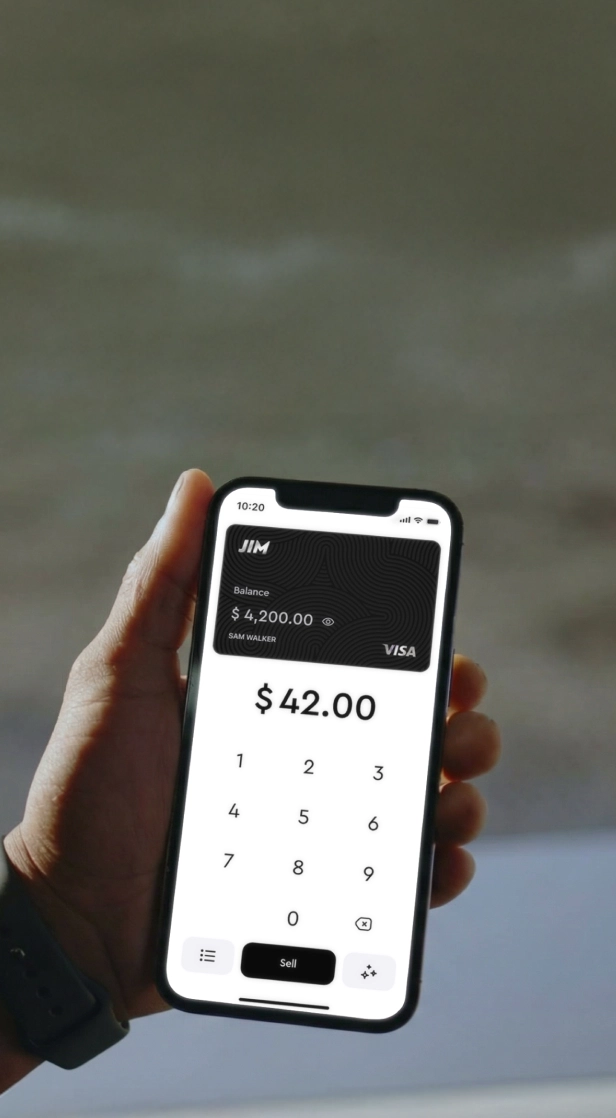
For railroad companies that need to accept payments on-site, JIM offers a streamlined solution. With JIM, you can accept debit, credit, and digital wallets directly through your smartphone. Just tap and you are done.
At just 1.99% per transaction with no hidden costs or extra hardware, it is a cost-effective option. Other providers often charge higher commission rates. It is particularly useful for collecting demurrage fees or payments for transloading services on the spot.
- Get Started: Download JIM app for iOS
- Make a Sale: Type the sales amount, hit sell, and ask your customer to tap their card or device on your phone
- Access Funds: Your money is available right on your JIM card as soon as the sale is done - no waiting for bank transfers
Here are 4 immediate steps to take:
- Draft your standard freight bill template with Net 30 payment terms.
- Open a business bank account to accept ACH transfers for contract payments.
- List services like demurrage where you can collect on-site payments.
- Download the JIM app to explore its features for mobile transactions.
Step 6: Fund your operations and manage finances
Secure your initial capital
Traditional bank loans are often difficult for new ventures. A better path is an SBA 7(a) loan, which guarantees a portion of the loan and can provide up to $5 million. Lenders will expect a detailed business plan, solid personal credit, and an owner equity injection of 10-20%.
Interest rates for these loans typically float around Prime + 2.75% to 4.75%. You could also consider asset-based lending, using your locomotives as collateral. This option often has faster approvals but may come with higher interest rates than SBA-backed financing.
In addition, look into the Federal Railroad Administration's (FRA) CRISI grant program. While these grants are highly competitive and often favor public-private partnerships, they can provide significant funds for infrastructure improvements and safety initiatives that benefit new short lines.
Plan for working capital
Many new operators focus on equipment financing but forget to budget for the first six months of operations. You will need substantial working capital for payroll, fuel, insurance, and unexpected track maintenance. A realistic budget for this period often falls between $500,000 and $1 million.
Here are 4 immediate steps to take:
- Contact an SBA-preferred lender to discuss 7(a) loan pre-qualification.
- Review the latest CRISI grant notice on the FRA website for eligibility.
- Calculate your six-month working capital needs, including fuel and payroll.
- Prepare a five-year financial projection to include in your loan package.
Step 7: Hire your crew and launch operations
Your first hires will be your train crew. You need at least one FRA-certified conductor to manage the train and one locomotive engineer to operate it. These roles are non-negotiable for legal operation, so you might want to recruit them early in the process.
Certifications and compensation
Conductors need a Part 242 certification, while engineers require a Part 240. A mistake some new operators make is not verifying these credentials, which can lead to fines. Expect to offer salaries from $70,000 to $100,000 to attract experienced professionals for these roles.
You will also need track maintenance staff, often called trackmen, to inspect and repair your line. Their salaries typically range from $45,000 to $65,000. A small short line can often start with a lean team of 5 to 10 total employees.
Operations and compliance
With a team in place, you must manage their schedules according to the FRA's strict Hours of Service (HOS) rules. You might want to use a system like PS Technology's CrewPro to automate scheduling and ensure you remain compliant, as manual tracking is prone to error.
Here are 4 immediate steps to take:
- Draft job descriptions for FRA-certified conductors and engineers.
- Budget for competitive salaries based on industry data.
- Request a demo of a crew management system like CrewPro.
- Review the FRA's Hours of Service regulations (49 CFR Part 228).
Step 8: Market your services and acquire customers
Your first customers will likely come from direct outreach, not broad advertising. Identify industrial parks, manufacturing plants, and agricultural producers along your route. You might want to prepare a professional capabilities statement that details your route, interchange points, and services for these meetings.
Build industry relationships
This business runs on relationships. A good move is to join the American Short Line and Regional Railroad Association (ASLRRA). Their conferences are invaluable for meeting potential shippers and partners. Also, connect with the economic development teams at the Class I railroads you interchange with.
They can refer business to you. A detail many overlook is the long sales cycle. It can take 6 to 12 months to secure a major shipping contract, so start these conversations early. Your customer acquisition cost will be tied to travel and time, not ad spend.
Here are 4 immediate steps to take:
- Create a target list of 10 potential shippers in your service area.
- Draft a one-page capabilities statement for your company.
- Register for the next ASLRRA regional meeting or national conference.
- Identify and contact the economic development manager at your Class I partner.
Step 9: Develop your pricing strategy
Your pricing will likely be based on a per-car or tonnage model. For mixed freight, a flat fee per car is straightforward. For bulk commodities like grain or stone, a per-ton rate is more common. For example, you might charge $600 per car for a 75-mile haul.
Your goal should be an operating ratio below 85%, which means your expenses consume no more than 85 cents of every revenue dollar. This leaves a 15% profit margin. To stay competitive, your rates should generally be 10-15% lower than truckload rates for the same route.
Price beyond the main journey
A mistake some new operators make is to only price the line-haul. You should also create a schedule for ancillary fees. This includes demurrage, which can be $75-$150 per car per day, and special switching fees for complex moves within a customer's facility.
In addition, your contracts must include a fuel surcharge. This protects you from volatile energy prices. You can tie your surcharge to a public index, like the one published by the Energy Information Administration (EIA), to make it transparent for your customers.
Here are 4 immediate steps to take:
- Analyze truckload rates for three key lanes in your service area.
- Draft a sample rate sheet with per-car and tonnage-based options.
- Create a fuel surcharge formula tied to the EIA index.
- List and price three ancillary services like demurrage or storage.
Step 10: Maintain quality and scale your operations
Measure your performance
Consistent service keeps customers. You should track your on-time performance (OTP), with a goal of 95% or higher. Also, monitor car cycle times—the time from receiving a car to returning it. A lower cycle time means higher efficiency and happier shippers.
Some new railroads make the mistake of ignoring these metrics. They focus on moving cars but lose track of service quality. Poor performance can quickly lead to lost contracts, so you might want to use a simple spreadsheet to log this data from day one.
Plan for growth
With your metrics in hand, you can plan your expansion. When locomotive utilization consistently runs above 80%, it is time to consider a lease or purchase of another unit. For your crew, a good signal to hire is when overtime regularly exceeds 15% of total hours.
As you grow, manual tracking becomes difficult. You might want to look at a rail-specific Transportation Management System (TMS) like Bourque Logistics’ RAILTRAC. It helps manage car movements and billing, which frees you to focus on securing new business.
Here are 4 immediate steps to take:
- Set an on-time performance (OTP) target of 95% for all deliveries.
- Create a spreadsheet to track car cycle times for your top three customers.
- Calculate your current locomotive utilization and crew overtime percentages.
- Request a demo for a rail TMS like Bourque Logistics’ RAILTRAC.
The railroad business is a long game. Your success will depend on the strong relationships you forge with shippers and partners. You have the blueprint for this complex journey. Now, go make it happen.
And while you focus on the big picture, simple answers for daily tasks help. For quick payments, JIM lets you accept cards on your smartphone for a flat 1.99% fee, no hardware needed. Download JIM and simplify your cash flow.
.avif)