How to start a seed company from the ground up

See article summary
- Total launch cost runs $3,500 to $17,000, with inventory as the biggest variable.
- You need a state Seed Dealer's License and Federal Seed Act labels for interstate sales.
- Form an LLC to protect personal assets from germination and purity claims.
- Source wholesale seed from established suppliers with current germination test reports.
- JIM charges 1.99% per Tap to Pay sale with no hardware for in-person selling.
A seed company sells packets of seed to home gardeners, market farmers, and specialty growers, and the path from idea to launch takes roughly 8 to 12 weeks. Total startup costs fall between $3,500 and $17,000, and the two legal requirements you cannot skip are a state Seed Dealer's License and Federal Seed Act labeling on every packet sold across state lines.
You can start from a spare room with wholesale seed, a heat sealer, and an e-commerce site. The steps below cover validation, licensing, insurance, suppliers, payment processing, funding, staffing, marketing, pricing, and quality control.
How do you validate a seed business idea?
Validation means confirming real demand for a specific seed niche before you commit capital. Pick a focus, such as heirloom vegetables, cut flowers, or rare peppers, because your niche determines your inventory, suppliers, and the labels you need. Check USDA National Agricultural Statistics Service data on crop acreage to see which plant categories have regional demand.
Conduct competitor analysis
Study what established sellers carry. Review the USDA Plant Variety Protection Office database to check whether a variety is PVP protected, which restricts how you can multiply and resell its seed. Browse Etsy and Shopify to compare pricing, packet counts, and branding across 5 to 10 sellers.
Baker Creek Heirloom Seeds, founded in 1998 by Jere Gettle in Missouri, started by mailing 500 heirloom seed catalogs and grew into one of the largest heirloom seed collections in North America. The lesson for a new seller: pick a defensible niche, prove demand with a small catalog, and expand only after the first batches sell through.
Estimate your startup costs
Most new seed sellers launch with $3,500 to $17,000. The biggest variable is your first inventory order. Start with 10 to 15 proven varieties rather than 50, because unsold seed loses viability within a year or two and ties up cash.
Here is a typical cost breakdown:
- Initial inventory (10 to 15 varieties): $2,000 to $10,000
- Packaging and shipping supplies: $500 to $2,000
- E-commerce website setup: $1,000 to $5,000
- Business formation and licenses: $100 to $500
A practical validation move: list 5 to 10 varieties on Etsy for 60 days before ordering wholesale. If the packets sell, you have proof of demand and early revenue to fund a larger inventory order.
Checklist:
- Research the specific Seed Dealer's License fee on your state Department of Agriculture website.
- Build a spreadsheet comparing product lines and prices across 5 competitors.
- Draft a preliminary budget covering inventory, packaging, licensing, and website setup.
How do you legally sell seeds in the US?
To sell seeds legally in the US, you need a state Seed Dealer's License plus Federal Seed Act compliant labels for any seed shipped across state lines. Form an LLC to separate your personal assets from business liability, and register with your state's Secretary of State.
Form a Limited Liability Company (LLC). It separates your personal assets from business debts, which matters if a customer files a germination or purity claim. File for an LLC through your state's Secretary of State for $50 to $500. An LLC offers pass-through taxation, meaning profits are taxed on your personal return, which is simpler than a C Corp taxed separately. Operating as a sole proprietor leaves your personal assets exposed, so skip that structure.
Secure the right permits
If you sell seeds across state lines, you must follow the Federal Seed Act. This law, enforced by the USDA's Agricultural Marketing Service under 7 CFR Part 201, requires labels showing seed kind, variety, purity percentage, germination percentage, and the date tested. Incorrect labeling can lead to fines and seized inventory.
Contact your state's Department of Agriculture for a Seed Dealer's License. Fees vary by state: Georgia charges a flat $100 for a three-year license, North Carolina charges $125, and Florida bases the fee on your prior-year gross seed receipts. Processing takes 2 to 8 weeks. You may also need a general business license from your city or county clerk's office.
Checklist:
- File LLC formation documents with your state's Secretary of State.
- Request a Seed Dealer's License application from your state's Department of Agriculture.
- Review the Federal Seed Act labeling requirements under 7 CFR 201 for your seed types.
- Check your local city or county government website for a general business license.
What insurance does a seed company need?
A seed company needs general liability, product liability, and commercial property coverage at minimum. The SBA business insurance guide outlines these standard categories, and seed businesses carry a specific risk: customers sue over germination failure and mislabeled varieties.
Key insurance policies
Your coverage depends on business size and whether you hire staff. Seed companies need product liability more than most retailers because a failed germination claim can come months after the sale.
- General liability: Covers third-party injuries and property damage. A typical small business pays $400 to $700 per year, though premiums vary by location and revenue.
- Product liability: Protects you if customers claim your seeds failed to germinate or were the wrong variety. It is often bundled with general liability.
- Commercial property: Covers inventory and equipment from theft, fire, or damage. Premiums range from $500 to $2,000 annually, based on inventory value.
- Workers' compensation: If you hire employees, most states require this. It covers medical costs and lost wages for work-related injuries.
Contact insurers who understand agricultural businesses. Providers like Hortica, The Hartford, or Next Insurance work with horticulture clients and can tailor a policy to seed-specific risks like spoilage and pest contamination.
Checklist:
- Request quotes from 2 to 3 insurance providers that specialize in agricultural businesses.
- Ask agents specifically about product liability coverage for seed germination and purity claims.
- Calculate the total value of your seed inventory to get an accurate commercial property quote.
- Review policy documents for exclusions related to spoilage or pest contamination.
Where do you store seeds and source inventory?
Store seeds in a cool, dark, dry space of 100 to 200 square feet, and source wholesale seed from established seed wholesalers with current germination test reports. Avoid garages and basements, where humidity swings degrade seed viability within weeks.
Set up your storage space
You can start this business from home. Designate a 100 to 200 square foot space that stays consistently cool, dark, and dry. A spare bedroom or large closet works well. Garages and basements are a trap because fluctuating humidity ruins seed viability quickly.
Gather your packaging and storage gear
You do not need expensive gear to start. Focus on accurate measurement and professional packaging. Your initial setup might include a digital scale ($50 to $150), an impulse heat sealer ($100 to $300), and sturdy metal shelving ($100 to $250 per unit) to keep inventory organized and off the floor.
Find your wholesale suppliers
Source inventory from wholesale seed suppliers with catalogs and current germination test reports. Known wholesalers that sell to resellers include Seedway, Jung Seed, Outsidepride, and True Leaf Market Wholesale. Ask each for minimum order quantities, lot germination data, and reseller pricing before you commit.
For packaging, suppliers like Uline and ClearBags sell seed packets and mylar bags, often in minimum quantities of 100 to 1,000 units. Order a single size first to standardize your labels and reduce setup cost.
Checklist:
- Designate a 100 to 200 square foot space that is cool, dark, and dry for seed storage.
- Budget for a digital scale, heat sealer, and metal shelving.
- Request catalogs and germination test reports from two wholesale seed suppliers.
- Compare seed packet pricing in quantities of 100 and 1,000 from two packaging suppliers.
How do you accept payments for seed sales?
Most seed sales happen online, so you need a payment processor integrated with your e-commerce platform. Online card fees typically run 2.6% to 3.5% plus $0.10 to $0.30 per sale, which is the going rate for credit card processing for small business.
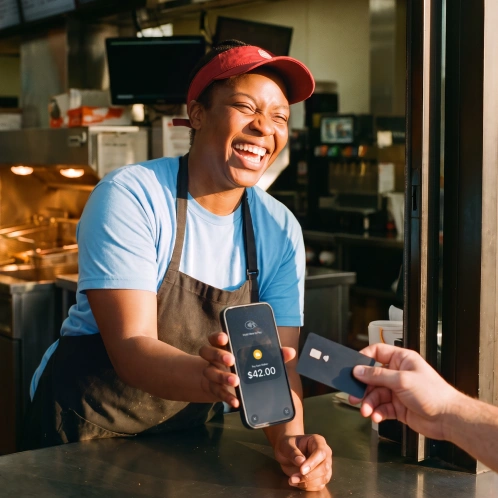
For in-person sales at farmers' markets and garden shows, JIM turns your phone into a card reader with no extra hardware. JIM is the payment product featured in this guide. You can accept debit, credit, and digital wallets directly through your smartphone with a tap.
JIM charges 1.99% per Tap to Pay transaction with no hidden costs or hardware, which is below the typical 2.6% to 3.5% range for traditional card processing. Funds land on your JIM card the moment the sale clears, so you are not waiting days for a bank settlement.
Getting started:
- Get started: Download the JIM app for iOS.
- Make a sale: Type the sales amount, hit sell, and ask your customer to tap their card or device on your phone.
- Access funds: Your money is available on your JIM card as soon as the sale is done, with no waiting for bank transfers.
Checklist:
- Research payment processors that integrate with your e-commerce platform.
- Compare the transaction fees of at least two different payment solutions.
- Download the JIM app to see how it works for in-person sales.
- Decide if you will sell at markets and need a mobile payment option.
How do you fund a seed company?
You can fund a seed company with an SBA Microloan up to $50,000 through nonprofit intermediary lenders, or with personal savings if your startup costs are modest. The SBA Microloan program caps loans at $50,000 and sets maximum interest rates based on the amount borrowed.
SBA Microloans and grants
The SBA Microloan program provides up to $50,000 through nonprofit intermediary lenders for working capital, inventory, and equipment. The maximum rate an intermediary can charge is set by the SBA: the rate it pays the SBA plus 7.75% for loans over $10,000, or plus 8.5% for loans of $10,000 or less. Your actual rate depends on the intermediary, so request quotes from at least two lenders.
For grants, the USDA Value-Added Producer Grant (VAPG) funds agricultural producers who process or market value-added products. Eligibility is limited to producers and producer-controlled entities, so a pure seed reseller likely does not qualify unless you also grow and process seed. Check the current application cycle on the USDA Rural Development site before relying on this option.
Estimate your working capital
New owners often budget for startup costs but forget the cash needed for day-to-day operations. Plan for $5,000 to $15,000 in working capital to cover inventory replenishment, marketing, and shipping for the first six months.
Once you have funding, open a separate business bank account. This keeps your personal and business finances distinct, which simplifies tax filing and preserves your LLC's liability protection. Use accounting software like Wave or QuickBooks Self-Employed to track income and expenses from day one. Pair this with digital banking for small business to keep payment processing and operating cash in separate, clear accounts.
Checklist:
- Research two SBA Microloan intermediary lenders in your region.
- Review the VAPG eligibility requirements on the USDA Rural Development site to confirm whether you qualify.
- Draft a six-month operating budget to estimate your working capital needs.
- Open a dedicated business bank account to keep finances separate from day one.
How do you staff a seed company?
You will likely run the business alone at first. Your first hire is usually a part-time Packing Assistant to help with order fulfillment and inventory checks. This role typically pays $15 to $20 per hour and requires no specific certifications.
Wait to hire full-time staff until you have consistent order volume. A common mistake is adding payroll too early, which drains cash before revenue stabilizes. Once orders are steady, a Customer Service Representative can manage emails and phone calls at $35,000 to $45,000 per year.
Set up your operational workflow
Daily operations can become a bottleneck. Software like ShipStation automates shipping label creation and connects directly to most e-commerce platforms, which saves hours during spring planting season.
A reasonable target is one full-time employee for every $100,000 in revenue. This ratio keeps labor costs proportional as you scale, but treat it as a rough guideline, not a rule. Your actual staffing needs depend on your order volume, fulfillment method, and whether you wholesale or sell direct.
Checklist:
- Draft a job description for a part-time Packing Assistant.
- Outline the daily tasks for order fulfillment and customer service.
- Research ShipStation's integration with your chosen e-commerce platform.
- Set a revenue target for your first full-time hire.
How do you market a seed company?
Marketing a seed company starts with visual platforms and search-optimized content, because seed buyers research varieties before they buy. Use Instagram and Pinterest to share photos of grown plants and packet designs, and write blog posts targeting long-tail queries like "how to grow Cherokee Purple tomatoes from seed."
Focus your digital marketing
Share images of your plants and seed packets on Instagram and Pinterest. Create short video guides on seed starting, or run a photo contest for the best customer-grown vegetable. Baker Creek and Botanical Interests both use customer-grown photo features to drive engagement and social proof.
Write blog posts optimized for search engines. Target long-tail keywords tied to the varieties you sell. Many new sellers skip this, but it builds a steady stream of free traffic over the season as gardeners search for growing instructions.
Connect with growers directly
Engage with potential customers in online communities like Reddit's r/gardening or niche Facebook groups. Do not join and immediately post store links. Spend a few weeks answering questions and offering advice to build credibility first.
Once you start advertising, track your metrics. A typical e-commerce conversion rate is 1 to 2%. Aim for a Customer Acquisition Cost below $20 to keep your marketing spend profitable. CAC, or Customer Acquisition Cost, is the total you spend on marketing divided by the number of new customers it generates.
Checklist:
- Identify three content themes for your Instagram account, such as planting tips or variety spotlights.
- Join one online gardening forum and answer a question to start building your reputation.
- Research five long-tail keywords related to one of your top-selling seed varieties.
- Create a spreadsheet to track marketing spend and calculate your CAC.
How should you price seed packets?
Price seed packets using a 100% markup on wholesale cost as your baseline, then adjust based on competitor pricing and bundle deals. Keystone pricing, a 100% markup, targets a 50% gross margin before you account for packaging, shipping, and marketing.
Determine your base price
If a seed packet costs you $1.75 wholesale, a 100% markup puts it at $3.50 retail. That margin covers packaging, shipping, and marketing with room for profit if your volume holds.
Research competitors on Etsy and Shopify. Build a spreadsheet to compare prices for your top 5 to 10 varieties. This shows whether your pricing is competitive or whether you have room to charge more for rare varieties or detailed growing guides.
Competing on price alone hurts your brand. Factor in unique value like heirloom rarity or region-specific growing notes, and set your price to reflect the quality and service you provide.
Use bundles to increase order value
Offer bundle deals to encourage larger purchases. Sell individual packets for $3.50 but offer a themed collection of three packets for $9. This lifts your average order value from under $10 to over $20 with minimal added cost.
Checklist:
- Calculate the retail price for your top five seed varieties using a 100% markup.
- Track the prices of three competitors for those same varieties in a spreadsheet.
- Develop a bundle deal for a themed collection of seeds.
- List all non-inventory costs like packaging and marketing to ensure your prices cover them.
How do you maintain seed quality and scale?
Test germination and purity on every new seed lot, and scale operations only when quality is consistent. Your reputation depends on germination rates, and a single bad lot can generate chargebacks and negative reviews that take a season to overcome.
Implement quality control measures
Conduct your own germination tests rather than trusting the supplier's report. Follow the Association of Official Seed Analysts (AOSA) Rules for Testing Seeds, the standard reference for North American seed testing. A germination rate above 85% is a reasonable threshold for most vegetable varieties, though the exact tolerance varies by species under the AOSA rules. Visually inspect each batch to remove debris or off-type seeds.
Organic and heirloom classification
If you plan to sell organic seed, understand the USDA National Organic Program requirements. Certified organic producers must use organic seed unless an equivalent organic variety is not commercially available, which creates a dedicated market for organic seed sellers. Heirloom seeds are open-pollinated varieties passed down through generations, while hybrid seeds are first-generation crosses of two distinct parent lines. Heirlooms breed true to type, so you can save seed from them, while hybrids do not.
Scale your operations
Once quality is consistent, plan for growth. A rough target is one full-time employee for every $100,000 in revenue. When you can no longer pack daily orders by hand, it is time to invest in automated filling and labeling equipment.
As you scale, a spreadsheet will not be enough. Inventory management software like Katana or Cin7 tracks seed lots, manages stock levels, and connects with your e-commerce platform so you can see which lots are aging.
Checklist:
- Set a minimum germination rate standard of 85% for your vegetable seed varieties.
- Outline a procedure for testing a sample from each new seed lot you receive.
- Research inventory management software like Katana or Cin7 for future growth.
- Define a specific daily order volume that will trigger your investment in automated packaging equipment.
Next steps
Your reputation as a seed company grows from the success of your customers' gardens. Test every lot, label every packet to Federal Seed Act standards, and ship on time. The market rewards sellers who deliver viable seed and clear growing information.
As you connect with customers at markets and online, you need a simple way to take payments. JIM turns your phone into a card reader for a flat 1.99% fee, with no extra hardware. Your funds are available instantly on your JIM card. Download JIM to get started.
Frequently Asked Questions
Is a seed company profitable?
Do I need a license to sell seeds in every state?
Can I sell seeds across state lines?
Can I resell patented or PVP-protected seed varieties?
How long does it take to start a seed company?




Sell and get paid in seconds with Jim