Starting a sewing business is a rewarding venture where you can blend creative craftsmanship with smart business sense. The demand for custom alterations and unique handmade items keeps the market accessible, though that doesn't guarantee an easy path to success.
This guide will take you through the practical steps of validating your business concept, securing funding, acquiring the right equipment, and obtaining necessary licenses to help you launch a successful sewing business in the U.S.
Step 1: Plan your business and validate your idea
Market research and competitor analysis
Start with local market research. Create simple polls in neighborhood Facebook groups or on Nextdoor to gauge interest in custom clothing or alteration services. This gives you direct feedback before you invest a dime.
Next, look at what others do. Use Google Maps to find local tailors and browse Etsy with specific search terms to see online competition. Avoid the temptation to just compete on price. Instead, analyze their services and reviews to find a market gap you can fill.
Estimate your startup costs
With your research done, you can build a budget. Your initial investment will likely range from $1,500 to $5,000. A reliable sewing machine can cost between $300 and $1,000, while a serger might add another $200 to $500.
You should also set aside funds for initial supplies like fabric and thread, which could be $300 to $800. Business registration and local permits typically run from $50 to $500, depending on your state and business structure.
Here are 3 immediate steps to take:
- Survey at least 20 potential customers in local online groups.
- Identify and analyze three local and three online competitors.
- Create a detailed startup budget that lists all potential equipment and legal fees.
Step 2: Set up your legal structure and get licensed
Choose your business structure
You might want to consider forming a Limited Liability Company (LLC). It protects your personal assets if the business faces debt or lawsuits. You can file for an LLC through your state's Secretary of State website, with fees typically between $50 and $500.
Many start as a sole proprietorship because it is simpler, but this leaves your personal finances exposed. An LLC offers a good balance of protection and simplicity for a new sewing business.
Secure your licenses and permits
Once your business structure is decided, get a free Employer Identification Number (EIN) from the IRS website. You will need this for taxes. Also, check with your state's department of revenue for a seller's permit, which allows you to collect sales tax.
Since you will likely work from home, look into a Home Occupation Permit from your city or county. This permit usually costs $25 to $100. Also, be aware of the FTC's Care Labeling Rule, which requires you to attach care instructions to garments you sell.
Here are 4 immediate steps to take:
- Decide between an LLC and a sole proprietorship for your business.
- Apply for a free EIN on the official IRS website.
- Research your state's requirements for a seller's permit.
- Contact your local city clerk to ask about a Home Occupation Permit.
Step 3: Insure your business and manage risks
Key insurance types to consider
General liability insurance is your first line of defense. It covers accidents, like a client tripping in your workspace. Look for a policy with at least $1 million in coverage, which can cost between $300 and $600 annually.
You should also have product liability insurance. This protects you if a product you sell causes harm, such as a button coming loose on a child's garment. It is often bundled with a general liability policy, so be sure to ask.
Many new owners assume their homeowner's policy covers business equipment, but it usually does not. Business property insurance protects your sewing machine, serger, and inventory from theft or damage. You can get quotes from providers like Hiscox, The Hartford, and Next Insurance.
If you hire help, you will need workers' compensation insurance. This is a state requirement that covers employee injuries. Commercial auto insurance is only necessary if you use a vehicle exclusively for business, like making deliveries.
Here are 4 immediate steps to take:
- Request a quote for a general liability policy with at least $1 million in coverage.
- Confirm if product liability is included in your general liability policy.
- Review your homeowner's insurance to check for business equipment exclusions.
- Compare quotes from three providers that specialize in small business coverage.
Step 4: Set up your workspace and buy equipment
Secure your location
A home-based studio is the most common starting point. You will need a dedicated area of at least 100-150 square feet to work comfortably. Make sure your space complies with the Home Occupation Permit you researched in the previous step.
If you decide to lease a commercial spot, try to negotiate a shorter lease term. Landlords often default to 3-5 years, but you can request a 1 or 2-year lease to give your new business more flexibility.
Acquire your sewing gear
Your main purchase will be a reliable, heavy-duty sewing machine. Models from brands like Juki or Brother can cost between $300 and $1,000. A serger, which gives seams a professional finish, typically runs from $200 to $500.
Many new owners buy a standard domestic machine to cut costs, but these often fail under the demands of a business. An industrial or heavy-duty model handles thicker fabrics and long hours of work much better, which saves you repair costs down the line.
For supplies like thread, zippers, and buttons, Wawak is a popular online supplier with no minimum order requirements. For fabric, you can start with online retailers or find local wholesalers who may offer better prices for bulk purchases.
Here are 4 immediate steps to take:
- Measure your workspace to confirm it meets the 100-square-foot minimum.
- Research two heavy-duty sewing machine models from Juki or Brother.
- Create a sample cart on Wawak to estimate the cost of initial notions.
- If you plan to lease, prepare questions about 1- and 2-year term options.
Step 5: Set up your payment processing
Establish your payment terms
For custom projects, you should ask for a 50% deposit upfront. This covers your material costs and secures the client's commitment. For simple alterations, payment upon completion is more common. A clear policy prevents misunderstandings with clients later on.
Choose a payment solution
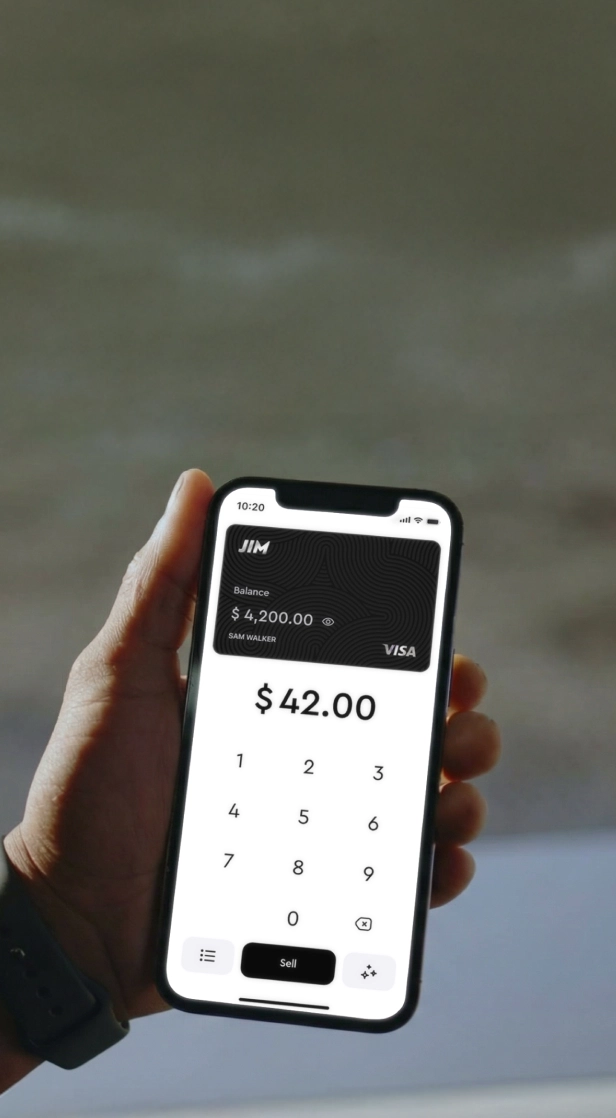
You will need a way to accept card payments. Many solutions charge between 2.5% and 3.5% per transaction, plus hardware fees. For a sewing business that needs to accept payments on-site or on-the-go, JIM offers a streamlined solution.
With JIM, you can accept debit, credit and digital wallets directly through your smartphone. At just 1.99% per transaction with no hidden costs or extra hardware needed, it is particularly useful for taking payments at craft fairs or during in-home fittings.
Getting started is straightforward:
- Get Started: Download the JIM app for iOS.
- Make a Sale: Type the sales amount, hit sell, and ask your customer to tap their card or device on your phone.
- Access Funds: Your money is available right on your JIM card as soon as the sale is done.
Here are 3 immediate steps to take:
- Decide on a 50% deposit policy for all custom garment orders.
- Compare JIM's 1.99% transaction fee with two other payment processors.
- Draft a simple contract template for projects over $500.
Step 6: Fund your business and manage finances
Secure your startup capital
You might want to look into an SBA Microloan. These loans range from $500 to $50,000 and are great for new businesses. Interest rates typically fall between 8% and 13%, and lenders focus more on your business plan than a long credit history.
Also, consider grants. The Amber Grant for Women is a popular choice that awards funds monthly. You can also check with your local arts council, as they sometimes offer small grants to support artisan businesses like yours.
Plan your working capital
For the first six months, you should have $2,000 to $4,000 in working capital. This fund covers ongoing supplies, marketing, and any unexpected costs, which lets you focus on your craft without financial pressure.
A mistake many new owners make is underpricing their services. To avoid this, create a clear pricing formula. Add your material costs to your hourly labor rate, then include a 30-50% markup to ensure you are actually building a profitable business.
Here are 4 immediate steps to take:
- Research one SBA-approved microlender in your state.
- Look up the application requirements for the Amber Grant.
- Calculate your working capital needs for the first six months.
- Create a pricing formula that includes materials, labor, and a markup.
Step 7: Hire help and manage your operations
Decide when to hire
You might want to wait until you consistently earn $3,000 to $5,000 in monthly revenue before you hire anyone. This ensures you have enough cash flow for payroll. Many owners hire too early, so it is better to wait until you have to turn down work.
Start with a part-time Sewing Assistant for 10-15 hours per week. This lets you delegate simpler tasks without taking on a full-time salary. As a general guide, aim to keep your total employee costs under 20% of your total revenue.
Define roles and find talent
A Sewing Assistant can handle tasks like cutting fabric, pressing seams, and basic alterations. Pay typically ranges from $15 to $25 per hour. While formal certifications are not required, you should ask applicants for a portfolio or give them a small sewing test.
Streamline your workflow
You can manage your projects without expensive software. A free Trello or Asana board helps you track custom orders from start to finish. For appointments and fittings, a shared Google Calendar is a simple and effective solution.
Here are 4 immediate steps to take:
- Set a monthly revenue goal that will trigger your first hire.
- Write a job description for a part-time Sewing Assistant.
- Create a simple sewing test for your interview process.
- Set up a free Trello board to track your current orders.
Step 8: Market your business and get customers
Build your online portfolio
Use Instagram and Pinterest to create a visual portfolio. Post high-quality photos of your work 3-5 times a week. Show before-and-after alteration photos and short videos of your sewing process. Many new owners only post finished items, but showing your process builds trust.
Connect with your local community
You can partner with local businesses like dry cleaners or bridal shops. Offer them a 10% referral fee for each customer they send you. This gives them an incentive to promote your services. Also, leave business cards or flyers at community centers and fabric stores.
Join local Facebook groups to find clients. Instead of just posting ads, answer questions about clothing repair or offer sewing tips. This establishes you as a helpful expert. Aim to convert 2-3 inquiries out of every 10 you receive into paying customers.
You might want to set a small ad budget of $50-$100 per month on Facebook or Instagram. You can target users in your zip code with interests like "weddings" or "sustainable fashion" to attract your ideal clients directly.
Here are 4 immediate steps to take:
- Create a business account on Instagram and post your first three projects.
- Identify three local businesses to approach for a referral partnership.
- Design a simple business card with your contact information and services.
- Join one local Facebook group and offer helpful advice on a relevant post.
Step 9: Price your services and create a strategy
Establish your pricing models
You can price your work in a few ways. For alterations, an hourly rate of $20 to $40 is standard. For custom projects like a bridesmaid dress, a flat fee between $250 and $400 is more common. This gives clients a clear, upfront cost.
For highly creative or complex garments, you might consider value-based pricing. This model prices the work based on the perceived value to the client, not just your time and materials. It works well for one-of-a-kind designs where your artistic skill is the main selling point.
Calculate your costs and profit
A simple formula is: (Material Costs + Labor Costs) + Markup = Final Price. A mistake many new owners make is to forget small overhead costs. Your labor rate should account for your time, plus electricity, thread, and other consumables.
With that in mind, apply a 30-50% markup to your calculated cost. This ensures you are profitable, not just breaking even. Check your final prices against local competitors on Yelp or Google to make sure you are positioned correctly in the market.
Here are 4 immediate steps to take:
- Calculate your base hourly labor rate, including overhead.
- Research the prices of three local competitors for standard alterations.
- Create a price sheet for five of your most common services.
- Decide on a standard markup percentage for all custom projects.
Step 10: Control quality and scale your operations
Establish your quality standards
Create a quality control checklist for every project. This should include specifics like a consistent 10-12 stitches per inch for medium-weight fabrics and a standard 5/8-inch seam allowance. Check every finished garment against this list before delivery.
Many new owners skip this formal check, which leads to inconsistent work. You should aim for a return or complaint rate below 2%. This metric helps you spot quality issues before they affect your reputation. There are no formal certifications required for this type of work.
Know when to expand
Once you consistently hit $3,000 in monthly revenue, you can consider your first part-time hire. When you reach the $5,000 mark, it might be time to invest in specialized equipment, like an industrial buttonhole machine or a coverstitch machine.
To manage this growth, you can use a simple inventory app like Sortly to track your fabric and notions. This prevents you from running out of key supplies mid-project. It also helps you understand your true material costs over time.
Here are 4 immediate steps to take:
- Create a quality control checklist with at least five checkpoints.
- Set a target return rate of 2% or less for your products.
- Identify a revenue goal for purchasing your next major piece of equipment.
- Download a trial version of an inventory app like Sortly to track supplies.
Starting a sewing business blends your creative passion with smart planning. Remember that your unique style is what sets you apart, so let it shine in every stitch. You have the steps, now you can confidently begin your journey.
And when it comes to getting paid, a simple solution like JIM lets you accept cards right on your phone for a flat 1.99% fee, no extra hardware needed. This makes payments easy from day one. Download JIM to get started.
.avif)