Starting a smoothie business is a rewarding venture that blends a passion for healthy ingredients with sharp business savvy. The industry is a multi-billion dollar market, fueled by consistent demand from health-conscious consumers, fitness enthusiasts, and busy professionals.
This guide will take you through the practical steps of validating your business concept, securing funding, obtaining necessary licenses, and selecting the right location to help you launch a successful smoothie business in the U.S.
Step 1: Create your business plan and validate your idea
Market and competitor research
Begin with on-the-ground research. Visit potential competitors at different times of day to observe their busiest hours, customer profiles, and menu prices. This direct observation gives you data you cannot find online.
For broader analysis, use databases like ReferenceUSA or IBISWorld, which many public libraries offer for free. These resources help you map out competitors and understand industry trends. A mistake many new owners make is to only look at other smoothie shops. You should also analyze cafes, gyms, and grocery stores.
Estimate your startup costs
Startup costs for a smoothie business can range from $20,000 for a small kiosk to over $375,000 for a full-service storefront. Your business model will be the largest factor in your initial investment.
A sample budget for a small location includes these typical costs:
- Commercial Blenders: $1,500 - $5,000
- Refrigeration and Ice Machines: $5,000 - $15,000
- Point-of-Sale System: $1,000 - $2,500
- Initial Inventory: $3,000 - $6,000
- Rent and Build-Out: $10,000 - $100,000+
The rent and build-out portion of your budget can fluctuate the most. To manage this, you might want to get several quotes from contractors before you sign a lease.
Here are 4 immediate steps to take:
- Visit three local competitors and document their pricing and customer flow.
- Check your local library’s website for access to business databases.
- Create a preliminary budget spreadsheet with estimated costs for equipment and inventory.
- Draft a one-page summary of your smoothie concept and target audience.
Step 2: Set up your legal structure and secure permits
Most new smoothie shop owners form a Limited Liability Company (LLC). This structure protects your personal assets if the business faces debt or lawsuits. It also offers pass-through taxation, so you avoid the double taxation common with C Corporations.
To form an LLC, you file Articles of Organization with your state's Secretary of State, which costs between $50 and $500. After that, get a free Employer Identification Number (EIN) from the IRS. You need an EIN to hire employees and open a business bank account.
Required permits and licenses
With your legal structure in place, you can focus on permits. Your main point of contact will be the local health department. They enforce food safety standards, many of which are set by the FDA, and will be a constant presence in your business life.
You will need a food service license, which can cost from $100 to $1,000 and take 30-90 days to process. Many new owners stumble during the initial health inspection because of incorrect equipment. Make sure all blenders and refrigerators are NSF-certified before the inspector visits.
You also need a general business license from your city and a seller's permit to collect sales tax. All staff, including you, must have a food handler's permit. This is usually a quick online course that costs about $15 per person.
Here are 4 immediate steps to take:
- Decide on an LLC structure and visit your Secretary of State's website.
- Apply for a free Employer Identification Number (EIN) on the IRS website.
- Contact your local health department for their food service application and checklist.
- List all required permits and their estimated costs in your budget spreadsheet.
Step 3: Secure your insurance and manage risk
Choose your insurance policies
General liability insurance is your first line of defense. It covers claims like a customer slip-and-fall or an allergic reaction. Most landlords require at least $1 million in coverage. Annual premiums typically range from $500 to $1,500 for a small shop.
Commercial property insurance protects your expensive blenders and refrigerators. A frequent oversight is not covering inventory loss from power outages. Ask your agent about a spoilage coverage endorsement. This add-on is a lifesaver if a freezer fails overnight.
If you have employees, you will need workers' compensation insurance as state laws mandate it. If you plan to use a vehicle for deliveries or supply runs, you also need a commercial auto policy. Personal auto insurance will not cover business-related accidents.
You might want to get quotes from providers that focus on food service businesses. Companies like The Hartford, Hiscox, or Next Insurance understand the specific risks. They can often provide a more tailored and competitive package than a general agent.
Here are 4 immediate steps to take:
- Request a quote for a $1 million general liability policy.
- Ask potential insurers about adding spoilage coverage to your property policy.
- Research your state's workers' compensation laws and requirements.
- Contact an insurance agent who specializes in restaurants or food service.
Step 4: Choose your location and buy equipment
Your location is your biggest advertisement. Aim for 400 to 800 square feet in an area with heavy foot traffic. Before you sign anything, confirm with the city planning department that the property is zoned for commercial food service. This simple check avoids costly surprises later.
When you negotiate your lease, ask for a Tenant Improvement (TI) allowance. This is money from the landlord to help pay for your build-out. It can cover plumbing and electrical upgrades needed for your specific equipment, which can be a significant part of your budget.
Select your core equipment
A mistake some owners make is to buy residential blenders to save money. These units are not NSF-certified and will fail a health inspection. They also burn out under commercial use. You should invest in commercial-grade equipment from the start.
- Commercial Blenders: Models like the Vitamix "The Quiet One" or Blendtec Stealth 885 run from $1,200 to $2,200 each.
- Refrigeration: A True or Avantco reach-in refrigerator will cost between $2,000 and $5,000.
- Ice Machine: An undercounter Hoshizaki or Manitowoc model costs about $1,500 to $4,000.
For supplies, you can use WebstaurantStore for equipment and disposables. For produce, look at local suppliers or a membership-based wholesaler like Restaurant Depot. Always check their minimum order quantities to make sure they fit your budget and storage capacity.
Here are 4 immediate steps to take:
- Identify three potential locations and verify their zoning classification.
- Ask a potential landlord about their Tenant Improvement (TI) allowance policy.
- Price out two NSF-certified commercial blender models.
- Research the minimum order quantities for a local produce supplier.
Step 5: Set up your payment processing
Your payment system needs to be fast. During a morning rush, you cannot afford delays. Most of your customers will use cards or digital wallets, so a reliable card reader or tap-to-pay function is a must-have.
Many new owners underestimate processing fees. Standard rates often run from 2.5% to 3.5% plus monthly charges. These costs add up and can significantly reduce your profit on each smoothie sold.
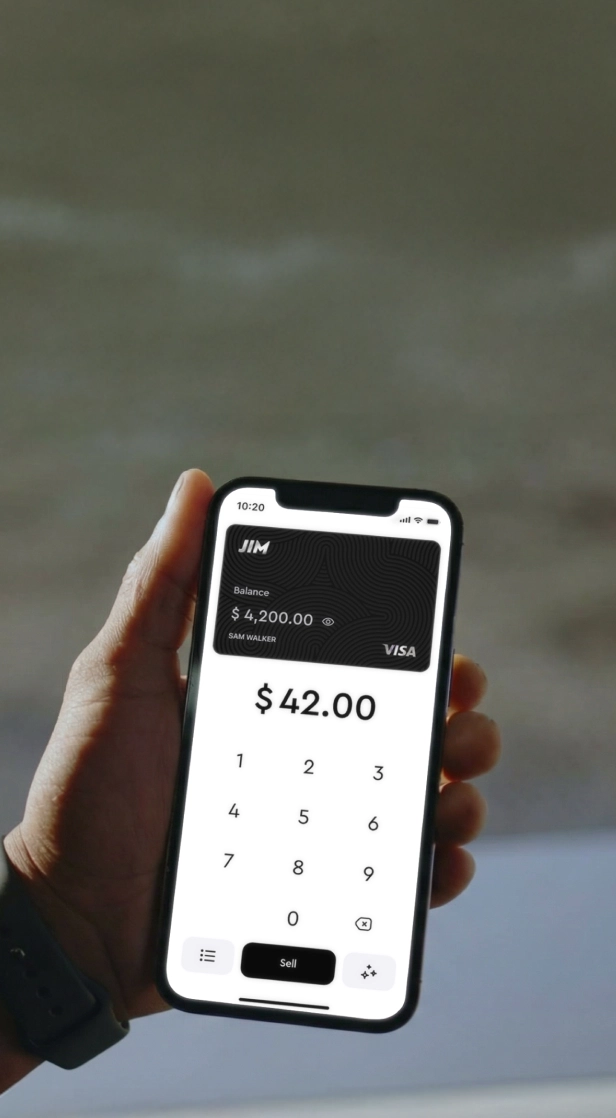
For smoothie businesses that need to accept payments on-site or on-the-go, JIM offers a streamlined solution. With JIM, you can accept debit, credit and digital wallets directly through your smartphone - just tap and done. At just 1.99% per transaction with no hidden costs or extra hardware needed, it's particularly useful for farmer's markets or local events.
Getting started is straightforward:
- Get Started: Download the JIM app for iOS.
- Make a Sale: Type the sales amount, hit sell, and ask your customer to tap their card or device on your phone.
- Access Funds: Your money is available right on your JIM card as soon as the sale is done - no waiting for bank transfers.
Here are 3 immediate steps to take:
- Compare the monthly cost of a processor at 2.9% against JIM's 1.99% rate based on your sales forecast.
- Decide if you will need a mobile payment option for pop-ups or deliveries.
- Review the features on the JIM website to see if it fits your business model.
Step 6: Secure funding and manage your finances
Find your funding
Many new owners first look to big banks and face rejection. You might have better luck with the Small Business Administration (SBA). The SBA 7(a) loan program is a popular choice, offering up to $250,000 with interest rates typically between 9% and 12%.
You should also explore local credit unions and Community Development Financial Institutions (CDFIs). These lenders often have more flexible requirements and a mission to support local businesses. They are more likely to understand your vision for a neighborhood smoothie shop.
Manage your working capital
With funding secured, your focus shifts to cash flow. You need enough working capital to cover at least six months of operating expenses without any revenue. For a small shop, this could mean having $50,000 to $80,000 set aside for rent, payroll, and utilities.
A frequent misstep is to underestimate inventory costs. Produce prices can change with the seasons. It is a good idea to build a 15-20% buffer into your weekly inventory budget to handle these price fluctuations without affecting your menu or profits.
Here are 4 immediate steps to take:
- Review the SBA 7(a) loan checklist on the SBA website.
- Find one local CDFI or credit union and review their business loan products.
- Calculate your total operating expenses for a six-month period.
- Add a 20% contingency line item to your inventory budget spreadsheet.
Step 7: Hire your team and set up operations
Hire your first team members
You will likely need one or two "Team Members" to start. Their duties include prepping ingredients, making smoothies, handling sales, and cleaning. Expect to pay an hourly wage between $12 and $18, plus tips, depending on your local market.
Before they start, every employee must have a Food Handler's Permit. This is a non-negotiable requirement from the health department. The process is usually a quick online course that you can often pay for on their behalf.
Set up your daily operations
Many new owners misjudge their staffing needs for peak hours. You might want to schedule an extra person for the morning and lunch rushes to keep service fast. This prevents lost sales from long wait times.
To manage schedules, you can use software like Homebase or 7shifts. These platforms help you build schedules, track hours, and communicate with your team. Now that you have a team, you need to watch your labor costs. Aim to keep your total payroll between 25% and 35% of your revenue, a standard benchmark for food service.
Here are 4 immediate steps to take:
- Draft a job description for a Team Member role.
- Check your state's website for Food Handler's Permit requirements.
- Compare the features of Homebase and 7shifts for your scheduling needs.
- Calculate your target weekly labor budget based on your sales forecast.
Step 8: Market your business and acquire customers
Local marketing strategies
Your first customers will come from your neighborhood. Plan a grand opening event with a "Buy One, Get One Free" offer to create initial buzz. You might also partner with a nearby gym or yoga studio for cross-promotion. Offer their members a 10% discount.
A simple loyalty program works wonders. A classic "buy 10, get one free" punch card is easy for customers to understand and encourages repeat visits. Some owners create complex digital point systems, but the simplicity of a physical card often wins.
For social media, focus on Instagram because your product is highly visual. Many new owners make the mistake of posting low-quality photos. You should use good lighting to make your smoothies look vibrant and appealing. A short video of the blending process can also perform well.
Digital presence and metrics
You need to claim your digital storefront. Set up your free Google Business Profile with your address, hours, and menu. This is how most new customers will find you through local search. Make sure all the information is accurate.
It is helpful to understand your Customer Acquisition Cost (CAC). If you spend $200 on local Facebook ads and get 40 new customers, your CAC is $5. For a smoothie shop, a CAC under $10 is a solid target to aim for.
Here are 4 immediate steps to take:
- Create and fully populate your Google Business Profile.
- Design a simple "Buy 10, Get 1 Free" punch card.
- Contact one local gym to propose a cross-promotion partnership.
- Plan a "Buy One, Get One Free" offer for your grand opening week.
Step 9: Develop your pricing strategy
Calculate your cost-based pricing
Your price must first cover your costs. Calculate the exact cost of goods sold (COGS) for each smoothie. This includes every ingredient, plus the cup, lid, and straw. A mistake many new owners make is to forget the cost of disposables, which can eat away 5-10% of your margin.
Aim for a food cost percentage between 25% and 35%. If your ingredients for a 16oz smoothie cost $1.75, a price of $5.85 would give you a 30% food cost ($1.75 / $5.85). This is a standard industry formula to ensure profitability on every sale.
Analyze competitor and value-based pricing
With your cost baseline set, look at what your competitors charge. Visit them and note their prices for comparable sizes and ingredients. You do not have to match their prices, but you need to know where you stand. This helps you avoid pricing yourself out of the local market.
You can also use value-based pricing. If you offer organic ingredients or unique superfood add-ins, you can justify a price 15-20% higher than competitors. Customers will often pay more for perceived higher quality or health benefits. Clearly communicate this value on your menu.
Here are 4 immediate steps to take:
- Calculate the full cost for one signature smoothie, including the cup and straw.
- Set a target food cost percentage for your menu, aiming for 25-35%.
- Create a spreadsheet to track the prices of three local competitors.
- Decide if you will add a 15% premium for smoothies with organic ingredients.
Step 10: Maintain quality and scale your business
Establish your quality standards
Consistency is your goal. Create detailed recipe cards for every menu item with exact measurements. This ensures a customer gets the same great smoothie every time, no matter who makes it. A common mistake is to let standards slip during a rush.
You should track metrics like customer complaints or online reviews. Aim for a Google or Yelp rating of 4.5 stars or higher. A dip below 4.0 is a clear signal to investigate issues with your product or service.
Know when to grow
Growth should be data-driven. A good benchmark to hire another team member is when you consistently process over 100 orders during your peak four-hour shift. This prevents long wait times and employee burnout.
Before you think about a second location, your first shop should be stable. A solid target is a net profit margin of 15% or more for at least two consecutive quarters. You also need documented operational procedures that a new manager can follow.
To manage this growth, you might want to look at software. Systems like MarketMan or Restaurant365 help you track inventory and recipe costs across multiple locations. This gives you a clear view of your profitability.
Here are 4 immediate steps to take:
- Create a detailed recipe card for one of your signature smoothies.
- Set a monthly goal to review your Google and Yelp ratings.
- Define the daily sales volume that would trigger hiring a new employee.
- Review the features of an inventory management system like MarketMan.
Starting a smoothie business is about more than just great recipes. Your success will depend on consistency in every cup you serve. Remember that detail, from ingredients to service, builds loyalty. You have the roadmap, now go build your brand one smoothie at a time.
As you build that brand, you'll need a simple way to get paid. JIM turns your phone into a card reader for a flat 1.99% fee, with no extra hardware. It keeps your checkout fast and your costs low. Download JIM to get started.
.avif)