How to start a solar panel cleaning business (2026 costs and steps)
See article summary
- Startup costs run $7,000 to $25,000 for equipment, a vehicle, licenses, and insurance.
- Form an LLC for $50 to $500 to separate personal assets from business liability.
- California requires a C-46 Solar contractor license; other states vary, so check local rules.
- General liability insurance with $1 million coverage costs roughly $400 to $1,500 per year.
- JIM accepts on-site card payments at 1.99% per Tap to Pay sale with no hardware.
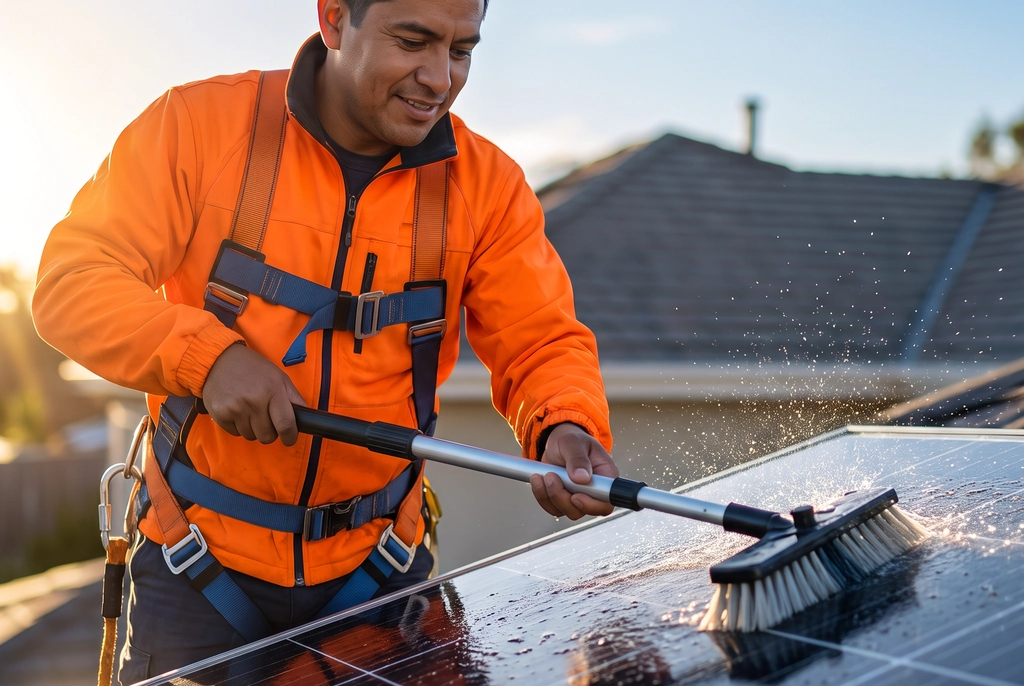
Starting a solar panel cleaning business costs between $7,000 and $25,000 and serves a market that keeps expanding as residential and commercial solar installations grow across the U.S. You need hands-on skill with a water-fed pole system, the right licenses for your state, and a clear pricing model to turn a profit.
The core terms you will use daily: a water-fed pole is a lightweight carbon fiber rod that delivers purified water to a brush at the panel surface. Deionization (DI) water is tap water passed through resin filters that strip minerals, leaving a spot-free finish. A Limited Liability Company (LLC) is a business structure that separates your personal assets from business debts. Customer Acquisition Cost (CAC) is the total marketing spend divided by the number of jobs booked.
How much does it cost to start a solar panel cleaning business?
Expect to spend $7,000 to $25,000 to launch, with equipment and a vehicle making up most of the budget. Below is the line-item breakdown that gets you operational.
First, gauge your local market size. Check online directories of solar installers, like the Solar Energy Industries Association (SEIA) database, to see how many homes and businesses in your area have panels. This gives you a direct look at your potential customer base. California, Texas, Florida, Arizona, and North Carolina lead U.S. solar capacity, according to the SEIA Solar Market Insight 2025 Year in Review.
Analyze your competition
Next, understand who you are up against. A quick search on Google Maps, Yelp, or Thumbtack for "solar panel cleaning" will show you the local players. Look at their services, pricing structures, and customer reviews.
Competing on price alone is a trap. Instead of undercutting everyone, focus on what makes you different. A subscription service for recurring cleanings or faster response times differentiates you better than the lowest price.
Calculate your startup costs
Your initial investment covers equipment, legal setup, and marketing. Planning for these expenses helps you start on solid financial ground. Most new businesses in this field require between $7,000 and $25,000 to get going. Here is a typical breakdown:
- Equipment: A water-fed pole system, brushes, and a deionization (DI) water filter will run you $2,000 to $5,500. This is the core of your operation.
- Vehicle: You need a reliable truck or van. A used vehicle might cost between $5,000 and $20,000.
- Business Formation & Insurance: Expect to pay $600 to $1,700 for LLC registration and your first year of general liability insurance.
- Initial Marketing: A simple website, business cards, and local flyers can cost between $500 and $2,000.
To make these numbers concrete, consider a representative launch: an operator in Phoenix, Arizona started in early 2025 for $11,400, with a used Transit van at $6,800, a complete water-fed pole kit at $3,200, and LLC registration plus the first year of general liability insurance at $1,400.
Three steps to take now:
- List all solar panel cleaning competitors within a 30-mile radius and note their advertised prices.
- Use the SEIA database to estimate the number of solar installations in your county.
- Create a detailed spreadsheet of your estimated startup costs using the ranges provided above.
What licenses do you need to clean solar panels?
You need a general business license in every state, and some states require a specialty contractor license for solar maintenance work. Check your state's contractor licensing board before you start.
Choose your business structure
Most new solar cleaning businesses register as a Limited Liability Company (LLC). This structure separates your personal assets from business debts. It provides a good balance of protection and simplicity, as profits pass through to your personal tax return.
A sole proprietorship is simpler to set up but offers no liability protection. For a small operation, an LLC is often the smarter long-term choice. You can file for an LLC through your state's Secretary of State website for about $50 to $500. For a broader overview of the startup process, see our guide on how to start a small business.
Secure licenses and insurance
You will not need a federal license. Your focus will be on state and local requirements. Start with a general business license from your city or county clerk's office. This typically costs between $50 and $100 annually.
Some states regulate solar maintenance under their contractor licensing laws. California requires a C-46 Solar contractor license for installing, modifying, maintaining, and repairing photovoltaic solar energy systems, per the Contractors State License Board. Check your state's contractor licensing board website. A mistake here can lead to fines, so confirm the rules for your area before you start work.
You also need general liability insurance. A policy with at least $1 million in coverage is standard and protects you from property damage claims. Expect to pay between $400 and $1,500 per year for this coverage.
Four steps to take now:
- Decide between an LLC and a sole proprietorship for your business structure.
- Visit your Secretary of State's website to review the LLC formation process and fees.
- Check your state's contractor board website for any specialty license requirements.
- Contact an insurance broker to get a quote for a $1 million general liability policy.
What insurance do you need for a solar panel cleaning business?
General liability insurance with $1 million in coverage is the minimum standard, costing $400 to $1,500 per year. Add commercial auto and workers' compensation as you grow your team.
Key insurance policies
Start with General Liability insurance. A policy with $1 million in coverage is the industry standard and costs about $400 to $1,500 per year. According to Insureon's data from small business policies, the median general liability premium runs roughly $45 per month, with contractor policies landing higher due to job-site risk. This covers you if you accidentally damage a client's roof or property.
Next, you need Commercial Auto insurance for your work truck or van. Relying on a personal auto policy is a common error, as it will not cover claims that happen during business use. This policy typically runs from $1,500 to $3,000 annually.
If you plan to hire anyone, you must have Workers' Compensation insurance. It is required by law in most states and covers employee injuries. In addition, consider Professional Liability insurance to protect against claims of poor workmanship.
Find a specialized provider
General insurance agents may not understand your specific risks, like working at heights or handling expensive solar equipment. Look for providers that specialize in contractor insurance. Companies like Hiscox, Next Insurance, and The Hartford are good places to start your search.
Four steps to take now:
- Request a quote for a $1 million General Liability policy.
- Contact an agent to get a quote for Commercial Auto insurance for your work vehicle.
- Research your state's requirements for Workers' Compensation insurance.
- Reach out to one of the recommended specialty insurers to compare their contractor packages.
What equipment do you need to clean solar panels?
A water-fed pole system with a deionization tank is your core investment, costing $2,000 to $5,500. A reliable used van or truck adds $5,000 to $20,000 to your budget.
Your business is mobile, so you do not need a commercial storefront. A garage or a 10x20 foot storage unit works perfectly for equipment. Check your local zoning code, as some neighborhoods ban overnight parking of commercial vehicles. Many homeowner associations restrict wrapped or marked vans, so confirm the rules before you commit.
Purchase your core equipment
Your main investment is a water-fed pole system. Expect to spend between $2,000 and $5,500 for a quality setup. This includes a carbon fiber pole, a specialized brush, and a deionization (DI) water tank. Pure water from a DI tank is a must; tap water leaves mineral spots.
Buying cheaper poles or skipping the DI tank leads to poor results and unhappy clients. You can find complete packages from suppliers like Window Cleaning Resource (WCR) or J. Racenstein Co. They do not have large minimum orders.
You also need a reliable used van or truck, which can cost from $5,000 to $20,000. Look for a vehicle with enough room to securely mount your water tank and organize your poles. A professional setup shows clients you are serious about your work.
Four steps to take now:
- Review your city's ordinances on parking commercial vehicles in residential areas.
- Get quotes for a complete water-fed pole system from two different suppliers.
- Create a budget for a used work van or truck.
- Compare monthly rates for 10x20 storage units near you.
How do you accept payments for a solar panel cleaning business?
Accept debit, credit, and digital wallets on site so you get paid the moment a job is done. Look for a payment solution with low transaction fees, no monthly charges, and no hardware purchase required.
Handle your payments
Most residential clients pay upon job completion. For larger commercial contracts, ask for a 50% deposit upfront. While cash and checks are options, not accepting cards can make your operation seem less professional.
When you choose a payment solution, look for low transaction fees and no monthly charges. Many new business owners get caught by hidden costs. Average commission rates from traditional providers often range from 2.5% to 3.5% plus equipment rental.
For a solar panel cleaning business that needs to accept payments on-site, JIM offers a streamlined solution. With JIM, you can accept debit, credit, and digital wallets directly through your smartphone, just tap and done. At just 1.99% per transaction with no hidden costs or extra hardware needed, it is useful for collecting payment immediately after a residential job is complete. This improves your cash flow. For a deeper comparison of processing options, see our guide to the best credit card processing for small business.
Getting started is straightforward:
- Get Started: Download the JIM app for iOS.
- Make a Sale: Type the sales amount, hit sell, and ask your customer to tap their card or device on your phone.
- Access Funds: Your money is available right on your JIM card as soon as the sale is done, no waiting for bank transfers.
If you prefer a traditional card reader, compare card readers for small businesses on effective rate, deposit speed, and hardware cost before you buy.
Three steps to take now:
- Decide on your payment terms for residential versus commercial jobs.
- Compare JIM's 1.99% transaction rate against two other mobile payment options.
- Draft a simple service agreement that outlines your payment schedule for contract work.
How do you fund a solar panel cleaning business?
Most solar cleaning businesses are self-funded or use small loans. Your best bet for outside capital is an SBA Microloan, which offers up to $50,000 for new businesses with limited credit history.
As of 2026, the SBA reports that Microloan interest rates generally fall between 8% and 13%. You will need a solid business plan and a credit score typically above 620 to 640, though each intermediary lender sets its own threshold. Another route is equipment financing, which covers your vehicle and pole system. For a broader view of funding options, see our guide to how to start a business from scratch.
Calculate your working capital
Beyond your startup equipment, you need cash to operate for the first six months. This is your working capital. Many new owners focus only on equipment and forget to budget for this buffer, which covers fuel, insurance, and marketing.
Plan for at least $5,000 to $10,000 to cover these initial operating costs. This ensures you can run your business smoothly while you build your client base. Without it, you might struggle to pay bills before your revenue stream is steady.
Look for grants
While grants specifically for solar panel cleaning are uncommon, you might find local or state programs for "green" or eco-friendly small businesses. The SBA website is a good place to start your search for these opportunities.
Four steps to take now:
- Check your credit score to see if you meet the typical 620 to 640 requirement for an SBA microloan.
- Contact your bank to ask about equipment financing for a work vehicle and pole system.
- Create a 6-month operating budget that includes fuel, insurance, and marketing costs.
- Search the SBA website for any "green business" grants available in your state.
How do you hire and manage a solar panel cleaning team?
Your first hire is a Solar Panel Cleaning Technician at $18 to $25 per hour. Require OSHA 10-hour construction safety training and classify every worker as a W-2 employee.
Define roles and compensation
Your first hire will likely be a Solar Panel Cleaning Technician. This person handles the core work: operating the water-fed pole system, driving the work van, and interacting with clients on-site. Look for someone who is reliable and comfortable working at heights.
Plan to offer an hourly wage between $18 and $25, based on experience. As your business grows, you can create a Lead Technician role with added responsibilities and a higher pay rate, perhaps around $28 to $35 per hour.
Focus on training and safety
While there is no specific license for technicians, safety training is a must. Require an OSHA 10-hour construction course from the agency's Outreach Training Program. This provides a solid foundation in job site safety, including fall protection standards, and shows clients you operate professionally.
Rushing training risks accidents that can derail your business. Ensure every team member receives proper instruction on fall protection and how to safely maneuver on different roof types before they work on their own.
Streamline your daily operations
Once you have a team, you need to manage jobs efficiently. Field service software like Jobber or Housecall Pro helps you schedule appointments, dispatch technicians, and handle invoicing from one place. Most offer free trials to get you started.
A good financial target is for a two-person crew to generate between $150,000 and $200,000 in annual revenue, based on typical pricing of 6 to 10 residential jobs per week. This helps you set your pricing. Your labor costs should ideally remain below 40% of your total revenue to ensure profitability.
Also, be careful with how you classify your workers. The temptation to hire technicians as 1099 independent contractors to save on taxes can lead to significant penalties from the IRS. The IRS provides worker classification guidance to help you determine whether a worker is an employee or an independent contractor. It is much safer to classify them as W-2 employees.
Four steps to take now:
- Draft a job description for a Solar Panel Cleaning Technician, including your target pay range.
- Research local providers for OSHA 10-hour safety training courses.
- Sign up for a free trial of a field service software like Jobber or Housecall Pro.
- Calculate your target revenue per crew based on your local market pricing.
How do you get customers for a solar panel cleaning business?
Start with a door hanger campaign in neighborhoods with solar panels and a free Google Business Profile. Keep your Customer Acquisition Cost below $100 per job through referral partnerships with local solar installers.
Build a local presence
Start with your immediate area. A door hanger campaign that targets neighborhoods with solar panels can cost $400 to $600 for 1,000 homes. This direct approach often yields a 1-2% response rate, which gives you your first 10 to 20 leads.
Also, create a free Google Business Profile. Encourage your first few clients to leave reviews. Positive reviews are powerful social proof and help you rank higher in local search results for "solar panel cleaning near me."
Form strategic partnerships
Contact local solar installers and roofing companies. You can offer them a 10% referral fee for every customer they send your way. This creates a steady stream of warm leads from a trusted source, as many installers do not offer cleaning services themselves.
Ignoring these partnerships and focusing only on direct advertising is more expensive. Your goal is a Customer Acquisition Cost (CAC) below $100 per job. Partnerships are a great way to keep that cost low.
Four steps to take now:
- Create and fully populate your Google Business Profile with photos and service areas.
- Get quotes from a local printer for a 1,000-piece door hanger run.
- Draft a simple email to introduce your referral program to five local solar installers.
- Set up a spreadsheet to track your marketing spend and calculate your CAC.
How do you price solar panel cleaning services?
Charge $5 to $10 per panel for residential jobs and $2 to $4 per panel for large commercial projects, with a minimum service fee of $150. Aim for a gross profit margin of 50 to 60 percent on each job.
Choose your pricing model
Most solar cleaners use a per-panel price, typically $5 to $10 per panel for residential jobs. For large commercial projects, this rate might drop to $2 to $4 per panel. Skipping a minimum service fee is a common error. Always have one, like $150, to make small jobs worthwhile.
Another option is a flat-rate price based on the home's size and story count. For example, you could charge $200 for any single-story home and $300 for a two-story home. This simplifies quoting but requires you to estimate your time accurately to remain profitable.
Define your service packages
You can increase your average ticket by offering service tiers. A basic package could be a simple water-fed pole cleaning. A premium package might add a visual inspection of the racking and a report for the homeowner. This adds value beyond just the cleaning itself.
With your pricing set, aim for a gross profit margin of 50-60% on each job. This is the revenue left after you pay for labor, fuel, and cleaning solution. This margin ensures you have enough cash to cover your overhead and grow the business.
Four steps to take now:
- Call three local competitors to get a quote for a standard 25-panel, two-story home.
- Set your minimum service charge, for example, $175.
- Outline a basic and a premium service package with clear deliverables for each.
- Calculate your per-panel price needed to achieve a 50% gross profit margin.
How do you scale a solar panel cleaning business?
Add a second technician when you are booked two to three weeks in advance, and add a second van when your first crew hits $150,000 to $200,000 in annual revenue. Track quality with the 40/50/2 rule.
Maintain service quality
While no formal certification exists for solar panel cleaning, your reputation depends on consistent results. Create a post-job checklist for every technician. It should confirm a spot-free finish, no damage to roofing or gutters, and include before-and-after photos for the client.
You can measure your service quality with a few key metrics. Aim for a customer callback rate under 2% for re-dos. In addition, track the percentage of jobs that result in a 5-star online review. This data gives you a clear picture of your performance.
Scale your business strategically
Once you are consistently booked two to three weeks in advance, it is time to hire a second technician. Many owners wait too long, burn out, and start to lose leads. This is your signal that demand has outpaced your capacity.
When your first crew generates between $150,000 and $200,000 in annual revenue, you have a solid financial case to add a second work van. This benchmark ensures you have the cash flow to support another team and its associated costs.
As you grow, field service software like Jobber or Housecall Pro helps manage multiple crews. Use their advanced features for route optimization and automated invoicing to keep operations smooth without adding administrative overhead.
Tie your key metrics together with the 40/50/2 rule: keep labor below 40% of revenue, maintain a gross margin of at least 50%, and hold your callback rate under 2%. This framework keeps your operation profitable as you add crews.
Four steps to take now:
- Create a post-job quality checklist for your technicians to use.
- Set up a simple spreadsheet to track your callback and customer review rates.
- Define the revenue goal that will trigger your investment in a second van.
- Explore the multi-crew scheduling features in a field service software trial.
You now have the steps to launch your solar panel cleaning business. Remember, consistent, spot-free results are what build your reputation in this field. With a clear plan and attention to detail, you are ready to turn this opportunity into a profitable venture.
As you start to land jobs, getting paid quickly is important. JIM turns your smartphone into a card reader and lets you accept payments on the spot for a flat 1.99% fee. No extra hardware is needed. Download JIM to simplify your cash flow.
Frequently Asked Questions
Is a solar panel cleaning business profitable?
Do I need a contractor license to clean solar panels?
How often do solar panels need cleaning?
What insurance do I need for a solar panel cleaning business?
Can I clean solar panels with a pressure washer?




Sell and get paid in seconds with Jim