How to start a stump grinding business: Your first moves
See article summary
- Startup costs run $17,000 to $30,000 for a used grinder, truck, insurance, and gear.
- Form an LLC and get a free EIN from the IRS to protect your personal assets.
- Buy a used 25 to 35 hp grinder from Vermeer or Bandit to start.
- Carry at least $1 million in General Liability insurance and call 811 before every job.
- Price at $3 to $5 per inch of stump diameter with a $125 minimum job fee.
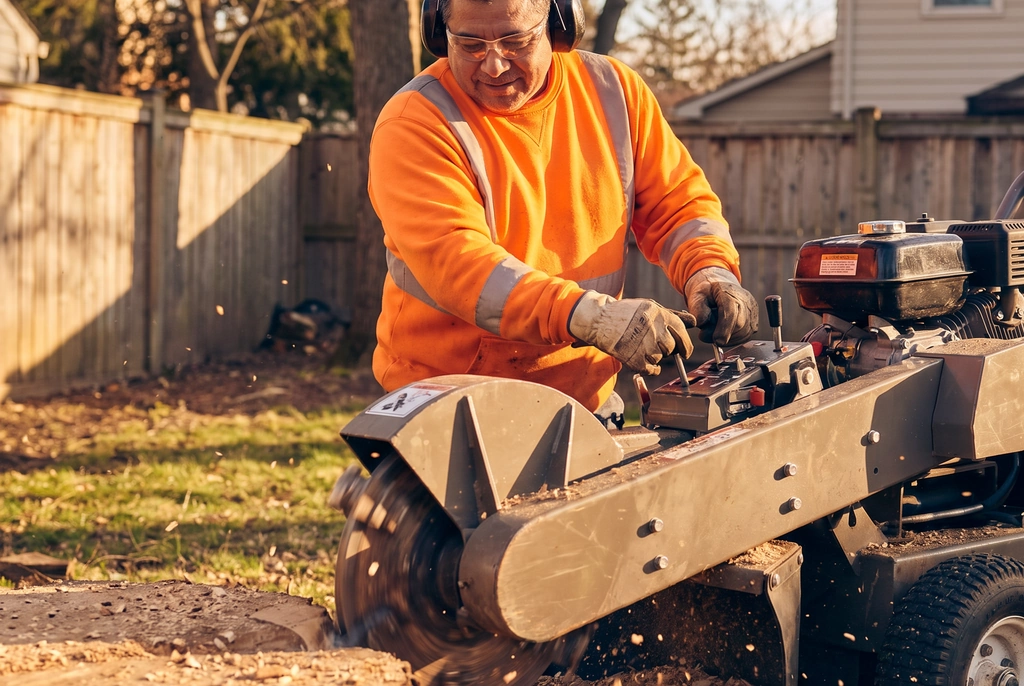
A stump grinding business uses a mechanical grinder to reduce tree stumps to wood chips below ground level, leaving the root ball in place. It is distinct from full stump removal, which excavates the entire root system and requires heavier equipment. Most operators charge by the inch of stump diameter, serve homeowners, landscapers, and tree services, and reach profitability within the first year when pricing and equipment are set up correctly.
Startup costs run $17,000 to $30,000. That covers a used grinder, a tow vehicle, insurance, licensing, and safety gear. The five moves that follow walk through funding, legal setup, insurance, equipment, pricing, and the daily workflow that turns a single grinder into a booked operation.
How do you validate demand for a stump grinding business?
Demand validation takes three steps: call local tree services to learn their subcontractor rates, count stump grinding providers within a 25-mile radius, and get a quote from one competitor to learn the going rate.
Gauge local demand
Start by contacting potential partners. Call local tree removal services, landscaping companies, and property managers. Ask if they currently subcontract stump grinding and what rates they pay. This gives you a direct read on commercial demand in your area.
Next, check online directories like Angi and Thumbtack to count the number of stump removal providers within a 25-mile radius. A high number of competitors is not always a bad sign, especially if they have poor reviews, which signals an opportunity.
Analyze competitors and estimate costs
Look at what your future competitors offer. Do they have a professional website? What do their customer reviews say? Call one or two for a "ghost quote" on a 15-inch stump to learn the local rate, which typically lands at $3 to $5 per inch of diameter.
With an idea of the market, map out your startup costs. A quality used stump grinder runs $5,000 to $15,000. A reliable truck and trailer can add $10,000 or more. Budget around $500 for safety gear like chaps, eye protection, and ear protection.
Business insurance and registration fees will likely cost between $1,500 and $3,000 for your first year. This brings your total estimated startup investment to between $17,000 and $30,000, a figure worth planning for carefully.
To see how these numbers play out, suppose a founder in Ohio starts with a used Vermeer SC30TX grinder at $12,000, a used truck and trailer at $11,000, insurance and licensing at $2,200, and $500 in safety gear. That brings the total to $25,700, which sits in the middle of the typical range. (This is an illustrative example, not a specific customer's ledger.)
Here are 3 immediate steps to take:
- Contact three local tree service companies to ask if they need stump grinding subcontractors.
- List all competitors in a 25-mile radius and get one "ghost quote" to learn local rates.
- Create a startup budget with low and high estimates for equipment, insurance, and licensing.
What licenses and legal structure does a stump grinding business need?
Form an LLC to protect your personal assets, get a free Employer Identification Number from the IRS, and secure a general business license from your city or county. Most states do not require a stump-specific license, but a few require a specialty contractor's license for larger jobs.
Choose your business structure
Form a Limited Liability Company (LLC). This structure protects your personal assets, like your home and car, from business debts or lawsuits. Operating as a sole proprietor leaves your personal finances exposed, a common mistake when you start a business from scratch.
An LLC offers pass-through taxation, so business profits pass to your personal tax return. Once your business entity is established, you need an Employer Identification Number (EIN) from the IRS. Apply for one online for free through the IRS EIN application, and it only takes a few minutes.
Secure the right licenses and permits
Most states do not require a specific license just for stump grinding. You will need a general business license from your city or county clerk's office. Expect to pay between $50 and $200 for this, with processing times of one to three weeks.
Some states, like California, require a specialty contractor's license if your work exceeds a certain dollar amount. Check with your state's contractor licensing board to confirm the rules. Follow Occupational Safety and Health Administration (OSHA) tree care safety standards for job site safety, which apply to pruning, removal, and the grinding work that follows.
Here are 3 immediate steps to take:
- File for an LLC with your state's Secretary of State office.
- Apply for a free Employer Identification Number (EIN) on the IRS website.
- Contact your city or county clerk to inquire about a general business license application.
How much does insurance cost for a stump grinding business?
Budget $2,100 to $4,200 a year for the core policies: General Liability ($600 to $1,200), Commercial Auto ($1,500 to $3,000), and Inland Marine for the grinder. Add Workers' Compensation when you hire your first employee.
Your next move is to secure insurance. Start with a General Liability policy with at least $1 million in coverage. This protects you if flying debris damages a client's home. Expect to pay between $600 and $1,200 annually for this, based on typical contractor insurance pricing.
You will also need Commercial Auto insurance for your work truck, which often costs $1,500 to $3,000 per year. To protect your grinder from theft or damage, add an Inland Marine policy. If you plan to hire help, you will need Workers' Compensation insurance.
A huge on-the-job risk is hitting an underground utility line. Before you ever start a job, call 811 to have public utilities marked. Some insurance claims may be denied if you fail to take this simple precaution.
When you look for providers, consider specialists in contractor insurance like The Hartford, Hiscox, or Next Insurance. They understand your specific risks better than a general agent and can help you find appropriate coverage without overpaying.
Here are 4 immediate steps to take:
- Request a quote for a $1 million General Liability policy from an insurer like Hiscox.
- Ask potential insurers about adding an Inland Marine policy to cover your equipment.
- Look up your state's Workers' Compensation requirements.
- Call 811 to understand the "call before you dig" process in your area.
What equipment do you need to start stump grinding?
Buy a used 25 to 35 horsepower self-propelled grinder, a 3/4-ton truck, and a trailer rated for at least 3,500 pounds. Add a $500 safety gear package and a secure place to store everything.
Choose your grinder and transport
Your main purchase is the stump grinder. A used 25 to 35 horsepower model from a brand like Vermeer or Bandit is a solid start and typically costs $5,000 to $15,000. Specific entry models include the Vermeer SC30TX (25 hp) and the Vermeer SC362 (35 to 40 hp), along with the Bandit SG-40 (38 hp). The trap to avoid is buying a machine that is too small, which limits the size of jobs you can accept.
With the grinder selected, you need a way to move it. A 3/4-ton truck, such as a Ford F-250 or Ram 2500, is a good match. Pair it with a trailer rated for at least 3,500 pounds. This combination can cost $10,000 to $20,000 for reliable used models.
Find a home base and get safety gear
You do not need a storefront, just a secure place for your equipment. A 400-square-foot lockable garage or a commercial storage unit works well. Before you sign a lease, check local zoning ordinances to confirm you can park a commercial truck and trailer at the location.
For safety gear, plan to spend around $500. You will need steel-toed boots, Kevlar chaps, and a helmet with an integrated face shield and ear protection. You can find these items at online retailers like Forestry Suppliers or Bailey's, which specialize in arborist supplies.
Here are 4 immediate steps to take:
- Research used stump grinders from brands like Vermeer and Bandit.
- Check local listings for a 3/4-ton truck and a trailer with a 3,500-pound capacity.
- Contact your local planning department about zoning for commercial vehicle storage.
- Price out a full safety gear package from a supplier like Bailey's.
How do you set up payments for a stump grinding business?
Require a 50% deposit on jobs above $500 and accept cards on site so you never chase an invoice for a finished job. A mobile card reader lets you collect payment the moment the grinder stops.
Most stump grinding jobs are paid upon completion. For larger projects, require a 50% deposit upfront. This protects you from last-minute cancellations. The trap here is accepting only cash, which turns away clients who prefer cards.
You need a simple way to accept payments on-site. For a field service business that needs to collect payment on the go, a mobile card reader is the right fit. JIM turns your phone into a card reader and accepts debit, credit, and digital wallets with a tap, no extra hardware.
JIM charges a flat 1.99% per Tap to Pay sale, with no monthly fee and no hidden costs. That compares favorably to payment processors that charge between 2.5% and 3.5% plus hardware fees. For larger commercial jobs you bill on Net 30 terms, payment links sent by text or email let the client pay online without a reader. The deciding criterion is whether you need to take payment the moment a job finishes: if yes, a tap-to-phone reader like JIM handles it; if you bill commercial accounts on Net 30 terms, a separate invoicing tool covers those.
- Get Started: Download the JIM app for iOS.
- Make a Sale: Type the sales amount, hit sell, and ask your customer to tap their card or device on your phone.
- Access Funds: Your money is available right on your JIM card as soon as the sale is done, no waiting for bank transfers.
Here are 3 immediate steps to take:
- Decide on your payment terms, including when you will require a deposit.
- Download and set up a mobile payment solution like JIM to accept card payments.
- Create a professional invoice template with your business name and contact information.
How do you fund a stump grinding business?
Use equipment financing for the grinder, since it serves as its own collateral, or an SBA Microloan for up to $50,000 in startup capital. Keep at least $3,000 to $5,000 in working capital for the first six months.
Secure your startup capital
Since your grinder serves as collateral, equipment financing is often easier to secure than a traditional loan. Lenders like Currency or CIT specialize in this and may offer loans covering 80% to 100% of the equipment cost. Expect interest rates between 6% and 18% depending on your credit; verify the exact rate against the lender's official rate sheet before signing.
Another option is an SBA Microloan. These offer up to $50,000 and are designed for new businesses that may not have a long credit history. The Small Business Administration does not lend directly, but it guarantees loans made by its partner lenders, with interest rates generally between 8% and 13%.
Plan for operating costs
With your main equipment funded, you still need cash for day-to-day operations. Plan for at least $3,000 to $5,000 in working capital for your first six months. This covers fuel, insurance premiums, and initial marketing costs before revenue becomes consistent.
Once you have funding, open a dedicated business checking account immediately. The trap here is mixing personal and business finances. This creates a headache at tax time and can risk the personal liability protection your LLC provides.
Here are 4 immediate steps to take:
- Contact an equipment financing lender like Currency for a quote.
- Research SBA Microloan requirements on the official SBA website.
- Open a dedicated business checking account at your local bank or credit union.
- Calculate your estimated operating costs for the first six months.
How do you hire your first crew member?
Hire a Groundworker once you consistently book over 20 hours of work a week, classify them as a W-2 employee, and enroll them in an OSHA 10-hour safety course. Pay $18 to $25 per hour depending on your market.
Find and train your first employee
Once you consistently book over 20 hours of work a week, it is time to hire. Your first employee will likely be a Groundworker. Their job is to handle site prep, clear debris with a rake and blower, and lay down protective plywood shields.
Expect to pay a Groundworker between $18 and $25 per hour, depending on your local market. Do not pay them as a 1099 contractor to avoid payroll taxes. Misclassifying an employee as a contractor can lead to significant penalties, so review the IRS guidance on independent contractor versus employee before you classify a worker. Set them up as a W-2 employee from day one.
While no state license is needed for this role, enroll them in an OSHA 10-hour construction safety course. Provide hands-on training for your specific grinder and safety gear. Your goal is to have labor costs account for 25% to 35% of revenue.
Streamline your daily workflow
As your job list grows, a paper calendar will not cut it. Adopt field service software like Jobber or Yardbook. These platforms help you manage quotes, schedule jobs, dispatch your crew, and handle invoicing from a single app.
Here are 4 immediate steps to take:
- Draft a job description for a Groundworker position.
- Research payroll providers like Gusto or QuickBooks Payroll to properly manage employee wages.
- Look up local providers for the OSHA 10-hour construction safety course.
- Sign up for a free trial of a field service software like Jobber to test its features.
How do you market a stump grinding business?
Build a referral network with tree services and landscapers, claim a free Google Business Profile, and leave door hangers on the five closest homes after every job. Partnerships generate the first jobs fastest.
Forge local partnerships
Your fastest path to jobs is through partnerships. Contact local tree service companies and landscapers. Offer them a 10% to 15% referral fee for any stump grinding work they send your way. This gives them a profitable way to offer a service they may not provide themselves.
Build your digital foundation
Next, claim your free Google Business Profile. Fill it out completely with your service area, hours, and phone number. Ask your first few customers for reviews. A profile with photos and positive reviews can quickly become your number one source of leads.
A simple website on a platform like Squarespace also adds credibility. It only needs one page with your contact information, photos of your work, and a list of services. Think of it as your online business card that works for you 24/7.
Use hyper-local marketing
The area right around a job site is your lowest-cost lead source. After you finish a job, leave door hangers on the five closest homes. A simple message like, "We were just in your neighborhood," is very effective and costs little.
Here are 4 immediate steps to take:
- Draft an email to send to three local tree services proposing a referral partnership.
- Set up your Google Business Profile and upload photos of your equipment.
- Design a simple door hanger with your business name, phone number, and services.
- Outline the content for a one-page website.
How do you price stump grinding work?
Charge $3 to $5 per inch of stump diameter, set a minimum job fee of $125 to $175, and add surcharges for slope, hardwood, and cleanup. Measure the widest part of the stump, including the root flare.
Price by the inch
The most common pricing model is to charge per inch of the stump's diameter. A typical rate is $3 to $5 per inch. For a 20-inch stump, your quote would be $60 to $100. This method is straightforward and easy for clients to understand.
The trap here is measuring only at ground level. Measure the widest part of the stump, including the root flare, to price the job correctly. Also, set a minimum charge, perhaps $125 to $175, to ensure small jobs are profitable.
Adjust for job complexity
Your base rate should change based on job difficulty. Add a 25% surcharge for stumps on a steep slope or near a fence. Hardwoods like oak take longer to grind, so add a 15% to 20% fee compared to softer pine stumps.
Cleanup is another factor. Your standard quote should specify that you will rake chips into a neat pile. You can offer to haul them away for an extra fee, often $50 to $75. This approach keeps your base price competitive while offering valuable add-ons.
Here are 4 immediate steps to take:
- Set your per-inch base rate and a minimum job fee.
- Create a list of surcharges for difficult access, hardwood, and other factors.
- Decide on your pricing for chip cleanup and removal services.
- Draft a quote template that clearly itemizes the base price and any extra fees.
How do you maintain quality and scale a stump grinding business?
Hold a written quality checklist for every job, hire a second Groundworker once you book over 30 grinding hours a week for a month, and add a second grinder when you turn down more than five jobs a week.
Set your quality standards
Your reputation depends on consistent work. Create a quality checklist for every job. This should include grinding stumps 4 to 6 inches below grade and raking all wood chips into a neat pile. Taking before-and-after photos is a great way to document your work.
Site protection is where operators cut corners and pay for it later. Always use plywood shields to guard windows and siding from flying debris. This simple step prevents costly damage claims and shows clients you respect their property.
Know when to expand
Growth should be driven by data, not just a feeling. When you consistently book over 30 hours of grinding work per week for a month, it is a good signal to hire another Groundworker. Turning down more than five jobs a week suggests it is time to consider a second grinder.
Before you buy more equipment, rent a larger machine for a few big jobs to test the demand. As your team grows, field service software like Jobber or Yardbook becomes even more valuable for managing schedules and dispatch across multiple crews.
Here are 4 immediate steps to take:
- Create a one-page quality control checklist for your jobs.
- Set a weekly revenue or booked-hours target that will trigger your first new hire.
- Identify a local equipment rental company and get rates for larger grinders.
- Re-evaluate field service software like Yardbook for managing a larger team.
You now have the complete roadmap for a stump grinding or tree stump removal business. Your reputation for clean, safe work is your best asset, because every job is a chance to impress a client and their neighbors. Pick up the phone, call three tree services this week, and book your first referral.
When it is time to get paid, JIM turns your phone into a card reader for a flat 1.99% fee, with no extra hardware. You collect payment on the spot and keep your cash flow steady from the first job, a simple way to get paid faster instead of chasing invoices. Download JIM to be ready.
Frequently Asked Questions
Is stump grinding profitable?
How long does it take to start a stump grinding business?
Do I need a license to grind stumps?
What size stump grinder should I buy first?
How do I get customers for a stump grinding business?



Sell and get paid in seconds with Jim






