How to start a thrift store business the right way

See article summary
- Opening a thrift store in the U.S. costs $10,000 to $40,000, covering inventory, fixtures, and a cash reserve.
- File an LLC, get a free EIN from the IRS, and secure a seller's permit plus local business licenses.
- Source inventory through donations, estate sales, auctions, and wholesale bales, aiming for a 4x to 8x markup.
- A thrift store needs general liability, commercial property, and workers' compensation insurance from day one.
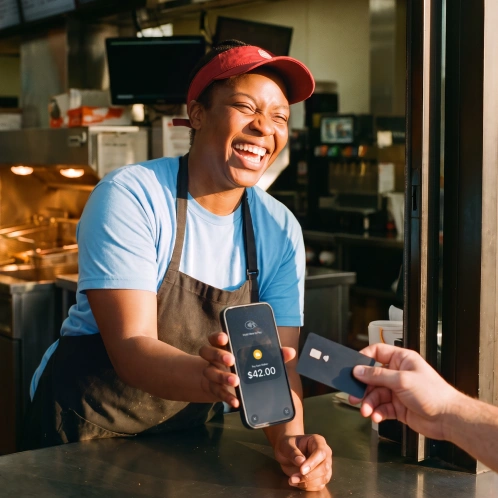
- JIM accepts card payments on your phone at a flat 1.99% per transaction with no extra hardware.
Opening a thrift store in the U.S. usually costs between $10,000 and $40,000, and the secondhand market keeps growing as shoppers look for affordable, sustainable goods. As of 2025, the U.S. secondhand market reaches roughly $56 billion, according to the National Association of Resale and Professionals. The steps below take you from validating your concept to running a profitable store: filing an LLC, getting licensed, insuring the business, sourcing inventory, and setting up payments.
Step 1: How to validate your thrift store concept and build a budget
A thrift store business plan should define your niche, map local competitors, and pin down a $10,000 to $40,000 startup budget before you sign a lease. Your niche drives every later decision, from where you source inventory to how you price it.
First, define your niche. Will you sell vintage clothing, modern brands, or furniture? Visit at least five local competitors. Note their pricing, store layout, and the type of customer they attract. This helps you find a gap in the market.
Use Google Maps to find all secondhand stores in a 10-mile radius. A common misstep is to only focus on direct thrift store competitors. You should also check out consignment shops, antique malls, and even local buy-sell-trade groups on social media.
Estimate your thrift store startup costs
With your research done, you can build a realistic budget. Your initial investment will likely fall between $10,000 and $40,000. The biggest variables are your location and how you source your first batch of inventory.
The table below breaks down the major thrift store startup costs so you can see the low and high range for each line item.
| Startup cost item | Low | High | Notes |
|---|---|---|---|
| Lease deposit | $2,000 | $10,000 | Depends on market and landlord negotiations |
| Initial inventory | $3,000 | $15,000 | Largest variable; donations lower this cost |
| Store fixtures | $2,000 | $7,000 | Racks, shelving, display cases, hangers |
| Licenses and permits | $100 | $1,000 | EIN is free; state and local fees vary |
| Point-of-sale system | $500 | $1,500 | Hardware and software combined |
| Marketing launch | $500 | $2,000 | Photos, signage, local ads |
| Cash reserve | $5,000 | $15,000 | First six months of operating expenses |
Plan for major expenses like a lease deposit ($2,000 to $10,000), initial inventory ($3,000 to $15,000), and store fixtures ($2,000 to $7,000). Also, set aside funds for licenses, a point-of-sale system, and marketing. It is a good idea to have a cash reserve for the first six months.
Quick checklist this week:
- Define your store's specific niche, like vintage menswear or children's toys.
- Map out all competitors within a 10-mile radius and visit the top five.
- Create a preliminary budget that breaks down your major startup expenses.
Step 2: How to license your thrift store business
To legally open a thrift store, file an LLC, get a free EIN from the IRS, and secure a seller's permit plus local business licenses. These steps protect your personal assets and let you collect sales tax legally.
Form a Limited Liability Company (LLC). This structure separates your personal assets from business debts. For tax purposes, the IRS treats a single-member LLC as a disregarded entity, so profits pass through to your personal tax return, which simplifies filings compared to a corporation. Source: IRS Publication 3402, Taxation of Limited Liability Companies. Filing fees vary by state, with most states charging between $50 and $500.
Next, get a free Employer Identification Number (EIN) from the IRS. You will need this federal tax ID to open a business bank account and hire employees. The online application takes only a few minutes to complete.
Secure state and local permits
You need a Seller's Permit, sometimes called a Resale Certificate, from your state's department of revenue. This allows you to buy inventory tax-free and collect sales tax from customers. A frequent misstep is sourcing inventory before getting this permit, which forces you to pay unnecessary sales tax.
Your city or county will require a Certificate of Occupancy to ensure your storefront is safe and zoned for retail. This involves an inspection and can cost $100 to $500. Also check with your local city clerk for a general business operating license, as requirements vary by municipality.
Numbers to nail down:
- Apply for a free EIN on the IRS website.
- File for an LLC with your state's Secretary of State.
- Get a Seller's Permit from your state's tax agency.
- Contact your city clerk about a Certificate of Occupancy and business license.
Step 3: What insurance does a thrift store need?
A thrift store needs general liability, commercial property, and workers' compensation insurance, plus a commercial auto policy if you use a vehicle for donation pickups. These policies protect your inventory, your customers, and your staff from day one.
With your legal structure in place, the next move is to secure insurance. You will want to start with General Liability Insurance. This covers customer injuries from accidents like slips and falls. A standard $1 million policy typically costs between $400 and $700 per year.
Key policies for your thrift store
Commercial Property Insurance is another must-have. It protects your inventory and fixtures from events like fire or theft. If you hire even one employee, you will also need Workers' Compensation insurance. Workers' compensation coverage is mandatory for most employers in every state except Texas, where private employers can choose whether to carry it. Source: National Association of Insurance Commissioners, Workers' Compensation Insurance. Check your state labor department for exact requirements before you hire.
A frequent oversight is using a personal vehicle for donation pickups. Your personal auto policy will not cover accidents during business use, so you need a Commercial Auto policy. This protects you from liability if an accident happens while you are on the clock.
When you shop for policies, consider providers like The Hartford, Hiscox, or Next Insurance. They often work with small retailers and can bundle policies for a discount. Be sure to mention you are a thrift store, as donated goods can present unique risks.
Do this this week:
- Request quotes for a $1 million general liability policy.
- Calculate your inventory's value to get an accurate property insurance quote.
- Check your state's laws for Workers' Compensation requirements.
- Ask about a Business Owner's Policy (BOP) to bundle coverage.
Step 4: Find a thrift store location and buy equipment
A thrift store typically needs 1,500 to 3,000 square feet of commercially zoned retail space, plus fixtures like clothing racks, a POS system, and security tags. The right location balances rent, visibility, and foot traffic.
Look for a retail space between 1,500 and 3,000 square feet. Your location needs to be in an area zoned for commercial retail. High visibility and foot traffic are good, but lower rent in a slightly off-beat location can work if your marketing is strong.
When you find a spot, negotiate the lease. Ask for a Tenant Improvement (TI) allowance to help pay for build-outs like fitting rooms or a sorting area. Many new owners accept the first offer, but you can often negotiate a lower rate or a few months of free rent.
Stock your store with fixtures
Your next spend is on equipment. A point-of-sale (POS) system will run you $500 to $1,500. Budget $50 to $200 per clothing rack and another $300 to $1,000 for a basic security tag system. You can buy hangers and price tags in bulk from suppliers like Uline.
To preserve your startup capital, consider used fixtures. You can often find quality racks, shelving, and display cases from stores that are closing or remodeling. This can cut your initial fixture costs by 50% or more, freeing up cash for inventory.
Quick checklist:
- Scout three potential locations with 1,500 to 3,000 square feet.
- Ask landlords about a Tenant Improvement (TI) allowance during tours.
- Price out a basic POS system and security tags.
- Compare costs for used versus new clothing racks and shelving.
Step 5: How to source inventory for your thrift store
Inventory is your lifeblood, and thrift stores source it through several channels: public donations, estate sales, auctions, and wholesale bale suppliers. Each channel has different cost, quality, and reliability tradeoffs. Your goal is a 4x to 8x markup on purchased inventory, so the cheaper your sourcing, the wider your margin.
Public donations are the lowest-cost channel but the least predictable. Put a labeled donation bin near your entrance and post drop-off hours on your door and Google Business Profile. Estate sales and auctions give you curated, often higher-value items, but you pay retail-plus prices and compete with other resellers. Wholesale bale suppliers sell clothing by the pound, typically from charity surplus, at predictable cost per pound but with mixed quality.
A practical sourcing mix for a new store is roughly 60% donations, 25% estate sales and auctions, and 15% wholesale bales. This keeps costs low while guaranteeing enough volume to fill the floor. Track the cost per item and the sell-through rate for each channel so you can shift budget toward what moves fastest.
Quick checklist:
- Set up a labeled donation bin and post drop-off hours.
- Identify three local auction houses or estate sale companies.
- Request price-per-pound quotes from two wholesale bale suppliers.
- Track cost per item and sell-through rate by sourcing channel.
Step 6: How to set up payment processing for your thrift store
Most customers expect to pay with a card or digital wallet, so you need a reliable system from day one. Payment processors typically charge a transaction fee plus a fixed charge per sale, and those fees add up across hundreds of small thrift store transactions.
For thrift stores that need to accept payments on-site or on-the-go, JIM offers a streamlined solution. With JIM, you can accept debit, credit, and digital wallets directly through your smartphone. Just tap and you are done. At just 1.99% per transaction with no hidden costs or extra hardware needed, it is particularly useful for sidewalk sales or selling at a local market.
Getting started is straightforward:
- Get Started: Download the JIM app for iOS.
- Make a Sale: Type the sales amount, hit sell, and ask your customer to tap their card or device on your phone.
- Access Funds: Your money is available right on your JIM card as soon as the sale is done. No waiting for bank transfers.
Quick checklist:
- Compare the transaction rates and monthly fees of at least two payment processors.
- Download the JIM app to see if its features fit your business model.
- Calculate your potential savings with a flat 1.99% transaction rate versus other options.
Step 7: How to fund your thrift store and manage finances
A thrift store can fund its launch through an SBA Microloan, a business line of credit, or local grants, paired with a six-month cash reserve. External funding protects your personal savings and gives you runway while sales build.
A smart approach is to secure external funding instead of using all your personal savings. An SBA Microloan is a solid option, offering up to $50,000 through intermediary nonprofit lenders. The SBA reports interest rates generally fall between 8% and 13%, and the maximum repayment term is seven years. Lenders typically look for a credit score above 650.
You might also consider a business line of credit. This gives you flexible access to cash for unexpected inventory buys or slow months. Unlike a loan, you only pay interest on the amount you use, which helps manage cash flow without taking on large, fixed debt.
Calculate your working capital
Set aside a cash reserve to cover your first six months of operation. A buffer of $15,000 to $25,000 is a realistic target. This money covers rent, utilities, and payroll while your sales build. Some new owners miscalculate this and face a cash crunch right before they hit their stride.
In addition, look for local grants. Your city's economic development agency or chamber of commerce often has programs for new retail businesses. These funds do not require repayment and can provide a welcome financial cushion as you get started.
Numbers to nail down:
- Check your credit score to see if you meet the 650+ benchmark for an SBA loan.
- Research SBA-approved lenders in your area for their Microloan programs.
- Calculate your first six months of operating expenses to set your working capital goal.
- Visit your city's economic development website to find local business grants.
Step 8: How to hire staff and run thrift store operations
A new thrift store typically starts with a Store Associate and a Sorter or Pricer. The sorting room is usually the first bottleneck, so prioritize it. A common guideline is one full-time employee per $100,000 in projected annual revenue, but treat this as a starting point to refine against your own sales data.
You will likely need two key roles to start: a Store Associate and a Sorter or Pricer. Associates handle sales and customer service for about $15 to $18 per hour. Sorters work in the back, processing donations. No special certifications are needed, but retail experience is a definite plus.
Manage your team and workflow
Many new owners find their biggest bottleneck is an understaffed sorting room. If you cannot process donations quickly, your sales floor will suffer. As a guideline based on typical resale operations, plan for roughly one full-time employee for every $100,000 in projected annual revenue, then adjust once you see your actual donation volume and sell-through rate.
Once your team is in place, you can use scheduling software like When I Work or Homebase to manage shifts. These platforms simplify communication and help you build a schedule that ensures your sales floor and sorting room are always covered, especially during peak donation times.
Quick checklist:
- Draft job descriptions for a Store Associate and a Sorter or Pricer.
- Estimate your staffing needs based on a goal of one employee per $100,000 in sales.
- Research scheduling software like When I Work or Homebase.
- Create a weekly schedule that balances floor coverage with backroom processing.
Step 9: How to market your thrift store and attract customers
Thrift store marketing works best on visual platforms like Instagram and Facebook, paired with a complete Google Business Profile and in-store events that drive repeat visits. Your goal is to spend less than $10 to acquire each new customer.
Build your online and local presence
Focus your marketing on Instagram and Facebook. Post daily photos of unique finds to create urgency. Use Reels and Stories to show off your store's personality. This visual approach keeps your audience engaged and eager to visit.
You should also claim your Google Business Profile immediately. Add high-quality photos, your address, and store hours. Many new owners overlook this free resource, but it is often the first place shoppers look for local thrift stores.
In-store events build a loyal community. Consider a "Fill-a-Bag" sale for a flat price to clear old inventory and create buzz. You could also host a monthly themed event like "Vintage Denim Weekend" to attract niche buyers.
Measure what works
Track your Customer Acquisition Cost (CAC). Aim to spend less than $10 to get a new customer through the door. If a $100 Facebook ad brings in 20 new buyers, your CAC is a healthy $5. This tells you where your marketing dollars are most effective.
Also, watch your in-store conversion rate, which is the percentage of visitors who make a purchase. A good target is between 20% and 40%. If your rate is low, you might need to adjust your pricing or store layout.
Quick checklist:
- Claim and complete your Google Business Profile with photos and hours.
- Set up an Instagram account and post five unique items you plan to sell.
- Plan your first in-store event, like a "Fill-a-Bag" sale.
- Calculate a target Customer Acquisition Cost (CAC) for your first month.
Step 10: How to price thrift store inventory and manage stock
A thrift store pricing strategy uses tiered pricing for basics and individual pricing for unique items, with a markup of 4x to 8x on purchased inventory. A color-tag rotation system keeps the floor fresh and clears slow movers.
Develop your pricing strategy
Your pricing model directly impacts profit. A tiered system works well for basics. You might price all t-shirts at $4 and all jeans at $8. This speeds up pricing and gives customers predictability. For unique or designer items, price them individually based on market value.
To find an item's value, check sold listings on eBay or Poshmark. A common mistake is to guess the value of vintage or brand-name goods. Research prevents you from underpricing a gem or overpricing an item that will not sell. Your goal is a 4x to 8x markup on purchased inventory.
Keep your stock fresh
A stale sales floor discourages repeat visits. You should implement a stock rotation system. Use different colored price tags for each week of the month. For example, week one is yellow, week two is blue, and so on. This shows you how long an item has been on the floor.
After four weeks, any item with the oldest color tag should be moved to a clearance rack for 50% off. If it still does not sell, you can include it in a "fill-a-bag" sale. This constant flow of fresh merchandise keeps shoppers coming back to see what is new.
Quick checklist:
- Create a tiered price list for your top five inventory categories.
- Research the sold prices for 10 unique items on eBay to practice valuation.
- Choose four colors for a monthly tag rotation system.
- Decide on a markdown schedule for items that do not sell within four weeks.
Step 11: How profitable is a thrift store?
A thrift store can be profitable, with the secondhand market supporting healthy margins, but actual profit depends on your sourcing cost, volume, and overhead. Resale industry benchmarks indicate the U.S. secondhand market reached roughly $56 billion in 2025, according to the National Association of Resale and Professionals.
Thrift stores benefit from low cost of goods when inventory comes from donations, which is why donation-based models often run higher gross margins than resellers buying wholesale bales. Your net margin depends on rent, payroll, and how efficiently your sorting room turns donations into floor-ready stock. A store hitting $300,000 in annual revenue with a tight sourcing cost is in a strong position to expand.
Step 12: Nonprofit vs for-profit thrift stores
A for-profit thrift store buys or receives inventory and keeps the profit, while a nonprofit thrift store, typically organized as a 501(c)(3) charity, can accept tax-deductible donations and reinvests surplus revenue into its mission. The choice changes your tax treatment, your sourcing model, and your paperwork.
A for-profit LLC files a standard tax return and passes profits through to the owner. Donations you receive are inventory, not tax-deductible contributions for the donor. A nonprofit must file for 501(c)(3) status with the IRS and register with the state as a charitable organization. Source: IRS, Charities and Nonprofits. Donors to a verified 501(c)(3) can deduct the fair market value of goods they give, which is why nonprofit thrift stores attract higher-quality, higher-volume donations.
Choose a nonprofit structure only if you have a clear charitable mission and a board willing to handle the additional governance. If your goal is a personal retail business, a for-profit LLC is simpler and faster to launch.
Step 13: Maintain quality and know when to scale your thrift store
Quality control keeps customers coming back, and clear metrics tell you when to hire or open a second location. A simple grading system and a few tracking numbers keep growth predictable.
Establish your quality standards
Create a simple A-B-C grading system for donations. "A" items are like-new and go to the main floor. "B" items have minor wear. "C" items have visible flaws and should go straight to a deep discount bin or be bundled for "fill-a-bag" sales.
Track your donation rejection rate. A healthy rate is 20 to 30%. Many new owners accept too much low-quality stock just to fill the racks, but this hurts your store's reputation. Be selective from day one to build a brand known for quality finds.
Know when to grow
Use clear metrics to guide your growth. Once your sorting room backlog consistently takes more than three days to clear, it is time to hire another sorter. Consider a second location only after your first store hits $300,000 in annual revenue and is consistently profitable.
As you grow, a basic POS may not be enough. Look into inventory management systems like Lightspeed Retail or Vend. They help you track stock levels, sales trends, and supplier data, which is valuable if you plan to open more stores.
Quick checklist:
- Create a simple A-B-C grading system for all incoming inventory.
- Start tracking your donation rejection rate, with a target of 20 to 30%.
- Set a revenue benchmark, like $100,000 in annual sales, for your next hire.
- Research inventory management systems like Lightspeed Retail or Vend.
Your thrift store is more than a shop; it is a community hub built on unique finds. The key is a constant flow of quality inventory to keep shoppers coming back. You have the complete roadmap, so take that first step with confidence.
When you make that first sale, keep the payment process simple. JIM lets you accept cards right on your smartphone for a flat 1.99% fee, with no extra hardware needed. Your money is available instantly. Download JIM to be ready from day one.
Frequently Asked Questions
Is a thrift store profitable?
How much does it cost to start a thrift store?
Do you need a license to sell secondhand goods?
How do thrift stores get inventory?
What insurance does a thrift store need?


Sell and get paid in seconds with Jim