Launching a tote bag business is an exciting venture that lets you blend creative design with smart business planning. It's a market worth billions, fueled by consistent demand for totes as daily carry-alls, eco-friendly shoppers, and unique fashion statements.
This guide will take you through the practical steps of validating your business concept, building supplier relationships, acquiring inventory, and marketing your products to help you launch a successful tote bag business in the U.S.
Step 1: Create your business plan and validate your concept
Find your market niche
First, dig into market research to find your niche. Spend time on Pinterest and Instagram with hashtags like #totebag and #canvastote. Note the styles, colors, and graphics that get the most engagement. This shows you what people actually want to buy.
Then, head to Etsy and Amazon. Analyze the top 20 best-selling tote bags. Read the reviews to find customer complaints about strap length or lack of pockets. Many new sellers fail because they create a generic bag instead of solving a specific problem.
Analyze your competition
To understand competitor strategy, you can use platforms like Ahrefs to see where their website traffic comes from. For Amazon sellers, resources like Jungle Scout reveal estimated sales volumes for specific tote bag listings, which helps you gauge demand for a product.
Estimate your startup costs
Your initial budget will likely range from $1,500 to $5,000. The largest portion is inventory. Sourcing 100 bags at $8 each costs $800. A basic Shopify website is about $29 per month, and initial design work might run you $200.
Remember to factor in less obvious expenses. Shipping supplies and the actual cost to mail each bag can be a surprise. It's a detail that, if overlooked, can quickly reduce your profit margins on every sale you make.
Here are 3 immediate steps to take:
- Analyze 10 best-selling tote bags on Etsy, noting their price, material, and common customer feedback.
- Use Google Trends to compare search interest for three niches, like 'book lover tote' versus 'funny graphic tote'.
- Draft a startup budget that includes inventory for 100 units, website fees, and packaging supplies.
Step 2: Set up your legal structure and get licensed
You will want to form a Limited Liability Company (LLC). This structure separates your personal assets from business debts, a protection you do not get as a sole proprietor. Filing costs range from $50 to $500 with your state's Secretary of State.
A frequent oversight is mixing personal and business funds. Once your LLC is approved, open a dedicated business bank account. This move simplifies tax preparation and reinforces your liability protection, so do not skip it.
Next, get an Employer Identification Number (EIN) from the IRS. It is a federal tax ID for your business and is required to open that bank account. You can apply online for free and receive the number instantly.
You also need a seller's permit from your state's department of revenue. This document allows you to buy wholesale inventory without paying sales tax. Finally, check with your city or county for a local business license, which typically costs $50 to $100 annually.
Here are 4 immediate steps to take:
- Apply for a free Employer Identification Number (EIN) on the IRS website.
- File for an LLC with your state's Secretary of State to protect your personal assets.
- Register for a seller's permit through your state's department of revenue.
- Open a separate business bank account once your LLC is approved.
Step 3: Protect your business with insurance
Choose the right coverage
General liability insurance is your foundation. It covers claims of bodily injury or property damage. For a small e-commerce brand, a $1 million policy typically costs between $400 and $700 per year. This is your shield against unexpected accidents unrelated to your actual products.
You also need product liability insurance. This specifically protects you if one of your tote bags is defective and causes harm, for instance, if a strap breaks and damages a customer's laptop. Many new owners are tempted to skip this to lower costs, a decision that can be financially fatal.
Find an e-commerce insurance provider
With your coverage needs in mind, approach insurers who specialize in e-commerce. Providers like Hiscox, The Hartford, and Next Insurance understand the risks of online retail. They can bundle general and product liability coverage into a single Business Owner's Policy (BOP) for a better rate.
If you store more than $5,000 of inventory at home or in a storage unit, you should also ask about inland marine insurance. This policy covers your stock against theft or damage while it is stored or in transit to a fulfillment center.
Here are 3 immediate steps to take:
- Request quotes for a $1 million general liability policy from three different providers.
- Confirm that any policy you consider includes product liability coverage.
- Ask about inland marine insurance if you plan to hold significant inventory.
Step 4: Source your inventory and equipment
Find your blank tote bag supplier
Start by finding a supplier for blank totes. Websites like ToteBagFactory.com and BagzDepot offer cotton and canvas bags for $2 to $5 per unit. Many suppliers have low minimum order quantities (MOQs), sometimes as few as 12 units, which lets you test designs without a large investment.
A frequent misstep is to order hundreds of bags for an unproven design. You should order a small batch of 25-50 units first. This approach minimizes risk and prevents you from getting stuck with inventory that does not sell.
Get your printing equipment
To print your designs, you will need a heat press, which costs between $300 and $600. You also need a vinyl cutter like a Cricut Maker 3 ($399) to create the transfers. For design work, Canva Pro is a user-friendly option at about $13 per month.
You do not need a commercial space at first. A 100-square-foot area in a spare room or garage is usually enough for your equipment, inventory, and shipping supplies. Just confirm your local rules for home-based businesses before you begin.
Here are 3 immediate steps to take:
- Research two blank tote suppliers and compare their MOQs and per-unit costs.
- Price out a heat press and a Cricut or Silhouette vinyl cutter.
- Designate a 10x10 foot space for your business operations at home.
Step 5: Set up your payment processing
Choose your payment solution
Your Shopify store will need a payment processor. Shopify Payments is the default and integrates seamlessly. Most processors charge around 2.9% plus 30 cents for each online sale, so read the terms carefully before you commit.
Many new sellers focus only on their website and forget about in-person sales. If you plan to sell at craft fairs or local markets, you need a way to accept payments on the go without clunky hardware.
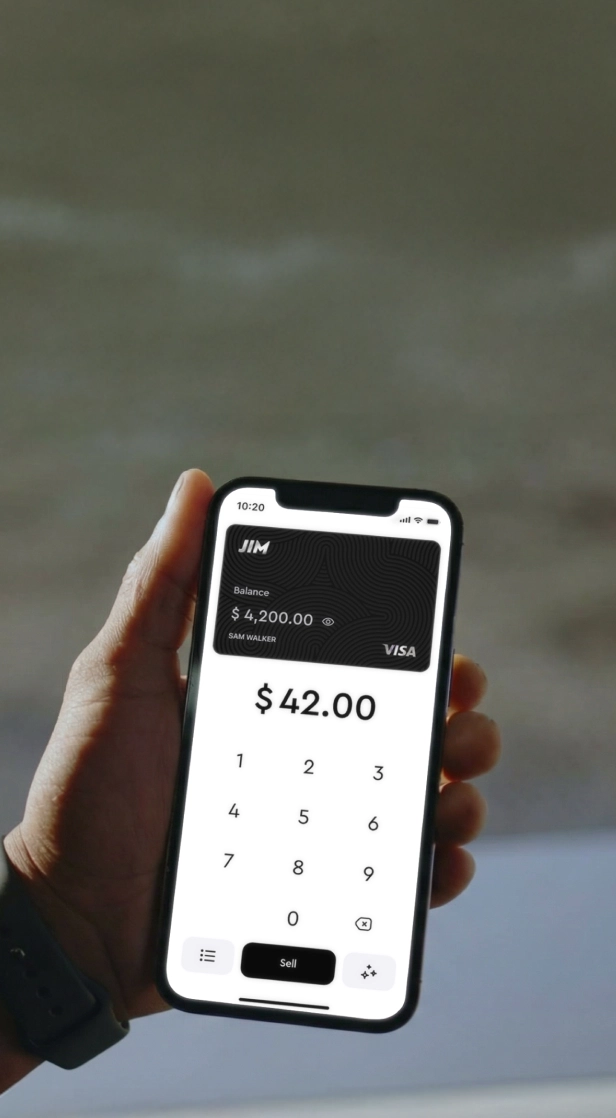
For on-site payments, JIM is a streamlined solution. Accept debit, credit, and digital wallets on your smartphone—just tap and done. At 1.99% per transaction with no hardware needed, it's great for pop-up markets, as other providers often charge 2.5% or more.
Here is how you make a sale:
- Get Started: Download the JIM app for iOS.
- Make a Sale: Type the sales amount, hit sell, and ask your customer to tap their card or device on your phone.
- Access Funds: Your money is available right on your JIM card as soon as the sale is done—no waiting for bank transfers.
Here are 3 immediate steps to take:
- Review the transaction fees for Shopify Payments to understand your online costs.
- Download the JIM app to prepare for in-person selling opportunities.
- Decide if you will sell at local markets this year to finalize your payment setup.
Step 6: Secure funding and manage your finances
Secure your startup funding
Most tote bag businesses start with personal savings. If you need outside capital, you might want to look into an SBA Microloan. These are loans up to $50,000 from nonprofit lenders, with interest rates typically between 8% and 13%. A personal credit score of 640 or higher is usually required.
Plan your working capital
With funding sorted, your focus shifts to managing cash flow. You will need about $3,000 to $6,000 in working capital for your first six months. This covers inventory restocks, marketing, and Shopify fees. It is the money that keeps the business running day-to-day.
Many new owners get tripped up by underestimating their marketing budget. You should set aside at least $200 per month for social media ads. This consistent spend is what drives traffic to your online store and generates sales, so do not treat it as an optional expense.
Here are 3 immediate steps to take:
- Research SBA Microloan lenders in your state on the SBA website.
- Calculate your estimated working capital needs for the first six months.
- Open a high-yield savings account to separate profits from operating cash.
Step 7: Set up your operations and hire your team
Manage your workflow
In the beginning, you will likely handle all operations yourself. This includes design, printing, packing, and shipping. To stay organized, you can use a free project management app like Trello to create boards for 'New Designs,' 'In Production,' and 'Ready to Ship.'
As you grow, Shopify's built-in inventory management is enough to track your stock levels. You will know exactly when to reorder blank totes without overspending on inventory that just sits on a shelf.
Hire your first employee
Once you consistently hit 50-75 orders per week, you might consider your first hire. A part-time Production Assistant can take over printing and packing. This role typically pays between $15 and $20 per hour, and no special certifications are required.
Many owners hire help too early, which can hurt cash flow. A good benchmark is to wait until you physically cannot keep up. The industry standard is about one full-time employee for every $100,000 to $150,000 in annual revenue.
Here are 3 immediate steps to take:
- Set up a free Trello board to track your production workflow.
- Write a job description for a part-time Production Assistant.
- Calculate the weekly order volume you must reach before hiring is financially viable.
Step 8: Market your business and acquire customers
Build your social media presence
Focus your efforts on Instagram and Pinterest, where visual products thrive. Plan a content calendar with 50% product photos, 30% customer photos (user-generated content), and 20% behind-the-scenes videos of your design or printing process. This mix sells products and builds a community.
Run targeted paid ads
Use Meta ads to reach specific buyers. You can start with a daily budget of $10 to target interests like "book lovers" or "eco-friendly gifts." A typical e-commerce conversion rate is 1-2%, so expect about one or two sales for every 100 ad clicks.
Many new sellers send ad traffic to their homepage instead of the product page. This is a mistake. Always link directly to the item you are advertising to reduce friction and make it easier for customers to buy.
Partner with micro-influencers
Collaborate with influencers who have 5,000 to 20,000 followers. Their audiences are often highly engaged. Offer a free product in exchange for an Instagram post and a few Stories. This is a cost-effective way to get authentic promotion and social proof.
Here are 3 immediate steps to take:
- Create a one-week content calendar for your Instagram account.
- Set up a Meta ad campaign with a $10 daily budget targeting one specific interest.
- Identify five micro-influencers in your niche and draft an outreach message.
Step 9: Price your products for profit
Calculate your cost per bag
First, calculate your cost of goods sold (COGS) for one tote bag. Add the price of the blank bag, design materials like vinyl, and a small amount for overhead. For example, a $3 bag plus $1 in vinyl gives you a $4 base cost.
Many new owners forget about labor and transaction fees. You should add at least $1-$2 to your COGS to account for your time and payment processing. This brings your true cost to around $5-$6 per bag, which is the number you will use to set your price.
Set your retail price with a markup
With your COGS figured out, you can set a retail price. A standard markup for handmade goods is between 100% and 300%. If your total cost is $6, a 200% markup results in a retail price of $18. This leaves you with a $12 gross profit per sale.
Now, look at what similar bags sell for on Etsy or at local markets. If competitors price their bags at $25, and your quality is comparable, you might adjust your price upward. Use their prices as a reference point, but do not just copy them without knowing your own numbers.
Here are 3 immediate steps to take:
- Calculate the total cost for one finished tote bag, including materials and labor.
- Research the prices of five direct competitors on Etsy to find the market average.
- Apply a 200% markup to your total cost to determine your initial retail price.
Step 10: Implement quality control and scale your operations
Establish your quality standards
Before you ship any order, inspect each bag. Check for straight seams, secure strap stitching, and centered print placement. A simple 30-second review per bag can prevent returns. Aim for a defect rate below 2% to protect your brand's reputation.
Many new sellers rush this step and send out bags with small flaws. This often leads to negative reviews that are hard to recover from. Your final quality check is your last chance to ensure a customer is happy with their purchase.
Know when to scale
Once you consistently process 75-100 orders per week, it is time to expand. This is a good benchmark to hire a part-time assistant. It frees you to focus on design and marketing instead of just production and shipping.
As your inventory grows, you might need more than Shopify's built-in features. Software like Katana can help you manage raw materials, track production costs, and forecast inventory needs. This gives you a clearer picture of your business health.
Here are 3 immediate steps to take:
- Create a three-point quality checklist for inspecting each finished tote.
- Set a weekly order volume, like 75 orders, as the trigger to write a job description.
- Explore the features of an inventory management app like Katana.
You now have a complete roadmap for your tote bag business. Remember, success comes from solving a specific need—like adding a pocket or using a unique material—not just selling another bag. You have the plan, now go make it happen.
And when you sell at local markets, JIM turns your smartphone into a simple card reader. You can accept payments without extra hardware for a flat 1.99% fee. Download JIM so you are ready for that first sale.
.avif)