Starting a TV mounting business is an exciting venture that combines technical skill and an eye for detail with business savvy. The market for home services is a multi-billion dollar industry, and there's steady demand for professional installations across homes, apartments, and offices.
This guide will take you through the practical steps of validating your business concept, getting the right licenses, acquiring equipment, and marketing your services to help you launch a successful tv mounting business in the U.S.
Step 1: Plan your business and validate your idea
First, gauge your local market. Spend an afternoon on neighborhood platforms like Nextdoor or local Facebook groups. Search for "TV mounting" to see how often people ask for this service and what they are willing to pay. This gives you a real-world look at demand.
Next, identify your direct competitors. Use Google Maps and service marketplaces like Thumbtack or Angi to find other installers in your area. Note their prices, read their customer reviews, and look at the services they package together. This helps you find a gap in the market.
A frequent misstep is competing only on price. Instead of just trying to be the cheapest, aim for value. If competitors charge $150 for a basic install, you might offer a $175 package that includes cord concealment. Quality service justifies a higher price.
Estimate your startup costs
Speaking of costs, you should map out your initial investment. A solid budget helps you avoid surprises. Most of your initial spending will go toward tools, insurance, and getting your business registered legally. A reliable vehicle is also a must-have.
Expect to spend between $500 and $1,200 on professional-grade tools like a quality drill, a stud finder, and a laser level. General liability insurance might run you $40 to $80 per month. Business registration fees vary by state but are typically $50 to $500.
All in, a startup budget of $1,500 to $3,000 is a realistic target, not including a vehicle purchase. This amount covers your initial equipment, basic marketing materials like business cards, and legal formation so you can operate professionally from day one.
Here are 3 immediate steps to take:
- Research five local competitors on Google Maps and note their pricing and reviews.
- Create a detailed spreadsheet to budget for your initial tool and equipment costs.
- Browse Nextdoor and local Facebook groups to confirm demand in your specific zip codes.
Step 2: Set up your legal structure and get licensed
Choose your business structure
You should consider forming a Limited Liability Company (LLC). This structure protects your personal assets, like your home, if your business faces a lawsuit. Profits pass through to your personal taxes, so you avoid the double taxation that corporations deal with.
You can file for an LLC on your state's Secretary of State website. The cost is typically between $50 and $500. Once that is done, get a free Employer Identification Number (EIN) from the IRS website. It's your business's tax ID and takes only minutes to acquire.
Secure your licenses and permits
Most cities require a general business license, which you can get from your city or county clerk for about $50 to $100 annually. This permit allows you to operate legally in your area.
Many new installers overlook the need for a low-voltage contractor license. If you plan to run cables inside walls, states like California and Georgia require this. Without it, you can only offer basic on-wall cord concealment, which limits your income.
Look up your state's contractor licensing board to find the exact requirements. The process often involves an exam and a fee of around $150 to $400. This small step unlocks higher-paying jobs.
Here are 3 immediate steps to take:
- File for an LLC with your state's Secretary of State.
- Apply for a free EIN on the IRS website.
- Research the "low-voltage contractor" license requirements for your state.
Step 3: Secure your insurance and manage risk
Types of insurance you'll need
General liability insurance is your first line of defense. It covers property damage if you drill into a pipe or cause other accidental harm. You should look for a policy with at least $1 million in coverage, which often costs between $500 and $900 annually.
A frequent oversight is skipping professional liability insurance, also known as errors and omissions. This protects you if a TV falls because of your installation advice or technique. It covers the mistake itself, which general liability does not.
If you use a vehicle primarily for work, you will need a commercial auto policy. Once you hire your first employee, most states require you to have workers' compensation insurance. This covers medical costs and lost wages if an employee gets hurt on the job.
Finding the right provider
You can get fast online quotes from insurers that focus on contractors, such as Next Insurance, Hiscox, and Thimble. These companies understand the specific risks of your trade, from property damage to customer injury, and can tailor a policy for you.
Working with a specialist is better than using a general agent. An agent who understands contractor work can ensure your policy has no gaps. They know that a TV mounting business faces different risks than a retail shop and can find appropriate coverage.
Here are 3 immediate steps to take:
- Get online quotes for a $1 million general liability policy from Next Insurance or Hiscox.
- Ask each provider if their policy includes professional liability coverage.
- Determine if you need commercial auto or workers' compensation insurance based on your setup.
Step 4: Get your equipment and set up a workspace
Find your home base
You do not need a commercial storefront. A 50 to 100-square-foot corner of your garage or a small storage unit works perfectly for holding equipment. This approach keeps your overhead low as you start.
Home-based service businesses rarely have zoning issues. However, you might want to check your city’s local ordinances for "home occupation" rules just to be safe. This confirms you can operate from your residence without a special permit.
Stock your professional kit
Your reputation depends on your equipment. Many new installers are tempted to buy cheap gear, but a drill that fails mid-job reflects poorly on your business. Invest in professional-grade brands like DeWalt or Milwaukee from the start.
Here is a basic shopping list with average costs:
- Professional Drill/Driver Kit: $200 - $300
- Magnetic Stud Finder (e.g., Zircon): $30 - $60
- Laser Level: $50 - $100
- Socket Wrench Set: $40 - $70
Source your mounts and cables
You can buy mounts and cables per job, but purchasing in bulk from suppliers saves money. For cables and wall plates, look at a site like Monoprice. For a range of quality TV mounts, consider brands like Sanus or Kanto, which you can find at electronics distributors.
Here are 3 immediate steps to take:
- Price a professional drill/driver combo kit from DeWalt or Milwaukee at a local hardware store.
- Check your city’s website for any "home occupation" permit requirements.
- Create an account on Monoprice to compare bulk pricing on HDMI cables and wall plates.
Step 5: Set up your payment processing
Most TV mounting jobs are paid upon completion. For larger projects that require expensive mounts or complex in-wall wiring, you might want to ask for a deposit to cover your upfront material costs. This protects your cash flow.
Choose a payment solution
You need a way to accept credit cards on-site. Many new business owners are surprised by the high transaction fees from typical payment providers, which often range from 2.5% to 3% plus additional charges. This eats into your profit on every job.
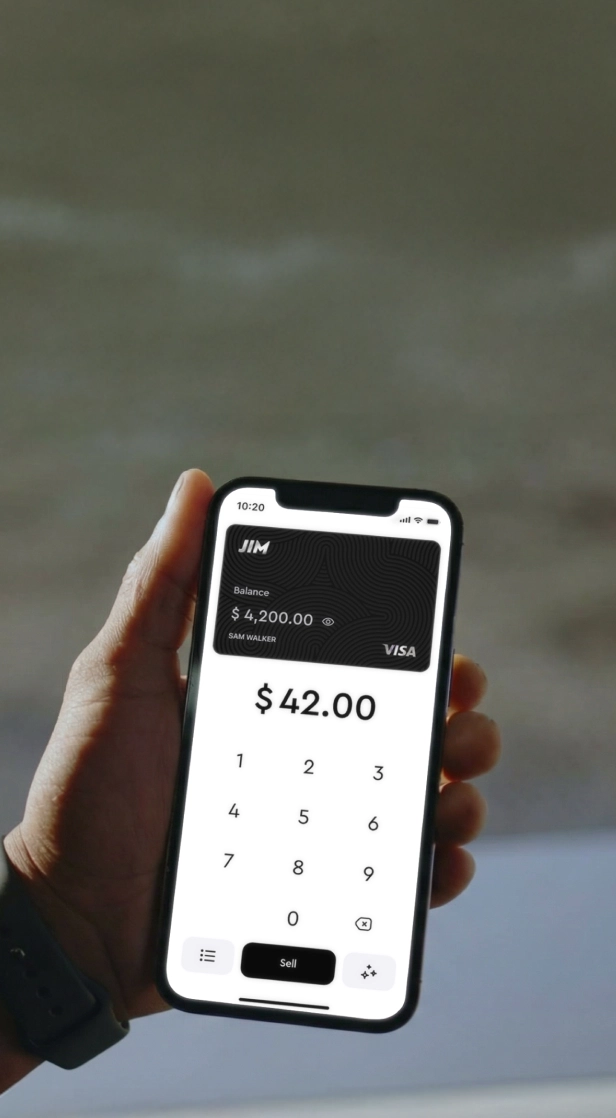
For a service business that accepts payments on the go, JIM offers a streamlined solution. With JIM, you can accept debit, credit, and digital wallets directly through your smartphone. Just tap and you are done. At just 1.99% per transaction with no hidden costs or extra hardware needed, it is particularly useful for collecting payment the moment a job is finished.
Getting started is straightforward:
- Get Started: Download the JIM app for iOS.
- Make a Sale: Type the sales amount, hit sell, and ask your customer to tap their card or device on your phone.
- Access Funds: Your money is available right on your JIM card as soon as the sale is done. There is no wait for bank transfers.
Here are 3 immediate steps to take:
- Decide on your payment terms, such as payment on completion or deposits for large jobs.
- Download the JIM app to see how it works on your phone.
- Calculate how much you would save with JIM's 1.99% rate versus the typical 2.9% on a standard $175 installation.
Step 6: Fund your business and manage finances
Secure your startup funding
Since you do not need a massive loan, you have flexible options. An SBA Microloan can provide up to $50,000, but most service startups borrow around $10,000. Interest rates are typically between 8% and 13%.
Another route is a business credit card with a 0% introductory APR. You can use it to purchase your tools and initial supplies without immediate interest. This is often faster to secure than a traditional loan application.
Set up your financial systems
Once you have funds, open a dedicated business checking account. A frequent misstep is to mix personal and business money, which creates a headache at tax time and can put your personal assets at risk, even with an LLC.
You should plan for about $3,000 to $4,000 in working capital to cover your first six months. This budget accounts for fuel, insurance premiums, and marketing costs before jobs become consistent and your cash flow stabilizes.
Here are 3 immediate steps to take:
- Open a separate business checking account at a local bank or credit union.
- Research SBA Microloan lenders in your area through the SBA's website.
- Compare business credit cards that offer a 0% introductory APR for at least 12 months.
Step 7: Hire your team and streamline operations
Hiring your first technician
Your first hire will likely be a TV Installation Technician. This person handles the installs, interacts with customers, and manages their on-site toolkit. You should look for someone with strong problem-solving skills and a clean driving record.
In most areas, expect to pay a technician between $20 and $35 per hour, depending on experience. A skilled installer can complete two to three jobs per day. A full-time technician should generate between $70,000 and $100,000 in annual revenue for the business.
A low-voltage contractor license is a significant advantage for any applicant. It allows them to legally perform in-wall cable concealment, which unlocks higher-paying jobs and expands your service offerings from the start.
Choosing your scheduling software
Some new owners try to manage jobs with a paper calendar, which can lead to missed appointments and double-bookings. You might want to use field service software from day one to appear more professional and stay organized.
Platforms like Jobber or Housecall Pro let you schedule jobs, dispatch technicians, and send automated reminders to customers. Plans typically start around $49 to $69 per month and can save you hours of administrative work each week.
Here are 3 immediate steps to take:
- Draft a job description for a TV Installation Technician, including responsibilities and desired skills.
- Research the average hourly pay for technicians in your city on sites like Indeed or Glassdoor.
- Sign up for a free trial of a scheduling software like Jobber or Housecall Pro to test its features.
Step 8: Market your business and get customers
Your first move should be to set up a free Google Business Profile. This action puts you on Google Maps. After each job, ask the customer for a review. Aim to get your first 5 to 10 reviews within 30 days to build trust quickly.
Next, create profiles on service marketplaces like Thumbtack and Angi. You will pay for leads, which can range from $15 to $50 each. You might want to start with a small budget to test which platform delivers the best return for you.
Do not overlook neighborhood platforms. A simple post on Nextdoor or in a local Facebook group with a clean photo of your work can bring in your first few clients. This is a low-cost way to build initial momentum and get your name out there.
Build your online presence
A simple one-page website acts as your professional home base. Use a builder like Squarespace or Carrd to list your services, show your pricing, and display a gallery of your best work. This legitimizes your business when customers search for you online.
A mistake many new owners make is not tracking where their customers come from. Make it a habit to ask every client, "How did you hear about us?" This simple question reveals which marketing efforts are worth your time and money.
Another frequent misstep is posting low-quality photos. Your work photos are your portfolio. Use good lighting and take clear shots of every installation. High-quality images on your Google profile can significantly increase customer calls.
Here are 3 immediate steps to take:
- Create and verify your Google Business Profile this week.
- Set up a profile on Thumbtack or Angi and define a weekly lead budget.
- Take high-quality photos of your next three installations for your portfolio.
Step 9: Price your services and create packages
Figure out your baseline price
Your standard installation is your bread and butter. This usually covers mounting a TV up to 65 inches on a drywall surface with no wire concealment. Check competitors on Google and Thumbtack to see what they charge. A price between $125 and $175 is a solid starting point.
Some new installers get caught out by difficult surfaces. You should plan to add a surcharge for brick, concrete, or plaster walls. An extra $50 to $100 is fair, as these jobs take more time and specialized drill bits, so you do not lose money on a tough job.
Develop tiered packages
Once you have your base price, you can build packages around it. This makes it easy for customers to choose. You might offer a "Standard" package for $225 that includes the mount and on-wall cord concealment. A "Premium" package could be $350 and include in-wall wire hiding.
You can also make a healthy profit on materials. If you buy a quality TV mount for $40 from a distributor, you can sell it to the customer for $80 to $100. This 100-150% markup is standard and covers your time for sourcing and stocking parts.
Here are 3 immediate steps to take:
- Research three local competitors and find their price for a standard 55-inch TV installation.
- Create three service tiers with prices for basic, standard, and premium packages.
- List your add-on fees for services like brick wall installation or soundbar mounting.
Step 10: Scale your business and maintain quality
Set your quality standards
Create a post-job quality checklist to ensure every installation is perfect. It should include items like "TV is perfectly level," "all debris is removed," and "customer is shown how to use the mount." This standardizes your service across all jobs.
A frequent oversight is not tracking mistakes. You should monitor your callback rate, which is the percentage of jobs that need a follow-up visit. Aim to keep this rate under 2%. If it climbs higher, it is a sign you need to review your process.
As you grow, you might look into certifications from an organization like CEDIA (Custom Electronic Design and Installation Association). This signals a higher level of professionalism and can justify premium pricing.
Decide when to expand
When you find yourself consistently working over 50 hours a week or turning down several jobs weekly, it is time to hire. That is a clear signal that demand has outgrown your personal capacity. Do not wait until you are completely burned out.
A solid financial benchmark for adding a second van and a full-time technician is when your business generates between $100,000 and $120,000 in annual revenue. This ensures you can comfortably cover the new expenses without straining your cash flow.
Here are 4 immediate steps to take:
- Draft a post-installation quality checklist for every job.
- Calculate your callback rate for the last 30 days.
- Set a revenue goal for when you will hire your first employee.
- Research CEDIA's entry-level certifications for home technology professionals.
You now have the steps to launch your TV mounting business. The key is attention to detail, from a perfectly level TV to a spotless work area. Your focus on quality service is what will set you apart. You have what it takes to get started.
As you finish each job, getting paid should be just as simple. JIM turns your smartphone into a card reader, so you can accept payments on the spot for a flat 1.99% fee with no extra hardware. Download JIM and you are ready to go.
.avif)