Starting a bathing suit line is a rewarding venture that combines creative design with business savvy. The swimwear market is worth billions, with steady demand for new styles for everything from beach vacations and resort getaways to competitive swimming.
This guide will take you through the practical steps of validating your business concept, building supplier relationships, and securing funding to help you launch a successful bathing suit line in the U.S.
Step 1: Plan your business and validate your idea
Market validation
First, confirm people want your designs. Use Google Trends to check search volume for styles like "sustainable swimwear" or "cheeky one-piece." This data shows what customers actively look for.
You can also create mood boards on Pinterest and run polls on Instagram Stories to get direct feedback on your concepts before you spend a dime on production.
Next, analyze your competition. Use platforms like WGSN for professional trend reports. For a direct look at competitor websites, a service like Similarweb reveals their traffic sources and audience demographics.
Budgeting your launch
Speaking of costs, a realistic budget is vital. Initial startup expenses for a small-scale launch typically range from $6,000 to $20,000. Planning for this investment helps manage expectations and secure adequate funding.
Here is a sample breakdown:
- Design & Sampling: $500 - $2,000
- Initial Production (50-100 units/style): $3,000 - $10,000
- E-commerce Website: $1,000 - $5,000
- Branding & Marketing: $1,000 - $3,000
Here are 3 immediate steps to take:
- Analyze search interest for two to three specific swimwear styles using Google Trends.
- Identify three direct competitors and review their website traffic with a tool like Similarweb.
- Draft a preliminary budget with estimated costs for sampling, production, and your website.
Step 2: Set up your legal structure and get licensed
Choose your business structure
An LLC is a solid starting point. It separates your personal assets from business debts and is more flexible than a corporation. You might consider an S Corp later for potential tax savings once your profits grow, but an LLC is simpler to manage initially.
Secure your licenses and permits
First, get an Employer Identification Number (EIN) from the IRS website; it is free and necessary for taxes. Next, apply for a seller’s permit from your state’s department of revenue. This permit allows you to collect sales tax from customers.
Permit costs are usually under $100, with processing times from a few days to two weeks. You will also need a general business license from your city or county, which can cost between $50 and $400 annually. Check your local government's website for specifics.
A frequent oversight is ignoring the Federal Trade Commission's (FTC) Care Labeling Rule. Your swimwear must have labels that specify fiber content and care instructions. Getting this wrong can lead to fines, so confirm the requirements before production.
Here are 4 immediate steps to take:
- Decide if an LLC is the right structure for your launch.
- Apply for a free EIN directly on the IRS website.
- Check your state and city government websites for seller’s permit and business license fees.
- Read the FTC’s Care Labeling Rule to understand swimwear labeling requirements.
Step 3: Insure your business and manage risk
Key insurance policies
Start with general liability insurance, which covers claims like property damage or injury. For a small e-commerce brand, expect to pay $400 to $700 annually for a $1 million policy. This is a foundational layer of protection.
You should also get product liability insurance, often bundled with general liability. It protects you if your swimwear causes harm, like a skin reaction from a dye. This specific coverage is a must-have for any apparel business.
When you look for quotes, consider providers that specialize in e-commerce, such as The Hartford, Hiscox, or Next Insurance. They understand the risks of online retail and can offer tailored packages that fit your budget and needs.
If you plan to hire employees, you will also need workers' compensation insurance. State laws require this coverage, and it protects your business if an employee gets injured on the job. Factor this in as your team grows.
Here are 3 immediate steps to take:
- Request quotes for general and product liability insurance from two providers.
- Confirm that product liability coverage includes issues like fabric dye reactions.
- Budget for annual insurance premiums, which typically start around $500.
Step 4: Set up your workspace and find suppliers
Workspace and equipment
A dedicated 150-250 square foot space in your home can work perfectly. Before you start, check your local zoning laws for home-based business regulations. A quick search on your city’s website will clarify any restrictions on commercial activity in residential areas.
Your main equipment will be an industrial sewing machine and a serger. Expect to invest $800-$2,000 for a machine from a reliable brand like Juki, plus another $400-$1,000 for a serger. For pattern design, Adobe Illustrator is a solid choice for creating digital patterns.
Fabric suppliers and manufacturers
Now that your space is ready, you can source fabrics. For sustainable options like recycled nylon, look at suppliers like Carvico, which uses Econyl yarn. Their minimum order quantities (MOQs) are typically one roll, or about 50-100 yards per color.
For smaller initial runs, suppliers like Spandex World and Spandex House in New York sell fabric by the yard. This approach lets you test designs without a large upfront fabric investment. A frequent misstep is not ordering enough material; always add 10-15% to your order for potential cutting errors.
You can also find a manufacturer to handle production. Platforms like Maker's Row connect you with U.S.-based factories that specialize in swimwear. Many of these partners can also source fabric for you, which simplifies your supply chain significantly.
Here are 4 immediate steps to take:
- Check your local zoning regulations for a home-based apparel business.
- Price out an industrial sewing machine and a serger from brands like Juki.
- Request fabric swatches from a bulk supplier like Carvico and a by-the-yard option like Spandex World.
- Create an account on Maker's Row to browse potential manufacturing partners.
Step 5: Set up your payment processing
Your online store needs a reliable payment gateway. Shopify Payments and Stripe are industry standards that integrate directly with most e-commerce platforms, allowing you to accept all major credit cards. Setup is usually part of your store’s configuration.
Many new owners are surprised by transaction fees, which can eat into profits. Standard rates from most providers often hover between 2.5% and 3.5% plus a fixed fee per sale. Always read the fine print before you commit.
In-person and mobile payments
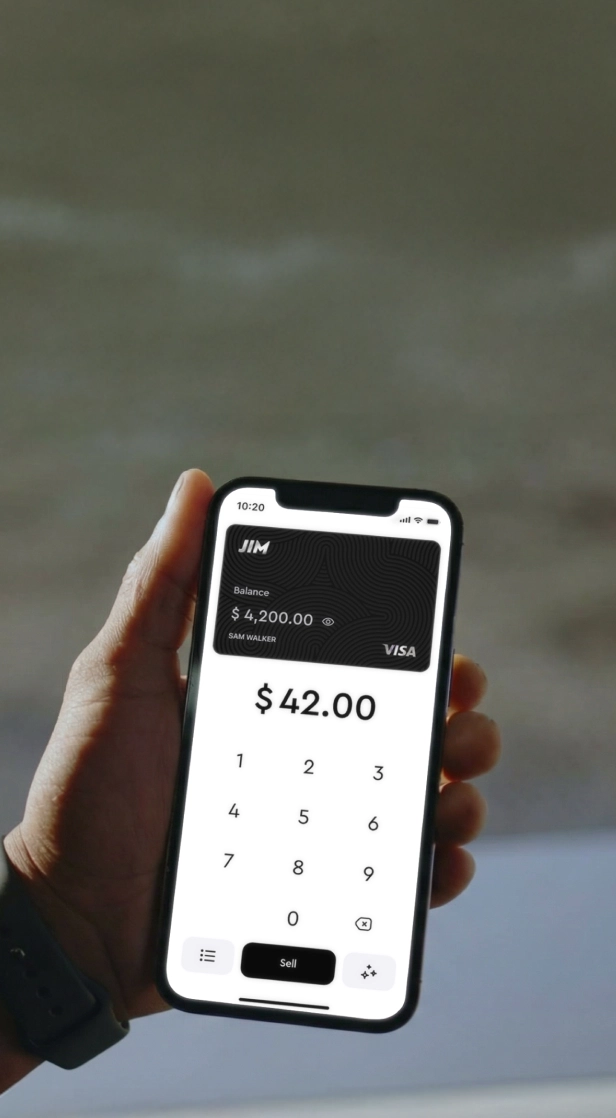
For pop-up shops or market stalls, you need a mobile solution. For bathing suit lines that need to accept payments on-site, JIM offers a streamlined solution. With JIM, you can accept debit, credit and digital wallets directly through your smartphone - just tap and done.
At just 1.99% per transaction with no hidden costs or extra hardware needed, it's particularly useful for selling at beachside events or local fairs. This rate is significantly lower than the average commission from other providers.
Getting started is straightforward:
- Get Started: Download the JIM app for iOS.
- Make a Sale: Type the sales amount, hit sell, and ask your customer to tap their card or device on your phone.
- Access Funds: Your money is available right on your JIM card as soon as the sale is done - no waiting for bank transfers.
Here are 3 immediate steps to take:
- Compare the transaction fees for Shopify Payments and Stripe for your online store.
- Download the JIM app to see if it fits your needs for in-person sales.
- Map out the checkout process for both an online purchase and a potential pop-up sale.
Step 6: Fund your business and manage finances
Secure your startup capital
With your budget planned, the next question is where the money comes from. An SBA microloan is a solid option, offering up to $50,000 with interest rates typically between 8% and 13%. You can apply through an intermediary lender found on the SBA website.
If you need capital faster, online lenders like OnDeck are an alternative, though their interest rates can be higher. You might also consider grants. The Amber Grant for Women, for example, awards funds monthly and is a good fit for small, women-owned businesses.
Manage your cash flow
Many new brand owners focus on launch costs but forget to budget for the first six months of operations. You will need a cash buffer for inventory reorders and marketing before sales become consistent. A good target for working capital is $15,000 to $30,000.
A simple but vital step is to open a dedicated business bank account. This move separates your personal and business finances. It makes tax time much simpler and gives you a clear view of your company's financial health from day one.
Here are 4 immediate steps to take:
- Research SBA microloan requirements and find an intermediary lender on the SBA website.
- Look into the application process for the Amber Grant.
- Calculate your estimated working capital needs for the first six months.
- Open a dedicated business bank account to separate your finances.
Step 7: Hire your team and set up operations
Your first hires
You will likely start by hiring freelancers to keep fixed costs low. A technical designer is a valuable first hire. They translate sketches into production-ready patterns and tech packs. Expect to pay an experienced freelancer between $40 and $75 per hour.
Many new owners hire a general designer instead of a technical one, which can cause expensive sampling errors. You should review portfolios to confirm a candidate has specific experience with swimwear or intricate apparel before you commit.
Streamline your daily operations
As your brand grows, a part-time virtual assistant can manage customer service and social media for $20 to $30 per hour. For project management, platforms like Asana or Monday.com offer free plans to help you track production timelines and marketing tasks.
Once you approach $80,000 to $100,000 in annual revenue, you might consider your first full-time employee. This person usually handles operations and order fulfillment, freeing you to focus on design and growth.
Here are 4 immediate steps to take:
- Draft a job description for a freelance technical designer with swimwear experience.
- Research virtual assistant rates for customer service tasks.
- Set up a free project management board on Asana or Monday.com.
- Define the revenue milestone for hiring your first full-time employee.
Step 8: Market your brand and acquire customers
Leverage social media and influencers
Focus your efforts on visual platforms like Instagram and TikTok. Encourage customers to post photos with a unique hashtag to generate user content. This builds social proof faster than branded posts alone.
You can collaborate with micro-influencers who have 10,000 to 50,000 followers. Their rates are often between $100 and $500 per post, and their audiences are highly engaged. A frequent misstep is to overlook audience alignment, so always vet an influencer’s follower demographics first.
Run targeted paid ads
Once you have organic traction, you might test Facebook and Instagram ads. A small daily budget of $20 is enough to start. Your goal is a low Customer Acquisition Cost (CAC). For swimwear, a CAC between $20 and $60 is a realistic target.
Keep an eye on your website’s conversion rate, which should ideally be 1-2%. If it is lower, you may need to improve your product photos or simplify the checkout process. Also, build your email list from day one by offering a 10% discount for sign-ups.
Here are 4 immediate steps to take:
- Identify five micro-influencers whose audience matches your target customer.
- Set up an email capture pop-up on your website offering a small discount.
- Outline your first Facebook ad campaign with a daily budget of $20.
- Calculate your target Customer Acquisition Cost based on your product margin.
Step 9: Price your swimwear and protect your margins
Calculate your cost and set your markup
First, calculate your Cost of Goods Sold (COGS). This number should include every expense to create one unit: fabric, hardware, labels, manufacturing labor, and freight. For example, if your total cost per suit is $25, that figure is your baseline for pricing.
A standard industry markup is 2.5x to 3x your COGS. A suit with a $25 COGS would retail for $62.50 to $75, which secures a 60-67% gross margin. Many new brands underprice to compete, but this leaves no room for marketing, returns, or future wholesale accounts.
Analyze the market
With a target price in mind, check your competitors. Create a simple spreadsheet and list the prices of similar styles from five other brands in your niche. If your $75 suit is priced far above comparable items, you may need to justify the premium or find ways to lower costs.
Here are 3 immediate steps to take:
- Calculate the full COGS for one of your core swimsuit styles.
- Research and document the retail prices of five direct competitors.
- Apply a 2.5x markup to your COGS to determine your initial retail price.
Step 10: Control quality and scale your business
Quality control standards
You need a clear quality control (QC) checklist for every production run. Inspect for consistent seam strength, colorfastness in chlorine, and fabric pilling. A defect rate below 2% is a solid target for your brand.
A frequent mistake is to only inspect the first few samples. You should check at least 10% of your full order. This practice helps you catch widespread issues before they reach customers and damage your reputation.
Benchmarks for growth
Once you consistently sell 80% of your inventory each season, it is time to scale production. This indicates strong demand and reduces the risk of over-ordering. Plan your next production run with a 20-30% increase in units.
When your annual revenue approaches $100,000, you might hire a full-time operations manager. As you grow, inventory management software like Katana or Cin7 can help you track stock levels and prevent costly sellouts.
Here are 4 immediate steps to take:
- Create a QC checklist covering seam strength, colorfastness, and fit consistency.
- Set an acceptable defect rate for your production runs, aiming for under 2%.
- Define the revenue milestone for hiring a full-time operations manager.
- Research an inventory management system like Katana for when you scale.
You now have a complete guide to launch your bathing suit line. Remember that in swimwear, the right fit is just as important as the design. Get that detail right, and you will build a loyal following. You have the plan; it is time to execute.
When you make those first sales at pop-ups or beach fairs, keep payments simple. JIM lets you accept cards directly on your smartphone for a flat 1.99% fee, with no extra hardware. Download JIM and you are ready to sell anywhere.
.avif)