How to start a billiards business: a founder's playbook

See article summary
- Opening a billiards hall in the U.S. costs $25,000 to $60,000 for a small to mid-size location.
- Plan 4 to 6 months of lead time for licensing, especially when a liquor license is involved.
- An LLC plus a free IRS EIN forms your legal and tax foundation; state and local permits follow.
- Profitability usually arrives in 18 to 24 months once table time and food and beverage margins hold.
- JIM accepts cards on your smartphone at 1.99% per transaction with no extra hardware.
A billiards business is a commercial venue, most often a pool hall or bar-and-billiards room, that earns revenue from hourly table rentals, league fees, food, and beverage sales. Opening one in the U.S. typically costs $25,000 to $60,000 for a small to mid-size hall, takes 4 to 6 months of licensing when alcohol is involved, and reaches profitability in 18 to 24 months when table utilization and food and beverage margins hold up.
The steps below cover market validation, legal structure, insurance, location and equipment, payment processing, funding, staffing, marketing, pricing, and scaling.
How do you validate a billiards business idea?
Research your local market
Start by visiting at least three competing pool halls in your target area. Observe their peak hours, table rates, and league activity. Note the condition of their equipment and the food or drink options they provide. This firsthand look shows you what customers already pay for and where competitors fall short.
A common gap in many markets is a hall that combines well-maintained tables with a food and beverage program. In a two-month competitor audit of three mid-size halls in a 50,000-resident metro, a new operator found that weekday table occupancy averaged under 30% before 5 p.m., while weekend nights ran at full capacity with a 45-minute wait. The takeaway: demand exists on weekends, but the weekday daypart is underused and open to lunch and league play.
Use online maps to identify every potential competitor. Check their customer reviews for common complaints or praise. This helps you spot gaps you can fill. A frequent oversight is picking a spot with low visibility or difficult parking, so map out foot traffic patterns before you sign a lease.
Calculate your startup costs
Startup costs for a small to mid-size hall range from $25,000 to $60,000, not including a bar or kitchen. These figures reflect typical cost ranges reported by operators and industry guides for entertainment venues; your actual costs depend on location, table count, and build-out scope.
Here is a typical breakdown for a small to mid-size hall:
- Lease and renovation: $10,000 to $25,000
- Pool tables (5 to 8 used): $10,000 to $20,000
- Cues, balls, and racks: $2,000 to $5,000
- Licensing and permits: $1,000 to $3,000
- Initial marketing and signage: $2,000 to $6,000
Many new owners forget to budget for ongoing table maintenance, like re-felting, which can cost $300 to $500 per table annually.
Three things to lock down before you go further:
- Visit three local competitors and document their pricing, atmosphere, and peak hours.
- Draft a preliminary budget with low and high estimates for each cost category.
- Research your city's commercial zoning requirements for entertainment venues.
How do you set up your legal structure and get licensed?
First decide on a legal structure. A Limited Liability Company, or LLC, is a popular choice for billiards businesses because it separates your personal assets from business debts. This structure also simplifies your taxes, as profits pass directly to you without being taxed at the corporate level.
Once you have a structure, get your Employer Identification Number, or EIN, from the IRS. It is free and you can apply for an EIN online in minutes. You need this number for taxes and to open a business bank account, a step many overlook early on.
Secure state and local permits
At the state level, register your business name with the Secretary of State. You also need a sales tax permit from your state's Department of Revenue. These registrations typically cost between $100 and $300.
Many owners underestimate the liquor license process. If you plan to serve alcohol, contact your state's Alcoholic Beverage Control (ABC) board immediately. Costs and timelines vary by state. In California, on-premises license annual fees range from about $985 to $1,545 depending on city population, and the state adjusts fees annually for inflation. Source: California Department of Alcoholic Beverage Control license fee schedules. In Texas, TABC reports a processing time of 30 to 35 days from a complete application, with license fees set on a two-year cycle. Source: Texas Alcoholic Beverage Commission licensing process. Plan for several months of lead time and budget anywhere from $1,000 to over $50,000 once you account for application, local, and renewal fees.
Locally, get a general business license from your city or county clerk. Ask about an amusement or entertainment license, which often applies to pool halls. Expect these to cost $50 to $400 and take a few weeks to process.
Handle these four items next:
- Decide on your business structure and file the paperwork with your state.
- Apply for a free EIN on the IRS website.
- Contact your state's ABC board to understand liquor license costs and timelines.
- Check your city's website for business and amusement license applications.
How do you secure insurance and manage risk?
With your legal structure in place, the next step is protecting your investment. The right insurance prevents a single accident from closing your doors. A billiards hall needs a few specific types of coverage.
Key insurance policies
General liability is your baseline. It covers customer injuries, like a slip and fall. A $1 million policy is standard, with annual premiums from $600 to $2,500. Property insurance protects your tables, cues, and building. Ensure your policy covers the full replacement cost of your equipment.
If you have employees, you must have workers' compensation insurance. If you serve alcohol, you need liquor liability insurance. Many owners mistakenly believe general liability covers alcohol-related incidents, but it does not. This add-on can cost an extra $500 to $4,000 per year.
Get quotes from providers like The Hartford or Hiscox, or use a broker like Insureon. They understand the risks for entertainment venues and can bundle policies for a better rate. A general agent may not find you the best coverage for your specific needs.
Get these four insurance tasks done before signing a lease:
- Request quotes for a $1 million general liability policy.
- Create an inventory of your equipment to get an accurate property insurance quote.
- Ask your insurance agent about adding a liquor liability rider if you plan to serve alcohol.
- Contact a broker who specializes in hospitality or entertainment businesses.
How do you find a location and buy equipment?
For a small hall with 5 to 8 tables, look for a space between 2,500 and 4,000 square feet. This allows for a regulation playing area around each table, plus room for a bar and seating. Check your city's zoning laws for areas approved for commercial or entertainment use.
When you talk to landlords, ask about the floor's load-bearing capacity. Pool tables are heavy. A common oversight is to sign a lease without confirming the floor can support the weight. Negotiate a 5-year lease with an option to renew, which protects your renovation investment.
Source your equipment
With your location requirements clear, focus on equipment. Commercial-grade tables are a must. They withstand heavy use much better than residential models. Find quality used 9-foot tables for $1,500 to $3,000 each, while new ones can exceed $4,000.
You also need house cues, ball sets, and racks. Budget around $1,500 for these initial supplies. Look at suppliers like Brunswick or Diamond Billiards, or find a local distributor who can offer package deals and installation services.
Four moves to nail down your space and equipment:
- Calculate your total required square footage based on the number of tables you plan to have.
- Review your city's zoning map for areas designated for entertainment venues.
- Ask potential landlords about floor load capacity and lease terms.
- Get quotes for used commercial-grade tables from two different suppliers.
How do you set up payment processing?
Your customers will expect to pay with credit and debit cards, so a reliable payment system is non-negotiable. You also need a way to manage recurring payments for league members or take deposits for private events, which requires some planning upfront.
When you compare payment solutions, look closely at transaction fees. Many providers charge 2.5% to 3.5% per swipe, plus monthly fees. A common mistake is to sign up for a system that requires expensive, proprietary hardware you may not need.
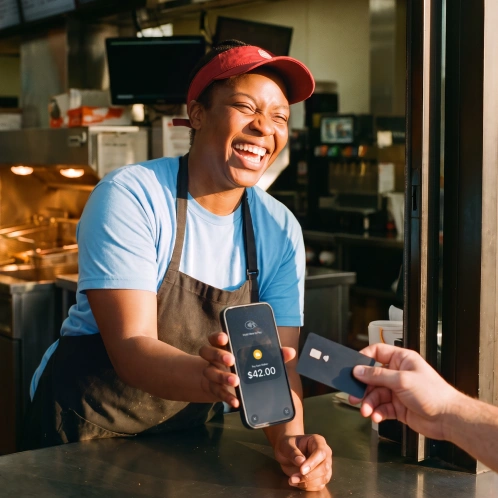
For a streamlined solution, consider JIM. You can accept contactless payments with debit, credit, and digital wallets directly on your smartphone, just tap and done. At 1.99% per transaction with no hidden costs or extra hardware, it works for collecting league dues on the spot.
This rate is competitive, as many other providers charge between 2.5% and 3.5% per transaction. Here is how JIM compares on in-person card rates:
| Solution | In-person rate | Hardware cost | Settlement | | --- | --- | --- | --- | | JIM | 1.99% | None (Tap to Pay on iPhone) | Instant to JIM card | | Square | 2.6% + 15¢ | $0 to $799 | One to two business days | | Traditional merchant account | 2.5% to 3.5% + 10¢ to 30¢ | $200 to $2,000+ | One to three business days |
Source: Square's official website, accessed August 2026.
Here is how JIM works:
- Get started: Download the JIM app for iOS.
- Make a sale: Type the sales amount, hit sell, and ask your customer to tap their card or device on your phone.
- Access funds: Your money is available right on your JIM card as soon as the sale is done, no waiting for bank transfers.
Wrap up payments with these three steps:
- Compare transaction fees from at least two payment providers.
- Plan how you will collect recurring league fees or event deposits.
- Download the JIM app to explore a mobile-first payment option.
How do you secure funding and manage your finances?
For funding, an SBA 7(a) loan is a common path. The SBA 7(a) loan program offers up to $5 million, and lenders set interest rates that cannot exceed SBA maximums pegged to the prime rate. For variable-rate loans over $350,000, the maximum is the base rate plus 3.0%; for smaller loans, the cap is higher. Lenders typically want to see a strong business plan and a credit score above 680.
Another path is equipment financing. Since the pool tables serve as collateral, these loans can be easier to secure. Approval is faster, but expect interest rates between 8% and 20%. This option helps you preserve cash for other startup needs.
Plan your working capital
Many new owners focus on startup costs but forget about day-to-day expenses. Have enough working capital to cover at least six months of rent, utilities, and payroll. For a small hall, this means having $15,000 to $30,000 in the bank before you open.
Once you secure funding, open a dedicated business bank account immediately. This keeps your personal and business finances separate, which simplifies tax time. Use accounting software like Wave or QuickBooks Online to track your income and expenses from day one.
Four things to sort out on the funding front:
- Draft a business plan to prepare for an SBA 7(a) loan application.
- Contact a lender that offers equipment financing to get a quote.
- Calculate your estimated operating expenses for the first six months.
- Open a separate business bank account for your billiards hall.
How do you hire staff and set up operations?
Build your team
You will likely need two key roles to start: a hall manager and a bartender. A hall manager handles schedules, inventory, and league coordination, with a typical salary of $35,000 to $50,000 annually. Bartenders serve customers and manage payments, earning minimum wage plus tips.
If you serve alcohol, your staff must have an alcohol server certification. Look into programs like TIPS or ServSafe. A lot of new owners try to run the whole show alone, but this often leads to burnout. To avoid this, hire even one part-time employee to focus on business growth.
Manage your daily operations
For staff schedules, use software like Homebase or 7shifts. They offer free or low-cost plans for a small team and help you manage shifts easily. Create simple opening and closing checklists to ensure consistency for your team.
As you plan your budget, aim to keep labor costs between 25% and 35% of total revenue. During non-peak hours, one employee can often manage the floor. For busy weekend nights, you need at least two people to keep service smooth and customers happy.
Set up your team with these four actions:
- Draft job descriptions for a hall manager and a bartender.
- Research your state's requirements for alcohol server certifications like TIPS.
- Compare the free plans for scheduling software like Homebase and 7shifts.
- Create a simple checklist for your daily opening and closing procedures.
How do you market your business and attract customers?
Build an online and local presence
Start with Facebook and Instagram to showcase your hall. Run targeted ads to locals interested in billiards for as little as $5 a day. Claim your Google Business Profile and fill it out completely. This is how most new customers find you.
Partner with nearby restaurants. Offer a 15% discount on table time to customers who show a receipt from a partner business. This is a low-cost way to get referrals and build local relationships from day one.
Host events to create community
Weekly events create a reliable customer base. Host an 8-ball tournament every Tuesday with a $10 entry fee and a $100 prize. This fills tables on a slow night and builds a community that keeps people coming back.
A frequent misstep is not promoting events enough. You have to actively market them. Announce tournaments at least a week in advance on social media and with in-house flyers to ensure a good turnout. A grand opening special also generates initial buzz.
Four moves to get your name out there:
- Claim and complete your Google Business Profile.
- Plan a weekly tournament with a clear prize structure.
- Contact two local restaurants to propose a cross-promotion.
- Design a simple flyer for your grand opening event.
How do you set pricing and maximize profit?
Choose your pricing model
Most halls charge by the hour. A good starting point is $12 to $18 per hour for a standard table. Use dynamic pricing, with rates closer to $20 per hour on busy Friday and Saturday nights. This maximizes revenue during peak times.
Another option is a flat rate per game, but this makes income less predictable. Some owners underprice their tables to attract crowds, but this can devalue your hall and hurt profits. Set a price that reflects the quality of your equipment and atmosphere.
Is a billiards business profitable?
A billiards hall can be profitable, but margins depend on how well you fill weekday hours and how much revenue comes from food and beverage. Table time alone rarely covers rent and payroll. Food and beverage sales carry higher profit margins and often make the difference between a hall that breaks even and one that turns a profit.
For food, aim for a cost of goods sold (COGS) between 28% and 35%. For beer and wine, your target COGS should be closer to 20% to 25%. Source: National Restaurant Association 2025 Restaurant Operations Data.
With your pricing model in mind, you can build a simple menu. If a burger and fries cost you $4 to make, a menu price of $12 to $14 hits that 30% food cost target. This is where you can boost your overall profitability.
Revenue model for a 6-table hall
Here is a worked example for a small 6-table hall. Figures are illustrative for planning, not guarantees of actual results.
| Revenue stream | Assumption | Monthly estimate | | --- | --- | --- | | Table time | 6 tables, $15/hr avg, 35% occupancy, 10 hrs/day | $9,450 | | League fees | 4 leagues, 8 teams, $120/team per season | $320 | | Food and beverage | 30% of total revenue at 70% gross margin | $5,500 | | Total revenue | | $15,270 | | Rent and utilities | | $3,800 | | Labor | 25% of revenue | $3,800 | | COGS (food and beverage) | 30% of F&B revenue | $1,650 | | Insurance and maintenance | | $700 | | Total expenses | | $9,950 | | Net profit | | $5,320 |
At this run rate, a hall that invested $45,000 to open reaches break-even in roughly 9 to 12 months. Most operators report 18 to 24 months to full payback once you account for slower ramp-up and one-time costs.
Four steps to finalize your pricing model:
- Call three local competitors to confirm their hourly table rates.
- Create a simple spreadsheet comparing weekday versus weekend pricing.
- Draft a small menu and set prices to achieve a 30% to 35% food cost.
- Plan a weekly special, like a burger and billiards combo, to test your pricing.
How do you maintain quality and scale your business?
Establish your quality benchmarks
Your equipment is your reputation. Commercial tables need re-felting every 12 to 18 months, and you should check that they are level weekly. Many owners let maintenance slip, but regulars will notice a slow or uneven table right away.
For service, aim for a Google review average of 4.5 stars or higher. Track repeat business. If fewer than 40% of your weekend customers are regulars after six months, re-evaluate your customer experience.
Plan your growth
With your quality standards set, look for signs it is time to expand. A good benchmark for adding more tables is when you hit 70% occupancy during peak hours for two consecutive months. This signals consistent demand beyond your current capacity.
When you spend more time on daily tasks than on growth, hire a hall manager. For organizing tournaments and leagues, use software like Leaguesecretary.com to automate scheduling and track standings, which frees up your time.
Four actions to protect quality and plan growth:
- Create a weekly checklist for table maintenance and leveling.
- Set a goal to achieve and maintain a 4.5-star Google review average.
- Calculate your table occupancy rate for Friday and Saturday nights.
- Review league management software like Leaguesecretary.com.
Starting a billiards hall is about more than just tables. Success comes from creating a community hub where people feel welcome. Consistent quality and a great atmosphere keep your regulars coming back. You have the roadmap, now make it happen.
When it comes to payments, keep it simple. JIM lets you accept cards right on your smartphone for a flat 1.99% per transaction, no extra hardware needed. This makes it easy to manage everything from table time to league fees. Download JIM and you are ready to go.
Frequently Asked Questions
How much does it cost to start a billiards business?
What licenses do I need to open a pool hall?
Is a billiards business profitable?
How long does it take to open a billiards hall?
How much space do I need for a pool hall?




Sell and get paid in seconds with Jim