Starting a business that sells hair products is a rewarding venture, blending a passion for hair care with sharp business savvy. The hair care market is worth hundreds of billions of dollars, fueled by consistent demand from people with diverse hair types, styling preferences, and specific treatment needs.
This guide will walk you through the practical steps, from validating your business concept and building supplier relationships to acquiring inventory and securing funds, to help you launch a successful hair product business in the U.S.
Step 1: Create your business plan and validate your concept
Find your market niche
You might want to start by defining a specific customer. Instead of a general hair care line, focus on a niche like products for color-treated curly hair or scalp treatments for men. Use social media trends and databases like Mintel to spot unmet needs.
Many new owners make the mistake of going too broad. A narrow focus helps your brand stand out and makes marketing much more effective from day one.
Analyze the competition
Once you have a niche, look at who is already there. You can use a platform like SEMrush to see what keywords your online competitors target. Also, spend time on retail sites like Sephora and Ulta to study their product descriptions, reviews, and pricing.
Estimate your startup costs
With this in mind, you can build a preliminary budget. The initial investment requires careful planning. Expect startup costs to range from $10,000 to over $40,000, depending on your scale and product complexity.
- Product Formulation: $3,000 - $10,000+ for custom formulas.
- Initial Inventory: $5,000 - $15,000 for your first production run.
- Branding and Packaging: $2,000 - $7,000.
- Website and E-commerce: $1,000 - $5,000.
- Business Registration: $300 - $800.
Here are 3 immediate steps to take:
- Define your target customer and the one problem you solve for them.
- Analyze three direct competitors, noting their prices and marketing angles.
- Create a spreadsheet to draft your initial budget based on these estimates.
Step 2: Set up your legal and regulatory framework
With your business concept defined, the next move is to make it official. Choosing the right legal structure is a foundational decision. Most new hair product entrepreneurs start with a Limited Liability Company (LLC) for its simplicity and protection.
Choose your business structure
An LLC separates your personal assets from business debts and offers pass-through taxation. You can file for an LLC with your Secretary of State for about $50 to $500. Once approved, get a free Employer Identification Number (EIN) from the IRS.
A common misstep is mixing personal and business funds. Use your new EIN to open a separate business bank account immediately. This maintains your liability protection and makes bookkeeping much cleaner from the start.
Navigate industry regulations and permits
Now for the rules. The U.S. Food and Drug Administration (FDA) oversees hair products as cosmetics. You do not need pre-market approval, but you must ensure your products are safe and your labels are truthful under the Fair Packaging and Labeling Act (FPLA).
You will also need local permits. Plan to get a general business license from your city or county, which is typically $50 to $100 annually. In addition, you must obtain a seller's permit from your state to collect sales tax. This is usually free but can take a few weeks to process.
Here are 4 immediate steps to take:
- Select a business structure and file the paperwork with your Secretary of State.
- Apply for a free Employer Identification Number (EIN) directly from the IRS.
- Open a dedicated business bank account to keep finances separate.
- Review the FDA’s cosmetic labeling guide to ensure your packaging is compliant.
Step 3: Secure your business insurance
Protecting your new venture from risk is a practical necessity. For a hair product business, the primary concern is liability. If a customer has an allergic reaction or claims your product caused damage, the financial fallout could be significant without the right coverage.
Key insurance policies to consider
You will want to secure a General Liability policy, but many new owners don't realize this often excludes claims related to the product itself. For that, you need Product Liability insurance. These are frequently bundled together, with a $1 million policy costing between $500 and $1,500 annually.
If you hold inventory, you should also add Commercial Property insurance to protect your stock from theft or damage. Once you hire your first employee, you will be legally required to have Workers' Compensation insurance in most states.
You can get quotes from insurers that focus on small businesses, such as Hiscox, The Hartford, and Next Insurance. They understand the risks associated with e-commerce and cosmetic sales and can help you find a suitable plan.
Here are 3 immediate steps to take:
- Get quotes for a combined general and product liability policy with at least $1 million in coverage.
- Compare plans from two providers that specialize in e-commerce, like Hiscox or Next Insurance.
- Confirm with an agent that your policy specifically covers claims from adverse customer reactions.
Step 4: Secure your workspace and equipment
Find your operational base
Your first workspace can be simple. A dedicated room in your home or a small 10x10 storage unit (100 sq. ft.) is often enough to start. Check your local city ordinances for rules on home-based businesses that store inventory, as some residential zones have restrictions.
If you decide to lease a commercial space, try to negotiate a shorter initial term, like one or two years. This gives you flexibility. Many new owners get locked into long leases before they know their actual space requirements, which can strain cash flow.
Get your fulfillment gear
You will need specific equipment to manage and ship orders efficiently. Plan to acquire a few key items to create a small-scale fulfillment station. Your initial investment here can be modest, under $1,000 for everything.
- Industrial Shelving: $150 - $400 to organize inventory.
- Digital Shipping Scale: $30 - $60 for accurate postage.
- Thermal Label Printer: $150 - $250 (e.g., a Rollo or Dymo) to avoid ink costs.
- Initial Packing Supplies: $200+ for boxes, mailers, and filler.
Source your packaging
Now, consider your product containers. Suppliers like Uline or Berlin Packaging offer stock bottles and jars. A mistake some founders make is ordering thousands of custom-printed bottles to lower the per-unit cost. This ties up a lot of money in packaging.
Start with stock packaging and use labels for branding. Minimum order quantities (MOQs) for stock items are often much lower, sometimes just a few hundred units. This approach lets you test the market without a huge upfront packaging commitment.
Here are 3 immediate steps to take:
- Review your city’s zoning rules for home-based business inventory.
- Create a budget for shelving, a shipping scale, and a thermal label printer.
- Get quotes from a supplier like Uline for 500 stock bottles or jars.
Step 5: Set up your payment processing
Choose your payment processor
Your online store needs a payment gateway to accept credit cards and digital wallets. Processors like Stripe and PayPal integrate directly with e-commerce platforms. Most will charge a percentage plus a flat fee per transaction.
Many new owners overlook the total cost of fees. Standard commission rates often hover between 2.5% and 3.5%. You should look for a provider with transparent pricing, as some add monthly charges that can reduce your profit margins.
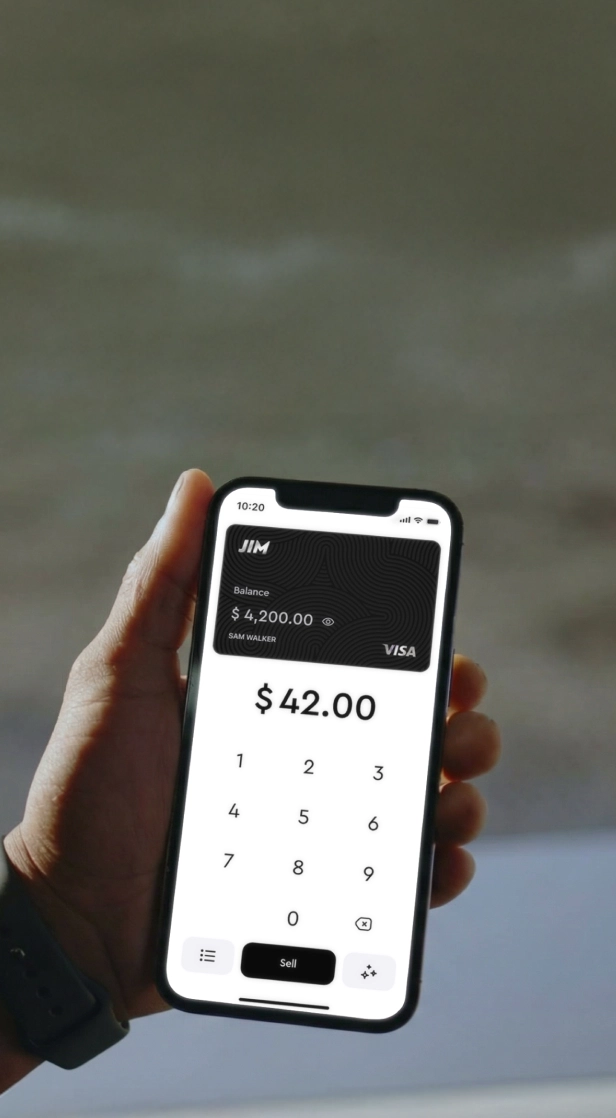
Now, for businesses that need to accept payments on-site or on-the-go, JIM offers a streamlined solution. With JIM, you can accept debit, credit, and digital wallets directly through your smartphone. Just tap and the sale is done.
At just 1.99% per transaction with no hidden costs or extra hardware needed, it is particularly useful for sales at local markets or pop-up events. This rate is much lower than what many other providers offer.
Here is how to use it:
- Get Started: Download the JIM app for iOS.
- Make a Sale: Type the sales amount, hit sell, and ask your customer to tap their card or device on your phone.
- Access Funds: Your money is available right on your JIM card as soon as the sale is done. There is no wait for bank transfers.
Here are 3 immediate steps to take:
- Compare transaction fees for two online payment gateways like Stripe and PayPal.
- Download the JIM app to explore its interface for potential in-person sales.
- Check if your chosen processor supports recurring billing if you plan to offer subscriptions.
Step 6: Secure your funding and manage finances
Find your startup capital
SBA Microloans are a solid option for new businesses. These loans range from $500 to $50,000, with interest rates typically between 8% and 13%. Lenders often prioritize a strong business plan over extensive collateral, which is helpful for new entrepreneurs.
You might also look into grants. Programs like the Amber Grant for Women or the NASE Growth Grant award funds to small businesses. These are highly competitive, so pay close attention to application deadlines and specific requirements.
Plan your working capital
With funding in mind, you need to budget for your first six months. Many new owners focus only on the initial inventory purchase and forget about the costs to keep the business running. This can stall growth right after launch.
Plan for at least $5,000 to $15,000 in working capital. This should cover inventory replenishment, marketing campaigns to attract your first customers, and ongoing operational costs like shipping supplies. A low marketing budget is a frequent misstep.
Here are 3 immediate steps to take:
- Research the eligibility criteria for an SBA Microloan on the SBA website.
- Create a six-month working capital budget that includes marketing and inventory costs.
- Identify one industry-specific grant, like the Amber Grant, and note its next application window.
Step 7: Hire your team and set up operations
Define your first hires
You will likely start as a solo operator, but you should plan for your first hire. A part-time Fulfillment Associate can take over packing and shipping for $15 to $20 per hour. This frees you up to focus on growing the business, not just running it.
Many founders also bring on a freelance Social Media Manager early. For a retainer of $500 to $1,500 a month, they can manage your content and community. This is a task that consumes a lot of time but is easy to delegate.
Streamline your daily workflow
You do not need complex management software at this stage. A shared Google Calendar for scheduling and a spreadsheet for tasks will work fine. If you hire an employee, use a payroll service like Gusto to handle taxes and payments correctly from day one.
A frequent misstep is trying to do everything yourself for too long. This leads to burnout and stalls growth. As a benchmark, aim for a revenue-per-employee ratio of over $150,000. Outsourcing tasks helps you reach that goal faster.
Here are 3 immediate steps to take:
- List five tasks you could delegate in the next three months.
- Draft a simple job description for a part-time Fulfillment Associate.
- Explore a payroll service like Gusto to understand employer tax obligations.
Step 8: Market your products and acquire customers
Create your content engine
Start with TikTok and Instagram Reels. Short-form video is powerful for hair products. Post tutorials, before-and-after results, and user-generated content. A brand like Olaplex built its reputation on stylists and customers sharing results organically.
Next, build an email list from day one. Use a platform like Klaviyo to capture emails on your site. You should aim for an initial email open rate of 20% to 25% for your welcome series.
Invest in targeted ads
Once you have organic traction, run Meta Ads. Target users based on interests like "curly hair care" or "natural hair." A healthy Customer Acquisition Cost (CAC) for a new e-commerce brand is often between $25 and $50.
Many founders burn cash on ads too early. You should confirm your product sells organically before you scale with paid traffic. Your first $1,000 in sales should come from your network and organic content, not ads.
Here are 4 immediate steps to take:
- Create a content calendar with 10 video ideas for TikTok or Instagram Reels.
- Set up a Klaviyo account and create a pop-up to collect emails on your website.
- Research three competitors in the Meta Ad Library to analyze their campaigns.
- Calculate your target Customer Acquisition Cost based on your product price and profit margin.
Step 9: Price your products and manage inventory
Set your pricing strategy
A common approach is cost-plus pricing. Calculate your Cost of Goods Sold (COGS)—including ingredients, packaging, and labor—then multiply it. A 3x to 5x markup is typical for hair products, which yields a 60% to 80% gross margin.
For example, if your COGS for a shampoo is $4, a 4x markup sets the retail price at $16. You might also consider value-based pricing for unique formulas, where the price reflects the results you deliver, not just the cost to produce.
Many new owners make the mistake of underpricing to attract customers. This can signal low quality and leave no room for marketing spend or wholesale discounts. Price confidently based on your brand's value and your financial needs from the start.
Manage your initial inventory
You can manage your first batch of products with a simple Google Sheet. Track each Stock Keeping Unit (SKU), current quantity, and the cost per unit. This helps you know exactly when to reorder before you run out of a popular item.
Use the "First-In, First-Out" (FIFO) method. This means you sell your oldest inventory first, which is important for cosmetics that have a shelf life. Aim to hold enough stock to cover 60 to 90 days of sales to balance availability with cash flow.
Here are 4 immediate steps to take:
- Calculate the Cost of Goods Sold (COGS) for one of your main products.
- Analyze the prices of three direct competitors for a similar product.
- Set a test price for your product using a 3x or 4x markup.
- Create a spreadsheet to track your initial inventory levels by SKU.
Step 10: Implement quality control and scale your operations
Establish your quality standards
To ensure product consistency, retain a sample from every batch you produce for at least two years. Before bottling, check and log the pH and viscosity. This simple check helps you catch deviations before a product reaches the customer.
You should also perform stability testing on new formulas to confirm their shelf life. For safety, send a sample from your first few production runs to a lab for microbial testing. This costs about $100 to $300 per test but confirms your preservative system works.
Know when to scale
Once you consistently ship 15-20 orders per day, it is time to hire part-time help for fulfillment. Many founders wait too long and burn out on packing boxes instead of growing the business. Your first hire frees you to focus on marketing and product development.
When your production demand exceeds 1,000 units per month, start looking for a contract manufacturer. This move allows you to produce at a larger scale. As your inventory grows, a spreadsheet will not be enough. Use inventory management software like Katana to track raw materials and finished goods.
Here are 4 immediate steps to take:
- Create a quality control log to track the pH and viscosity of each batch.
- Set a calendar reminder to review your customer complaint and return rates monthly.
- Identify a benchmark, like 20 daily orders, for when you will hire help.
- Research two contract manufacturers that specialize in hair care products.
Starting your hair product line is a journey of details, from formulas to finances. Remember that your brand's story is as important as the product itself. Connect with your niche, solve their problem, and you will build a loyal following. You have the steps, now go make it happen.
As you start to make sales, especially at markets or pop-ups, you will need a simple way to get paid. JIM turns your phone into a card reader for a flat 1.99% fee, with no extra hardware. Download JIM and be ready for your first sale.
.avif)