How to Start a Chocolate-Covered Strawberry Business
See article summary
- Startup costs run $500 to $1,500 for equipment, ingredients, packaging, and licenses.
- Most home sellers operate under a state cottage food law with an annual revenue cap.
- Use a 200 to 300% markup to target a 65 to 75% gross margin per dozen.
- Demand peaks around Valentine's Day and Mother's Day, so plan inventory early.
- Take in-person payments with JIM at a flat 1.99% fee and no hardware.
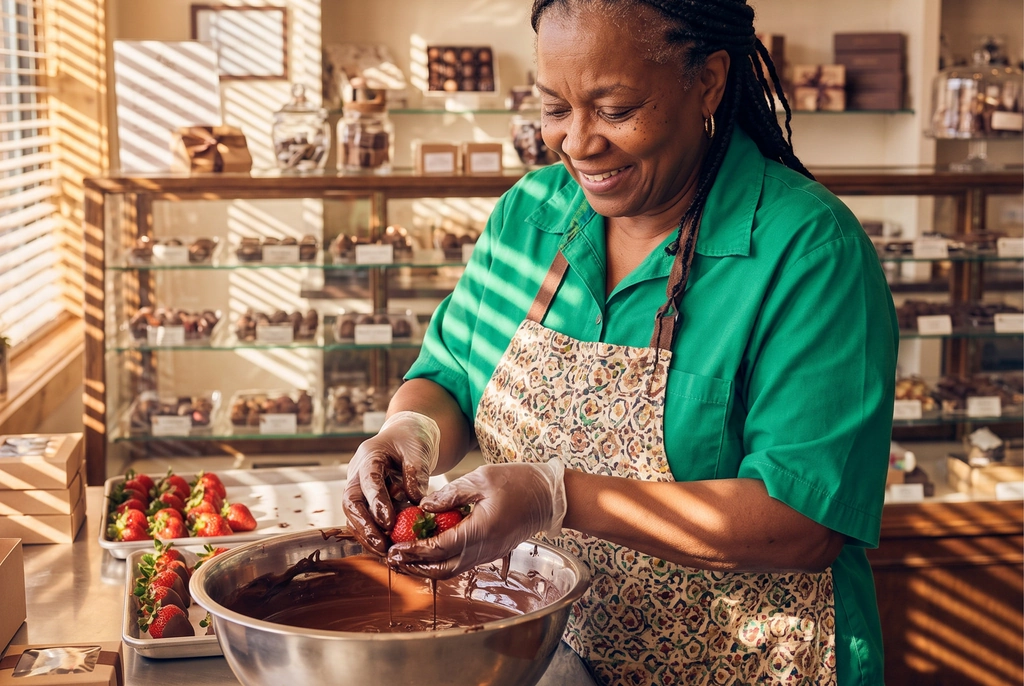
A chocolate-covered strawberry business launches for $500 to $1,500, turns a 200-300% markup on each berry, and hits a hard revenue ceiling under your state's cottage food law. Demand spikes around Valentine's Day and Mother's Day, and the product lasts just 24 to 48 hours refrigerated, so the real work is operations, not the recipe.
The biggest mistake new sellers make is treating this like a baking hobby instead of a perishable-goods operation. The strawberries set your schedule, your delivery radius, and your pricing, so get the legal structure, licensing, and payment setup right first and let the production follow.
1. How do you validate a chocolate strawberry business idea?
Validate demand before you buy ingredients. Visit local bakeries, gift shops, and farmers' markets to record competitor pricing, packaging, and product quality, then search Instagram, Etsy, and Google Trends for "chocolate covered strawberries" in your city or state to confirm search interest and see how crowded the local market is.
Estimate your startup costs
Budget $500 to $1,500 to start. A common mistake is buying bulk supplies before you know what sells, so begin with small quantities of chocolate and packaging, test a few designs, and reorder only what moves.
A typical cost breakdown looks like this: kitchen equipment such as melting pots and dipping tools runs $200 to $500, initial ingredients cost $150 to $300, packaging costs $100 to $250, and business licenses run $50 to $400 depending on your location. Track every expense from day one so you know your true cost per berry before you set prices.
Before you move on, research pricing at three local competitors, draft a startup budget, check Google Trends demand for your state, and make a small test batch for honest feedback from friends and family.
2. What licenses and permits do you need to sell chocolate strawberries from home?
You need a registered business entity, a state tax ID, a local business license, and food safety certification that satisfies your state's cottage food law. Most home-based food sellers register as a Limited Liability Company, or LLC, because it separates personal assets from business debts and passes profits through to your personal tax return, which keeps paperwork simpler than a corporation. State filing fees typically run $50 to $500, and the Small Business Administration walks through how to register your business and choose a structure state by state.
Understand your state's cottage food law
A cottage food law is a state regulation that allows certain non-potentially-hazardous foods to be produced in a home kitchen and sold directly to consumers, often with a cap on annual gross revenue. Those caps vary widely: some states limit sales to about $20,000 a year, while others allow up to $250,000, and several states have raised their limits recently, so confirm the exact figure and allowed sales channels with your state department of agriculture. The National Agricultural Law Center tracks cottage food law changes by state, including which products are allowed and whether direct-to-consumer or wholesale sales are permitted. A common mistake is assuming you can sell anywhere, but many cottage food laws restrict sales to direct, in-person channels and forbid wholesale or shipping.
Get your food safety certification
You will also need a general business license from your city or county and a Food Handler's Permit. The permit requires a short course from an ANSI-accredited provider, and course fees typically run $10 to $25 online, with renewal every two to three years depending on your jurisdiction. The training standards trace back to the FDA Food Code, which sets the model food safety rules most states adopt. Your local public health department enforces these standards, so confirm its requirements for home kitchen surfaces and sanitation before you produce.
If you form an LLC or hire employees, you also need an Employer Identification Number, or EIN, which you can get free from the IRS in minutes.
Before you move on, register your LLC with your secretary of state, look up your state's cottage food revenue cap and allowed sales channels, apply for a local business license, and complete an ANSI-accredited Food Handler's course.
3. What insurance does a chocolate strawberry business need?
Your first policy is General Liability Insurance, which covers you if a customer has an allergic reaction or gets sick. A $1 million policy is standard for small food businesses, and premiums vary by state, coverage level, and insurer, so request quotes rather than relying on a single number. This policy usually includes Product Liability coverage, which matters for any food you sell.
Do not assume your personal car insurance covers deliveries, because most personal policies exclude business use. If you use your vehicle for deliveries, you need a Commercial Auto policy to stay covered during a delivery run.
As you grow and hire help, Workers' Compensation insurance becomes legally required in most states for employers and covers employee injuries on the job. Consider Inland Marine insurance as well to protect your finished goods from damage or theft during transport.
When you shop for policies, look for providers that underwrite food businesses, since they understand the contamination and spoilage risks specific to small-scale food production.
Before you move on, get a quote for a $1 million General Liability policy, review your auto policy for a business-use exclusion, check your state's Workers' Compensation requirements, and compare quotes from at least two providers.
4. How do you set up a workspace and choose equipment?
Start lean with a dedicated home kitchen space and a few core tools, then add equipment only when your order volume justifies it. Under cottage food rules your home kitchen is your workspace, so dedicate a clean, organized area of at least 50 to 100 square feet and confirm your local health department's requirements for surfaces and sanitation.
Master tempering without a machine
Tempering is the process of heating and cooling chocolate to stable crystal temperatures so it sets with a shiny finish and a firm snap. You can temper on your stovetop with a digital thermometer instead of buying a machine, which saves you more than $500 at launch. Working temperatures for tempered chocolate are dark 88 to 90°F, milk 84 to 86°F, and white 82 to 84°F. Master these ranges before you invest in a dedicated tempering machine, and put the savings into quality ingredients.
Acquire your production equipment
A chocolate melting pot or double boiler runs $30 to $100, and dipping tools, silicone mats, and cooling racks total $50 to $150. Resist buying every specialty mold you see, since the fundamentals produce most of your early orders.
For chocolate, bulk suppliers such as Callebaut and Guittard sell in 5- to 10-pound bags, and packaging companies such as Uline and Paper Mart offer boxes, inserts, and ribbons. Order samples before you commit to a large quantity so you can test fit and presentation.
Plan around shelf life and delivery
Dipped strawberries keep for 24 to 48 hours refrigerated and enter the USDA "Danger Zone" between 40 and 140°F, where bacteria double every 20 minutes. Never leave them at room temperature longer than 2 hours, so plan same-day delivery or pickup within a tight window and build your production schedule backward from the delivery time. The USDA Food Safety and Inspection Service explains the Danger Zone and the 2-hour rule in full.
Before you move on, designate a 50 to 100 square foot workspace, buy a melting pot and basic dipping tools, practice tempering with a digital thermometer, request a bulk chocolate price list, and order sample boxes and inserts.
5. How do you handle payment processing and deposits?
Require full payment upfront for online orders and a 50% non-refundable deposit on larger custom event orders to protect yourself if a client cancels after you have bought ingredients. JIM is the payment solution featured in this guide because its flat rate fits a low-volume, mobile food business.
Compare in-person payment rates
Traditional card processors charge 2.6% to 2.7% plus a per-transaction fee for in-person sales, and many add hardware or monthly costs. JIM charges a flat 1.99% per Tap to Pay sale with no hardware and no monthly fee, which is why it fits farmers' market booths and local deliveries.
<figure>
| Provider | In-person rate | Hardware needed |
|---|---|---|
| JIM | 1.99% flat (Tap to Pay) | None, uses your phone |
| Square | 2.6% + $0.15 | Reader or terminal |
| Stripe Terminal | 2.7% + $0.05 | Reader or terminal |
| PayPal Zettle | 2.29% + $0.09 | Reader or terminal |
Sources: JIM, Square, Stripe, and PayPal official websites, accessed August 2026. Rates shown are for in-person, card-present transactions and may change.
</figure>
Accept payments with JIM
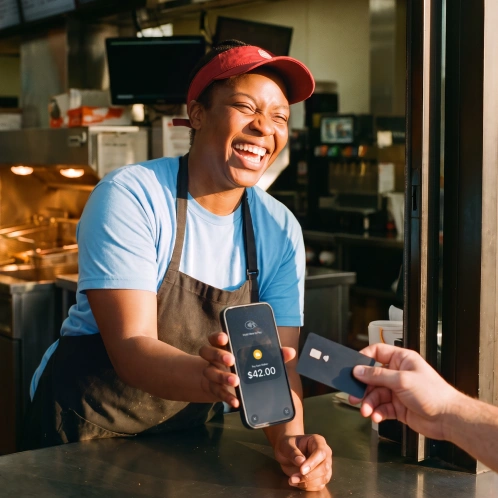
With JIM you accept debit, credit, and digital wallets directly through your smartphone, so you tap and the sale is done. At 1.99% per transaction with no hidden costs and no extra hardware, it works for selling at farmers' markets and handling local delivery payments. Funds land on your JIM card as soon as the sale is approved, with no waiting for bank transfers. Choosing the best credit card processing for your small business comes down to comparing effective rate, deposit speed, and hardware cost rather than the headline percentage alone.
Before you move on, define your deposit policy for orders over $100, pick your in-person payment method, download the JIM app to explore its features, and draft a simple payment process for both online and in-person sales.
6. How do you fund the business and manage finances?
Most new owners self-fund, but you have other options. The SBA Microloan program provides loans up to $50,000 with an average loan of about $13,000, and interest rates are set by intermediary lenders and capped by an SBA formula rather than a single fixed rate. These loans suit equipment or initial inventory purchases.
Relying only on personal savings leaves no buffer for unexpected costs, so consider a small business credit card for emergencies and look into grants such as the Amber Grant, which awards funds to women-owned businesses.
Estimate your working capital
Plan for enough cash to cover your first six months of operation, including ingredients, packaging, marketing, and insurance. A safe estimate runs $3,000 to $5,000 depending on your sales goals and initial marketing spend.
Once you have funds, open a dedicated business bank account to separate personal and business finances, which makes tax time far simpler. Do not mix personal grocery runs with business supply purchases on the same card.
Before you move on, research SBA Microloan requirements through a local intermediary, calculate your six-month working capital need, look up small business grant deadlines such as the Amber Grant, and open a dedicated business checking account.
7. When and how do you hire staff?
When you consistently hit 20 to 30 orders per week, hire help to avoid burnout and protect product quality. Many owners wait too long and let consistency slip, so start with one part-time person to handle production tasks.
Your first hire is usually a Kitchen Assistant who handles fruit prep, dipping, and cleanup, and the role typically pays $15 to $20 per hour. Use a formal job description to set clear expectations from day one, even if you hire someone you know.
Anyone who handles food must hold a Food Handler's Permit. As you grow, you may add a part-time Delivery Driver, and for scheduling you can start with a shared Google Calendar, then move to an app like Homebase once you have two or more employees.
Before you move on, set the weekly order volume that triggers your first hire, draft a one-page Kitchen Assistant job description, confirm your state's payroll and tax requirements for a new employee, and set up a shared production and delivery calendar.
8. How do you market a chocolate strawberry business?
Your primary marketing channel is visual, so build a presence on Instagram and Pinterest with high-quality photos. Post 3 to 5 times per week with a content calendar that showcases your products, packaging, and behind-the-scenes work.
Plan around seasonal demand
Chocolate strawberries are heavily seasonal. Valentine's Day and Mother's Day drive the largest demand spikes of the year, so build inventory, ad spend, and staff capacity around these windows and treat the four-day Valentine's rush as your biggest revenue event. Slower periods are the time to land corporate gift accounts and wedding contracts that smooth out your cash flow. To capture impulse and local buyers year-round, learn how to accept contactless payments so checkout never stalls at a market booth.
Build local partnerships and run targeted ads
Reach out to florists, event planners, and corporate gift coordinators with a sample box and propose a 10 to 15% referral fee for business they send your way, which builds a valuable B2B network.
Once you have a solid photo portfolio, run targeted ads on Facebook and Instagram starting at $10 to $20 per day, aimed at users in your delivery area with upcoming birthdays, anniversaries, or recent engagements.
Customer Acquisition Cost, or CAC, is the total you spend on ads divided by the new customers those ads bring in. If you spend $100 on ads to get four new customers, your CAC is $25, and your profit per order must stay higher than your CAC for paid advertising to pay off.
Before you move on, build a one-week Instagram content calendar, draft a partnership email to a local florist, set up a draft Facebook ad campaign targeting upcoming birthdays, and calculate your maximum allowable CAC from your average order profit.
9. How do you price chocolate strawberries for profit?
Use a cost-plus pricing model. Calculate your cost per berry, which includes the fruit, chocolate, toppings, and a share of the packaging, then apply a 200 to 300% markup. If your cost per berry is $1, price it at $3 to $4.
Many new owners price too low to compete, which signals lower quality and makes profitability hard to reach. Your price should reflect the premium, handmade nature of the product, so aim for a gross profit margin of 65 to 75% before you account for labor and overhead.
Analyze competitors and build pricing tiers
Look at what local sellers on Etsy and Instagram charge for a standard dozen, and note their prices for custom designs or special occasion boxes. Your goal is to understand the market rate, not to be the cheapest, so position your offerings without starting a price war.
Create pricing tiers to capture more value from custom requests. A standard dozen is your base price, and custom lettering, intricate designs, or premium toppings such as edible gold leaf can add $10 to $20 to the order total.
Picture the math with an example
Suppose an illustrative seller processes 30 orders a week at an average $45 order. Gross revenue lands near $5,850 a month against roughly $1,500 in ingredients and packaging, which leaves room for the 65 to 75% gross margin target before labor and overhead. Use that shape to pressure-test your own numbers.
Before you move on, calculate your cost per berry for a standard dozen, track the prices of three local competitors in a spreadsheet, set a base dozen price with a 200 to 300% markup, and list your add-ons with their price increases.
10. How do you maintain quality and know when to scale?
Consistency is what keeps customers coming back, so create a quality control checklist that confirms every berry meets your standard for freshness, size, and chocolate coverage before it leaves your kitchen.
Photograph each completed order to build a visual record you can compare against your standards, and aim for a customer complaint rate below 2%. If that rate rises, treat it as a signal to review your process.
Know when to grow
Your state's cottage food revenue cap is a hard limit. Once you approach 80% of that cap, plan your move to a commercial kitchen. If you consistently handle more than 50 orders a week, a home kitchen becomes inefficient, and renting a commercial kitchen lets you invest in larger equipment such as a dedicated tempering machine that can cost more than $1,000.
As volume grows, use an e-commerce platform like Shopify to handle orders and track inventory automatically, which prevents overselling and shows you which products sell best.
Before you move on, create a quality control checklist for every dozen, identify your state's cottage food revenue limit, research hourly rental rates for a local commercial kitchen, and set a target customer complaint rate under 2% for your first six months.
Presentation is everything in this niche, from your photos to your packaging, so protect your margins at checkout the same way you protect your product. You saw that traditional card processors charge 2.6% to 2.7% plus per-transaction fees for in-person sales. JIM charges a flat 1.99% per Tap to Pay sale with no hardware and no monthly fee, which keeps more of each farmers' market and delivery sale in your pocket. Download JIM and you are set to take your first payment.
Frequently Asked Questions
Is a chocolate covered strawberry business profitable?
Do I need a license to sell chocolate strawberries from home?
How long do chocolate covered strawberries last?
What equipment do I need to start?
How much can you make selling chocolate covered strawberries?


Sell and get paid in seconds with Jim