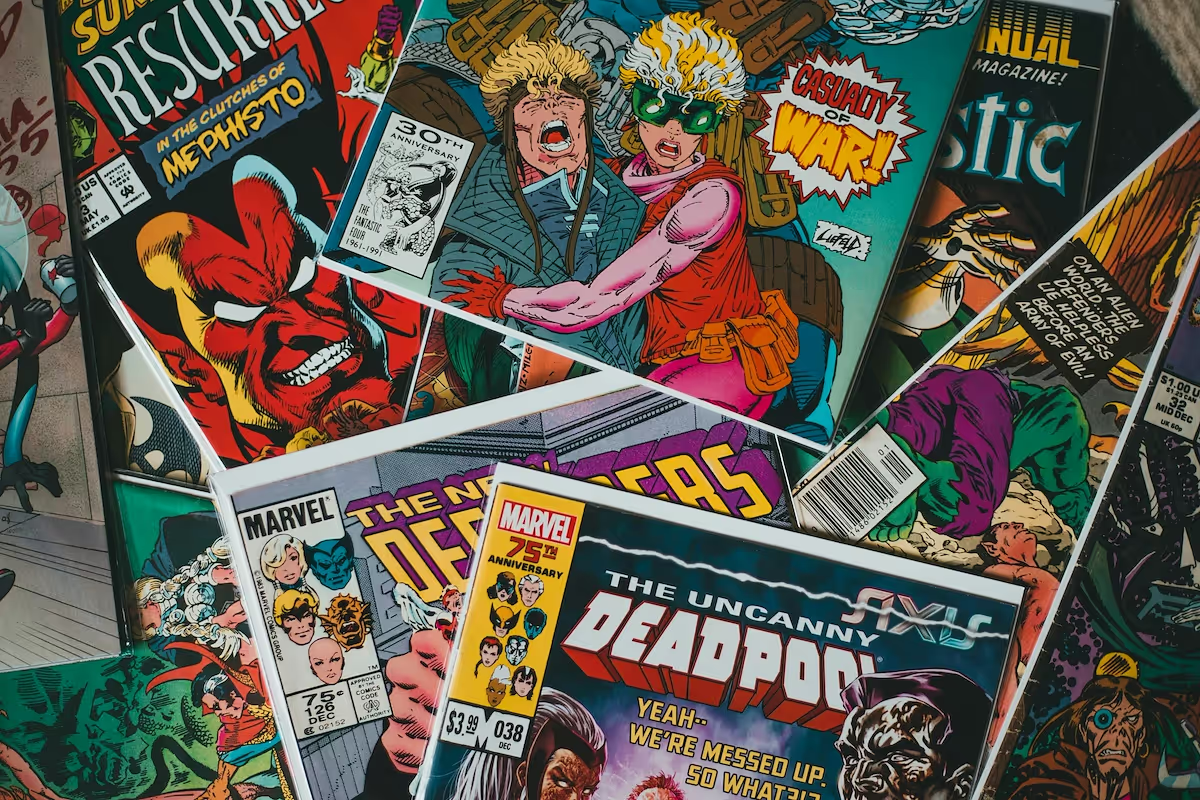
Launching a comic book company is a rewarding venture, blending creative passion for storytelling and art with sharp business acumen. It's a market worth billions, with steady demand for compelling stories from dedicated collectors and new fans alike.
This guide will take you through the practical steps of validating your concept, securing funding, building supplier relationships, and getting the right licenses to help you launch a successful comic book company in the U.S.
Step 1: Plan your business and validate your concept
Start by visiting local comic shops to see what sells. Talk to owners and customers. You can also monitor online forums like Reddit’s r/comicbooks or attend a local convention to understand fan interests and what gaps exist in the market.
Analyze competitors and costs
For sales data, review public information from distributors like Diamond Comic Distributors or sites like Comichron. Study successful Kickstarter comic campaigns to see what funding goals, reward tiers, and marketing strategies work with modern audiences.
Speaking of costs, your budget has a few key items. For a 24-page, full-color comic, a print run of 500 copies often costs $1,500 to $2,500. Many new publishers print too many copies at first, so a smaller initial run is a safer financial choice.
Artist and writer fees can range from $50 to over $200 per page. You might also want to budget about $500 for business registration, like an LLC, and another $500 to $1,000 for a basic website and some initial marketing materials.
Here are 3 immediate steps to take:
- Draft a one-page business plan that defines your niche and target audience.
- Get quotes from two different printers for a 500-copy print run.
- Analyze three successful independent comics launched in the last two years.
Step 2: Set up your legal structure and get licensed
Most new comic publishers choose a Limited Liability Company (LLC). This structure protects your personal assets if the business faces debt or lawsuits. An LLC also offers pass-through taxation, so profits are taxed on your personal return, which avoids the double taxation of a C Corp.
Once you decide on a structure, get a free Employer Identification Number (EIN) from the IRS website. You need this number to open a business bank account. It is a good practice to keep your personal and business finances separate from day one to avoid issues later.
Secure your licenses and permits
Next, register your business with your state's Secretary of State, which can cost between $50 and $500. You will also need a general business license from your city and a Seller's Permit from your state tax agency to legally sell comics and collect sales tax.
You should also protect your intellectual property. Register the copyright for your comic with the U.S. Copyright Office. This costs about $45 to $65 per application and provides strong legal protection for your work, a step many new creators miss until it is too late.
Here are 4 immediate steps to take:
- Decide on a business structure like an LLC and file the paperwork.
- Apply for a free Employer Identification Number (EIN) online.
- Research your local requirements for a business license and Seller's Permit.
- Visit the U.S. Copyright Office website to understand the registration process.
Step 3: Secure your insurance and manage risk
General liability insurance is your foundation. It covers claims like someone getting injured at your convention booth. A $1 million policy is a standard starting point, with annual premiums often between $400 and $1,200.
Key policies for publishers
You should also get professional liability insurance, also known as Errors & Omissions (E&O). This protects you from claims of copyright infringement or libel. Premiums typically run from $500 to $2,000 annually.
Business property insurance covers your physical inventory, like printed comics and original art, from theft or damage. A frequent mistake is to undervalue stock, so keep an accurate count of your assets for your policy.
If you hire employees, most states require workers' compensation insurance. This covers medical costs if an employee is injured on the job. When you look for providers, you might want to check with companies like Hiscox, The Hartford, or Chubb for quotes.
Here are 4 immediate steps to take:
- Get a quote for a $1 million general liability policy.
- Research professional liability (E&O) insurance for publishers.
- Calculate the value of your inventory for a property insurance quote.
- Confirm your state's workers' compensation laws for small employers.
Step 4: Set up your location and equipment
Most new comic publishers start from a home office. A dedicated 100-150 square foot room is usually enough space to store inventory and manage the business. This approach helps you avoid the high cost of commercial rent when you first start.
If you need a separate space, look for properties with mixed-use or light commercial zoning. A common mistake is signing a long-term lease right away. You might want to negotiate a one-year lease with an option to renew to maintain flexibility.
Equip your studio
Your main equipment will be a powerful computer and a high-resolution scanner for digitizing original art. A scanner like the Epson Perfection V600 costs around $250 to $350 and is a reliable option. For software, the Adobe Creative Cloud subscription is standard.
An Adobe plan with Photoshop and InDesign runs about $55 per month. This gives you the programs for lettering, coloring, and page layout. This brings us to suppliers. Printers like PrintNinja or Greko Printing specialize in comics and understand the format.
Their minimum order quantity is typically 250 to 500 copies. Always request a physical proof to check colors and paper quality before you approve the full print run. This small step can save you from a costly printing error.
Here are 4 immediate steps to take:
- Measure a 100-150 square foot space in your home for an office.
- Research local properties zoned for mixed-use.
- Compare prices for an Epson Perfection V600 scanner.
- Request sample packs from two comic book printers.
Step 5: Set up your payment processing
You will need a way to accept payments both online and in-person at events. Most customers expect to pay with credit cards, debit cards, or digital wallets. When you review payment solutions, focus on the transaction fees, as many providers charge 2.5% to 3.5% per sale.
Choose your payment solution
For comic book companies that need to accept payments on-site or on-the-go, JIM offers a streamlined solution. With JIM, you can accept debit, credit and digital wallets directly through your smartphone - just tap and done.
At just 1.99% per transaction with no hidden costs or extra hardware needed, it's particularly useful for selling directly to fans at conventions. This rate is lower than the typical fees from other providers, so you keep more of your revenue from each sale.
The process is simple:
- Get Started: Download JIM app for iOS
- Make a Sale: Type the sales amount, hit sell, and ask your customer to tap their card or device on your phone
- Access Funds: Your money is available right on your JIM card as soon as the sale is done - no waiting for bank transfers
Here are 3 immediate steps to take:
- Compare transaction fees for two online payment gateways for your website.
- Download the JIM app to explore its features for in-person sales.
- Calculate your potential savings on a $100 sale using JIM versus a provider that charges 2.9%.
Step 6: Secure funding and manage your finances
Funding your first comic
Many new publishers find their first funds through crowdfunding. Platforms like Kickstarter or Zoop let you pre-sell your comic and build an audience before you print. A successful campaign often raises between $5,000 and $20,000, which can cover a full print run and artist fees.
If you prefer a more traditional route, an SBA Microloan is a solid option. These loans go up to $50,000, with interest rates typically between 8% and 13%. You will need a strong business plan and a decent credit score to qualify.
You can also look for grants. While comic-specific ones are rare, local arts councils often have funds for independent creators. Also, check for programs like the Creators for Creators grant, which offers financial support and mentorship to new talent.
Manage your working capital
For your first six months, plan for $5,000 to $15,000 in working capital. This covers your initial print run, artist payments, marketing, and distribution fees. A frequent oversight is to budget only for production, so set aside at least 20% for marketing.
Here are 4 immediate steps to take:
- Outline a Kickstarter campaign with reward tiers.
- Find an SBA-approved microlender in your area.
- Search your local arts council's website for grant opportunities.
- Create a six-month budget that includes a 20% marketing allocation.
Step 7: Build your team and manage operations
Your first team will likely be freelancers, not full-time employees. This approach keeps your initial costs low. You will act as the publisher, managing the project, while hiring creative talent on a per-project basis. As you grow, you can bring roles in-house.
Assemble your creative talent
Key roles include a writer, penciler, colorist, and letterer. Page rates vary by experience. A writer might get $25-$100 per page. A penciler and inker team could ask for $75-$250, while a colorist often charges $50-$150. Letterers typically get $25-$50 per page.
You can find talent on sites like ArtStation or by networking at conventions. A frequent mistake is hiring without seeing sequential art samples. Always ask for a portfolio that shows storytelling ability across multiple pages, not just single pin-up images.
Set up your operational workflow
To manage production, you can use a free project management app like Trello. Create a board with columns for each stage: Script, Pencils, Inks, Colors, and Letters. This gives everyone a clear view of the project's status and deadlines.
Before anyone starts, have them sign a work-for-hire agreement. This contract clarifies that you own the copyright to the work they create for you. You can find templates online, but you might want a lawyer to review it to ensure it is solid.
Here are 4 immediate steps to take:
- Draft a basic work-for-hire agreement for your freelancers.
- Create a project board on Trello for your first comic issue.
- List three potential artists from ArtStation whose portfolios show strong sequential work.
- Set a budget with per-page rates for a writer, artist, colorist, and letterer.
Step 8: Market your comic and find customers
Build your online presence
Start with social media platforms like Instagram and Twitter. Post character designs, behind-the-scenes process art, and short story snippets. A consistent schedule of 3-4 posts per week keeps your audience engaged before the launch.
Once you have some content, build an email list using a service like Mailchimp or Substack. You can offer a free digital ashcan or exclusive art to get sign-ups. An email list gives you a direct line to your most dedicated fans.
Sell directly to fans
Conventions are a great sales channel. A table at a small local show might cost $100 to $300. A good goal is to earn at least three times your table cost. Many new creators only bring a few copies, so be sure to have enough inventory.
You can also run targeted ads on platforms like Facebook. Instead of a wide audience, target users who like specific indie creators or publishers similar to you. A small budget of $10 a day can be effective for testing.
For inspiration, look at the marketing for a campaign like the "Lackadaisy" animation. They used frequent updates and direct fan engagement to build a massive following, a model many comic creators now follow.
Here are 4 immediate steps to take:
- Draft three social media posts with character art and a project update.
- Set up a free email list on Mailchimp and create a sign-up incentive.
- Research table costs for one local and one regional comic convention.
- Analyze the backer updates on a successful comic Kickstarter campaign.
Step 9: Price your comics for profit
Calculate your cover price
Most standard 24-page, full-color comics are priced between $3.99 and $5.99. Your final price should reflect the book's page count and production quality. A premium paper stock or a higher page count, for instance, can justify a price closer to $7.99.
A good rule of thumb is a 3x to 4x markup on your per-unit print cost. If each comic costs you $2.00 to print, a cover price of $5.99 gives you a healthy margin. This buffer is not just for profit; it also covers your marketing and operational expenses.
Account for hidden costs
Once you have a baseline price, you need to stress-test it. Many new publishers forget that distributors take a large cut, often 50% to 60% of the cover price. On a $4.99 comic, that means you might only see about $2.00 from a distributor sale.
To see what the market will bear, you can research similar indie books on PreviewsWorld. Also, look at successfully funded Kickstarter comics in your genre. This shows what dedicated fans are willing to pay for both digital and physical editions, giving you real-world data.
Here are 4 immediate steps to take:
- Calculate your final per-unit print cost from your chosen printer.
- Set a target cover price using a 3x markup formula as your baseline.
- Analyze the pricing of three competing indie comics on PreviewsWorld.
- Figure out your net profit per issue after applying a 55% distributor discount.
Step 10: Control quality and scale your business
For quality control, create a checklist for your print proofs. It should cover color accuracy, binding alignment, and paper stock consistency. Many new publishers make the mistake of approving a digital proof that looks perfect on screen but prints differently. Always get a physical copy.
Know when to grow
Your sales data will tell you when to scale. If you sell 80% of a 500-copy print run within 90 days, that is a strong signal to increase your next order to 1,000 copies. This shows you have consistent demand that can support a larger investment.
Once you manage two or more projects at once, you might want to hire a part-time virtual assistant for 5-10 hours a week. They can handle fulfillment and customer emails. This frees you up to focus on creative and business development, a better use of your time.
With a larger audience from crowdfunding, you can use a pledge manager like BackerKit. It automates surveys and add-on sales. This becomes very helpful once you have more than 200 backers, as manual spreadsheets can lead to shipping errors.
Here are 4 immediate steps to take:
- Create a print quality checklist covering color, binding, and paper stock.
- Set a sales goal of 80% sell-through in 90 days for your first issue.
- List three administrative tasks you could delegate to a virtual assistant.
- Review BackerKit's features for managing crowdfunding fulfillment.
Launching your comic company is a journey of art and business. Remember that your story's success depends just as much on smart decisions, like your print runs and sales strategy, as it does on the creative work. You have the roadmap, now go tell your story.
And when you sell those stories, getting paid should be simple. JIM turns your phone into a card reader, so you can accept payments without extra hardware for a flat 1.99% fee. Download JIM to get started.
.avif)