Launching a cup business can be a rewarding venture, blending your creative flair with sharp business acumen. It's a massive, multi-billion dollar market, fueled by a steady need for cups at cafes, special events, offices, and homes.
This guide will take you through the practical steps of validating your business concept, building supplier relationships, and acquiring inventory to help you launch a successful cup business in the U.S.
Step 1: Plan your business and validate your idea
Begin your market research on Google Trends to check search interest for terms like “reusable coffee cups” or “custom event tumblers.” Then, browse marketplaces like Etsy and Amazon to identify current best-sellers and spot gaps in the market.
For a deeper look at competitors, you can use databases like Statista for market size reports. SEO platforms like Ahrefs or Semrush also have free features that show you which products get the most traffic on competitor websites.
Estimate your startup costs
Your initial investment will likely fall between $2,630 and $7,100. A frequent misstep is to order too many units of an unproven design. You might want to start with a smaller test batch to confirm customer interest before you commit to a larger inventory.
- Initial Inventory: $2,000 - $5,000 for a first run of 500-1,000 cups.
- Business Formation (LLC): $100 - $500. Check your state’s Secretary of State website for exact fees.
- E-commerce Website: $30 - $100 per month for a platform like Shopify.
- Product Photography & Ads: $500 - $1,500 for your launch.
Here are 3 immediate steps to take:
- Analyze search volume for three different cup styles on Google Trends.
- List five direct competitors and identify their top-selling products.
- Create a draft budget based on the cost estimates provided.
Step 2: Set up your legal structure and get licensed
Choose your business structure
For most new cup businesses, forming a Limited Liability Company (LLC) is a smart move. It protects your personal assets if the business faces debt or lawsuits. An LLC also offers pass-through taxation, meaning profits are taxed once on your personal return.
A sole proprietorship is simpler but offers no liability protection, a risk you might not want to take. You can register your LLC through your state's Secretary of State website, with fees ranging from $100 to $500 depending on your location.
Secure your licenses and permits
You will need a few key documents. First, get a free Employer Identification Number (EIN) from the IRS website; you need this to open a business bank account. Next, apply for a seller's permit from your state's Department of Revenue to collect sales tax.
Also, check with your city or county clerk for a local business license, which typically costs between $50 and $150. Since your products hold beverages, they must meet U.S. Food and Drug Administration (FDA) standards. A frequent oversight is failing to confirm this with suppliers.
Here are 4 immediate steps to take:
- Decide between an LLC and a sole proprietorship for your business.
- Apply for a free Employer Identification Number (EIN) on the IRS website.
- Research the cost of a seller's permit and local business license in your area.
- Draft an email to potential suppliers asking for FDA compliance certificates.
Step 3: Insure your business and manage risk
Your main focus should be product liability insurance. This protects your business if a customer claims your cup was defective and caused harm, like a burn from a leak. A frequent misstep is to assume general liability coverage is sufficient, but it often excludes product-related incidents.
Key insurance policies
You can often bundle general and product liability insurance into a single Business Owner's Policy (BOP). This simplifies management and can reduce your total cost.
- Product Liability Insurance: Expect annual premiums between $500 and $1,200. This is the most important policy for your cup business.
- General Liability Insurance: This covers non-product claims, like someone getting injured at your market stall. Coverage typically costs $400 to $700 annually.
- Commercial Property Insurance: You will want this policy if you store a large amount of inventory in a rented warehouse or office space.
When you request quotes, turn to providers that work with e-commerce businesses, such as The Hartford, Hiscox, or Next Insurance. They understand the specific risks you face better than a general agent might. Aim for at least $1 million in coverage to start.
Here are 3 immediate steps to take:
- Request quotes for a policy with at least $1 million in product liability coverage.
- Contact an agent from an e-commerce insurance specialist like Hiscox or The Hartford.
- Allocate between $900 and $1,900 in your annual budget for insurance premiums.
Step 4: Source your inventory and equipment
Your next move is to find reliable suppliers. For bulk orders at a lower cost per unit, platforms like Alibaba are a common starting point. You can find manufacturers with minimum order quantities (MOQs) of 500 to 1,000 cups, but expect lead times of 30 to 60 days.
A frequent oversight is to place a large order without first vetting the product. Always pay the $50 to $100 for a physical sample to check quality before you commit to a full production run. For smaller, faster orders, you might look at U.S.-based wholesalers like Discount Mugs.
Set up your workspace
You can start this business from home. You will want about 100-200 square feet of clean, dry space to store an initial inventory of 500-1,000 cups. As you grow, you might need a small commercial storage unit, but avoid a long-term lease at first.
If you do need a commercial space, try to negotiate a 1-2 year lease instead of the standard 3-5 years. This gives you more flexibility. Your equipment needs are straightforward for an e-commerce setup.
- Heat Press: $200 - $500 if you plan to apply custom designs yourself.
- Shipping Label Printer: $150 - $250 for a thermal printer like a Rollo or Dymo.
- Photography Setup: $100 - $500 for a simple lightbox and a good smartphone camera.
Here are 4 immediate steps to take:
- Request product samples from two overseas and one domestic supplier.
- Compare the total cost, including shipping and tariffs, for a 500-unit order.
- Price out a shipping label printer and a basic photography lightbox.
- Measure a 10x10 foot space in your home to confirm you have room for inventory.
Step 5: Set up payment processing
For online sales, your e-commerce platform, like Shopify, has a built-in payment processor, which is the simplest route. If you take large custom orders, it is standard practice to require a 50% deposit upfront to cover material costs before you start production.
When you compare payment solutions, look closely at transaction fees. A frequent mistake is to overlook these costs, as many providers charge between 2.5% and 3.5% per sale. These fees can quietly eat into your profit margins over time.
Accepting payments in person
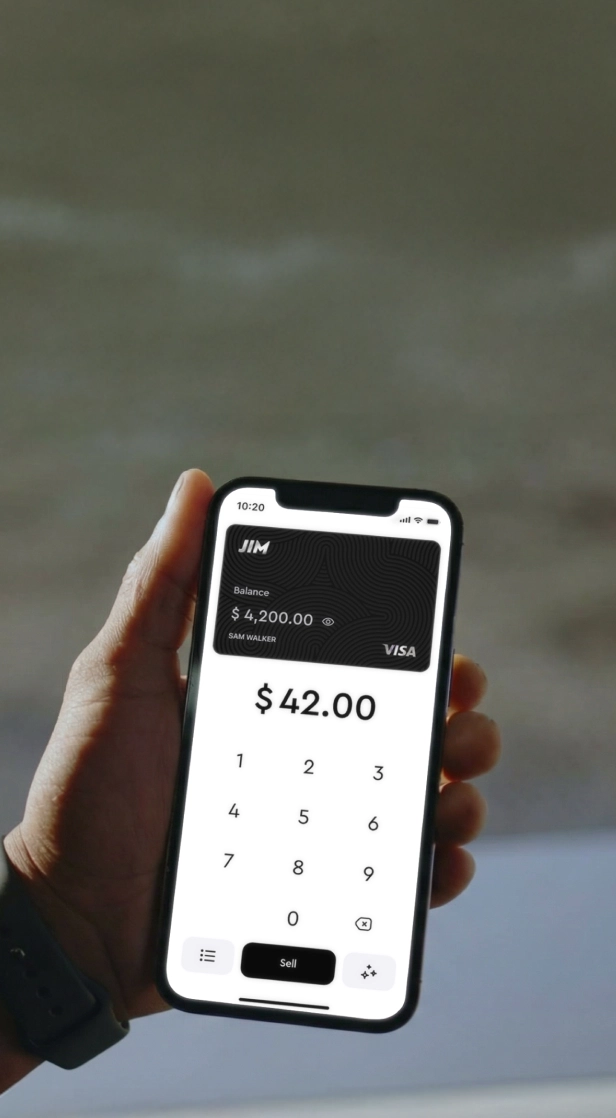
If you plan to sell at markets or pop-up events, you will need a mobile option. For cup businesses that need to accept payments on-site, JIM offers a streamlined solution. With JIM, you can accept debit, credit and digital wallets directly through your smartphone - just tap and done.
At just 1.99% per transaction with no hidden costs or extra hardware needed, it's particularly useful for selling at craft fairs. This rate is noticeably lower than the average commission rates from other providers, which helps you keep more of your earnings.
Here is how it works:
- Get Started: Download JIM app for iOS
- Make a Sale: Type the sales amount, hit sell, and ask your customer to tap their card or device on your phone
- Access Funds: Your money is available right on your JIM card as soon as the sale is done - no waiting for bank transfers
Here are 3 immediate steps to take:
- Compare the transaction fees for your e-commerce platform's default processor.
- Draft an invoice template that requires a 50% deposit for custom orders.
- Download the JIM app to explore its features for in-person sales.
Step 6: Fund your business and manage finances
For your first inventory purchase, an SBA Microloan is a strong option. These loans go up to $50,000, but most new businesses secure around $13,000. Expect interest rates between 8% and 13%. You can also look into local grants through your city’s economic development office.
Calculate your working capital
You will need cash on hand for the first six months to cover inventory restocks, marketing, and platform fees. A safe estimate is between $3,000 and $8,000. One thing that catches new owners off guard is forgetting to budget for this after the initial launch.
With your funding secured, open a separate business checking account. This makes tax season much simpler. You should also use accounting software like Wave, which is free, or QuickBooks Self-Employed to track every expense and sale from day one.
Here are 4 immediate steps to take:
- Research one SBA Microloan lender in your state.
- Calculate your working capital needs for the first six months.
- Open a dedicated business checking account.
- Sign up for a free Wave account to track your expenses.
Step 7: Build your team and streamline operations
You will likely handle everything yourself at first. Once you find yourself spending more than two hours a day on fulfillment, it is a good time to consider your first hire. This keeps you focused on growing the business instead of just running it.
Your first hire
Your first employee will probably be a part-time Fulfillment Assistant. Their main jobs are to pack orders, print shipping labels, and manage inventory. You can expect to pay an hourly rate between $15 and $20, depending on your local market.
Many new owners wait too long to hire help and burn out. A good rule of thumb is to bring someone on when you consistently hit 10-15 orders per day or reach $5,000 in monthly revenue. Specific certifications are not usually required for this role.
As for software, you can manage early operations with a simple spreadsheet. You might overspend if you invest in complex management systems too soon. Once you hire an employee, you can use a payroll service like Gusto to handle payments and taxes correctly.
Here are 3 immediate steps to take:
- Write a one-page job description for a part-time Fulfillment Assistant.
- Set a daily order volume that will trigger your decision to hire.
- Create a simple spreadsheet to track your fulfillment time per order.
Step 8: Market your business and get customers
Focus your initial marketing on visual platforms. Instagram and Pinterest are perfect for showcasing your cup designs. Post high-quality photos and short videos of your products in use. A common mistake is to try to be on every platform at once; master one or two first.
Launch your first campaign
Partner with micro-influencers (10k-50k followers) in the home, coffee, or lifestyle niche. You can often secure a dedicated post for $100 to $250. This approach builds credibility and drives targeted traffic. Aim for a customer acquisition cost (CAC) below $25 to start.
You can also run targeted ads on Facebook or Instagram. Start with a small daily budget of $10-$15, focused on audiences interested in brands like Etsy, reusable products, or specific aesthetics that match your designs. A 1-2% conversion rate from these ads is a solid benchmark.
Here are 4 immediate steps to take:
- Create a business profile on Instagram and start posting product photos.
- Research five micro-influencers whose followers match your target customer.
- Set an initial monthly marketing budget, perhaps between $300 and $500.
- Draft your first ad creative using a free design platform like Canva.
Step 9: Price your products for profit
Calculate your cost-plus price
A straightforward way to price your cups is the cost-plus model. First, calculate your landed cost per unit, which includes the product, shipping, and any import tariffs. Many new owners only consider the product cost, which can quickly shrink their profits.
Once you have your landed cost, apply a markup. For e-commerce, a 100% to 150% markup is standard. This should give you a gross profit margin of 50% to 60%. For example, if your landed cost is $5 per cup, a 100% markup prices it at $10.
Analyze your competitors
Look at what similar cups sell for on marketplaces like Etsy and Amazon. Do not just copy prices. Instead, analyze why they are priced that way. Is it the unique design, the material quality, or the brand's reputation that commands a higher price?
You might find a simple ceramic mug sells for $18, while a personalized stainless steel tumbler goes for $35. This shows how perceived value affects what customers will pay. Position your pricing based on where your products fit in the market.
Here are 3 immediate steps to take:
- Calculate the full landed cost for one of your main cup designs.
- List the prices of five direct competitors for a similar product.
- Set a target retail price for your cup using a 100% markup.
Step 10: Control quality and scale your operations
Establish your quality standards
As your orders arrive, you need a system to check quality. Create a simple inspection checklist for each shipment. Check for scratches, confirm the lid fits securely, and verify that custom prints are accurate. A frequent slip-up is to trust a supplier's claims without proof.
Aim for a defect rate below 2% for any batch. If you find more issues, you have grounds to request a partial refund or replacement from your supplier. Also, always request the FDA compliance certificates for your materials to confirm they are food-safe and BPA-free.
Know when to scale
Growth should be deliberate. Once you hit 10-15 orders per day, it is time to hire a part-time fulfillment assistant. This frees you up to focus on marketing and product development instead of just packing boxes. Do not wait until you are completely overwhelmed.
When your inventory consistently fills over 80% of your storage space, start looking for a small commercial storage unit. As for software, a spreadsheet works well at first. But once you manage over 1,000 units, you might explore inventory management software like Katana to automate tracking.
Here are 3 immediate steps to take:
- Create a quality inspection checklist for your cup shipments.
- Set a daily order volume that will trigger your first hire.
- Research one inventory management software for future growth.
You now have a complete roadmap to launch your cup business. Remember that a great design is what connects with customers; your cup becomes part of their daily routine. With a solid plan, you are ready to build a brand people will love.
And when you make those first sales at a local market, getting paid should be simple. JIM turns your phone into a card reader for a flat 1.99% fee, with no extra hardware. Download JIM to be ready from day one.
.avif)