Starting a diamond painting business is an exciting venture that combines creativity and an eye for detail with business savvy. The global craft market is a multi-billion dollar industry, and there's steady demand for diamond painting kits from hobbyists, DIY enthusiasts, and even those seeking a relaxing, therapeutic activity.
This guide will take you through the practical steps of validating your business concept, building supplier relationships, acquiring inventory, and obtaining necessary licenses to help you launch a successful diamond painting business in the U.S.
Step 1: Validate your business idea and create a plan
Before you spend a dollar, confirm people want what you plan to sell. Start by exploring social media hashtags like #diamondpainting on Instagram and TikTok. Note the styles, colors, and themes that get the most engagement. This is your direct line to what customers find exciting right now.
Market and competitor research
Next, analyze the competition. Use tools like eRank or Marmalead to see what keywords and themes are trending on Etsy. Look at the top sellers on Amazon and specialized sites. Pay attention to their pricing, canvas sizes, and what they include in their kits. This research gives you a benchmark.
A mistake some sellers make is ignoring the type of drills used. You will want to decide if you will offer round drills, square drills, or both. Check competitor listings and customer reviews to see if there is a strong preference in the niches you are targeting.
Budgeting your startup costs
With that research in hand, you can build a realistic budget. Initial startup costs typically range from $800 to $3,000. This covers your first batch of inventory, website fees, and business licensing. Here is a sample breakdown:
- Initial Inventory: $500 - $2,000 for a small variety of kits.
- E-commerce Platform: $30 - $100 per month for a service like Shopify.
- Business License & LLC Formation: $100 - $500 one-time fee, depending on your state.
- Shipping Supplies: $100 - $200 for mailers, labels, and tape.
Here are 3 immediate steps to take:
- Research 10 successful diamond painting shops on Etsy and note their top three best-selling themes.
- Use Google Trends to compare search volume for "custom diamond painting" versus "animal diamond painting".
- Draft a startup budget with line items for initial inventory, website fees, and shipping supplies.
Step 2: Set up your legal structure and get licensed
Choose your business structure
You might want to consider forming a Limited Liability Company (LLC). While operating as a sole proprietor is simpler, it leaves your personal assets unprotected. An LLC separates your business and personal finances, which is a safeguard many new owners appreciate. State filing fees range from $50 to $500.
With an LLC, you also get pass-through taxation. This means business profits pass directly to you, and you report them on your personal tax return. This avoids the double taxation that corporations face and simplifies your accounting significantly at the start.
Secure the right permits and licenses
First, get a free Employer Identification Number (EIN) from the IRS website. You will need this number to open a business bank account and file taxes, even if you do not have employees. The online application is quick and you receive your number instantly.
Next, visit your state’s Department of Revenue website to apply for a seller's permit, also known as a resale license. This permit allows you to legally collect sales tax from customers. A detail many new sellers miss is failing to collect this tax, which can lead to penalties.
Finally, check with your city or county clerk’s office for a local business license. These requirements vary widely but often involve a small annual fee, typically between $25 and $100. This ensures you operate in compliance with local regulations.
Here are 3 immediate steps to take:
- Decide if an LLC is right for you and check your state's filing fees.
- Apply for a free Employer Identification Number (EIN) on the IRS website.
- Research your state's seller's permit requirements to prepare for collecting sales tax.
Step 3: Protect your business with insurance
Key insurance policies
General Liability insurance is your first line of defense. It covers claims of injury or property damage. Expect to pay between $300 and $600 annually for a policy with $1 million in coverage. This is a standard amount for a small e-commerce business.
Your General Liability policy should include Product Liability coverage. This is not just a nice-to-have. It protects you if a customer has an allergic reaction to the canvas glue or if a child swallows one of the tiny drills. Always confirm this is included.
Next, consider Commercial Property insurance. This covers your inventory of diamond painting kits from theft, fire, or damage. A frequent oversight is to insure stock for its cost instead of its retail value. Make sure your coverage reflects what it would cost to replace everything.
If you hire employees, you will also need Workers' Compensation. A dedicated delivery vehicle requires Commercial Auto insurance. Most solo entrepreneurs starting from home will not need these policies immediately, but it is good to know about them for future growth.
Finding a provider
You can get quotes from insurers that specialize in small businesses. Companies like Hiscox, The Hartford, and Next Insurance are familiar with e-commerce risks and can help you find the right coverage without overpaying. It is wise to compare at least two options.
Here are 3 immediate steps to take:
- Request a quote for a General Liability policy and confirm it includes product liability.
- Calculate the full retail value of your inventory to determine your property insurance needs.
- Compare quotes from two providers that specialize in e-commerce, such as Hiscox or The Hartford.
Step 4: Source your inventory and set up your workspace
Find your suppliers
Your main source for kits will likely be overseas manufacturers on platforms like Alibaba. You can find suppliers who offer custom designs from your own artwork. Expect to pay between $4 and $8 per kit, with a Minimum Order Quantity (MOQ) of 10 to 50 units per design.
A frequent misstep is to order a large volume of one design. You might want to test the market first. Order the MOQ for five to ten different designs instead. This lets you see what customers actually buy before you place a larger order.
Prepare your workspace and equipment
You do not need a commercial space to start. A dedicated area in your home of about 100 square feet is plenty. This gives you room for inventory storage and a small packing station. Make sure the space is clean and dry to protect your canvases and drills.
For equipment, you will need a few items to process orders efficiently. Here is what to budget for:
- Industrial Shelving: $70 - $200 to keep your kits organized.
- Shipping Scale: $25 - $50 to calculate postage accurately.
- Thermal Label Printer: $150 - $250 to print shipping labels without ink.
Here are 3 immediate steps to take:
- Contact three potential suppliers on Alibaba to request quotes and confirm their MOQs.
- Measure a dedicated 100-square-foot workspace in your home.
- Create a budget for shelving, a shipping scale, and a thermal label printer.
Step 5: Set up your payment processing
Your e-commerce site will need a payment processor. Platforms like Shopify have built-in options that integrate seamlessly. These typically charge a fee around 2.9% plus $0.30 for each online sale. You should build this cost into your product pricing to protect your margins.
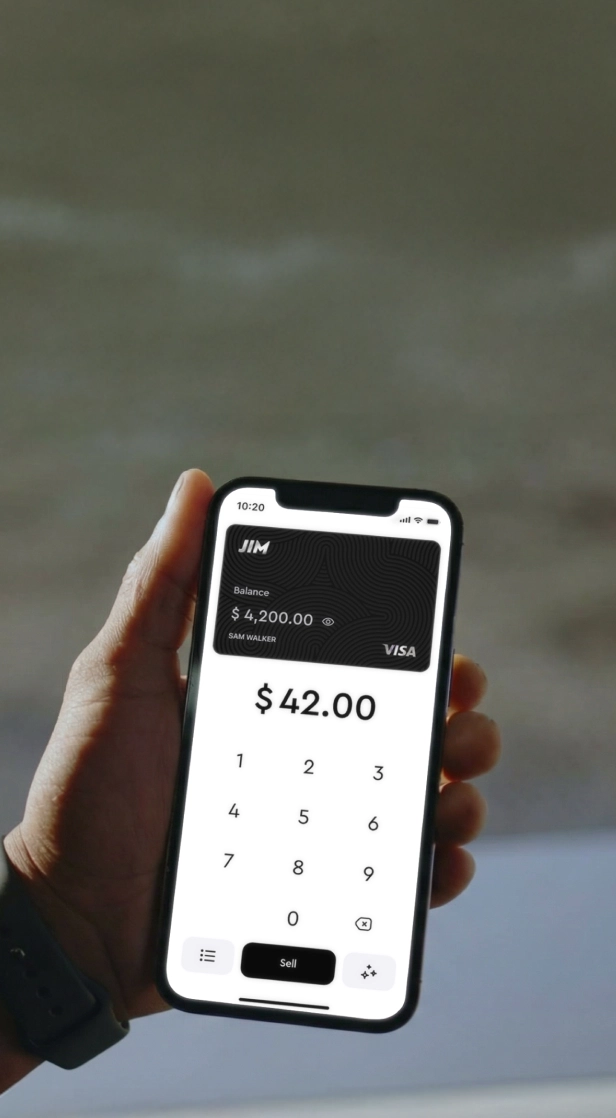
Now, think about selling at craft fairs or pop-up events. For these situations, JIM offers a streamlined solution. With JIM, you accept debit, credit, and digital wallets directly on your smartphone. Your customer just taps their card or device on your phone.
At just 1.99% per transaction with no hidden costs or extra hardware, it is a cost-effective choice. Other providers often have higher commission rates, so this difference adds up. It is particularly useful for managing quick transactions at a busy market stall.
- Get Started: Download the JIM app for iOS.
- Make a Sale: Type the sales amount, hit sell, and ask your customer to tap their card or device on your phone.
- Access Funds: Your money is available right on your JIM card as soon as the sale is done, with no waiting for bank transfers.
Here are 3 immediate steps to take:
- Review the transaction fees for your e-commerce platform's payment processor.
- Factor payment processing fees into the final price of your diamond painting kits.
- Download the JIM app to prepare for in-person sales.
Step 6: Secure funding and manage your finances
Funding your business
Many owners self-fund their initial inventory with personal savings. If you need a loan, you might want to consider an SBA Microloan. These government-backed loans range up to $50,000, with interest rates typically between 8% and 13%. Qualification is often more flexible than with traditional banks.
You could also look into grants. The Amber Grant for Women is a popular option, and many local arts councils offer small business funding. These are competitive, so it is best to view them as a bonus, not a primary plan.
Managing your working capital
Once you have your initial funds, you need to manage your cash flow. You will need enough cash on hand to cover costs for the first six months. This is your working capital. A frequent oversight is to only budget for the first inventory purchase.
Plan for about $2,000 to $4,000 in working capital. This should cover inventory replenishment, shipping supplies, and your e-commerce platform fees for six months. This buffer ensures you can operate smoothly without the stress of running out of cash.
Here are 3 immediate steps to take:
- Calculate your working capital needs for the first six months.
- Research the SBA Microloan program requirements on the SBA website.
- Look up local arts council grants in your city or state.
Step 7: Hire your team and streamline operations
Hiring your first team member
You might want to hire help once you consistently pack over 50-75 orders per week. This is the point where your time is better spent on marketing and product development. A part-time Order Fulfillment Assistant is a good first hire.
This role handles picking kits, packing orders, and printing shipping labels. The pay typically ranges from $15 to $18 per hour. No special certifications are required, but you should provide clear on-the-job training for your specific inventory and shipping process.
A mistake some owners make is to hire without a system. Create a simple checklist for the packing process. This reduces errors and ensures every customer gets the right order.
Setting up your operations
You do not need complex software at the start. Your Shopify or other e-commerce platform has built-in order management features that work well. For task management between you and your new hire, a free Trello board is a great way to track what needs to be done.
Here are 3 immediate steps to take:
- Track the hours you spend on fulfillment each week to decide when to hire.
- Draft a one-page job description for an Order Fulfillment Assistant.
- Create a simple packing process checklist to train your first hire.
Step 8: Market your business and acquire customers
Build a following on social media
Focus your efforts on visual platforms like Instagram, TikTok, and Pinterest. You can create time-lapse videos that show a painting come to life. Post three to five times a week to build momentum and engage with commenters to create a community around your brand.
Use Pinterest as a visual search engine. Create boards for different themes like "Animal Diamond Paintings" or "Holiday Craft Ideas." This helps potential customers discover your products when they search for inspiration. Pin high-quality images of your finished kits.
Run targeted paid ads
Once you have some content, you might want to run paid ads on Facebook and Instagram. You can start with a small budget of $10 per day. Target users with interests like "DIY crafts," "scrapbooking," or those who follow major craft store pages.
A mistake many new sellers make is to spend on ads without tracking results. Calculate your Customer Acquisition Cost (CAC) by dividing your ad spend by the number of new customers. If your CAC is higher than your profit per kit, your ad is not profitable.
You can also collaborate with micro-influencers in the crafting niche who have 1,000 to 10,000 followers. Offer them a free kit in exchange for an honest review. Their followers are often highly engaged and trust their recommendations.
Here are 3 immediate steps to take:
- Plan one week of content for Instagram, including at least one time-lapse video.
- Set a test budget of $10 per day for a Facebook ad campaign.
- Identify five craft micro-influencers you could send a free kit to.
Step 9: Price your products for profit
Establish your pricing model
You might want to use a cost-plus pricing model. First, calculate your total cost per kit. If a kit costs you $6 from a supplier and shipping supplies are $1, your total cost of goods sold (COGS) is $7.
With that cost in mind, apply a markup. A standard markup in this niche is 100% to 200%. This means you would price your $7 kit between $14 and $21. This strategy aims for a gross profit margin of 50% to 66%.
Analyze competitor pricing
Look at what similar shops on Etsy and Amazon charge for kits of the same size and complexity. This gives you a market baseline. A mistake some new sellers make is to price too low, which can signal poor quality and hurt your brand.
You could also offer tiered pricing based on canvas size. For example, you might sell a small 30x40cm kit for $19.99, a medium 40x50cm kit for $29.99, and a large 50x70cm kit for $39.99. This gives customers clear choices at different price points.
Here are 3 immediate steps to take:
- Calculate your total cost per kit, including the unit price and shipping supplies.
- Research the prices of five competitor kits with similar sizes and themes.
- Set a test price for one of your kits using a 150% markup over your total cost.
Step 10: Maintain quality and scale your operations
Establish your quality standards
As orders increase, you must have a system for quality control. For every new shipment from your supplier, spot-check 5-10% of the kits. Check for clear canvas printing, consistent adhesive coverage, and accurately colored drills with no defects.
A mistake some sellers make is assuming quality will remain constant. It can vary from batch to batch. You should aim for a defect rate below 2%. Tracking customer complaints about missing drills or poor adhesion gives you a real-world quality metric.
Know when to grow
Once you consistently ship over 150-200 orders per week, your home workspace will feel cramped. This is the point to consider leasing a small commercial space or outsourcing fulfillment to a third-party logistics (3PL) provider to handle packing and shipping.
With that growth, your e-commerce platform's basic features may not be enough. You might want to look at dedicated inventory management software like Katana or Cin7. These systems help you manage larger stock levels and track profitability per product more accurately.
Here are 3 immediate steps to take:
- Create a quality checklist for incoming inventory that covers canvas printing, adhesive, and drills.
- Set a benchmark for when to research a 3PL service, such as hitting 150 weekly orders.
- Look into one inventory management software like Katana to understand its features for future growth.
Your diamond painting business is built on creativity. The key is to balance your artistic vision with what customers want. Listen to the community, trust your plan, and start your first chapter. You are ready for this.
And when you make those first sales at a craft fair, JIM can help. It lets you accept cards on your phone for a simple 1.99% fee, with no extra hardware needed. Download JIM and be ready for business.
.avif)