Turning a passion for donuts into a business is a rewarding venture, blending baking creativity with business acumen. The donut market is a multi-billion dollar industry, with steady demand from morning commuters, office meetings, and families looking for a weekend treat.
This guide will take you through the practical steps of validating your business concept, securing funding, obtaining permits, and selecting the right location to help you launch a successful donut business in the U.S.
Step 1: Plan your business and validate your concept
First, get a feel for your local market. Visit nearby bakeries and coffee shops between 7-9 AM on a weekday to see what sells. You can also create a simple survey on Google Forms to ask potential customers about their favorite flavors and what they would willingly pay.
A step many people miss is checking local demographic data. The U.S. Census Bureau offers free information on income and age in your target area. This helps you set prices and decide on your shop's vibe without guessing.
Analyze competitors and budget for startup
Now, map out your competition. Use Google Maps to find every bakery and cafe within a five-mile radius. Take note of their prices, hours, and online reviews. This will show you where the gaps in the market are.
With that research in hand, it is time to talk numbers. Your initial startup costs will likely range from $30,000 to $75,000. This budget accounts for kitchen equipment ($20k-$50k), your first ingredient order ($3k-$7k), and business permits ($500-$2k).
A frequent misstep is buying specialty equipment too early. You might want to hold off on that fancy filled-donut injector until you confirm customers actually want them. Stick to versatile gear at first.
Here are 3 immediate steps to take:
- Survey 50 people in your target neighborhood about their donut habits.
- List all competitors in a five-mile radius and their top-selling items.
- Create a spreadsheet with estimated startup costs for equipment and permits.
Step 2: Set up your legal structure and get licensed
You should consider forming a Limited Liability Company (LLC). It protects your personal assets from business debts and offers pass-through taxation, which simplifies your tax filings. A sole proprietorship might seem cheaper but offers no personal liability protection.
Once your business is registered, get a free Employer Identification Number (EIN) from the IRS website. You will need this nine-digit number to open a business bank account, file tax returns, and hire employees.
Navigate state and local permits
Your main point of contact will be your local county health department. They issue the Food Facility Health Permit, which can cost between $100 and $1,000 and take 4-6 weeks to process. Submit your kitchen plans before you start construction to avoid expensive changes later.
You and your staff will also need a Food Handler's Permit, often obtained through a program like ServSafe. In addition, you must get a seller's permit from your state's tax agency to collect sales tax on your donuts.
Here are 4 immediate steps to take:
- Register your business as an LLC with your state's Secretary of State.
- Apply for a free Employer Identification Number (EIN) on the IRS website.
- Download the food facility plan check guide from your county health department.
- Inquire about a seller's permit from your state's tax agency.
Step 3: Secure insurance and manage risk
Start with General Liability insurance to cover customer incidents like slips or falls. A standard policy offers $1 million in coverage and typically costs between $500 and $1,500 annually. Also, get Commercial Property insurance for your building and equipment.
A frequent mistake is underinsuring kitchen gear. Make sure your policy covers the full replacement cost of your deep fryers and mixers, as these are significant assets and fire risks. This foresight prevents a major financial loss after an accident.
Protect your team and operations
If you hire even one employee, you must have Workers' Compensation insurance. This covers lost wages and medical costs if a team member gets injured, for example, from a burn. For deliveries, you will need a Commercial Auto policy for your business vehicle.
You might want to consider providers that focus on the food industry. Look into the Food Liability Insurance Program (FLIP), The Hartford, or Next Insurance. They understand the specific risks of a business like yours and can offer tailored policies.
Here are 4 immediate steps to take:
- Request quotes for a $1 million General Liability policy.
- Create an inventory of your equipment to get an accurate Commercial Property insurance quote.
- Confirm your state's specific requirements for Workers' Compensation.
- Contact an agent from a food-specialty provider like FLIP.
Step 4: Find your location and buy equipment
Secure your physical space
Look for a space between 1,200 and 2,000 square feet. This gives you enough room for a kitchen and a small customer area. Your location needs to be in an area zoned for commercial use. You can confirm this with your local city planning department before you sign anything.
When you negotiate your lease, ask for a Tenant Improvement (TI) allowance. This is money from the landlord to help pay for your kitchen build-out. A 3- to 5-year lease with an option to renew gives you stability without a long-term trap if the location underperforms.
Purchase your kitchen equipment
Your equipment will be a large part of your startup budget. A 20-quart commercial mixer can run from $3,000 to $10,000, while a commercial deep fryer will cost between $1,500 and $5,000. You will also need a proofing cabinet ($1,000-$4,000) for consistent dough rising.
Some owners try to cut costs with used equipment. This can be risky. A surprise repair on a second-hand mixer can halt production. If you buy used, have a technician inspect it first. For new items, check suppliers like WebstaurantStore or a local Restaurant Depot.
Here are 4 immediate steps to take:
- Identify three potential locations between 1,200 and 2,000 square feet.
- Contact your city's planning department to confirm zoning for a bakery.
- Ask a commercial real estate agent about typical Tenant Improvement allowances.
- Price out a 20-quart mixer and a 50-pound capacity deep fryer from two suppliers.
Step 5: Set up payment processing
Most of your sales will come from cards and digital wallets. When you choose a payment solution, look closely at the transaction fees. Many providers charge between 2.5% and 3.5% per transaction, and often add monthly hardware rental fees on top of that.
Some owners get stuck with clunky terminals and long-term contracts. You might want to find a solution with transparent pricing and no long-term commitments, especially when you are just starting out and need flexibility.
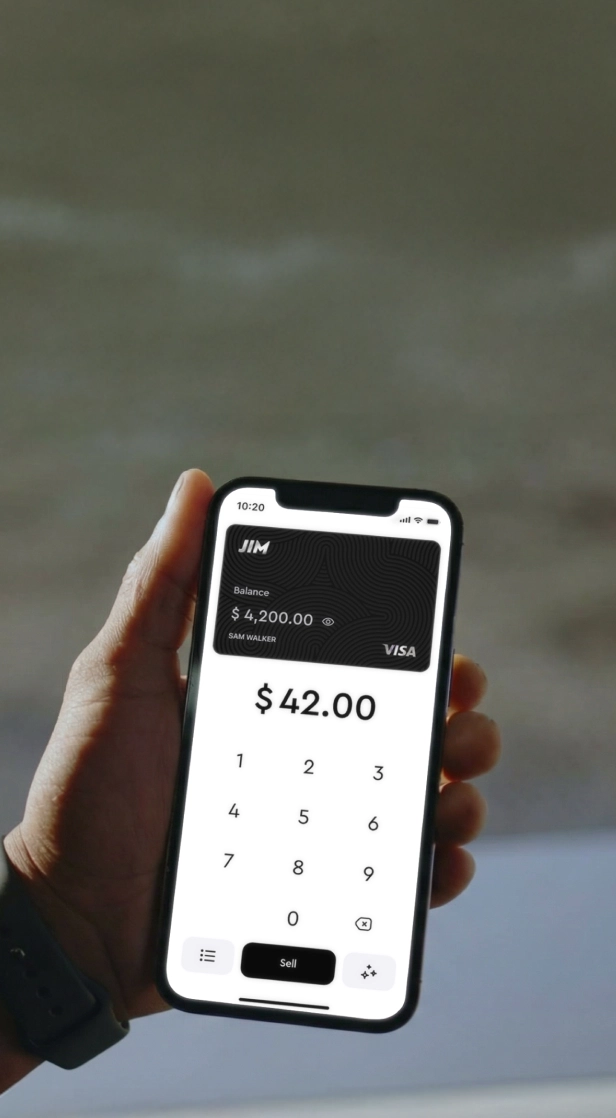
For a donut business that accepts payments in-store or on-the-go, JIM offers a streamlined solution. With JIM, you can accept debit, credit and digital wallets directly through your smartphone - just tap and done.
At just 1.99% per transaction with no hidden costs or extra hardware needed, it's particularly useful for selling at farmers' markets or catering events. Your funds are also available instantly.
Here is how you can make a sale:
- Get Started: Download the JIM app for iOS.
- Make a Sale: Type the sales amount, hit sell, and ask your customer to tap their card or device on your phone.
- Access Funds: Your money is available right on your JIM card as soon as the sale is done - no waiting for bank transfers.
Here are 3 immediate steps to take:
- Compare the transaction fees and hardware costs of two traditional payment providers.
- Decide if you plan to sell at off-site locations like farmers' markets.
- Download the JIM app to see how it works on your phone.
Step 6: Fund your business and manage finances
Secure startup capital
An SBA 7(a) loan is a popular choice for new bakeries. Lenders typically want to see a credit score above 680 and a detailed business plan with financial projections. Loans can range from $30,000 to $150,000 with interest rates often between 11% and 15%.
You might also consider equipment financing. This type of loan is secured by the equipment itself, which can make it easier to qualify for. Your suppliers often have financing partners, so ask them directly when you get quotes for your mixers and ovens.
Look into grants and working capital
In addition to loans, grants offer money you do not have to repay. Look into the Amber Grant, which awards funds to women-owned businesses. While competitive, these opportunities can provide a significant boost without adding to your business debt.
A frequent misstep is underestimating cash needs for the first six months. You should have enough working capital to cover rent, payroll, and ingredients for at least half a year. For a small shop, this could be between $25,000 and $40,000, separate from your startup costs.
Here are 4 immediate steps to take:
- Download the SBA 7(a) loan application checklist from the SBA website.
- Ask two equipment suppliers if they offer financing options.
- Research the eligibility requirements for the Amber Grant.
- Create a spreadsheet to calculate six months of operating expenses.
Step 7: Hire your team and set up operations
Staff your shop
For a small shop, you will likely start with two key roles: a Baker and a Cashier. A Baker handles all dough preparation, frying, and glazing, typically earning $17-$22 per hour. Your Cashier manages sales and customer service, with pay around $15-$18 per hour.
A frequent oversight is not cross-training. A cashier who can also box donuts or brew coffee becomes much more valuable during the 7-9 AM rush. This simple step prevents bottlenecks and keeps customers happy. Remember, all employees must have a Food Handler's Permit.
Manage daily operations
To manage schedules, you might want to look at software like 7shifts or Homebase. Many offer free plans for small teams and help you track hours accurately. This is better than a paper schedule, which can lead to confusion and missed shifts.
As you grow, aim to keep your total labor costs between 25% and 35% of your revenue. This is a standard benchmark in the food service industry. Exceeding this range can quickly eat into your profits, so monitor it closely from the start.
Here are 4 immediate steps to take:
- Write job descriptions for a Baker and a Cashier with clear responsibilities.
- Confirm the process for obtaining a Food Handler's Permit in your city.
- Compare the free plans of scheduling software like 7shifts and Homebase.
- Calculate your target weekly payroll based on a 30% labor cost goal.
Step 8: Market your business and attract customers
Create your digital storefront
Start with Instagram and Facebook. You should post high-quality photos of your daily specials around 8 AM, just as people think about their morning coffee. Use local hashtags like #[YourCity]Donuts to appear in local searches. This is your digital window display.
Once you have some content, run a targeted Facebook ad campaign. A $10 daily budget can reach thousands of people within a 3-mile radius of your shop. Aim for a Customer Acquisition Cost (CAC) under $5 for these initial ads.
Connect with your neighborhood
You can also partner with local offices for a "Donut Friday" promotion. Offer a 15% discount on dozen-box orders to secure recurring revenue. A frequent mistake is to just drop off flyers. A better approach is to bring a sample box to the office manager to close the deal.
A simple loyalty program also works wonders. You might offer a free donut after ten purchases. This simple tactic can increase customer lifetime value by over 25% in the first year by encouraging repeat visits from your regulars.
Here are 4 immediate steps to take:
- Create an Instagram business account and post your first photo.
- Draft a Facebook ad targeting users within a 3-mile radius of your shop.
- List three local offices to approach for a "Donut Friday" partnership.
- Outline a "buy 10, get one free" loyalty program.
Step 9: Price your donuts for profit
Calculate your costs per donut
Start with your Cost of Goods Sold (COGS). Add up the price of every ingredient in a single donut. For a classic glazed, this might be $0.25 for flour, sugar, and oil. This is your base cost.
Next, factor in labor. If your baker makes 100 donuts an hour at $20/hr, your labor cost per donut is $0.20. Your total prime cost for one donut is now $0.45. A frequent mistake is to forget labor in this calculation.
Set your menu prices
With that cost in mind, you can set your prices. Aim for a food cost percentage between 25% and 35%. This means you should mark up your prime cost by three to four times. A $0.45 donut priced at $1.80 has a 25% food cost.
Now, look at your competitors. If other local shops sell a similar donut for $2.25, your $1.80 price is attractive. You might also create tiered pricing. For example, sell a single donut for $1.80, a half-dozen for $9, and a dozen for $16 to encourage bulk buys.
Here are 3 immediate steps to take:
- Calculate the total ingredient and labor cost for one classic glazed donut.
- Research the menu prices of three local competitors for similar items.
- Create a tiered price list for single, half-dozen, and dozen donuts.
Step 10: Maintain quality and scale your operations
Keep your product consistent
Your classic glazed donut should weigh between 85 and 95 grams every time. Use a digital food scale for daily spot checks. You can also create a simple quality checklist for your opening baker to sign off on, covering size, color, and glaze coverage.
Some new owners rely on memory, but this leads to inconsistent batches and erodes customer trust. A formal checklist ensures every donut meets your standard. This simple process is what separates amateur shops from professional bakeries.
Use data to guide growth
Your sales data tells you when to expand. If you sell out of your top items before 10 AM for a month straight, it is time to increase production. This is a clear signal that demand outstrips your current supply and you can afford to grow.
Once you hit 85% of your kitchen's maximum daily output, you should consider hiring another part-time baker. For managing inventory and sales trends, you might look at restaurant-specific systems like Toast or Lightspeed Restaurant to see what sells best.
Here are 4 immediate steps to take:
- Create a daily quality checklist for donut weight and appearance.
- Track your sell-out times for one month to identify growth signals.
- Calculate your kitchen's maximum daily donut output.
- Review the inventory management features of Toast or Lightspeed Restaurant.
You now have a complete roadmap for your donut business. The key is consistency, from the weight of your dough to the glaze on top. That attention to detail is what brings people back. You have done the research, so trust your plan.
And when your first customer arrives, make the sale easy. JIM turns your smartphone into a card reader. It lets you accept payments without extra hardware for a flat 1.99% fee, and your money is available instantly. Download JIM and you are ready to go.
.avif)