Launching a glitter business can be a rewarding venture, blending creative flair with sharp business acumen. The global cosmetics and craft market is worth billions, with steady demand for glitter in everything from makeup and nail art to fashion and DIY projects.
This guide will walk you through the practical steps, from validating your business concept and building supplier relationships to acquiring inventory and securing the right permits, to help you launch a successful glitter business in the U.S.
Step 1: Research your market and plan your budget
First, validate your idea with market research. Use Google Trends to compare search volume for niches like ‘biodegradable glitter’ versus ‘chunky glitter’. You can also browse platforms like Etsy and Instagram, using hashtags such as #glittertumblers or #festivalmakeup to identify popular products and styles.
Next, analyze your direct competitors. Look at the top-selling glitter shops on Amazon and Etsy. Note their product range, pricing strategy, and packaging. Reading their customer reviews will give you direct insight into what buyers love and what they find lacking in current offerings.
Map out your startup costs
Speaking of costs, your initial investment can range from moderate to significant. A frequent misstep is to underestimate packaging expenses. You should budget not just for glitter jars, but also for branded labels, shipping boxes, and protective filler, as these costs accumulate.
Here is a typical breakdown for a small-scale launch:
- Initial Inventory: $500 - $2,000 for 20-50 glitter varieties
- Packaging & Shipping Supplies: $200 - $500
- Business Registration & Permits: $100 - $400 for an LLC and local licenses
- Website & E-commerce Platform: $50 - $300 for initial Shopify or Etsy fees
This brings your estimated total startup cost to between $850 and $3,200. This range provides a flexible starting point that you can adjust based on the scale of your launch.
Here are 4 immediate steps to take:
- Track search interest for three glitter niches you are considering on Google Trends.
- Identify five direct competitors on Etsy and document their pricing for a 2oz jar of glitter.
- Create a spreadsheet to budget for your initial inventory, packaging, and legal fees.
- Visit your state's Secretary of State website to review the process for LLC formation.
Step 2: Set up your legal structure and get licensed
Choose your business structure
You might want to form a Limited Liability Company (LLC). This structure separates your personal assets from business debts. Filing costs range from $50 to $500, depending on your state. An LLC also offers pass-through taxation, so profits are taxed on your personal return.
A frequent misstep is to mix personal and business finances. Once your LLC is approved, open a dedicated business bank account immediately. This simplifies bookkeeping and reinforces your legal liability protection.
Secure your licenses and permits
First, get a free Employer Identification Number (EIN) from the IRS website. You will need this number to open your business bank account and to file taxes. The online application takes about 15 minutes to complete.
Next, check your state’s requirements for a seller’s permit, which allows you to collect sales tax. In addition, your city or county likely requires a general business license, which can cost between $50 and $100 annually.
If you sell cosmetic-grade glitter, your products fall under FDA regulations. Ensure your supplier uses only color additives approved by the FDA for cosmetic use. Selling non-compliant glitter for makeup can create serious legal problems.
Here are 4 immediate steps to take:
- Visit your Secretary of State’s website to start the LLC formation process.
- Apply for a free EIN on the official IRS website.
- Research your state’s seller’s permit application and your city’s business license requirements.
- Ask potential suppliers for documentation that proves their cosmetic glitter is FDA-compliant.
Step 3: Secure your business insurance
With your legal structure in place, the next step is managing risk. General liability insurance is your baseline, covering claims like property damage. For an online glitter business, you should plan for a policy with $1 million in coverage, which typically costs between $300 and $700 per year.
A frequent mistake is to skip product liability insurance. If a customer has an allergic reaction to your cosmetic glitter, this policy covers the associated legal and medical fees. It is often bundled with general liability, so confirm it is included in your quote.
You might also consider inland marine insurance. This policy protects your inventory from damage or loss while it is in transit from your supplier or on its way to a customer. It provides a safety net for your most valuable asset.
For quotes, look to providers that specialize in e-commerce, such as Hiscox, The Hartford, or Next Insurance. Their online platforms can quickly generate a policy tailored to small retail operations.
Here are 4 immediate steps to take:
- Request a quote for a $1 million general liability policy.
- Confirm with the insurance agent that product liability for cosmetics is included.
- Compare annual premiums from at least two providers, like Hiscox and The Hartford.
- Ask about the cost to add inland marine coverage to protect your inventory.
Step 4: Set up your workspace and source inventory
Find your workspace
You can start your glitter business from home. A dedicated space of 100-150 square feet, like a spare room or a clean garage area, provides enough room for inventory and packing stations. Check your local city ordinances for any restrictions on home-based businesses.
Get your equipment and supplies
To operate professionally, you will need a few key pieces of equipment. A digital scale ensures you package consistent amounts and typically costs $20-$40. A heat sealer, for about $50, adds a professional, tamper-evident seal to your bags or pouches.
Now, let's talk about sourcing your glitter. A frequent misstep is to place a large order without vetting the product. Always get samples first to verify color accuracy and quality. This simple step prevents you from getting stuck with inventory that does not meet your standards.
You can source from domestic wholesalers for faster shipping or use a platform like Alibaba for lower costs per kilogram. On Alibaba, expect minimum order quantities of 1kg per color and plan for shipping times of 4-6 weeks. Domestic suppliers may offer smaller quantities but at a higher price.
Here are 4 immediate steps to take:
- Designate a 100 sq ft area in your home for the business.
- Price a digital scale and a heat sealer on Amazon or Uline.
- Request samples from two potential bulk glitter suppliers, one domestic and one overseas.
- Create a spreadsheet to compare supplier costs per kilogram, including shipping fees.
Step 5: Set up your payment processing
Your customers will expect to pay with credit cards or digital wallets. Most e-commerce platforms have built-in payment processors. A frequent mistake is to ignore transaction fees, which can quietly eat away at your profits with every single sale you make.
Look for a processor with clear, flat-rate pricing. Many providers charge between 2.5% and 3.5% per transaction, sometimes with added monthly fees. These costs add up, so compare options before you commit to one for your online store.
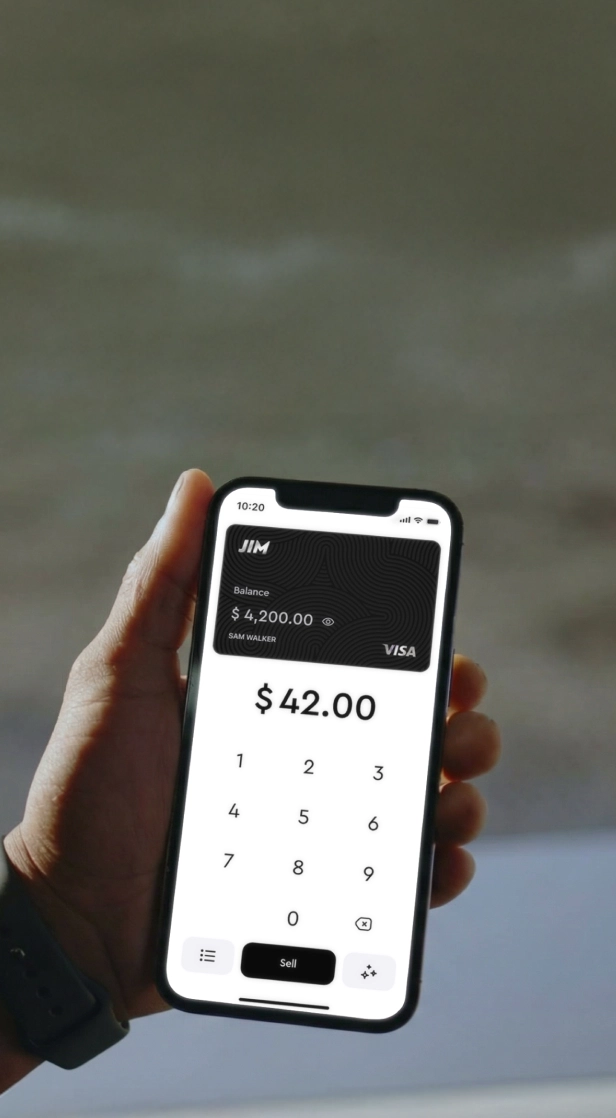
Now, let's cover in-person sales. For a glitter business that needs to accept payments on-site or on-the-go, JIM offers a streamlined solution. With JIM, you can accept debit, credit and digital wallets directly through your smartphone - just tap and done.
At just 1.99% per transaction with no hidden costs or extra hardware needed, it's particularly useful for selling at craft fairs or pop-up markets. Other payment solution providers often have higher commission rates, so this difference helps protect your margins.
- Get Started: Download JIM app for iOS
- Make a Sale: Type the sales amount, hit sell, and ask your customer to tap their card or device on your phone
- Access Funds: Your money is available right on your JIM card as soon as the sale is done - no waiting for bank transfers
Here are 3 immediate steps to take:
- Compare the transaction fees for your e-commerce platform’s native payment processor against another option like PayPal.
- Download the JIM app to see how it works for in-person sales.
- Calculate the total payment processing cost for a hypothetical $500 in monthly sales with two different providers.
Step 6: Fund your business and manage finances
Most glitter businesses start with personal savings. If you need external capital, an SBA Microloan is a strong option. These loans go up to $50,000, with interest rates typically between 8% and 13%. They are designed for new businesses with limited credit history.
You might also look into grants. The Amber Grant, for example, awards $10,000 to a different woman-owned business each month. Unlike a loan, you do not have to repay a grant. Competition is high, but the opportunity is worth the application effort.
Plan your operating cash flow
A frequent miscalculation is to focus only on startup costs and forget about day-to-day expenses. You need working capital to restock popular glitter colors, run marketing campaigns, and cover shipping supplies for your first six months. Plan for at least $2,000 to $5,000.
To manage your finances, open a separate business checking account and get a business credit card. This keeps your bookkeeping clean and makes tax time much simpler. It also reinforces the legal separation between you and your LLC.
Here are 4 immediate steps to take:
- Research SBA Microloan lenders in your state.
- Review the application requirements for the Amber Grant.
- Calculate your estimated working capital needs for the first six months.
- Open a business checking account as soon as your LLC is approved.
Step 7: Hire your team and set up operations
When to make your first hire
You will likely run the business solo at first. Plan to hire a part-time Packing Assistant once you consistently process 50-70 orders per week. This frees you to focus on marketing and product development, which are key to growth.
This role handles weighing glitter, packing orders, and printing shipping labels. Expect to pay between $15 and $18 per hour. A frequent misstep is to hire too soon, which can strain your cash flow before sales are stable. No special certifications are needed, but attention to detail is a must.
Streamline your daily workflow
To manage your operations, use the inventory management system built into your e-commerce platform. Shopify and Etsy automatically track stock levels as you make sales. This helps prevent you from selling out-of-stock glitter colors, which can frustrate customers.
Once you hire someone, you might use a platform like When I Work for scheduling. It simplifies communication about shifts and availability. Many of these platforms offer free plans for businesses with only one or two employees, so you can start without an added cost.
Here are 4 immediate steps to take:
- Define the weekly order volume that would trigger your first hire.
- Draft a job description for a part-time Packing Assistant with a pay range.
- Explore the inventory management features within your chosen e-commerce platform.
- Review a scheduling platform like When I Work to understand its features.
Step 8: Market your brand and acquire customers
Build a following on visual platforms
Your marketing should focus on visual platforms where glitter shines. Create an Instagram and TikTok profile to post high-quality videos. Show your glitter under different lighting, create satisfying mixing videos, or film short application tutorials. These visuals do the selling for you.
Pinterest is another powerful channel. Create boards for different themes like ‘Festival Makeup Looks’ or ‘DIY Glitter Crafts’. Pin your product photos and link them directly to your shop. This drives traffic from users who are actively looking for inspiration and products.
Use email and track your metrics
Capture customer emails by offering a 10% discount on their first order. Use an email marketing platform like Mailchimp to manage your list. This gives you a direct line to your most interested buyers, independent of social media algorithms.
A frequent mistake is to only send sales promotions. Instead, mix in valuable content like customer features or tutorials. Track your metrics closely. A good e-commerce conversion rate is 2-3%. If your Customer Acquisition Cost (CAC) exceeds your average profit per order, adjust your ad spend.
Here are 4 immediate steps to take:
- Create business profiles on Instagram and Pinterest.
- Plan and film three short video concepts for TikTok or Instagram Reels.
- Set up an email signup form on your website with a first-order discount.
- Calculate your target Customer Acquisition Cost based on your average profit margin.
Step 9: Price your glitter for profit
Most glitter businesses use a cost-plus model. Calculate your total cost per unit, then add your desired profit margin. Aim for a 60-70% gross profit margin, which means a 300-400% markup on your cost of goods is a good target.
A frequent mistake is to only account for the glitter itself. Your cost per unit must also include the jar, label, and a fraction of your platform fees. Forgetting these costs will quietly shrink your actual profit on every sale.
Analyze competitor pricing
Look at five top sellers on Etsy and Amazon for a product you plan to offer, like a 2oz jar of holographic glitter. Note their prices. This gives you a market-based price range to work within. You can price slightly higher if your branding and quality are superior.
For example, if your total cost for a 2oz jar is $1.25 and competitors sell it for $5.00-$6.00, pricing yours at $5.50 is a strong starting point. This gives you a healthy profit while staying competitive. You might also offer bundles, like a "festival kit" of five glitters for a slight discount.
Here are 4 immediate steps to take:
- Calculate your total cost per unit for one glitter product, including all packaging.
- Research the average price for a similar 2oz product on Etsy.
- Set a target gross profit margin between 60% and 70%.
- Create a pricing sheet for at least three different product sizes or bundles.
Step 10: Maintain quality and scale your operations
As your business grows, you must maintain consistent product quality. Create a quality control checklist for every new inventory shipment. Check for color accuracy against a master sample, ensure uniform particle size, and test for color bleed in a clear liquid.
For cosmetic glitter, always require documentation from your supplier that proves the color additives are FDA-approved. A frequent oversight is to trust a supplier’s claim without verification. This documentation protects you and your customers. Aim to keep your return rate for quality issues below 2%.
Plan your growth
Once you consistently hit 200 orders per week, your manual processes will slow you down. This is the time to invest in an automatic powder filling machine, which can cost $500-$1,500. This purchase frees up hours of labor, letting you focus on expansion.
When your product line grows beyond 100 SKUs, the basic inventory features on Shopify or Etsy may not be enough. You might explore a dedicated inventory management system like Katana. For shipping, a platform like ShipStation helps you batch-print hundreds of labels efficiently.
Here are 4 immediate steps to take:
- Create a quality control checklist for inspecting new glitter shipments.
- Set a target return rate for quality issues, aiming for under 2%.
- Research the cost of an automatic powder filling machine for when you reach 200 weekly orders.
- Review the features of a shipping platform like ShipStation to understand how it can save time.
Starting a glitter business blends creativity with careful planning. Remember that your brand's shine is just as important as the product's, so focus on quality and presentation. You have the roadmap, now it is time to build something that sparkles on your own terms.
And when you start to sell at markets, a simple payment solution helps. JIM turns your smartphone into a card reader, letting you accept payments with a flat 1.99% fee and no extra hardware. Download JIM to get ready for your first sale.
.avif)