Starting a golf business is an exciting venture that combines a passion for the game with sharp business savvy. The golf industry is a multi-billion dollar market, showing consistent demand for lessons, equipment, and course access from beginners, seasoned players, and families.
This guide will take you through the practical steps of validating your business concept, securing funding, selecting the right location, and acquiring equipment to help you launch a successful golf business in the U.S.
Step 1: Plan and validate your business idea
Start by researching your local market. Use the National Golf Foundation (NGF) database to understand golfer demographics and spending habits in your area. This data shows who your potential customers are and what they are willing to pay for.
Next, identify your direct competitors. A simple search on Google Maps will reveal all nearby driving ranges, golf courses, and indoor simulator facilities. Visit them to observe their pricing, customer traffic, and overall experience. Note what they do well and where there are gaps.
Estimate your startup costs
Your initial investment will vary. For an indoor golf business, a commercial-grade simulator from a brand like TrackMan or Foresight Sports can range from $20,000 to $70,000. A common mistake is buying a cheaper, residential unit that cannot withstand heavy commercial use.
Beyond simulators, budget for commercial space rent, which could be $5,000 to $15,000 per month. Also factor in business licenses ($500-$2,000), initial marketing ($2,000-$5,000), and other equipment like clubs and balls ($5,000+). A realistic startup budget often lands between $75,000 and $200,000.
Here are 3 immediate steps to take:
- Download a local market report from the National Golf Foundation.
- Create a spreadsheet of at least five local competitors with their services and prices.
- Draft a preliminary budget with estimated costs for simulators, rent, and licenses.
Step 2: Establish your legal structure and secure licenses
Your first move is to choose a legal structure. Most new golf businesses operate as a Limited Liability Company (LLC). This structure protects your personal assets if the business faces debt or lawsuits. File your LLC with your state’s Secretary of State for a fee of $50 to $500.
Once your LLC is formed, open a separate business bank account. A frequent misstep is mixing personal and business finances, which can erase the liability protection your LLC provides. This leaves your personal assets vulnerable.
Secure federal and local permits
Next, get a free Employer Identification Number (EIN) from the IRS website. You will also need a general business license from your state. For your physical location, do not sign a lease until you verify zoning with the city. This is required to obtain a Certificate of Occupancy.
If you plan to serve alcohol, apply for a liquor license from your state’s Alcohol Beverage Control board immediately. The process can take 3-6 months and cost several thousand dollars. You will also need a seller's permit for any retail sales.
Here are 3 immediate steps to take:
- Apply for a free EIN directly from the IRS website.
- Register your LLC with your state’s Secretary of State office.
- Verify zoning regulations for your target location with the local planning department.
Step 3: Secure insurance and manage risk
Your first policy should be General Liability insurance, which covers customer injuries from slips, falls, or errant golf balls. A standard policy with $1 million per occurrence and a $2 million aggregate limit typically costs between $1,000 and $5,000 annually.
In addition, you need Property Insurance to protect your assets. A frequent oversight is underinsuring expensive simulators for their depreciated value instead of their full replacement cost. Make sure your policy covers what it would cost to buy them new today.
Choose the right coverage and provider
If you or your staff provide lessons, Professional Liability insurance is necessary to cover claims related to instruction. Once you have employees, you must also carry Workers' Compensation insurance. This is a state requirement that covers employee injuries on the job.
You might want to get quotes from providers who understand the golf industry. Consider specialists like Philadelphia Insurance Companies, The Hartford, or Sadler Sports & Recreation Insurance. A general agent may not fully appreciate the specific risks of your business.
Here are 3 immediate steps to take:
- Request a quote for a General Liability policy with at least $1 million in coverage.
- Create an inventory of all equipment with full replacement values for a Property Insurance quote.
- Contact an insurance broker who specializes in sports and recreation businesses.
Step 4: Select your location and buy equipment
For an indoor facility with three simulators, you should look for a space between 3,000 and 5,000 square feet. Pay close attention to ceiling height. A frequent misstep is choosing a location with low ceilings; you need at least 12 feet of clearance for a full golf swing.
Look for properties zoned for commercial or recreational use. Before you sign anything, negotiate a Tenant Improvement (TI) allowance into your lease. This is money from the landlord to help pay for your specific build-out, like constructing simulator bays.
Purchase your core equipment
Your simulators are the main attraction. As mentioned, a commercial unit from TrackMan or Foresight Sports costs $20,000 to $70,000. You will also need high-quality hitting mats ($500-$1,500 each), durable golf balls ($500+ for bulk), and a set of rental clubs ($2,000+).
Beyond the golf-specific items, remember to budget for lounge furniture, a front desk, and a point-of-sale system to manage bookings and payments. These items can add another $10,000 to $20,000 to your initial equipment costs.
Here are 3 immediate steps to take:
- Measure the ceiling height of any potential location to confirm it is over 12 feet.
- Ask for a Tenant Improvement (TI) allowance in your lease negotiations.
- Get quotes for a full equipment package that includes mats, balls, and clubs.
Step 5: Set up your payment processing
Your customers will pay for simulator time by the hour, buy lesson packages, or sign up for memberships. You need a system that can handle these different transaction types smoothly. Look for a solution with low transaction fees and flexible hardware options.
Many new owners get surprised by hidden monthly fees or the cost of proprietary hardware. Some systems lock you into expensive equipment rentals. Always read the fine print on fees before you commit to a payment processor.
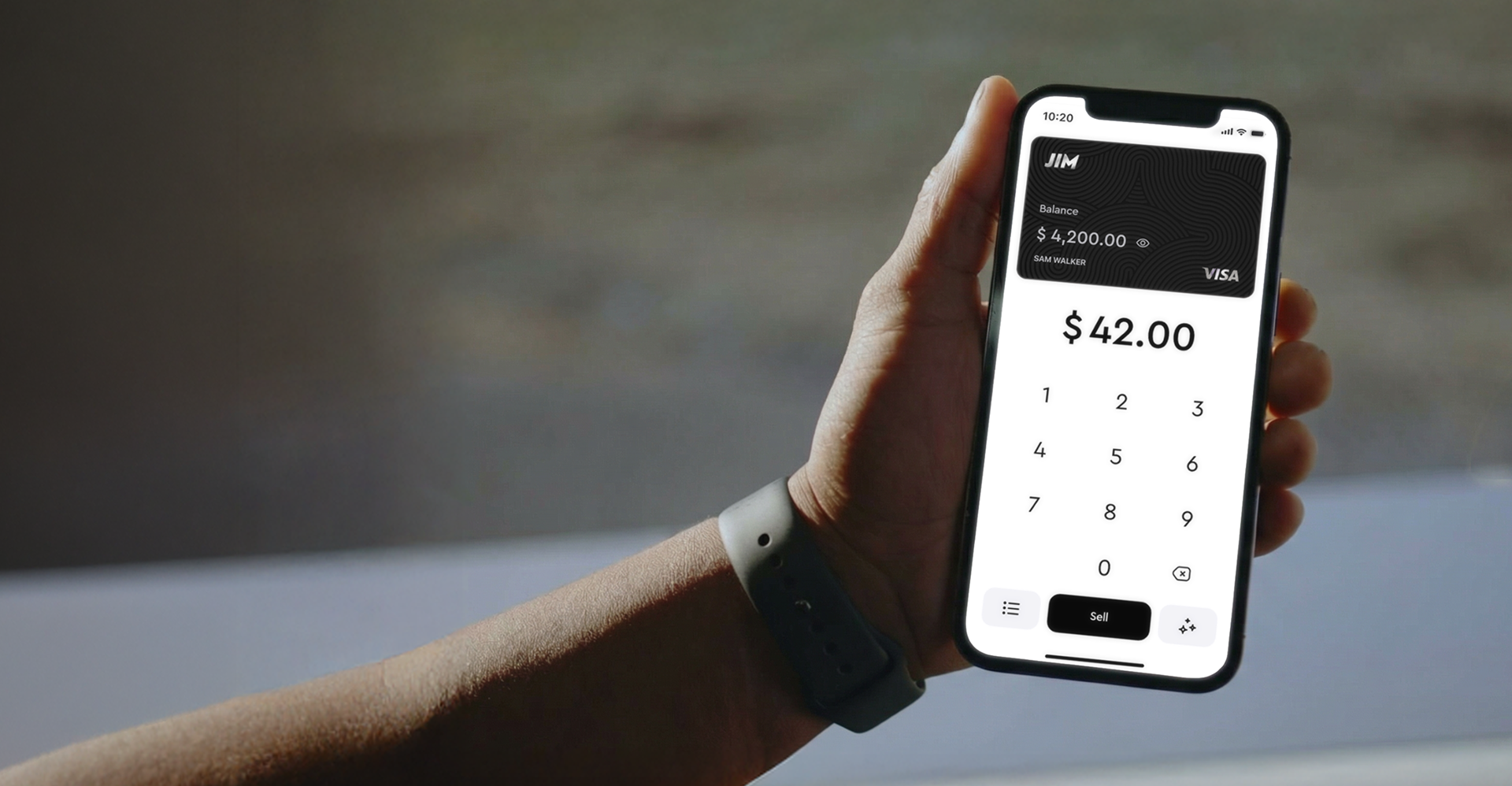
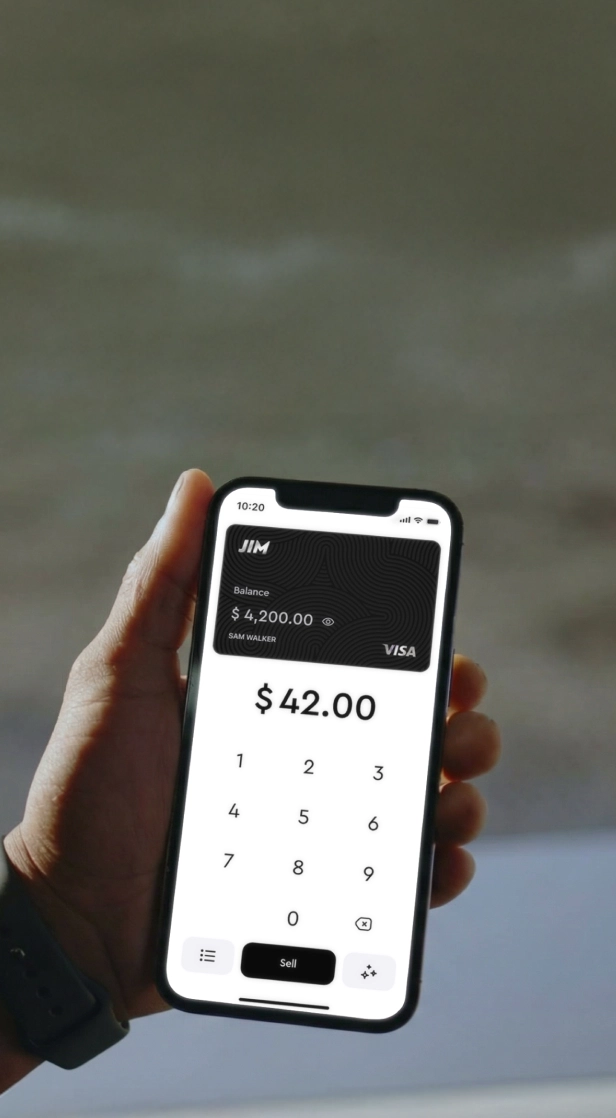
For businesses that need to accept payments on-site, JIM offers a streamlined solution. With JIM, you can accept debit, credit, and digital wallets directly through your smartphone. Just tap and the payment is done.
At just 1.99% per transaction with no hidden costs or extra hardware, it is very cost-effective. This is much lower than the typical 2.5% to 3.5% plus monthly fees from other providers. It's perfect for instructors taking payment right in the simulator bay.
- Get Started: Download the JIM app for iOS.
- Make a Sale: Type the sales amount, hit sell, and ask your customer to tap their card or device on your phone.
- Access Funds: Your money is available right on your JIM card as soon as the sale is done - no waiting for bank transfers.
Here are 3 immediate steps to take:
- Decide on your pricing for simulator time, lessons, and memberships.
- Compare the full fee structures of at least two payment processors.
- Download the JIM app to see how it works for on-the-spot sales.
Step 6: Secure funding and manage your finances
Secure your startup capital
With your business plan ready, you can approach banks for an SBA 7(a) loan. For a new golf business, you might seek between $75,000 and $200,000. Lenders typically look for a credit score over 680 and a business plan with detailed financial projections.
Another path is equipment financing, which is specific to your simulators. These loans use the equipment as collateral, which can make them easier to obtain. Interest rates often range from 8% to 15%, and the loan term usually matches the equipment's expected lifespan.
Plan for your operating costs
Many new owners focus on the big equipment purchase and underestimate their daily operating costs. You need cash on hand to run the business before revenue is steady. This is your working capital, and running out of it is a fast track to failure.
For the first six months, you should have at least $50,000 to $90,000 set aside. This covers rent, utilities, insurance, and marketing while you build your customer base. This figure is what keeps the lights on before you become profitable.
Here are 3 immediate steps to take:
- Draft detailed financial projections for your first three years of operation.
- Contact your bank’s small business department about an SBA 7(a) loan.
- Calculate your working capital needs for the first six months of business.
Step 7: Hire your team and set up operations
Build your core staff
For a typical three-simulator facility, you will need at least one front desk associate and one golf instructor. A front desk associate handles bookings and customer service, usually for $15 to $20 per hour. Some owners also act as the general manager initially.
Your golf instructors are key to attract repeat business. You might want to find instructors with PGA or LPGA certifications, as this builds immediate credibility. They often work on a commission split (40-60%) or an hourly rate of $50 to $100 per lesson.
Set up your management systems
To manage bookings, consider software like Acuity Scheduling or a golf-specific platform like foreUP. These systems prevent double bookings and let customers reserve time online. Many new owners try to manage this with a simple calendar, which quickly becomes unworkable.
Once you are operational, aim to keep total payroll costs between 30% and 40% of your gross revenue. This is a standard benchmark for service-based businesses. It helps you remain profitable as you grow your team.
Here are 3 immediate steps to take:
- Draft job descriptions for a front desk associate and a PGA-certified instructor.
- Request demos for two scheduling software platforms, like Acuity and foreUP.
- Search the PGA of America’s website for certified teaching professionals in your area.
Step 8: Market your business and acquire customers
Your first marketing push should be local and direct. Reach out to high school golf coaches and corporate wellness coordinators. You can offer them a special rate for team practice or company events. This builds a base of recurring revenue before you even open your doors.
Launch your digital marketing
Set up your Google Business Profile immediately. Many new owners overlook this, but it is how most customers will find you. Fill it out completely with high-quality photos, your hours, and a direct link to your booking system. This is free, powerful marketing.
On social media, focus on video. Post short clips on Instagram and Facebook that show off the simulator experience. A simple giveaway for a free hour of play can quickly build your initial follower count. Engagement on video content is much higher than on static photos.
Once you have some traction, you can run targeted ads. Use Facebook Ads to reach users interested in golf within a 10-mile radius. A budget of $30 per day is a good start. Aim for a Customer Acquisition Cost (CAC) under $40 for each new booking.
Here are 3 immediate steps to take:
- Draft an email to three local high school golf coaches with a special offer.
- Set up and complete your Google Business Profile with at least five photos.
- Outline a Facebook ad campaign targeting local golfers with a $30 daily budget.
Step 9: Set your pricing and profit margins
Choose your pricing model
Most indoor golf facilities charge by the hour. You might set peak rates at $50 to $70 per hour for evenings and weekends. Off-peak times, like weekday mornings, could be lower, around $35 to $50 per hour to attract more traffic.
Memberships create steady income. Consider a basic plan for $150 per month that includes five hours of simulator time. A premium option at $300 could offer unlimited off-peak play and discounts on lessons, building a loyal customer base.
Simulator time itself offers high profit margins, often over 80 percent, since your main variable costs are minimal. For any retail items like gloves or apparel, a standard markup is 50 to 100 percent, which results in a 33 to 50 percent profit margin.
Analyze competitor pricing
With a structure in mind, check your competitors. Call them or look at their websites to find their rates for hourly play and memberships. Put this information into a simple spreadsheet for a clear side-by-side comparison.
Some new owners believe they must have the lowest price to attract customers. This often backfires because it can signal low quality. Instead, aim to price within 10 to 15 percent of the local average and justify it with a better experience.
Here are 3 immediate steps to take:
- Create a pricing sheet with peak and off-peak hourly rates for your simulators.
- Outline two membership tiers with specific monthly costs and benefits.
- Call three local competitors to get their current pricing for one hour of simulator time.
Step 10: Maintain quality and scale your operations
Monitor your performance metrics
To maintain quality, you need to track specific numbers. Aim for a customer retention rate of 40 percent, meaning four out of ten new clients return within three months. Also, monitor your Google Business Profile reviews, and strive for an average rating of 4.5 stars or higher.
Another key metric is simulator utilization. If your bays are consistently booked over 70 percent during peak hours for three straight months, it is a strong indicator that you have room to grow. This data tells you when demand outstrips your current supply.
Decide when to expand
With strong metrics, you can plan your expansion. Some owners make the mistake of expanding too quickly. Before you sign a lease on a second location, ensure your first one is consistently profitable and operates without your daily presence. Your systems should run the business.
Hiring should also be data-driven. When your lead instructor’s schedule is booked more than 80 percent for two consecutive months, it is time to hire another PGA professional. This prevents burnout and lost revenue from turning away lesson requests.
Here are 3 immediate steps to take:
- Set a goal to have 40% of new customers return within 90 days.
- Track your peak-hour simulator utilization rate on a weekly basis.
- Create a quarterly checklist for inspecting all golf equipment for wear.
You now have the blueprint to turn your passion for golf into a business. Remember, the small details, like a welcoming atmosphere and top-notch service, are what create loyal customers. With a clear plan, you are well-equipped to succeed.
As you welcome your first customers, make payments easy. JIM turns your smartphone into a card reader, letting you accept payments on the spot for a flat 1.99% fee without extra hardware. Download JIM to simplify your sales from day one.
.avif)