Starting a kombucha business is a rewarding venture that combines the art of brewing and flavor creation with smart business sense. The market is already worth billions of dollars, with steady demand from health-conscious consumers, cafe patrons, and those looking for a healthier alternative to soda.
This guide will take you through the practical steps of validating your business concept, obtaining the right licenses, acquiring equipment, and building supplier relationships to help you launch a successful kombucha business in the U.S.
Step 1: Plan your business and validate your concept
Market and competitor analysis
Start by visiting local health food stores, cafes, and farmers' markets to see what brands are on the shelves. Note their flavors, bottle sizes, and prices. A frequent mistake is to launch without a unique flavor profile, so your goal is to find a gap you can fill.
For a deeper look, you can review an IBISWorld report on the RTD Tea Production industry. A simple spreadsheet that tracks local competitors is also very effective. Document their branding, price per ounce, and where they sell their products to help position your brand.
Estimate your startup costs
Speaking of costs, your initial investment requires careful planning. A commercial kitchen rental is a significant part of the budget. Expect to pay between $25 and $75 per hour. Budgeting for this upfront can prevent early cash flow problems.
Here is a typical breakdown for a small-scale launch:
- Licenses and Permits: $500 - $1,500
- Basic Brewing Equipment: $2,000 - $5,000
- Initial Ingredients: $500 - $1,000
- Liability Insurance: $500 - $1,200 annually
This brings your initial startup costs to a range of $3,500 to $9,200. This figure does not include marketing or unexpected expenses, so a contingency fund is a good idea.
Here are 4 immediate steps to take:
- Visit at least five local retailers to analyze their kombucha selection.
- Create a spreadsheet to track competitor pricing, flavors, and bottle sizes.
- Draft a preliminary budget based on the cost estimates provided.
- Research hourly rental rates for three commercial kitchens in your area.
Step 2: Set up your legal structure and get licensed
Business structure and registration
Choosing a Limited Liability Company (LLC) is a smart move. It protects your personal assets if the business faces legal issues. You can file for an LLC through your state's Secretary of State website, with fees typically between $50 and $500.
An LLC also offers pass-through taxation, which means business profits are reported on your personal tax returns. This simplifies your accounting compared to a corporation.
Navigating food and beverage laws
The FDA requires you to register as a food facility, which is free on their website. The real challenge is alcohol content. The Alcohol and Tobacco Tax and Trade Bureau (TTB) regulates any beverage with 0.5% or more Alcohol by Volume (ABV).
A frequent misstep is failing to monitor this. If your ABV creeps up, you fall under brewery regulations, which are far more complex. Regularly test your batches to stay compliant.
At the local level, you will need a food facility health permit from your county health department. This can cost between $200 and $1,000 and take 4-8 weeks to process. Ensure your commercial kitchen is already approved by them before you sign a lease.
Here are 4 immediate steps to take:
- File for an LLC with your state's Secretary of State.
- Register your business as a food facility on the FDA website.
- Contact your county health department for their food facility permit application.
- Purchase a hydrometer or refractometer to test your kombucha's ABV.
Step 3: Secure your insurance and manage risk
Choosing the right insurance coverage
You will need several types of insurance. General Liability covers accidents at your booth or facility, while Product Liability protects you if someone gets sick from your kombucha. Aim for at least $1 million in coverage for each. These are often bundled together.
If you have equipment, you need Commercial Property insurance. Once you hire staff, Workers' Compensation is legally required. Annual premiums for a basic general and product liability policy typically range from $1,000 to $3,000 for a small operation.
A frequent mistake is not having adequate product liability. Exploding bottles from over-carbonation can cause injury and lead to lawsuits. Look into providers like the Food Liability Insurance Program (FLIP), Hiscox, and The Hartford, as they specialize in food businesses.
Here are 4 immediate steps to take:
- Request quotes from three insurance providers that cover food startups.
- Verify that your general liability policy explicitly includes product liability.
- Check your commercial kitchen lease for its minimum insurance requirements.
- Draft a plan to test for and prevent over-carbonation in your batches.
Step 4: Find a location and buy equipment
Location and lease negotiation
For a small-scale launch, a 200-500 square foot space within a shared commercial kitchen is a good start. Your location must be in a commercially zoned area. A frequent oversight is leasing a space without adequate floor drains and ventilation, which are non-negotiable for brewing.
When you negotiate your lease, ask about a tenant improvement allowance. This can help cover costs for any plumbing or electrical upgrades you might need. Also, confirm the landlord permits food and beverage production before you sign anything.
Brewing equipment and suppliers
You can start with used equipment to manage costs, but some items are worth buying new. Many new brewers use plastic fermenters to save money, but stainless steel is far better for sanitation and prevents flavor carryover. Here is a sample budget:
- Brewing Vessels (15-30 gallon): $400 - $900
- pH Meter: $50 - $150
- Bottle Filler and Capper: $100 - $400
- Commercial Refrigerator: $1,000 - $3,000
For ingredients, you might look at suppliers like Rishi Tea & Botanicals. They often have minimum order quantities around 25 pounds, so factor that into your initial inventory budget.
Here are 4 immediate steps to take:
- Tour three commercial kitchens and check for floor drains and ventilation.
- Price out a starter equipment package from two different restaurant supply stores.
- Contact your local planning department to confirm zoning requirements for beverage production.
- Request minimum order quantities from one bulk tea and one sugar supplier.
Step 5: Set up payments and manage finances
Set up your payment system
When you sell to cafes, expect Net 30 payment terms, which means you get paid 30 days after invoicing. For direct sales at markets, you need to accept payments on the spot. Many new brewers get caught by high transaction fees that eat into their margins.
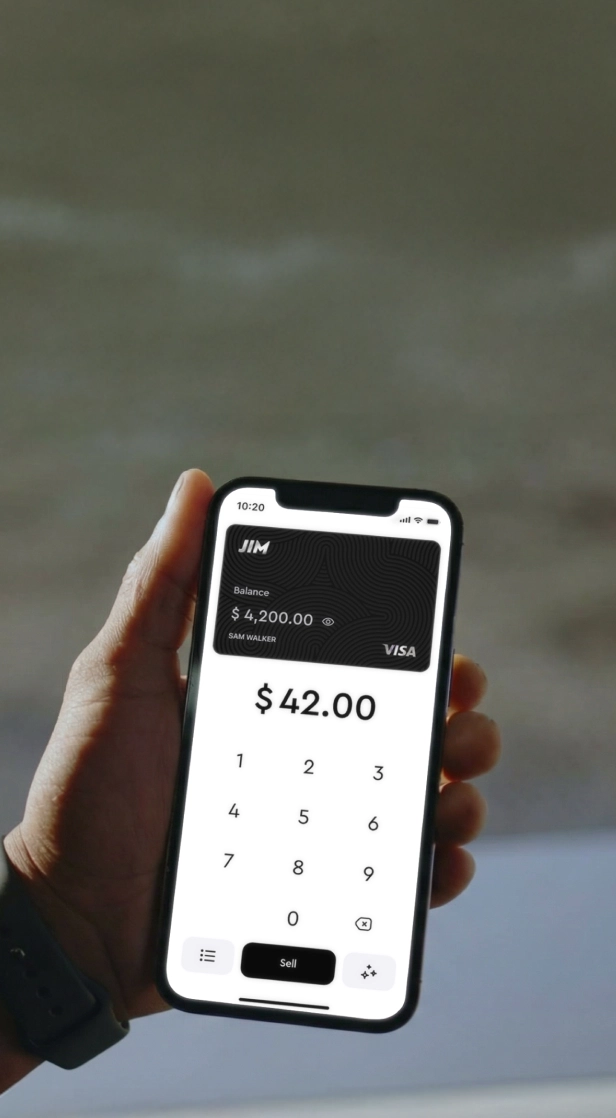
For kombucha businesses that need to accept payments on-site or on-the-go, JIM offers a streamlined solution. With JIM, you can accept debit, credit and digital wallets directly through your smartphone - just tap and done. Other providers often charge 2.5% to 3.5% plus hardware costs.
At just 1.99% per transaction with no hidden costs or extra hardware needed, it's particularly useful for selling bottles at a busy farmers' market. Here is how it works:
- Get Started: Download JIM app for iOS
- Make a Sale: Type the sales amount, hit sell, and ask your customer to tap their card or device on your phone
- Access Funds: Your money is available right on your JIM card as soon as the sale is done - no waiting for bank transfers
Here are 4 immediate steps to take
- Download the JIM app to explore its features.
- Ask two local cafes about their typical payment terms for suppliers.
- Open a dedicated business bank account for your kombucha sales.
- Create a simple invoice template for your first wholesale order.
Step 6: Fund your business and manage finances
Funding sources
For initial funding, you might look into an SBA Microloan. These loans go up to $50,000 with interest rates typically between 8% and 13%. They are often more accessible for new businesses than traditional bank loans.
Another option is Kiva, which facilitates 0% interest, crowdfunded loans up to $15,000. This can be a great way to get community support and avoid interest payments. A frequent misstep is to secure funds only for equipment, forgetting day-to-day expenses.
Grants and working capital
You could also explore grants, though they are competitive. The USDA's Value-Added Producer Grant (VAPG) is a good one to research, as it supports businesses that process raw agricultural products, like tea for kombucha.
With funding in mind, you should plan for at least six months of working capital. This buffer covers your operating costs before sales become consistent. A typical monthly budget might include $1,000 for kitchen rent, $500 for ingredients, and $500 for insurance and other costs.
This means you should aim for a working capital fund of around $12,000 to ensure a smooth start for your first six months.
Here are 4 immediate steps to take:
- Research SBA Microloan requirements on the SBA website.
- Create a profile on Kiva to see if you qualify for a 0% interest loan.
- Review the USDA's Value-Added Producer Grant application.
- Calculate your estimated six-month working capital based on your budget.
Step 7: Hire your team and set up operations
Hiring your first employee
Once you consistently produce over 50 gallons a week, you likely cannot do it all alone. Your first hire should be a part-time Production Assistant. They handle brewing, bottling, and sanitation. Expect to pay between $18 and $25 per hour for this role.
Anyone who handles your product needs a Food Handler Permit. You can find these courses online, and they usually cost around $10 to $15. A frequent mistake is to hire friends without a formal agreement. Always outline duties and pay in writing to avoid issues down the road.
Standardizing your operations
To ensure every bottle tastes the same, you need Standard Operating Procedures (SOPs). Create a simple document that details your recipe, fermentation times, and cleaning process. This removes guesswork and makes it easy to train new staff when you expand.
For scheduling, an app like When I Work can help you manage shifts once you have a small team. It simplifies communication and ensures your production schedule is always covered. Initially, a shared digital calendar also works well.
Here are 4 immediate steps to take:
- Draft a job description for a part-time Production Assistant.
- Check your local health department for Food Handler Permit requirements.
- Create a one-page SOP for your most popular kombucha flavor.
- Explore a scheduling app like When I Work to see its features.
Step 8: Market your brand and find customers
Direct-to-consumer sales
Farmers' markets are your best starting point. Booth fees typically run from $50 to $150 per day. Offer free samples to everyone who stops by. A good budget is to set aside 10% of your market inventory for sampling, as this directly drives sales.
Many new brewers show up with a plain table. Instead, invest in a branded tablecloth and a simple A-frame sign. This small touch can increase foot traffic to your booth and makes your brand look professional from day one.
Wholesale and local partnerships
To get into local cafes and stores, create a one-page sell sheet. It should list your flavors, wholesale pricing, and a short version of your brand story. Leave this with a sample bottle for the manager or owner.
A frequent mistake is to not follow up. If you do not hear back within a week, send a brief, friendly email. Persistence often pays off. Also, consider partnerships with yoga studios or gyms for cross-promotional events.
Digital marketing on a budget
Your digital presence should focus on Instagram. Use high-quality photos of your product, the brewing process, and happy customers at your market stall. Visuals sell your brand before anyone tastes the product.
Run a simple giveaway to grow your local following. You could partner with a nearby cafe to offer a prize, like a four-pack of your kombucha and a coffee gift card. This builds community and introduces your brand to new audiences.
Here are 4 immediate steps to take:
- Create a one-page sell sheet with your wholesale prices.
- Contact three local farmers' markets about booth fees and availability.
- Set up a business Instagram account and post five high-quality photos.
- Draft an email template for following up with potential wholesale clients.
Step 9: Price your kombucha for profit
Cost-plus vs. value-based pricing
Your pricing strategy directly impacts your profit. A simple method is cost-plus pricing. Calculate your total cost per bottle—ingredients, labor, and overhead—and add a markup. A 100-200% markup is typical for wholesale.
For example, if your cost per bottle is $1.75, a 100% markup sets your wholesale price at $3.50. The retailer then marks it up again for a final price around $4.99. This ensures you and your retail partners are profitable.
Another approach is value-based pricing. You set your price based on what local customers already pay for similar products. If premium kombuchas in your area sell for $5.50, pricing yours at $5.00 can make you an attractive alternative without a race to the bottom.
Calculating your margins
Many new brewers miscalculate their costs and end up with thin margins. You should include a fraction of your rent, insurance, and marketing budget into your cost per bottle. This gives you an accurate picture of your profitability.
Aim for a gross profit margin of 50-70% for direct-to-consumer sales. For wholesale, margins are lower, typically 30-50%, but the volume is higher. Your goal is to find a balance that supports growth.
Here are 4 immediate steps to take:
- Calculate your complete cost per bottle, including all overhead and labor.
- Research the prices of five competing kombuchas at a local health food store.
- Create a pricing sheet with your wholesale price and suggested retail price (SRP).
- Decide on a starting markup percentage that gives you at least a 50% gross margin.
Step 10: Control quality and scale your operations
Keep your quality consistent
Your goal is a consistent product. Create a quality control log for every batch. Track fermentation time, final pH, and ABV. A frequent mistake is to rely only on taste. Your pH should be between 2.5 and 3.5, and your ABV must stay below 0.5% to avoid TTB regulations.
You should also develop a sensory checklist. This helps you rate each batch on aroma, flavor balance, and carbonation level. It removes guesswork and creates a standard for anyone who helps with production. This document is your guide to a reliable product.
Know when to grow
Once you consistently sell over 100 gallons a week, you might consider your first full-time hire. This is usually a Production Manager who can run the day-to-day brewing. This frees you up to focus on sales and growth.
When you have 20-30 wholesale accounts, a shared kitchen may no longer work. This is the time to look for a dedicated facility. As you grow, brewery management software like Ekos can help you track inventory, production schedules, and sales data all in one place.
Here are 4 immediate steps to take:
- Create a quality control log to track pH, ABV, and taste for each batch.
- Define the production volume that will trigger your first full-time hire.
- Research the features of a brewery management software like Ekos.
- Outline the costs for moving into a dedicated space with larger fermenters.
Launching a kombucha business is about more than a great recipe; it's about consistency. Customers return for the flavor they love, so keep your quality steady. You have a clear path forward, so go turn your passion into a successful venture.
And when you make that first sale, getting paid should be simple. JIM lets you accept payments right on your smartphone for a 1.99% fee, no extra hardware needed. It makes market days much easier. Download JIM and you're all set.
.avif)