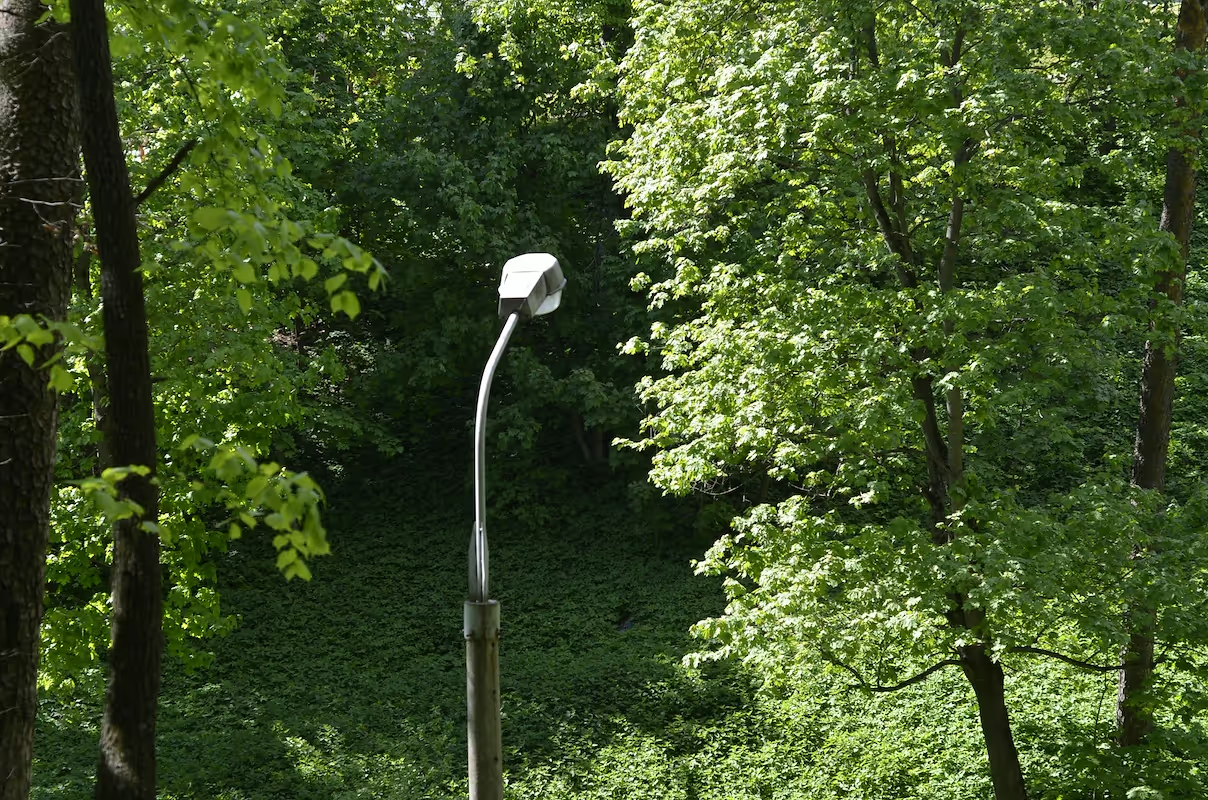
Starting a landscape lighting business is a rewarding venture that blends creativity and technical skill with smart business sense. The market is worth billions, fueled by steady demand for professional lighting installations for residential homes, commercial properties, and outdoor living spaces.
This guide will take you through the practical steps of validating your business idea, obtaining the necessary permits, and acquiring equipment to help you launch a successful landscape lighting business in the U.S.
Step 1: Plan your business and validate the idea
Start by researching your local market. Drive through affluent neighborhoods and areas with new, high-end home construction. Note properties with poor or no outdoor lighting because these represent direct opportunities. You can also connect with landscape designers and pool builders for potential partnerships.
Next, analyze your competition. Use Google Maps and search for "landscape lighting" in your city. Review the top five results, looking at their websites, service offerings, and customer reviews. A frequent misstep is competing on price alone; instead, focus on the quality of their work and their value.
Understand your startup costs
A clear budget is your financial roadmap. Initial equipment like a trenching shovel, drills, and wire connectors might cost between $2,000 and $5,000. General liability insurance is another line item, typically running from $600 to $1,200 per year.
In addition, set aside about $500 to $1,500 for initial marketing. This covers a simple website, business cards, and perhaps a few local online ads. Your total initial investment will likely fall between $3,100 and $7,700 before you purchase any light fixtures for a job.
Here are 3 immediate steps to take:
- Scout two to three target neighborhoods to gauge demand.
- List the top three local competitors and analyze their online presence.
- Draft a startup budget with estimated costs for tools, insurance, and marketing.
Step 2: Establish your legal structure and licensing
You should form a Limited Liability Company (LLC) to protect your personal assets. This structure separates your business liabilities from your personal finances. Most LLCs offer pass-through taxation, so you report business profits on your personal tax return, which simplifies your accounting early on.
Once your LLC is registered with your state, get a free Employer Identification Number (EIN) from the IRS website. You will need this number to open a business bank account, hire employees, and file your federal taxes. The online application takes only a few minutes to complete.
Navigate state and local requirements
Many people assume low-voltage work requires no license, which can be a costly mistake. Most states demand a specialty electrical or low-voltage contractor license. For example, you might need a C-7 Low Voltage Systems license. Check with your state’s contractor licensing board for specifics.
For individual projects, you may also need to pull an electrical permit from the local city or county building department. These permits can cost between $50 and $200 and usually take a few business days to process. Always factor this potential time and cost into your project quotes.
Here are 4 immediate steps to take:
- File for an LLC with your Secretary of State's office.
- Apply for a free EIN on the official IRS website.
- Identify the specific low-voltage license your state requires.
- Contact your local building department to understand their permit process.
Step 3: Secure your insurance and manage risk
Protect your business with the right insurance. Start with a general liability policy with at least $1 million in coverage. This typically costs between $600 and $1,200 annually and protects you if you damage a client’s property, like accidentally cutting a sprinkler line.
Many new owners underinsure themselves to save money, only to face a massive bill after one mistake. You should work with an agent who understands contractors. Consider providers like Hiscox, Next Insurance, or The Hartford, as they specialize in policies for trade businesses.
Additional coverage to consider
Once you buy a dedicated work truck, you will need a commercial auto policy. Your personal auto insurance will not cover accidents that happen during business use. Also, most states require you to get workers’ compensation insurance the moment you hire your first employee.
Here are 4 immediate steps to take:
- Request quotes for a $1 million general liability policy.
- Ask potential agents if their policies cover damage to underground utilities.
- Review your state’s laws on workers’ compensation insurance.
- Contact your auto insurance provider to discuss a commercial policy for your work vehicle.
Step 4: Set up your workspace and buy equipment
You do not need a commercial storefront when you start. A 100 to 200 square foot space in your garage or a small storage unit is enough to hold inventory and equipment. Just confirm your local zoning rules allow for a home-based business without customer traffic.
If you rent a storage unit, try to find one with a first-month-free promotion and a month-to-month lease. This approach gives you flexibility and avoids a long-term contract before you have steady cash flow.
Purchase your core equipment
Start with the foundational gear. A quality trenching shovel costs between $50 and $100, while a reliable cordless drill set will be about $200 to $400. You will also need wire strippers and connectors, which you can find in kits for around $100 to $150.
For fixtures and transformers, open wholesale accounts with distributors like SiteOne Landscape Supply or Ewing Irrigation. Resist the urge to buy cheap fixtures from big-box stores; professional-grade products from a distributor have better warranties and protect your reputation.
Here are 4 immediate steps to take:
- Measure a 10x10 foot space in your garage for equipment storage.
- Research local storage unit prices and ask about month-to-month leases.
- Create a shopping list with prices for a trenching shovel, drill set, and wire tools.
- Apply for a wholesale account with a supplier like SiteOne or Ewing.
Step 5: Set up your payment processing
Establish clear payment terms from the start. A standard practice is to require a 50% deposit to purchase materials and schedule the job. The remaining 50% is then due upon project completion. Not collecting a deposit is a frequent misstep that can hurt your cash flow.
Choose your payment solution
You will need a reliable way to accept credit cards and digital payments, especially on-site. When you compare options, look at transaction fees and how quickly you get your money. Many processors charge between 2.5% and 3.5% per transaction, sometimes with added monthly fees.
For a landscape lighting business that accepts payments on the go, JIM offers a streamlined solution. With JIM, you can accept debit, credit, and digital wallets directly through your smartphone. At just 1.99% per transaction with no hidden costs or extra hardware, it is particularly useful for collecting a deposit right after a client agrees to the proposal.
- Get Started: Download the JIM app for iOS.
- Make a Sale: Type the sales amount, hit sell, and ask your customer to tap their card or device on your phone.
- Access Funds: Your money is available on your JIM card as soon as the sale is done, with no waiting for bank transfers.
Here are 3 immediate steps to take:
- Finalize your payment terms, such as a 50% deposit policy.
- Compare payment processing rates against the 2.5% to 3.5% industry average.
- Download the JIM app to explore its features for on-site payments.
Step 6: Fund your business and manage finances
Most landscape lighting businesses start with personal savings. If you need outside capital, an SBA Microloan is a strong option. These loans go up to $50,000, with interest rates typically between 8% and 13%. You will need a solid business plan and a decent credit score to qualify.
For larger purchases like a work truck, equipment financing is another route. Lenders use the vehicle as collateral, which can make approval simpler. You might explore options from companies like Crest Capital or even your local bank. This keeps your cash free for other expenses.
Calculate your working capital
Your working capital covers daily operations before client payments clear. For the first six months, a reserve of $5,000 to $10,000 is a safe target. This buffer handles insurance, fuel, marketing, and the upfront cost of fixtures without causing cash flow problems.
A frequent misstep is to underestimate how much cash you need on hand. Forgetting that you must buy materials before you get paid can force you to delay jobs. This not only stalls your growth but can also damage your reputation with clients and suppliers.
Here are 4 immediate steps to take:
- Research one SBA Microloan lender in your state.
- Get a quote for equipment financing for a work vehicle.
- Calculate your estimated operating costs for the first six months.
- Open a dedicated business checking account to separate your finances.
Step 7: Hire your team and set up operations
Build your installation crew
Your first hire will likely be a Landscape Lighting Technician. This person handles the physical work like trenching, wiring, and fixture installation. Expect to pay an experienced technician between $22 and $28 per hour, depending on your market and their skill level.
Look for candidates with hands-on electrical or landscaping experience. While not always required, a certification like the Certified Low Voltage Lighting Technician (CLVLT) from the Association of Outdoor Lighting Professionals (AOLP) shows a serious commitment to the trade.
Streamline your daily operations
To manage your growing team and schedule, you might consider field service software. A program like Jobber helps you organize appointments, send quotes, and manage customer details from your phone. This keeps your operations smooth as you take on more projects.
A mistake some new owners make is misclassifying their first hire as an independent contractor to save on taxes. The IRS has strict rules, and getting it wrong can lead to major penalties. It is often safer to classify your technician as a W-2 employee from day one.
As you grow, a good benchmark is for each field technician to generate between $100,000 and $150,000 in annual revenue. This target helps you decide when it is profitable to hire another person and expand your capacity.
Here are 4 immediate steps to take:
- Draft a job description for a Landscape Lighting Technician.
- Look up the requirements for the AOLP’s CLVLT certification.
- Review the IRS guidelines for classifying employees versus contractors.
- Schedule a demo with a field service software like Jobber.
Step 8: Market your business and find customers
Focus on local and digital marketing
Start with hyper-local tactics. Print 500 professional door hangers and distribute them in the affluent neighborhoods you scouted earlier. When you complete a job, place a small, tasteful yard sign on the property for a week with the client’s permission. This provides immediate social proof.
Your digital presence is just as important. Create a free Google Business Profile and fill out every section. Add your service area, hours, and photos of your work. Ask every satisfied customer to leave a review, as this directly impacts your visibility in local search results.
Build your portfolio and partnerships
Many new owners make a mistake by using poor photos. Your work is visual, so blurry or dark images will not attract clients. Invest in a good camera or hire a photographer for your first few projects to build a portfolio of high-quality "before" and "after" shots.
You can also generate leads through referral partnerships. Offer a 5% to 10% referral fee to landscape designers, pool builders, and real estate agents who send clients your way. A single strong partnership can provide a steady stream of work with almost no marketing cost.
Here are 4 immediate steps to take:
- Design and order 500 door hangers for your target neighborhoods.
- Create and fully optimize your Google Business Profile.
- Identify three potential referral partners and draft an outreach email.
- Take high-quality "before" and "after" photos of your next project.
Step 9: Price your services for profit
Your price reflects your skill, so avoid competing to be the cheapest. Instead, focus on the value you provide through design and quality materials. This approach allows you to command higher rates and attract clients who appreciate professional work.
Develop your pricing model
A common method is per-fixture pricing, which typically ranges from $250 to $450 per installed light. This price should cover the fixture, transformer capacity, wire, labor, and overhead. For example, a 12-light project at $350 per fixture would be quoted at $4,200.
You can also offer tiered packages. A "Basic" package might include six path lights for $2,100, while a "Premium" package could feature 20 assorted fixtures with smart controls for $8,000. This simplifies choices for the client.
When you calculate costs, aim for a 100% to 200% markup on materials. If a fixture costs you $75 from a distributor, your price to the client for that part should be between $150 and $225. Some owners forget to add labor and overhead, which is a fast track to losing money.
Here are 4 immediate steps to take:
- Calculate your all-in cost for one installed fixture, including labor and overhead.
- Set your material markup percentage, starting with at least 100%.
- Create three tiered lighting packages with clear prices and features.
- Call two local competitors for a "ghost quote" to understand their pricing structure.
Step 10: Control quality and scale your operations
Implement a final walkthrough checklist for every job. This list should include checking each fixture's aim, burying all wires to the correct depth, and confirming the transformer settings. You and the client should sign off on it together to ensure satisfaction and prevent callbacks.
Establish your growth benchmarks
Use revenue per employee as your primary metric for expansion. Once a technician consistently generates between $100,000 and $150,000 in annual revenue, it is a strong signal that you can support hiring another. Some owners hire too soon, which strains cash flow before lead volume can support the team.
You can also scale by adding service offerings. Consider annual maintenance plans that include lens cleaning, fixture adjustments, and bulb replacements. These plans create recurring revenue and cost between $200 and $500 per year, depending on the system size.
As you add technicians and clients, your manual scheduling will become a bottleneck. Revisit field service software like Jobber to manage a larger team. This helps you dispatch crews, track job progress, and maintain customer history without things falling through the cracks.
Here are 4 immediate steps to take:
- Create a final project walkthrough checklist for client sign-offs.
- Set a revenue-per-technician goal to guide your hiring decisions.
- Draft a simple annual maintenance plan with pricing.
- Review field service software features needed for a two-person crew.
Your landscape lighting business is about creating experiences, not just installing lights. Remember that every design choice shapes how a client feels about their home. You have the roadmap, so go build something beautiful and profitable.
And as you build, make sure getting paid is simple. JIM turns your smartphone into a card reader, so you can accept payments on-site for a flat 1.99% fee without extra hardware. Download JIM and get ready for your first project.
.avif)