Starting a mobile nail business is a rewarding venture that blends your creative nail artistry with smart business sense. The nail care industry is a multi-billion dollar market, with steady demand for services at weddings, corporate events, and private home appointments.
This guide will take you through the practical steps of validating your business concept, securing funding, obtaining necessary licenses, and acquiring the right equipment to help you launch a successful mobile nail business in the U.S.
Step 1: Create your business plan and validate your idea
Begin with hyper-local market research. Spend a week monitoring local Facebook community groups and wedding forums. Note what services people ask for, the prices they mention, and any complaints about existing options. This gives you direct insight into customer demand.
Analyze the competition
Use Google Maps and Instagram to identify other mobile nail technicians and local salons. Review their service menus, pricing, and online reviews. Many new owners make the mistake of trying to offer the lowest price. Instead, find a gap you can fill, like specializing in intricate nail art or offering packages for corporate events.
Budget your startup costs
Mapping out your finances is a key first step. Your initial investment will likely fall between $3,000 and $7,000. A basic breakdown includes:
- Professional Nail Kit: $1,500 - $3,000 for quality gels, polishes, e-file, and UV/LED lamps.
- Portable Equipment: $300 - $700 for a foldable table, comfortable client chair, and proper lighting.
- Business Formation & Insurance: $500 - $1,500 for LLC registration and liability insurance.
- Initial Marketing: $200 - $800 for business cards, a simple website, and social media ads.
Here are 3 immediate steps to take:
- Join three local online community groups to track service requests for one week.
- List five local competitors and document their services and pricing in a spreadsheet.
- Create a preliminary budget that estimates your specific startup costs.
Step 2: Set up your legal structure and get licensed
You might want to consider forming a Limited Liability Company (LLC). This structure separates your personal assets from business debts and offers pass-through taxation. Filing with your Secretary of State typically costs between $50 and $500, depending on your state.
Once that's handled, get a free Employer Identification Number (EIN) from the IRS website. You will need this for business banking and taxes, even if you do not plan to hire anyone right away.
Navigate state and local licensing
Your primary regulatory body is the State Board of Cosmetology. Most states require a Nail Technician license, which involves completing 200-600 training hours and passing an exam. Check your state board’s website for the exact requirements and fees, which are usually $100-$200.
A detail many new owners miss is the need for a separate mobile salon permit. Your standard license may not cover services outside a fixed location. These permits have specific rules for sanitation and waste disposal, so review them carefully to avoid fines.
Finally, contact your city or county clerk to get a general business license. This is usually a simple form and an annual fee of around $50 to $100, allowing you to operate legally within that jurisdiction.
Here are 4 immediate steps to take:
- Choose your business structure and register your LLC with the Secretary of State.
- Apply for a free Employer Identification Number (EIN) on the IRS website.
- Find your State Board of Cosmetology's website to confirm nail tech and mobile unit license rules.
- Contact your local city clerk’s office about obtaining a general business license.
Step 3: Insure your business and manage risk
You need two core policies. General liability insurance covers accidental property damage, like spilling polish on a client’s expensive rug. Professional liability protects you if a client claims your service caused an injury, such as an infection. Aim for at least $1 million in coverage for each.
Protect your assets on the go
Many new owners assume their personal auto insurance covers them for work. It almost never does. You must get a commercial auto policy or an add-on to your personal one. Without it, an accident on the way to an appointment could leave you completely exposed financially.
Also, consider inland marine insurance. This policy specifically protects your professional kit and equipment, which can be worth thousands of dollars, while you transport it between appointments. Your standard business property insurance may not cover items once they leave a fixed address.
Annual premiums for a solid policy package typically run between $400 and $1,200. You can get quotes from providers like Hiscox, NEXT Insurance, or Beauty & Bodywork Insurance, who all specialize in the beauty industry. If you plan to hire help, you will also need workers' compensation insurance.
Here are 4 immediate steps to take:
- Request a quote for a $1 million general liability policy.
- Ask your auto insurer about adding commercial use coverage to your policy.
- Look up inland marine insurance to protect your equipment in transit.
- Compare quotes from two providers that specialize in beauty businesses.
Step 4: Equip your mobile salon and manage logistics
Your reputation depends on your equipment. Invest in reliable, professional-grade items from the start. Many new technicians buy cheap e-files or lamps that fail quickly. This costs more in the long run and can damage your credibility.
Select your core equipment
Focus your budget on these key pieces. Professional suppliers like The Nail Superstore or Universal Companies often sell to licensed technicians without minimum orders. Expect to spend:
- Portable Nail Desk & Chairs: $200 - $500 for a sturdy, foldable setup.
- Professional LED Lamp: $150 - $300. Brands like Gelish or Kiara Sky are industry standards.
- Electric File (E-file): $150 - $400. Look at models from Kupa or MelodySusie for durability.
- Sterilization System: $100 - $500. An autoclave is the gold standard, but EPA-registered hospital-grade disinfectants are a valid alternative.
Since you are mobile, you avoid commercial rent. Your main location concern is storage and transport. You need a clean, climate-controlled space in your home to store supplies. Also, check your local city ordinances about parking a vehicle with business branding in a residential area.
Here are 4 immediate steps to take:
- Compare prices for a professional-grade e-file and LED lamp from two brands.
- Research portable autoclaves versus EPA-approved chemical sterilization systems.
- Create a sample shopping cart on a site like The Nail Superstore to finalize your supply list.
- Contact your city clerk about rules for parking a branded vehicle at your home.
Step 5: Set up your payment processing
Most clients pay immediately with a card or digital wallet. For group bookings like weddings or corporate parties, you should require a 50% non-refundable deposit. This policy protects your schedule and confirms the client's commitment.
When you choose a payment processor, watch out for hidden fees and hardware costs. Many providers charge between 2.5% and 3.5% per transaction. A mistake some new owners make is signing up for a system that requires a bulky card reader.
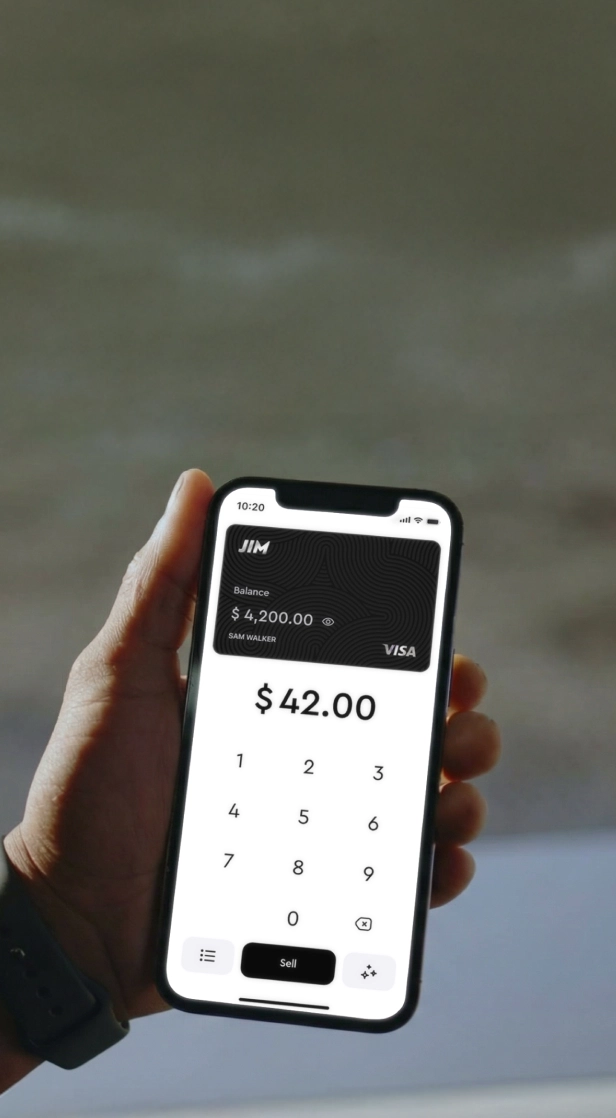
For a mobile nail business that needs to accept payments on-site, JIM offers a streamlined solution. With JIM, you can accept debit, credit, and digital wallets directly through your smartphone. Just tap and you are done.
At just 1.99% per transaction with no hidden costs or extra hardware needed, it is particularly useful for taking payments at a client's home. You avoid carrying extra devices and keep more of your earnings.
- Get Started: Download the JIM app for iOS.
- Make a Sale: Type the sales amount, hit sell, and ask your customer to tap their card or device on your phone.
- Access Funds: Your money is available on your JIM card as soon as the sale is done. There is no wait for bank transfers.
Here are 3 immediate steps to take:
- Define your deposit policy for group bookings and add it to your service agreement.
- Download the JIM app to explore its features and low transaction fee.
- Set up your chosen payment system so you are ready to accept money from day one.
Step 6: Secure your funding and manage finances
Explore funding options
Start with an SBA Microloan. These loans range from $500 to $50,000 and are great for startups. Interest rates are typically between 8% and 13%. You will need a solid business plan and a credit score above 640 to qualify.
Also, look into grants. The Amber Grant for Women is a popular choice. You can also search Grants.gov for local small business opportunities. Many new owners miss out on this free money because they assume they will not qualify.
Plan your working capital
Once you have funding ideas, map out your cash flow. You need enough working capital for the first six months. A good estimate is $4,000 to $8,000. This covers fuel, supply restocks, insurance premiums, and marketing costs.
A mistake some make is to underestimate monthly supply costs. High-quality gels and polishes need frequent replacement. Budget at least $300 per month for supplies alone, especially as you build your color collection.
Here are 4 immediate steps to take:
- Check your credit score to see if you meet SBA Microloan requirements.
- Research the Amber Grant for Women application deadlines.
- Create a six-month budget for your working capital needs.
- Set up a spreadsheet to track all business expenses from day one.
Step 7: Hire your team and streamline operations
Once your schedule is consistently full, you might consider hiring another nail technician. Your first hire should hold a valid state Nail Technician license. Their duties will include performing services, maintaining sanitation standards, and managing their client appointments.
Define roles and compensation
You can offer a commission split, typically 40-60% of the service price, or an hourly wage between $15 and $25 plus tips. Be clear about who pays for supplies. One thing to watch out for is misclassifying an employee as an independent contractor, which can lead to tax penalties.
Set up your scheduling system
As you grow, manual booking becomes difficult. A dedicated scheduling system saves time and reduces no-shows with automated reminders. Software like Acuity Scheduling or Square Appointments lets clients book and pay online, which is perfect for a mobile setup.
A productive full-time technician can generate between $3,000 and $5,000 in monthly service revenue. This figure helps you forecast income and decide when it makes financial sense to expand your team.
Here are 4 immediate steps to take:
- Draft a job description for a licensed Nail Technician.
- Decide between a commission or hourly pay structure for your first hire.
- Compare the features of two scheduling apps like Acuity and Square Appointments.
- Read the IRS guidelines on independent contractor vs. employee status.
Step 8: Market your business and get clients
Your first marketing channel should be a visual portfolio on Instagram. Use high-quality photos of your best work. A mistake many new techs make is using generic hashtags. Instead, use hyper-local tags like #[yourcity]nails or #[yourneighborhood]nailtech to attract nearby clients.
Once you have a portfolio, build a simple website using a platform like Squarespace. It should clearly display your service menu, prices, and a link to your booking software. This gives you a professional hub and makes it easy for clients to schedule appointments.
Tap into local networks
You can also partner with local businesses. Offer a 10% referral fee to wedding planners, boutique hotels, or corporate event managers who send clients your way. This strategy helps build a steady stream of high-value group bookings.
With this in mind, run targeted social media ads. On Facebook, you can set a small budget of $5-$10 per day to reach women in specific zip codes. Create ads that promote packages for events, like "Bridal Party Nails" or "Office Wellness Day," to capture immediate interest.
Here are 4 immediate steps to take:
- Create an Instagram business profile and post five high-quality photos of your work.
- Outline the pages for your website: Home, Services, Portfolio, and Booking.
- Identify three local wedding planners or corporate offices to contact for partnerships.
- Draft a Facebook ad concept for a specific service package with a $10 daily budget.
Step 9: Set your pricing and service menu
First, calculate your cost-per-service. Add up the product cost for one client, your desired hourly rate, and travel expenses. A mistake many new techs make is forgetting to include travel time and fuel. You might want to add a separate travel fee of $15-$25 or build it into your prices.
Choose your pricing model
Most clients expect a la carte pricing, where each service has a set price. For example, a gel manicure might be $65 and simple nail art is an extra $5 per nail. This model is straightforward and easy for clients to understand.
You can also create tiered packages to encourage upselling. A "Basic" package could include a simple gel manicure, while a "Luxe" package adds a scrub, massage, and intricate art for a higher price. For group events, consider an hourly rate like $125 per hour with a two-hour minimum.
Many new owners underprice their services to attract clients. Instead, price based on the premium convenience you offer. Your prices should reflect your skill and the luxury of an at-home service. A typical profit margin on services, after accounting for supplies, can be 70-80%.
Here are 4 immediate steps to take:
- Calculate your cost-per-service for a standard gel manicure, including supplies and time.
- Research the service menus of three local mobile techs and three salons.
- Draft a service menu with both individual prices and two bundled packages.
- Set your travel fee policy, either as a separate charge or built into your prices.
Step 10: Maintain quality and scale your operations
As your client list grows, you must maintain consistent service quality. Adopt a strict sanitation protocol. Use an autoclave for metal tools or follow the full contact time for EPA-registered hospital-grade disinfectants. You can also complete the free online Barbicide certification to show clients your commitment to safety.
Track your performance with key metrics
Measure your success with data, not just feelings. Track your client retention rate, aiming for 60-70% of clients to return within three months. Also, monitor your average ticket price and the number of new clients you get from referrals each month. This data shows you what is working.
Once your schedule is consistently 80% booked for two months straight, it is time to scale. This is your signal to either increase your prices by 10-15% or start the process to hire another technician. A mistake some owners make is waiting too long and burning out.
When you hire, create a simple onboarding process. Your new technician needs to learn your specific service steps and communication style. This ensures every client receives the same high-quality experience associated with your brand, regardless of who performs the service.
Here are 4 immediate steps to take:
- Complete the free online Barbicide certification to add to your website.
- Create a spreadsheet to track your monthly client retention and referral numbers.
- Set your personal scaling trigger, such as being 80% booked for two months.
- Draft a one-page guide of your service standards for a future hire.
You now have a clear path to start your mobile nail business. The key is to remember you are not just selling a manicure, you are selling a luxury experience at home. Go forward with confidence, your first client is waiting.
And when it is time to get paid, keep it simple. JIM lets you take card payments directly on your smartphone for a flat 1.99% fee, with no extra hardware to carry. Download JIM and you are ready for business.
.avif)