How to start a mocktail business
See article summary
- Startup costs run $3,000 to $8,500 for permits, a mobile bar, inventory, and insurance.
- Form an LLC, get a free EIN, and apply for food handler permits 4 to 8 weeks early.
- Mocktails usually need no liquor license but still fall under food service regulations.
- Charge $20 to $35 per guest with a $800 minimum and a 75% to 80% gross margin.
- Accept card payments on your phone at 1.99% per transaction to settle event balances.
The U.S. no-alcohol beverage market is forecast to grow at an 18% annual volume rate through 2028, driven by sober-curious consumers and expanding zero-proof menus, according to IWSR's no-alcohol market analysis. A mocktail business serves this growing demand through mobile bars, event catering, and dry bar service, but turning creative drink recipes into a profitable operation requires permits, insurance, and a clear cost structure.
How do you validate a mocktail business idea?
Validate your mocktail business by confirming local demand and mapping direct competitors before you spend on equipment. Demand research and competitive analysis together tell you whether your market can support another non-alcoholic beverage provider.
Identify your target audience using Google Trends to compare search interest for terms like "mocktails," "zero-proof cocktails," or "dry bar catering" across your city. Visit farmers' markets and upscale grocery stores to observe which premium non-alcoholic beverages people buy and what they pay. The sober-curious market spans pregnant customers, designated drivers, people in recovery, and health-conscious event guests, each with different flavor preferences.
Map your direct and indirect competition by searching Instagram and Yelp for local mocktail caterers, mobile bars, and restaurants with strong non-alcoholic menus. Visit two or three competitors to record their pricing, presentation, and service model. This firsthand research reveals gaps you can fill rather than copying an existing concept.
Estimate your startup costs
Startup costs for a mocktail business range from $3,000 to $8,500, covering permits, a mobile bar, initial inventory, and insurance. Budget each category individually before purchasing anything so you can track where your money goes.
- Permits and LLC formation: $300 to $1,500
- Mobile bar and equipment: $2,000 to $5,000
- Initial inventory: $500 to $1,500. Focus on a small, signature menu with unique ingredients rather than buying large volumes of generic stock that sits unused.
- Insurance: $400 to $600 annually
Here are 3 immediate steps to take:
- Use Google Trends to check search interest for "mocktails" and "zero-proof cocktails" in your city.
- Identify and visit two potential competitors to analyze their menu and pricing.
- Create a startup budget spreadsheet based on the cost estimates above.
How do you set up your legal structure and get licensed?
Form a Limited Liability Company (LLC) and obtain the required food handling permits, which together protect your personal assets and let you serve beverages legally. Most mocktail businesses can complete this process in 4 to 8 weeks.
An LLC protects your personal assets if the business faces debt or lawsuits. For federal tax purposes, a single-member LLC defaults to a "disregarded entity" taxed as a sole proprietorship, while a multi-member LLC defaults to a partnership. Both classifications pass business income through to your personal return. You can elect different tax treatment, including S corporation status, by filing Form 8832, Entity Classification Election with the IRS.
State LLC filing fees vary widely, from around $40 in some states to $500 in others. The SBA notes that total registration costs typically stay under $300, though the exact amount depends on your state and business structure.
After registration, apply for a free Employer Identification Number (EIN) on the IRS website. You need this number to open a business bank account and file taxes. The online application issues your EIN immediately.
Do you need a liquor license to sell mocktails?
Mocktails made without alcohol generally do not require a liquor license, because liquor licensing regulates the sale of alcoholic beverages. Since mocktails contain no alcohol, they fall under food service regulations instead. The rules vary by state and depend on what you serve. Some states require a non-alcoholic beverage license for businesses that manufacture, bottle, or distribute non-alcoholic drinks. If you add alcohol-free spirits or bitters to your mocktails, check your state's specific requirements, because some products classified as "non-alcoholic" can contain trace amounts of alcohol up to 0.5% ABV.
Contact your state alcohol beverage control board to confirm whether your specific product line requires any alcohol-related permit. When in doubt, classify your operation as a food service business and work with your local health department.
Navigate local permits and regulations
Your local health department regulates any beverage served to the public, including mocktails. A food handler permit costs around $15 through providers like ServSafe, but fees and requirements vary by state and county. Some jurisdictions charge more or require local certifications instead of a national program. For events, you also need a temporary food facility permit, typically costing $75 to $250 per event.
Start permit applications 4 to 8 weeks in advance, since processing times vary by jurisdiction. A common mistake is assuming mocktails are exempt from food regulations. Any beverage served to the public falls under health department rules.
Here are 4 immediate steps to take:
- Register your business as an LLC with your state's Secretary of State.
- Apply for a free EIN on the IRS website.
- Contact your local health department about food handler permit requirements.
- Check your city or county clerk's office for business license application details.
How do you secure insurance and manage risk?
General liability and product liability insurance protect your mocktail business from the most common claims, and most event venues require proof of coverage before you can operate. Budget $400 to $700 annually for a $1 million general liability policy.
Event venues will not let you operate without proof of coverage, making insurance a non-negotiable step. The right policies protect you from risks that could otherwise shut you down.
Key insurance policies
Carry the right coverage from day one to avoid significant financial risk if an accident happens.
- General liability insurance: Covers injuries or property damage at your setup, like a guest tripping over a cord. A $1 million policy typically costs $400 to $700 per year.
- Product liability insurance: Protects you if someone has an allergic reaction or gets sick from your mocktails. It is often included with general liability policies.
- Commercial auto insurance: Your personal auto policy will not cover accidents when you drive for business. Expect annual premiums of $1,500 to $3,000.
Request quotes from providers that specialize in the food service space, such as the Food Liability Insurance Program (FLIP), Next Insurance, or Insureon. If you hire employees, you must also carry workers' compensation insurance to cover on-the-job injuries.
Here are 4 immediate steps to take:
- Request quotes for a combined general and product liability policy.
- Review your personal auto insurance for a business use exclusion clause.
- Contact an agent from a specialized provider like FLIP to discuss your needs.
- Ask a potential event venue about their minimum insurance requirements.
How do you choose a location and buy equipment?
Use a licensed commissary kitchen for prep and storage, and invest in a durable mobile bar setup that meets health code requirements. Your mobile bar is your primary service location, but health departments often require a commercial kitchen for food and beverage preparation.
Expect to pay $25 to $50 per hour or a monthly fee of $300 to $800 for shared commissary kitchen access. Ask about hourly rates or short-term memberships when you tour kitchens. This gives you flexibility as you start. Avoid long-term leases until your event schedule is consistent and you understand your volume needs.
Stock your mobile bar
Your mobile bar setup is a significant part of your budget. A sturdy, professional-looking bar cart costs between $1,000 and $3,000. Invest in quality from the start rather than buying cheap carts that fall apart quickly.
- Portable handwashing sink: $200 to $500. Required for health code compliance.
- High-performance coolers: $300 to $600. Needed to keep ingredients at safe temperatures.
- Professional barware set: $150 to $300. Includes shakers, jiggers, and strainers.
- Durable glassware or premium disposables: Costs vary based on event size.
For basic supplies, WebstaurantStore is a good starting point. For unique syrups and bitters, explore specialty producers like Liber and Co, which often have lower minimum order quantities than large distributors. This helps you manage initial inventory costs while building a distinctive zero-proof menu.
Here are 4 immediate steps to take:
- Research three commissary kitchens in your area and compare their hourly rates.
- Price out a portable, three-compartment sink to meet health code rules.
- Create a detailed equipment list with a budget for each item.
- Get quotes for your initial inventory from a restaurant supplier and a specialty syrup company.
How do you set up payment processing?
Accept credit cards, debit, and digital wallets, and require a deposit in your contract to protect against cancellations. Compare credit card processing rates before choosing a provider, since transaction fees directly affect your profit margin.
Define your payment terms
Your contract should clearly state your payment terms. A standard practice is to require a 50% non-refundable deposit to secure a date, with the remaining balance due 7 to 14 days before the event. This policy protects you from last-minute cancellations.
You must be able to take credit cards, debit, and digital wallets. Transaction fees from traditional processors typically range from 2.5% to 3.5% plus monthly fees, which can eat into profits if you process many small-event payments.
Choose your payment solution
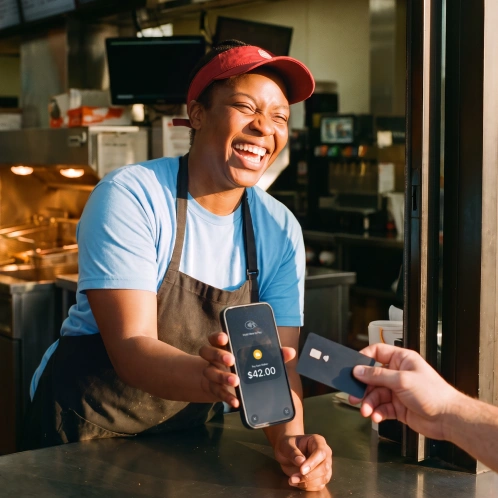
For on-site and on-the-go payments, JIM turns your smartphone into a card reader at a flat 1.99% per transaction, with no monthly fees or extra hardware. You can accept debit, credit, and digital wallets by having customers tap their card or device on your phone, and funds are available on your JIM card immediately after each sale. This rate undercuts the 2.5% to 3.5% typical of traditional processors, which matters when you are settling final balances at events or taking walk-up sales at a farmers' market.
Here are 3 immediate steps to take:
- Draft a standard contract that includes your payment terms and deposit policy.
- Calculate the potential savings of a 1.99% transaction rate versus a higher rate.
- Download the JIM app to explore its interface before your first event.
How do you secure funding and manage finances?
Fund your mocktail business through an SBA Microloan, community lending, or personal savings, and maintain six months of working capital separate from your startup costs. Choose the funding source that matches your credit profile and how quickly you need cash.
SBA Microloans provide up to $50,000 through nonprofit intermediary lenders, with interest rates generally between 8% and 13%. They are often more accessible for new businesses without a long credit history. Another option is Kiva, which facilitates 0% interest, crowdfunded loans up to $15,000. Personal savings or a loan from family are also common starting points.
Plan your working capital
Keep enough cash to cover your first six months of operation. This working capital, separate from your startup costs, typically ranges from $4,000 to $10,000. It covers ongoing expenses like inventory, insurance, and marketing before your event schedule becomes consistent.
Budgeting only for the initial setup and forgetting about operating costs creates cash flow problems if bookings are slow in the first few months. Open a separate business bank account to keep your finances organized for tax purposes.
Here are 4 immediate steps to take:
- Look up an SBA Microloan intermediary lender in your state.
- Create a six-month operating budget to determine your working capital needs.
- Open a dedicated business checking account for your LLC.
- Compare accounting software like Wave (free) and QuickBooks Self-Employed.
How do you hire your team and streamline operations?
Hire on-call event bartenders with food handler permits, and use scheduling software to manage a small team. One bartender per 50 to 75 guests is a reliable staffing ratio for standard mocktail service.
As you book events, you will need help. An event bartender handles setup, service, and breakdown. Pay typically ranges from $20 to $35 per hour plus tips. Hire on-call staff for the first year to manage costs while you build a consistent event schedule.
Each team member must have their own food handler permit. While not always required for non-alcoholic service, having your staff complete a program like TIPS certification shows venues a high level of professionalism and a commitment to safe, responsible service.
Streamline your event workflow
Use scheduling software like Homebase or When I Work to manage schedules when you have reliable people on call. Their free plans are often enough for a small team and help you avoid confusion with text messages and emails.
For staffing levels, a good starting point is one bartender for every 50 to 75 guests. This ratio ensures that service remains quick and personal without long waits for drinks. Adjust based on the complexity of your menu for a specific event.
Here are 4 immediate steps to take:
- Draft a job description for an on-call event bartender.
- Confirm your state's requirements for employee food handler permits.
- Explore the free plan features on a scheduling app like Homebase.
- Calculate your ideal staff-to-guest ratio for different event sizes.
How do you market your business and get customers?
Build a visual portfolio on Instagram and Pinterest, claim your Google Business Profile, and forge local partnerships with event planners and venues. Personal outreach generates more bookings than cold email.
Build your online presence
Visual platforms like Instagram and Pinterest are your portfolio. Post high-quality photos of your mocktails, your mobile bar, and your setup at events. This visual proof is more convincing than any sales pitch. Create a Google Business Profile to appear in local searches for mocktail catering and dry bar service.
Forge local partnerships
Your most consistent bookings will come from relationships. Connect with event planners, wedding venues, and corporate wellness coordinators. A personal approach, like offering a complimentary tasting, works much better than a cold email that stops at the first contact.
Aim to contact 5 to 10 new potential partners each month. A 10% to 20% conversion rate from that initial outreach to a booked event is a solid goal. Attend local festivals or farmers' markets to sell drinks by the glass and generate catering leads directly.
Here are 4 immediate steps to take:
- Create an Instagram account and post five high-quality photos of your signature mocktails.
- Set up your free Google Business Profile and add your service area.
- List ten local event planners or venues to contact for potential partnerships.
- Attend one local farmers' market to scope out opportunities for a pop-up.
How do you price your services for profit?
Charge $20 to $35 per guest for a standard three-hour mocktail event, keep your ingredient cost at 20% to 25% of menu price, and set a minimum booking fee around $800. A per-person pricing model scales easily and gives clients a clear expectation.
Develop your pricing packages
Most mocktail businesses use a per-person pricing model. A typical range is $20 to $35 per guest for a three-hour event that includes two or three signature mocktails. You can also offer a flat-rate package for smaller gatherings or corporate clients who prefer a fixed budget.
Set a minimum booking fee, around $800, to ensure that even small events cover your time, travel, and basic costs. The table below shows a three-tier structure you can adapt to your market.
| Package | Drinks included | Event length | Price range | Minimum guests |
|---|---|---|---|---|
| Essential | 2 signature mocktails | 2 hours | $20 to $25 per guest | 25 |
| Signature | 3 signature mocktails | 3 hours | $28 to $32 per guest | 35 |
| Premium | 4 custom mocktails plus a welcome drink | 4 hours | $35 to $45 per guest | 50 |
Calculate your cost of goods
Your ingredient cost per drink should be 20% to 25% of its menu price, which leaves a 75% to 80% gross profit margin. Include every garnish, syrup, and even the ice to calculate your true cost, not just the main juices.
Research what local caterers and mobile bars charge. Create a simple spreadsheet to compare their packages, service hours, and what is included. This analysis helps you position your offerings competitively without undervaluing your service.
Here are 4 immediate steps to take:
- Research three local competitors and document their pricing packages.
- Calculate the full cost-per-serving for two of your signature mocktails.
- Create three tiered pricing packages with clear differences in offerings.
- Establish a minimum booking fee to cover your fixed costs for any event.
How do you maintain quality and scale your operations?
Track client satisfaction with post-event feedback, and scale only when you turn down more than 20% of inquiries. Consistent quality builds your reputation, and clear growth benchmarks prevent premature expansion.
A good goal is to keep client complaints below 1% of total guests served. Track this with a simple post-event feedback form. This data helps you refine your service and recipes over time.
Set your growth benchmarks
You will know it is time to hire more staff when you start to turn down more than two out of every ten event requests. That is a clear sign that demand exceeds your capacity. Consider adding a second mobile bar once you have consistent double-bookings for three consecutive months.
As you grow, managing clients with email gets messy. Explore client management software like HoneyBook or Dubsado to handle contracts, invoices, and communication once your monthly event volume justifies the subscription cost.
Here are 4 immediate steps to take:
- Create a simple feedback form to track client satisfaction after each event.
- Set a benchmark for hiring, such as turning down 20% of monthly inquiries.
- Decide on a metric for when to invest in a second mobile bar setup.
- Explore the free trials for client management software like HoneyBook or Dubsado.
Your 60-day launch timeline
Use this 60-day timeline to move from planning to your first paid event.
Days 1 to 15: Plan and register. Validate demand with Google Trends and competitor visits. Form your LLC, apply for an EIN, and open a business bank account. Research your state's food handler permit requirements and start the application.
Days 16 to 30: Get permitted and insured. Apply for food handler and temporary food facility permits. Request general and product liability insurance quotes. Secure commissary kitchen access with an hourly or monthly arrangement.
Days 31 to 45: Buy equipment and build your menu. Purchase your mobile bar, barware, and initial inventory. Develop three to five signature zero-proof mocktails. Set your pricing packages and minimum booking fee based on competitor research.
Days 46 to 60: Market and launch. Launch your Instagram and Google Business Profile. Contact ten local event planners or venues with a personalized offer. Book and execute your first event, using JIM to accept card payments on your phone at a flat 1.99% fee with no extra hardware. Download JIM and you are ready for your first sale.
Frequently Asked Questions
Do you need a liquor license to sell mocktails?
How much does it cost to start a mocktail business?
What insurance does a mocktail business need?
How much should you charge for mocktail catering?
Can you sell mocktails at farmers' markets?


Sell and get paid in seconds with Jim