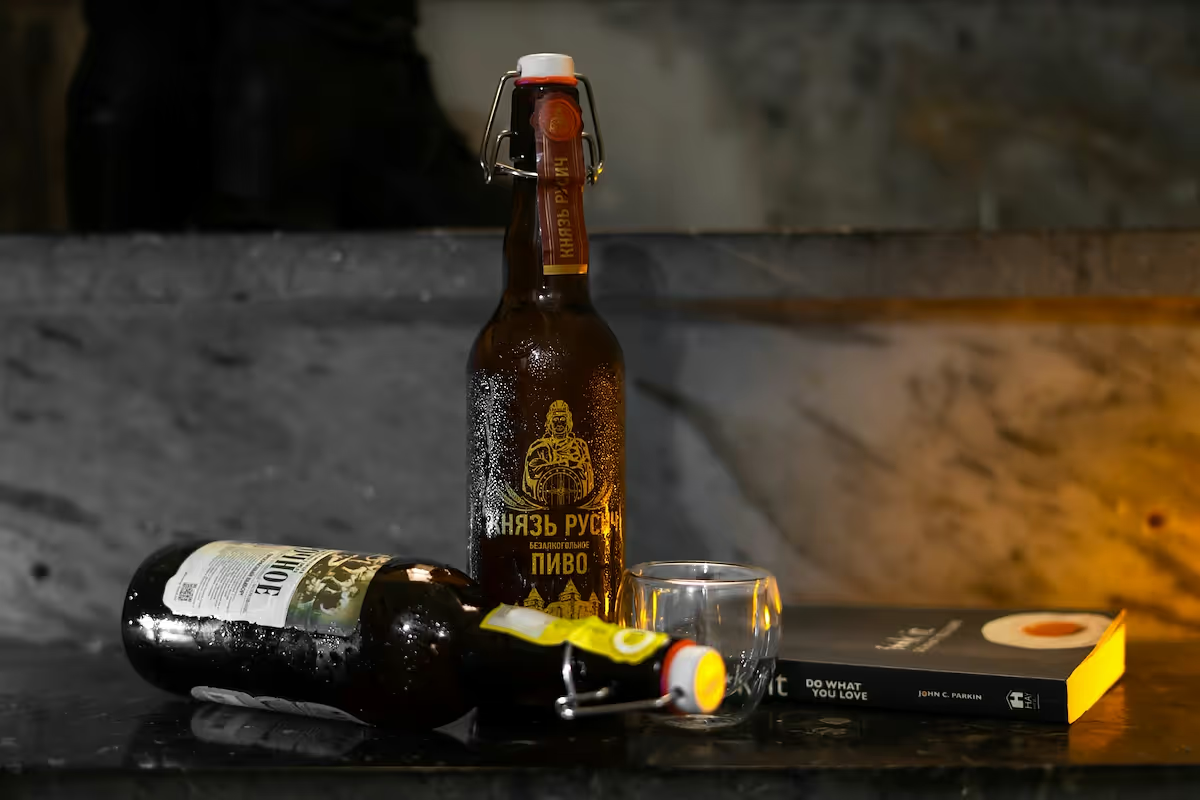
Starting a non-alcoholic beverage company is a rewarding venture that combines creativity in recipe development and branding with sharp business savvy. The market is worth billions of dollars, with steady demand for interesting drinks from health-conscious consumers, social drinkers, and restaurants.
This guide will take you through the practical steps of validating your concept, securing funding, obtaining the right licenses, and building supplier relationships to help you launch a successful non alcoholic beverage company in the U.S.
Step 1: Plan your business and validate your idea
Market and competitor research
First, define your target customer. Are they health-conscious millennials or sober-curious Gen Z? Use online surveys through platforms like SurveyMonkey to gather direct feedback on flavor profiles, brand concepts, and what they would pay. This data is more valuable than just guessing.
Next, analyze the competition. Databases like SPINS offer sales data for the natural products space. A frequent oversight is to focus only on national players. Pay close attention to local craft brands, as they are often your most direct competitors for shelf space and customer loyalty.
Create your startup budget
With your research done, it is time to map out your finances. A clear budget is your roadmap. Initial costs can range from $10,000 to over $75,000, so it helps to break them down. This financial clarity is vital before you seek funding or spend a single dollar.
Expect to allocate funds for recipe development ($2,000-$5,000), a pilot production run ($5,000-$15,000), branding and packaging design ($3,000-$10,000), and business licenses ($500-$2,000). These figures provide a realistic starting point for your financial plan.
Here are 3 immediate steps to take:
- Draft a one-page profile of your ideal customer, including their habits and values.
- Identify three direct local competitors and analyze their pricing and online presence.
- Create a preliminary budget spreadsheet using the cost categories mentioned above.
Step 2: Set up your legal structure and get licensed
First, protect your personal assets. You might want to form a Limited Liability Company (LLC). This structure separates your business and personal finances, which is a safeguard you want from day one. It also offers pass-through taxation, so profits are taxed as your personal income.
An LLC is often more straightforward than a C-Corporation, which faces double taxation on profits and dividends. You can file for an LLC through your state's Secretary of State website. The cost is typically between $50 and $500, depending on your state.
Licenses and permits
With your legal entity established, the next focus is licensing. The primary federal agency you will work with is the Food and Drug Administration (FDA). You must complete the FDA Food Facility Registration online before you start production. This registration is free but mandatory.
At the state and local levels, you will need a business license and a food handler’s permit from your health department. A frequent misstep is not accounting for processing times. A health permit can take 30-90 days, so apply well before you plan to launch.
Here are 3 immediate steps to take:
- File for your LLC with your state's Secretary of State office.
- Complete the free FDA Food Facility Registration online.
- Contact your local health department for their food business permit application and timeline.
Step 3: Secure insurance and manage risk
Key insurance policies
Your next move is to shield your business. General liability insurance is the foundation, covering accidents or property damage. You should aim for a policy with $1 million to $2 million in coverage. Annual premiums typically run from $500 to $2,000.
Product liability insurance is just as important. It protects you if someone gets sick from your beverage. Many new owners overlook this, but a single contamination claim can sink a business. Expect this to add another $1,000 to $3,000 to your yearly premium.
If you own or rent a production space, you will also need commercial property insurance. In addition, once you hire your first employee, you must get workers' compensation insurance, as it is required by state law. This covers medical costs and lost wages from work-related injuries.
You might want to work with an insurance broker who specializes in the food and beverage industry. They understand the specific risks and can find better rates. Consider getting quotes from providers like The Hartford, Hiscox, or the Food Liability Insurance Program (FLIP).
Here are 3 immediate steps to take:
- Request quotes for a combined general and product liability policy with at least $1 million in coverage.
- Contact an insurance broker who has experience with food and beverage startups.
- Research your state’s specific requirements for workers' compensation insurance.
Step 4: Find a location and buy equipment
Find your production space
Look for a space between 1,000 and 2,000 square feet zoned for commercial or light industrial use. This gives you room for production and storage. You can check your city’s zoning map online to confirm the classification for any potential property.
When you negotiate a lease, you might want to ask for a 1-2 year term with an option to renew for more flexibility. A frequent oversight is to ignore utility capacity. Confirm the space has three-phase power and adequate floor drains before you sign anything.
Purchase your equipment
Your equipment budget is a significant part of your startup costs. Many new owners buy equipment that is too large, which ties up cash. It is often better to start with a smaller system that matches your pilot run volume and scale up later.
Here are some typical costs for a small-batch setup:
- Brite tanks (1-5 BBL): $3,000 - $8,000 each
- Entry-level canning line: $15,000 - $40,000
- Glycol chiller: $4,000 - $10,000
You can find new and used equipment from suppliers like Ss Brewtech or through the classifieds on ProBrewer.
Here are 3 immediate steps to take:
- Research local commercial zoning laws for food and beverage production.
- Get quotes for a 1-5 BBL brite tank and an entry-level canning line.
- Draft a list of questions for potential landlords about power, water, and floor drains.
Step 5: Set up payment processing
Payment terms and solutions
For wholesale accounts like cafes or retailers, Net 30 terms are standard, meaning they have 30 days to pay your invoice. For direct sales at markets or online, you need immediate payment processing. Your system should handle both scenarios.
When you look for a payment solution, focus on transaction fees. Many providers charge between 2.5% and 3.5% plus monthly fees. A frequent oversight is to ignore these recurring costs, which can add up quickly, especially when your sales volume is low at the start.
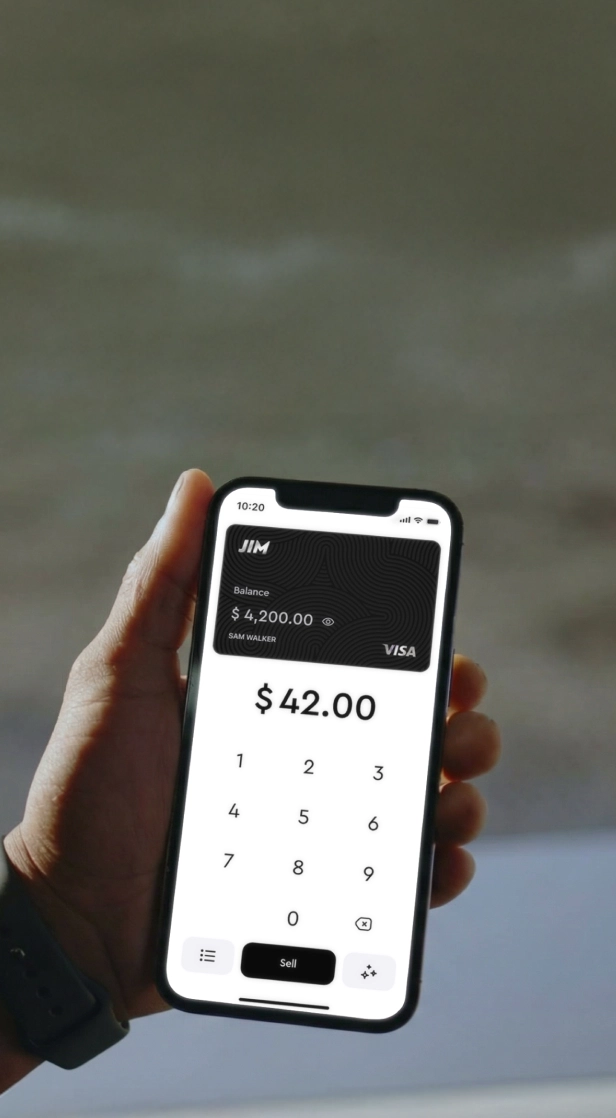
For selling at farmers' markets or pop-up events, JIM offers a streamlined solution. With JIM, you can accept debit, credit and digital wallets directly through your smartphone - just tap and done. At just 1.99% per transaction with no hidden costs or extra hardware needed, it is a cost-effective choice.
Getting started is straightforward:
- Get Started: Download JIM app for iOS.
- Make a Sale: Type the sales amount, hit sell, and ask your customer to tap their card or device on your phone.
- Access Funds: Your money is available right on your JIM card as soon as the sale is done - no waiting for bank transfers.
Here are 3 immediate steps to take:
- Define your payment terms for wholesale customers (e.g., Net 30).
- Download the JIM app to see how it works for in-person sales.
- List the total monthly cost of two other payment processors to compare against JIM's flat rate.
Step 6: Get funding and manage your finances
Your first funding sources are often personal savings or loans from friends and family. For more formal financing, you might want to look at an SBA 7(a) loan. These government-backed loans can offer better terms than conventional bank loans.
Startups often seek between $50,000 and $250,000. Interest rates are usually the Prime rate plus a few points. You will need a solid business plan and a good personal credit score, typically above 680, to qualify.
Also, explore industry-specific grants. The USDA's Value-Added Producer Grant (VAPG) is a great option if you use locally sourced agricultural ingredients. These grants are competitive but do not require repayment, which is a huge advantage.
With funding in mind, let's talk about daily operations. You will need enough working capital to cover your first six months. This includes costs for ingredients, marketing, and rent. A common oversight is to focus only on equipment and forget about this day-to-day cash.
For a small-batch operation, plan for $20,000 to $50,000 in working capital. This buffer ensures you can pay suppliers and cover unexpected expenses before your sales become consistent. It gives your business breathing room.
Here are 3 immediate steps to take:
- Research the SBA 7(a) loan requirements on their official website.
- Calculate your working capital needs for the first six months of operation.
- Review the eligibility criteria for the USDA Value-Added Producer Grant.
Step 7: Hire your team and set up operations
Key roles and compensation
As you grow, you will need a Production Manager to oversee brewing and quality control. A typical salary is $45,000 to $65,000. You might also want a Sales Representative to land wholesale accounts. This role often has a base salary around $40,000 plus commission.
Many new owners hire a full-time sales rep before production is consistent. You might want to handle early sales yourself or hire a part-time Brand Ambassador ($18-$25/hour) for weekend markets. This approach helps you manage cash flow in the beginning.
Training and management
All employees who handle your product must have a Food Handler’s Permit from the local health department. For your production lead, you might want to look into Hazard Analysis Critical Control Point (HACCP) certification to ensure food safety standards are high from the start.
Once you have a team, scheduling software like Homebase or When I Work can simplify shift management. As you scale, a good goal is to generate $150,000 to $200,000 in revenue per full-time employee. This is a solid benchmark for efficiency.
Here are 3 immediate steps to take:
- Draft a job description for a Production Manager, outlining key responsibilities.
- Check your local health department website for food handler permit requirements.
- Compare the free plans for scheduling apps like Homebase and When I Work.
Step 8: Market your brand and acquire customers
Digital marketing channels
Focus your initial efforts on one or two social media platforms where your target customer spends time, like Instagram or TikTok. Create content that shows your brand’s personality. You might want to collaborate with micro-influencers (10k-50k followers), who often have higher engagement rates than larger accounts.
Many new owners pour money into paid ads too early. Instead, use your first $1,000 on high-quality photos and building a small community. Once you have engagement, you can set up an email list with a platform like Mailchimp. Aim for an open rate of 20-25%.
In-person and wholesale strategies
For direct sales, in-store demos and farmers' markets are effective. A good conversion rate for a demo is 10-15% of people who try your product. Track this to see what works. For wholesale, create a one-page sell sheet with your product details, pricing, and UPC codes.
When you approach retailers, start with small, independent shops. They are often more open to new brands than large chains. For direct-to-consumer sales, a customer acquisition cost (CAC) under $40 is a solid benchmark. Calculate this by dividing your marketing spend by your new customers.
Here are 3 immediate steps to take:
- Create a one-page sell sheet with your product info and wholesale pricing.
- Identify five local micro-influencers and draft an outreach email.
- Set up a simple email capture form on your website using a service like Mailchimp.
Step 9: Develop your pricing strategy
Set your wholesale and retail prices
First, calculate your Cost of Goods Sold (COGS) per unit. This number should include your ingredients, packaging, and direct labor. A clear COGS is the foundation for any profitable pricing model.
You might want to use cost-plus pricing. A 200-300% markup on your COGS is a common starting point for your wholesale price. For example, if your COGS is $1.00 per can, your wholesale price would land between $2.00 and $3.00.
Retailers will then add their own margin, which is often 30-50%. This means your can with a $2.50 wholesale price might sell for around $3.75 on the shelf. This structure helps ensure both you and your retail partners can succeed.
Analyze the market
With a baseline price in mind, look at your competitors. Visit local independent stores and browse online marketplaces. A frequent oversight is to price too low to gain entry. This can signal lower quality and make it difficult to achieve profitability.
For direct-to-consumer sales, your prices should align with what customers find in stores. This protects your wholesale relationships. Instead of discounts, you can offer value through exclusive bundles or a subscription service on your website.
Here are 3 immediate steps to take:
- Calculate your total COGS for a single can or bottle.
- Create a spreadsheet to track the retail prices of three direct competitors.
- Set a draft wholesale price using a 250% markup on your COGS.
Step 10: Maintain quality and scale production
Establish your quality standards
Your first step is to create a quality control log. For every batch, you should measure and record the pH and Brix (sugar content). This data helps you ensure each can tastes exactly like the last. Consistency builds trust with your customers.
You might also want to set up a small sensory panel. This can be your team or a few trusted customers. They can provide feedback on taste, aroma, and appearance. Formalizing this process helps you catch issues before they reach the market.
As you grow, look into certifications. Good Manufacturing Practices (GMP) and HACCP are foundational for food safety. You could also pursue USDA Organic or Non-GMO Project Verified status. These certifications can open doors to larger retail accounts.
Know when to scale
Growth should be deliberate. A good benchmark for your first full-time hire is when you approach $150,000 in annual revenue. Many founders wait too long to hire, which can lead to burnout and quality issues.
When your facility consistently operates at 80% capacity, it is time to plan your expansion. This gives you a buffer to find a new space or order larger equipment before production bottlenecks slow your growth.
With growth comes complexity. Production software like Ekos or OrchestratedBeer helps manage inventory, orders, and batch tracking. It moves you from spreadsheets to a system built for beverage producers.
Here are 3 immediate steps to take:
- Create a quality control log to track pH and Brix for every batch.
- Research the requirements for Good Manufacturing Practices (GMP) certification.
- Request a demo for a beverage production software like Ekos.
You now have a clear guide to launch your non-alcoholic beverage company. Remember that in this crowded market, a compelling brand story is just as important as a great recipe. The steps are laid out for you, so take the first one with confidence.
And when you make your first sales, a simple payment solution helps. JIM turns your smartphone into a card reader, so you can accept payments without extra hardware for a flat 1.99% fee. Download JIM to get started.
.avif)